

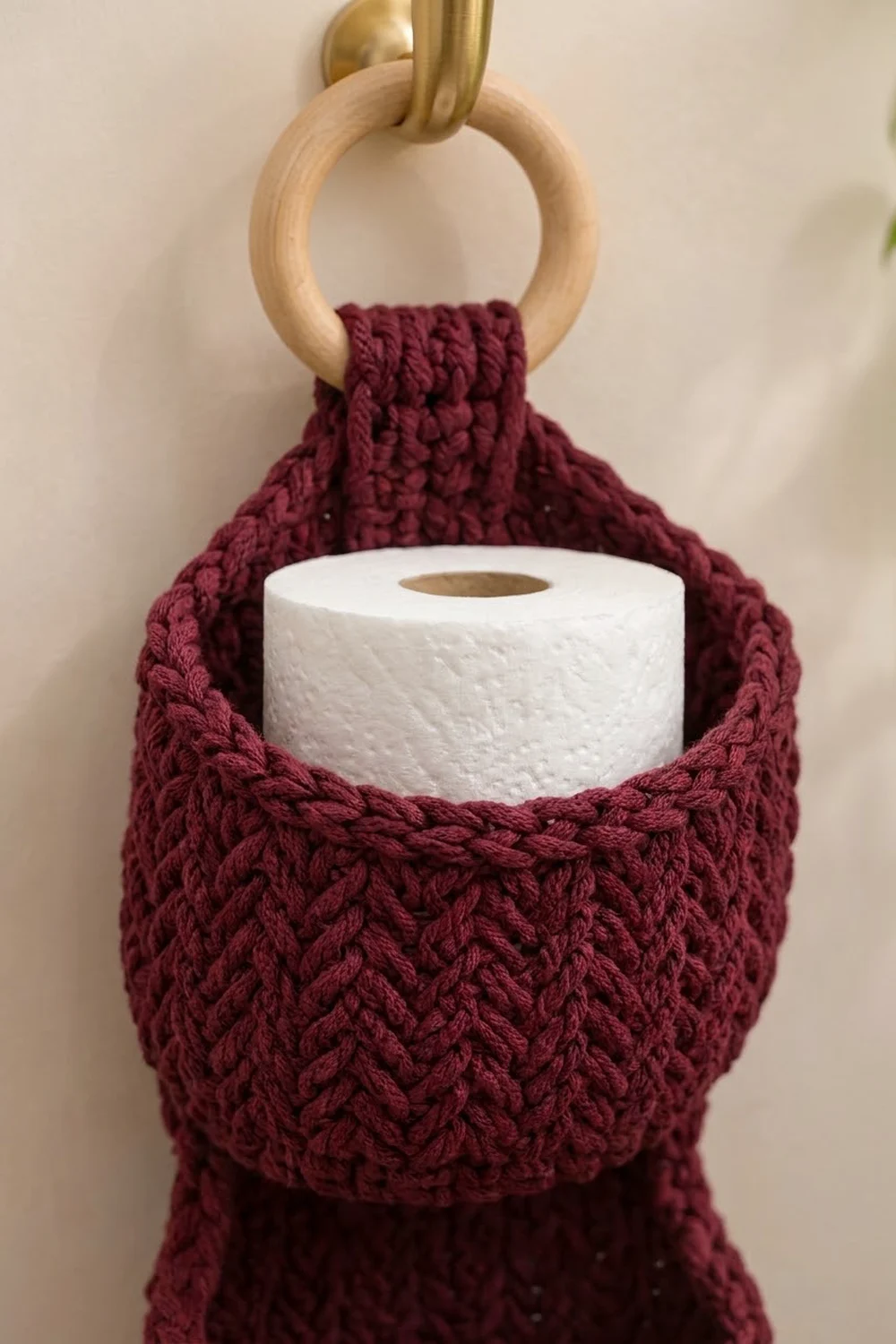
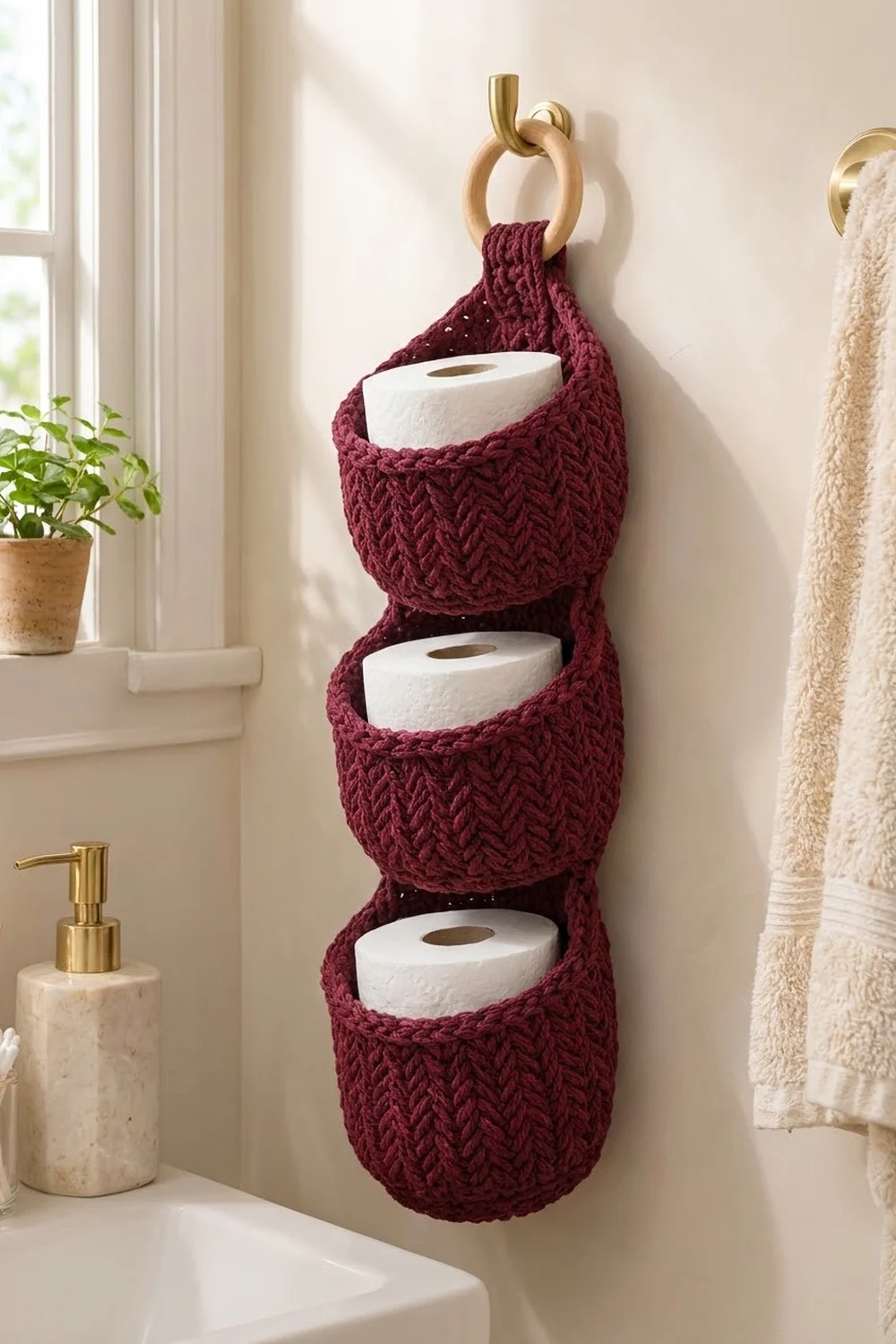
This hanging toilet paper holder stacks three round baskets in a single column, one above the other, on a sturdy back strap that loops over a natural wooden ring. Each basket holds one standard roll, so you keep three spares within reach without using any floor or shelf space.
The whole piece is worked in one deep burgundy, or merlot, color. The texture comes from herringbone half double crochet worked in turned rounds, which gives tidy rows of slanted “V” stitches that look almost knitted. A crab stitch rim along the top of each basket adds a twisted, braided edge that frames the opening.
The pattern uses US crochet terms. The finished hanger measures about 5.75 in (14.6 cm) wide, about 19.5 in (49.5 cm) from the bottom of the lowest basket to the fold over the ring, and about 21.5 in (54.6 cm) including the ring.
You make it in four pieces: three identical baskets and one long back strap (the “spine”). Each basket starts as a flat single crochet circle, turns up into straight herringbone walls, and is sewn to the spine. You add the rims after assembly so the braid covers the top of each seam.
Finished Size and Construction
- Finished size: 5.75 in (14.6 cm) wide x 19.5 in (49.5 cm) long, plus ring
- Skill level: Easy-intermediate
- Terminology: US crochet terms
- Yarn weight: Bulky (#5)
- Hook: 6.0 mm (J-10)
- Number of pieces: 4 (3 baskets + 1 spine), plus 1 wooden ring
- Layout: 3 baskets stacked vertically on 1 spine, with 1 in (2.5 cm) gaps between them
- Basket size: 5.75 in (14.6 cm) diameter x 4.75 in (12.1 cm) tall
- Wall height before border: 4.25 in (10.8 cm)
- Border (rim) depth: 0.5 in (1.3 cm)
- Spine: 2.6 in (6.6 cm) wide x 22 in (55.9 cm) long after edging
Materials
Yarn: Choose a bulky (#5) cotton or cotton-acrylic blend with good stitch definition. Cotton holds its shape and keeps the basket walls upright. Avoid fuzzy or very soft yarns, because they hide the herringbone texture and let the walls sag.
- Burgundy (merlot): about 200 g / 240 m (about 262 yd), based on a yarn with roughly 120 m per 100 g
The quantity includes a margin of about 40% for your gauge swatch, sewing, and small gauge differences.
Tools:
- 6.0 mm (J-10) crochet hook
- Wooden ring, 2.75 in (7.0 cm) outer diameter
- Tapestry needle
- 4 locking stitch markers
- Rust-proof pins
- Measuring tape
- Scissors
- 1 standard toilet roll for fit-testing
Abbreviations (US Terms)
- ch – chain
- sl st – slip stitch
- sc – single crochet
- inc – 2 sc in the same stitch
- BLO – back loop only
- HBhdc – herringbone half double crochet
- rev sc – reverse single crochet (crab stitch)
- st(s) – stitch(es)
- rnd(s) – round(s)
Herringbone half double crochet (HBhdc): Yarn over, insert hook into the stitch, yarn over and pull up a loop, pulling it straight through the first loop on the hook as well (2 loops remain on hook). Yarn over and pull through both loops.
Reverse single crochet (rev sc): Working from left to right (right-handed), insert hook into the next stitch to the right, yarn over and pull up a loop, yarn over and pull through both loops.
Gauge and Checkpoints
Gauge:
- Single crochet: 12 sts and 13 rnds = 4 in (10.2 cm)
- HBhdc: 12 sts and 9 rnds/rows = 4 in (10.2 cm)
Both fabrics measure 3 sts per inch, so the 54-stitch base and the 54-stitch walls are the same circumference: 18 in (45.7 cm). That match is what keeps the walls straight.
Test one piece first. Make one complete basket before starting the others. It’s your real gauge swatch.
Checkpoints:
- After Rnd 5 (30 sts): the base measures about 3.2 in (8.1 cm) across.
- After Rnd 9 (54 sts): the base measures 5.75 in (14.6 cm) across and lies flat.
- After Rnd 15: the wall measures about 2.5 in (6.4 cm) from the fold line.
- After Rnd 19: the wall measures 4.25 in (10.8 cm) from the fold line.
- Fit test: a standard roll, about 4.5 in (11.4 cm) wide, should drop in easily with a little space around it.
Too big? Go down to a 5.5 mm (I-9) hook. Too small, or the roll is tight? Go up to a 6.5 mm (K-10.5) hook. If the base ruffles, your increases are working up looser than your rounds. Go down half a hook size for the base only.
Basket (Make 3)
Work in joined rounds. Place the join at the same spot each round. This line becomes the center back, and the spine will cover it.
Base
Rnd 1: Make a magic ring, ch 1, 6 sc in ring, sl st to first sc to join. (6 sts)
Rnd 2: Ch 1, inc in each st around, join. (12 sts)
Rnd 3: Ch 1, *sc in next st, inc in next st; repeat from * 6 times, join. (18 sts)
Rnd 4: Ch 1, *sc in next 2 sts, inc; repeat from * 6 times, join. (24 sts)
Rnd 5: Ch 1, *sc in next 3 sts, inc; repeat from * 6 times, join. (30 sts)
Rnd 6: Ch 1, *sc in next 4 sts, inc; repeat from * 6 times, join. (36 sts)
Rnd 7: Ch 1, *sc in next 5 sts, inc; repeat from * 6 times, join. (42 sts)
Rnd 8: Ch 1, *sc in next 6 sts, inc; repeat from * 6 times, join. (48 sts)
Rnd 9: Ch 1, *sc in next 7 sts, inc; repeat from * 6 times, join. (54 sts)
Check: the base is flat and measures 5.75 in (14.6 cm) across.
Walls
Rnd 10 (turning round): Ch 1, sc BLO in each st around, join. (54 sts)
The unworked front loops form a crisp fold line, so the wall turns up at a clean right angle.
Rnd 11: Ch 1, turn, HBhdc in each st around, join to first HBhdc. (54 sts)
Rnds 12–19: Repeat Rnd 11 eight more times. (54 sts in each round)
Turning every round makes the slants alternate direction, which creates the stacked “V” herringbone texture.
Check: the wall measures 4.25 in (10.8 cm) from the fold line. Fasten off, leaving a 6 in (15.2 cm) tail. Weave in the tails. Place a marker in the join stitch of Rnd 19 to mark the center back.
Spine (Make 1)
The spine is a flat strip worked in rows.
Row 1: Ch 7, HBhdc in 2nd ch from hook and in each ch across. Turn. (6 sts)
Rows 2–48: Ch 1 (does not count as a stitch), HBhdc in each st across. Turn. (6 sts in each row)
Check: the strip measures 2 in (5.1 cm) wide x about 21.3 in (54.1 cm) long. Don’t fasten off. Continue with the spine edging.
Spine edging round: Ch 1. Working around the whole strip:
- Top edge: 3 sc in first st, sc in next 4 sts, 3 sc in last st. (6 worked 1-per-stitch + 4 extra at the corners = 10 sts)
- Long side: Work 3 sc for every 2 row ends. (48 rows ÷ 2 x 3 = 72 sts)
- Bottom edge: Work 3 sc in the first foundation ch, sc in next 4 ch, 3 sc in last ch. (6 + 4 = 10 sts)
- Second long side: 72 sts, as before.
Join to the first sc. (10 + 72 + 10 + 72 = 164 sts)
Check: the spine measures 2.6 in (6.6 cm) wide x 22 in (55.9 cm) long. Fasten off, leaving a 24 in (61.0 cm) tail for sewing the ring fold.
Make All Pieces
All pieces use burgundy:
- Baskets: 3, each with 54 sts in the final wall round
- Spine: 1, with 164 sts in the edging round
Layout (front view, measured up from the bottom of the spine):
        ( O )        wooden ring
          |          strap fold: 3.75 in (9.5 cm) over the ring
          |          exposed strap: 16.25-18.25 in (41.3-46.4 cm)
     [  TOP   ]      wall 11.5-15.75 in (29.2-40.0 cm), rim to 16.25 in (41.3 cm)
          |          gap 1 in (2.5 cm)
     [ MIDDLE ]      wall 5.75-10 in (14.6-25.4 cm), rim to 10.5 in (26.7 cm)
          |          gap 1 in (2.5 cm)
     [ BOTTOM ]      wall 0-4.25 in (0-10.8 cm), rim to 4.75 in (12.1 cm)
Joining
Method: Whipstitch the long edges of the spine to the back of each basket wall with a tapestry needle and matching yarn.
Placement: Lay the spine flat, right side down. Pin each basket so that its center back marker sits on the spine’s center line and the basket’s fold line sits at the bottom of its zone:
- Bottom basket: 0 in
- Middle basket: 5.75 in (14.6 cm)
- Top basket: 11.5 in (29.2 cm)
Stitch-to-stitch logic: The spine has 72 edge sc over 22 in (55.9 cm), which is about 3.3 sc per inch. Each wall is 4.25 in (10.8 cm) tall, so each basket’s zone covers 14 spine edge stitches per side. The spine is 2.6 in (6.6 cm) wide, so it covers 8 wall stitches at 3 sts per inch, 4 on each side of the center-back join. Sew 1 whipstitch through each spine edge sc and into the matching wall stitch or row. Then tack straight across the spine at the fold line and again at the top of Rnd 19.
Tension: Pull each stitch snug but not tight. If you pull the yarn too hard, the wall puckers and the basket tips forward.
Ring: Fold the top 3.75 in (9.5 cm) of the spine around the wooden ring and down to the back. Sew the end flat to the back of the spine using the long tail.
Size checkpoint: The hanger measures 19.5 in (49.5 cm) from the bottom of the lowest basket to the fold over the ring. Each gap between baskets measures 1 in (2.5 cm) once the rims are added.
Border (Basket Rims)
Border gauge: 3 sc per inch, the same as the wall. The rim adds 0.5 in (1.3 cm) of height.
Work the rim on each basket after joining. Join yarn at the center back of Rnd 19.
Rim Rnd 1: Ch 1, sc in each st around, join. (54 worked 1-per-stitch + 0 extra = 54 sts) For the 8 back stitches that sit over the spine, insert the hook through the wall stitch and the spine fabric behind it. This locks the spine into the rim.
Rim Rnd 2: Ch 1, do not turn. Rev sc in each st around, join. (54 sts)
Fasten off and weave in the ends.
Why the math works: The wall, base, and rim are all 54 sts at 3 sts per inch, which gives 18 in (45.7 cm) of circumference. Working the rim one stitch per stitch keeps the opening exactly as wide as the wall. Crab stitch compresses slightly, so the rim firms up and gently holds the opening round instead of flaring out.
Final basket height: 4.25 in + 0.5 in = 4.75 in (12.1 cm).
Final Blocking
- Lightly spray the whole piece with water until it is damp, not soaked.
- Put a toilet roll, or a jar about 5.5 in (14.0 cm) wide wrapped in a towel, inside each basket.
- Pat the walls upright and press each base flat.
- Lay the hanger flat on its back on a towel and straighten the spine.
- Check the gaps: 1 in (2.5 cm) between baskets.
- Leave it to dry completely, then remove the forms.
Final Quality-Control Checklist
- Each base lies flat at 5.75 in (14.6 cm) across.
- Each wall has 54 sts and measures 4.25 in (10.8 cm) before the rim.
- The herringbone “V” pattern looks consistent all the way around.
- The joins sit at the center back, hidden by the spine.
- Every rim is 54 sts, with an even braid and no gaps.
- The spine measures 22 in (55.9 cm) before folding.
- The baskets are centered and level, with 1 in (2.5 cm) gaps.
- The ring fold is sewn securely.
- All ends are woven in.
Troubleshooting
- The base cups or ruffles: Recount the stitches. The total should go up by exactly 6 each round. Adjust your hook size for the base.
- The walls slant: Check that you turned every HBhdc round.
- The roll doesn’t fit: Go up half a hook size, or work one more base increase round to 60 sts and carry 60 sts up the walls and rim.
- A basket tips forward: Tighten the tack line at the fold line, and catch the spine in Rim Rnd 1.
- The rim flares: Go down half a hook size for the crab stitch round.
- The spine stretches: Use cotton yarn and keep the HBhdc rows firm.
Care
Hand wash in cool water, press out the water with a towel, and dry flat with the baskets reshaped. Don’t tumble dry.
Final Notes
The measurement chain is simple. 3 sts per inch gives a 54-stitch base 5.75 in (14.6 cm) across and an 18 in (45.7 cm) circumference. Ten wall rounds reach 4.25 in (10.8 cm), and the rim brings each basket to 4.75 in (12.1 cm). Three baskets with two 1 in (2.5 cm) gaps fill 16.25 in (41.3 cm) of the spine. With the exposed strap and the ring fold added, the finished hanger measures 19.5 in (49.5 cm) to the ring. If you check each step against these numbers, the finished holder hangs straight, holds its shape, and fits standard rolls.
Happy crocheting!