

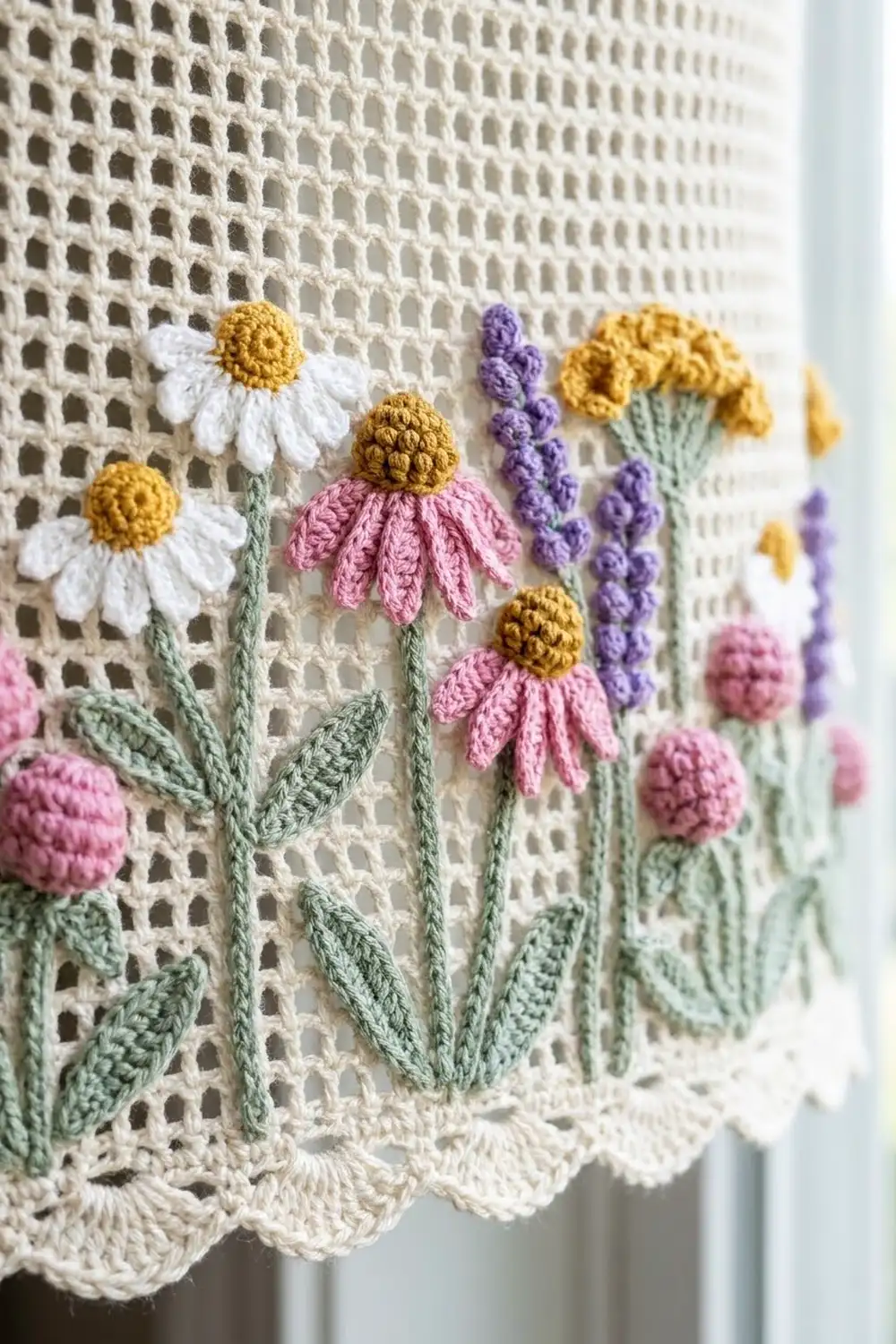
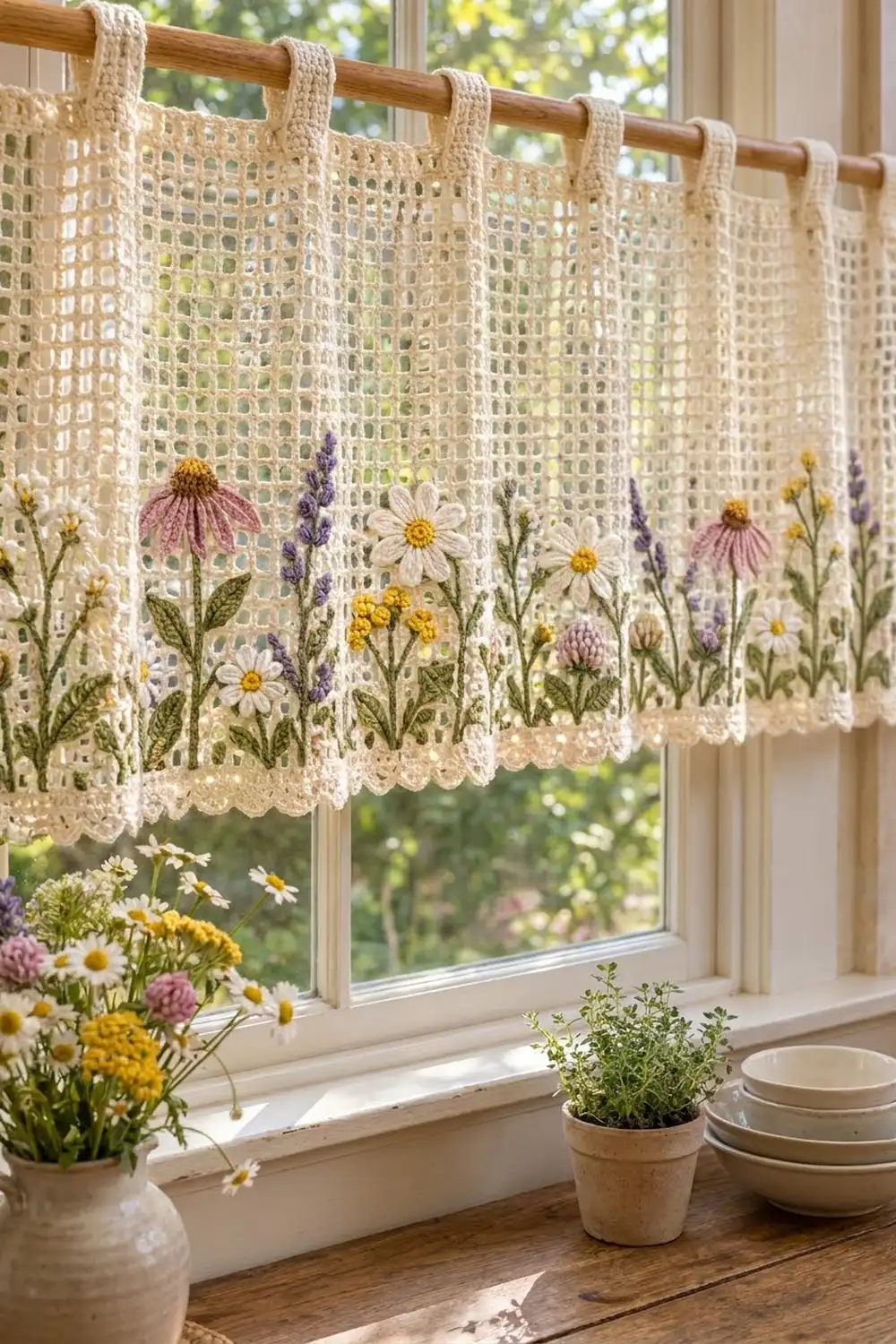
This café curtain is one soft cream filet mesh panel with a wildflower meadow along its lower edge. White daisies, pink coneflowers, lavender spikes, golden yarrow and pink clover rise on sage-green stems. A row of shell scallops finishes the hem, and eight tabs hang the panel from a rod.
The palette is warm and calm. The curtain itself is cream. The daisies are white and golden yellow, the coneflowers and clover are dusty pink, the lavender is purple, the coneflower centers are golden brown, and the stems and leaves are sage green. The open mesh lets light through, while the flowers sit in raised relief.
The pattern uses US crochet terms. The finished panel measures 36.5 in (92.7 cm) wide by 17.25 in (43.8 cm) long, not counting the tabs. Each tab adds a 3 in (7.6 cm) loop above the top edge.
You work the curtain flat from the bottom up as one piece: a solid band, an open mesh body, then a solid top band. Next comes a two-round border with scallops along the hem, and then you work the tabs straight off the top edge. Last, you sew small crocheted flowers, stems and leaves onto the right side.
Finished Size and Construction
- Finished size: 36.5 in x 17.25 in (92.7 cm x 43.8 cm), not counting the tabs
- Skill level: Intermediate
- Terminology: US
- Yarn weight: DK / light worsted (#3) cotton
- Hook: 4.0 mm (US G-6)
- Number of pieces: 1 curtain panel, plus small flowers, stems and leaves sewn on
- Layout: One rectangle, 90 mesh squares wide, with 8 tabs along the top
- Panel size before border: 36 in x 16 in (91.4 cm x 40.6 cm)
- Border depth: 0.25 in (0.6 cm) at the sides, 0.5 in (1.3 cm) at the top, 0.75 in (1.9 cm) at the scalloped hem
Materials
Use a smooth mercerized or combed cotton in DK weight, about 115 m per 50 g. Cotton keeps the mesh crisp, blocks well and holds up in sunlight. Avoid fuzzy yarns, because they blur the open squares.
- Cream (main): 450 g, about 1035 m
- Sage green (stems, leaves): 50 g, about 115 m
- White (daisy petals): 25 g, about 58 m
- Dusty pink (coneflowers, clover): 25 g, about 58 m
- Golden yellow (daisy centers, yarrow): 20 g, about 46 m
- Lavender purple (lavender): 15 g, about 35 m
- Golden brown (coneflower centers): 10 g, about 23 m
All quantities include a margin of about 15%.
Tools: 4.0 mm (US G-6) hook, tapestry needle, stitch markers, rust-proof pins, measuring tape, blocking mats, and a spray bottle or steamer.
Abbreviations (US Terms)
- ch – chain
- sl st – slip stitch
- sc – single crochet
- hdc – half double crochet
- dc – double crochet
- sp – space
- st(s) – stitch(es)
- RS / WS – right side / wrong side
3-dc bobble: Make an unfinished dc 3 times in the same stitch. For each one, yarn over, insert the hook, pull up a loop, yarn over and pull through 2 loops. Then yarn over and pull through all 4 loops on the hook.
Shell: 5 dc in the same stitch.
Gauge and Checkpoints
- Mesh gauge: 10 mesh squares x 10 rows = 4 in (10.2 cm)
- Single crochet gauge: 15 sc = 2 in (5.1 cm), which is 7.5 sc per inch
Make a test swatch first. Ch 32, then sc in the 2nd ch from the hook and in each ch across (31 sc). Work 10 mesh rows as in Rows 4–38 below, so the swatch is 10 squares wide. Block it and measure it. Then make one daisy as a test flower. It should measure 2.75 in (7.0 cm) across.
Checkpoints:
- After Row 3: 36 in (91.4 cm) wide, about 1 in (2.5 cm) tall
- After Row 13: about 5 in (12.7 cm) tall
- After Row 38: about 15 in (38.1 cm) tall
- After Row 41: 36 in x 16 in (91.4 cm x 40.6 cm)
- After the border: 36.5 in x 17.25 in (92.7 cm x 43.8 cm)
If your swatch is too big, go down 0.25 mm in hook size. If it is too small, go up 0.25 mm. If the width is right but the height is off, add or remove mesh rows. Each mesh row is 0.4 in (1.0 cm) tall. Never change the 271-stitch width, because the border and tab math depend on it.
Curtain Panel
With cream, ch 272.
Row 1 (bottom band): Sc in 2nd ch from hook and in each ch across, turn. (271 sc)
Row 2: Ch 3 (counts as dc), dc in each st across, turn. (271 dc)
Row 3: Repeat Row 2. (271 dc)
Row 4 (conversion to mesh): Ch 5 (counts as dc + ch 2), skip 2 sts, dc in next st. Ch 2, skip 2 sts, dc in next st; repeat from * across. The last dc goes in the top of the turning ch. Turn. (91 dc + 90 ch-2 sps = 90 squares)
Rows 5–38 (mesh): Ch 5 (counts as dc + ch 2), skip the ch-2 sp, dc in next dc. Ch 2, dc in next dc; repeat from * across. Work the last dc in the 3rd ch of the turning ch-5. Turn. (90 squares)
The mesh body is 35 rows, which is 14 in (35.6 cm). Keep your dc posts upright and your chains relaxed so the squares stay square.
Row 39 (conversion to solid): Ch 3 (counts as dc). 2 dc in next ch-2 sp, dc in next dc; repeat from * across, turn. (91 dc worked 1 per existing dc + 180 dc worked 2 per space = 271 dc)
Row 40: Ch 3 (counts as dc), dc in each st across, turn. (271 dc)
Row 41: Ch 1, sc in each st across. (271 sc) Fasten off.
Wildflower Appliqués
Leave a 10 in (25.4 cm) tail on every piece for sewing.
Daisy (make 5)
With yellow, make a magic ring.
- Rnd 1: Ch 1, 6 sc in ring, join. (6 sc)
- Rnd 2: Ch 1, 2 sc in each st, join. (12 sc) Fasten off.
- Rnd 3: Join white in any st. Ch 7. Working back along the chain from the 2nd ch from the hook: sc, hdc, dc, dc, hdc, sc. Sl st in next st; repeat from * 12 times. (12 petals)
The finished daisy is 2.75 in (7.0 cm) across.
Coneflower (make 5)
With golden brown, make a magic ring.
- Rnd 1: Ch 1, 6 sc in ring, join. (6 sc)
- Rnd 2: Ch 1, (sc, 3-dc bobble) in each st, join. (6 sc + 6 bobbles = 12 sts) Fasten off.
- Rnd 3: Join pink in any sc. Ch 9. Working back from the 2nd ch from the hook: sc, hdc, dc, dc, dc, dc, hdc, sc. Sl st in next st; repeat from * 7 more times. (8 petals) Sl st in each remaining st.
When you sew it on, place the bare edge at the top and angle the petals downward like a skirt. The coneflower is 3 in (7.6 cm) wide.
Lavender Spike (make 10)
With purple, ch 11.
- Row 1: 3-dc bobble in 2nd ch from hook. Sl st in next ch, 3-dc bobble in next ch; repeat from * 3 more times. Sl st in last ch. (5 bobbles + 5 sl sts)
- Other side: Rotate and work along the free loops of the chain: sl st in next loop, 3-dc bobble in next loop; repeat from * 4 more times. (5 sl sts + 5 bobbles)
The buds sit staggered on both sides. The spike is 1.75 in (4.4 cm) long.
Yarrow Floret (make 25, 5 per sprig)
With yellow, ch 2. Work 5 hdc in the 2nd ch from the hook, then sl st to join. Pull the starting tail tight so the floret cups into a ball 0.4 in (1.0 cm) across.
Clover (make 10)
With pink, make a magic ring.
- Rnd 1: Ch 1, 8 sc in ring, join. (8 sc)
- Rnd 2: (3-dc bobble, ch 1) in each st, join. (8 bobbles)
Cinch the ring and stuff the tail inside to form a 1 in (2.5 cm) ball.
Leaf (make 40)
With green, ch 8. Starting in the 2nd ch from the hook: sc, hdc, dc, dc, dc, hdc, then 3 sc in the last ch. Working along the other side of the chain: hdc, dc, dc, dc, hdc, sc. Sl st in the first sc. (15 sts)
The leaf is 1.25 in (3.2 cm) long.
Stems
With green, chain the length given below, then sl st in the back bump of each ch so the stem lies flat. Gauge is about 7 ch per inch.
- Daisy: ch 35, 5 in (12.7 cm)
- Coneflower: ch 42, 6 in (15.2 cm)
- Lavender (2): ch 28, 4 in (10.2 cm)
- Yarrow: ch 28, 4 in (10.2 cm), plus 2 branches of ch 7, 1 in (2.5 cm)
- Clover (2): ch 21, 3 in (7.6 cm)
Make 5 sets of these stems.
Placement
The meadow repeats every 18 squares, which is 7.2 in (18.3 cm). The 90-square width holds 5 repeats. In each repeat, count squares from the right and place the stems in these squares:
- Lavender: squares 2 and 14
- Daisy: square 5
- Clover: squares 7 and 16
- Yarrow: square 9
- Coneflower: square 12
Each stem starts at the top of Row 3 and runs up a dc column. Tack it down with small stitches through the posts.
Sew a flower to the top of each stem. Add 2 leaves to each daisy, coneflower and yarrow stem, and 1 leaf to each clover stem. Fan 5 florets into a dome across each yarrow stem and its branches. The tallest flowers reach about 7 in (17.8 cm) above the hem.
Border
Border gauge: Along the top and bottom, work 7.5 sc per inch. Along the sides, work 2 sc in each dc row end. A dc row is 0.4 in (1.0 cm) tall, so 2 sc fill it without ruffling or pulling.
Round 1: With RS facing, join cream in the first sc of Row 41.
- Top: 3 sc in first st, sc in next 269 sts, 3 sc in last st.
- Side: 2 sc in each dc row end from Row 40 down to Row 2. (39 rows x 2 = 78 sc)
- Bottom: 3 sc in the first free loop of the foundation chain, sc in next 269 loops, 3 sc in last loop.
- Second side: 78 sc up the second side, as before. Join.
Between the corner groups you have 269 + 269 + 78 + 78 sts, plus 4 corners x 3 sc = 706 sc. Mark the center sc of each corner.
Round 2: Ch 1. Work 3 sc in each marked corner st. Work 1 sc in each st along the top and sides. Along the bottom, between the corner groups: sc in first st, skip 2 sts, shell in next st, skip 2 sts, sc in next st; repeat from * 44 more times. Join and fasten off.
Stitch counts between the corner groups:
- Top: 271 sc
- Each side: 80 sc
- Bottom: 46 sc + 45 shells (225 dc) = 271 sts
- Corners: 4 x 3 = 12
Total: 271 + 271 + 80 + 80 + 12 = 714 sts. That is 706 + 8, because each corner adds 2 sts.
Why the math works: Each scallop repeat uses 6 sts. Since 6 x 45 + 1 = 271, the bottom row begins and ends on a sc. Each scallop is 0.8 in (2.0 cm) wide, so 45 scallops measure 36 in (91.4 cm), which matches the panel width.
Tabs (make 8)
The top of Round 2 has 271 sts between the corner groups. Each tab is 12 sts wide, and each gap is 25 sts: 8 x 12 + 7 x 25 = 271.
With RS facing, join cream in st 1.
- Row 1: Ch 1, sc in same st and in next 11 sts, turn. (12 sc)
- Next rows: Ch 1, sc in each st, turn. Repeat until the tab is 6 in (15.2 cm) long, about 24 rows. Fasten off.
Start the remaining tabs in sts 38, 75, 112, 149, 186, 223 and 260. The last tab ends in st 271. Fold each tab to the WS and whipstitch its last row along the base of Round 1. This makes a loop 3 in (7.6 cm) deep and 1.6 in (4.1 cm) wide.
Final Blocking
- Weave in all ends along the dc posts so they stay hidden.
- Dampen the curtain all the way through, then roll it in a towel to remove excess water.
- Lay it RS down on a towel over the mats so the flowers stay plump.
- Pin the corners to 36.5 in x 17.25 in (92.7 cm x 43.8 cm).
- Pin the sides every 2 in (5.1 cm), keeping the mesh columns straight.
- Pin the tip of each scallop.
- Steam lightly from the WS if needed. Never flatten the bobbles.
- Let it dry completely before unpinning.
Final Quality-Control Checklist
- 90 squares in every mesh row
- Panel before border is 36 in x 16 in (91.4 cm x 40.6 cm)
- Round 1 has 706 sts; Round 2 has 714 sts
- 45 even scallops, with a sc at each end
- 8 matching tabs, 12 sts wide, with 25-st gaps
- 5 meadow repeats, each 7.2 in (18.3 cm)
- Stems straight, and flowers and leaves sewn flat
- Finished size is 36.5 in x 17.25 in (92.7 cm x 43.8 cm)
Troubleshooting
- Squares tall and narrow: Your chains are tight. Loosen the ch-2s.
- Panel slants: Make sure every row ends in the turning chain.
- Hem ruffles: Recount the bottom of Round 1. It should have 269 sts between the corner groups.
- Sides pull in: Work exactly 2 sc per dc row end.
- Coneflower petals curl up: Pin them pointing downward while they dry.
- Uneven tabs: Count rows instead of measuring each tab.
Care
Hand wash in cool water with mild soap, then reshape and dry flat. Do not tumble dry.
Final Notes
Here is the measurement chain:
- 271 stitches make 90 mesh squares, 36 in (91.4 cm) wide.
- 35 mesh rows plus the two solid bands give 16 in (40.6 cm) of height.
- The same 271 stitches hold exactly 45 scallops and 8 tabs with 25-stitch gaps.
- Five 18-square meadow repeats fill the hem.
- The border brings the curtain to 36.5 in x 17.25 in (92.7 cm x 43.8 cm).
Happy crocheting!