

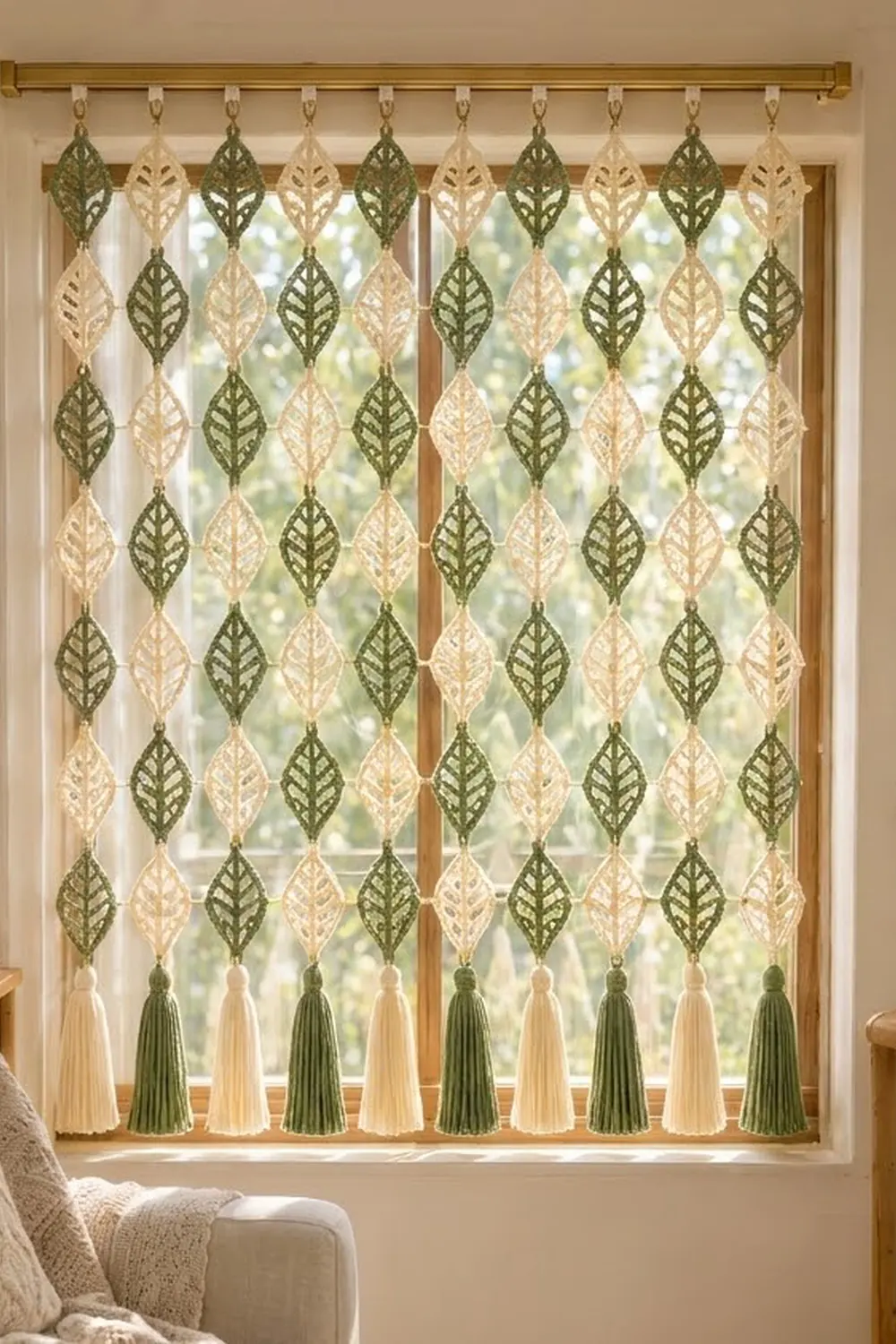
The Sage Meadow Leaf Curtain is a light, airy window panel made from lacy leaf motifs. Each leaf has a bold center vein, angled side veins and a smooth, rounded outline. The leaves link point to point into hanging strands, and each strand ends in a full, swinging tassel.
Sage green and cream alternate in a checkerboard, both down each strand and across the curtain. The look is soft boho with a botanical feel, and sunlight shows through every open window in the leaves.
This pattern uses US crochet terms. The finished curtain measures about 30 in (76.2 cm) wide and 53 in (134.6 cm) long, including hanging loops and tassels.
Here is how it’s built. You crochet each leaf in the round around a short foundation chain. While you work the last round of each leaf, you join it to the leaf above it. You finish each strand with a hanging loop at the top and a tassel at the bottom, then hang the 10 strands side by side from a rod.
Finished Size and Construction
- Finished size: 30 in (76.2 cm) wide × 53 in (134.6 cm) long
- Skill level: Easy intermediate
- Terminology: US crochet terms
- Yarn weight: Worsted (#4) cotton
- Hook: 5.0 mm (H-8)
- Number of pieces: 80 leaves (40 sage, 40 cream), plus 10 tassels
- Layout: 10 strands × 8 leaves, in a checkerboard
- Piece size: each leaf is 3 in (7.6 cm) wide × 5.25 in (13.3 cm) long, point to point
- Size before border: each strand of joined leaves is 45.5 in (115.6 cm) long
- Border depth: a 1.5 in (3.8 cm) hanging loop at the top and a 6 in (15.2 cm) tassel at the bottom
Materials
Yarn: Use a smooth, mercerized or combed worsted-weight cotton. Cotton keeps the veins crisp and hangs straight without stretching. Avoid fuzzy or very soft acrylics, because they blur the open windows.
- Sage green: 250 g / about 425 m (465 yd)
- Cream: 250 g / about 425 m (465 yd)
Each leaf uses about 4 g (7 m). Each tassel uses about 10 g (17 m). These quantities include a margin of roughly 10% for gauge differences and test pieces.
Tools:
- 5.0 mm (H-8) crochet hook
- Tapestry needle
- Scissors
- A stiff card 6.5 in (16.5 cm) tall, for winding tassels
- Rust-proof pins and a blocking mat
- Spray bottle
- 10 curtain rings or ring-glider hooks
- Curtain rod at least 32 in (81.3 cm) long
Abbreviations (US Terms)
- ch – chain
- sl st – slip stitch
- sc – single crochet
- sk – skip
- sp – space
- st(s) – stitch(es)
- [ ] – repeat the instructions inside the brackets as directed
Special technique – point join: Work the round to the point space. Then work sc, ch 2, remove the hook from the loop, insert it from the front into the free ch-2 point of the leaf above, pick up the dropped loop and pull it through. Ch 2 and sc in the same point space of the current leaf. The connector is about 0.5 in (1.3 cm) long.
Gauge and Checkpoints
Gauge: 16 sc = 4 in (10.2 cm), worked in Round 1 along the foundation chain.
Make one complete leaf first and block it before you make the rest. Check it at each stage:
- After Round 1: 4 in (10.2 cm) long × 0.75 in (1.9 cm) wide
- After Round 2: 4.5 in (11.4 cm) long × 2 in (5.1 cm) wide
- After Round 3: 4.75 in (12.1 cm) long × 2.5 in (6.4 cm) wide
- After Round 4: 5.25 in (13.3 cm) long × 3 in (7.6 cm) wide
A tolerance of ±0.25 in (0.6 cm) is fine. If your leaf is too big, go down to a 4.5 mm hook. If it’s too small, go up to a 5.5 mm hook. Don’t change the chain-loop counts, because the vein angles depend on them.

Leaf Motif (Make 80)
The base end of the leaf is where the foundation chain ends. The tip end is where it starts. Both ends become points with the same shape.
Foundation: Ch 17.
Round 1 (center vein): Sc in the 2nd ch from the hook and in each of the next 15 ch. That’s 16 sc on Side A, worked from tip to base. Ch 2 for the base space. Now work in the unused loops on the other side of the foundation: sc in each of the 16 ch for Side B, worked from base to tip. Ch 2 for the tip space, then sl st to the first sc.
Count: 32 sc and 2 ch-2 spaces. This doubled band of sc forms the bold center vein.
Round 2 (side veins): Ch 1. Work Side A as follows:
- Sc in the first sc.
- Ch 4, sk 2 sc, sc in the next sc.
- Ch 6, sk 2 sc, sc in the next sc.
- Ch 7, sk 2 sc, sc in the next sc.
- Ch 6, sk 2 sc, sc in the next sc.
- Ch 4, sk 2 sc, sc in the next sc. This is the 16th sc of Side A.
At the base, work (sc, ch 3, sc) in the ch-2 space.
Work Side B exactly like Side A, starting with the first sc of Side B.
At the tip, work (sc, ch 3, sc) in the ch-2 space. Sl st to the first sc.
Count: 16 sc (6 anchor sc per side + 2 sc at each point), 10 chain loops (four ch-4, four ch-6 and two ch-7) and 2 ch-3 points.
The two chain legs that rise from each shared anchor sc lie side by side and form a doubled side vein. The inside of each loop becomes an open window. Because the loops go 4–6–7–6–4, the leaf is widest in the middle and narrows to both points.
Round 3 (outline, conversion round): Sl st into the first ch-4 loop and ch 1. Work along Side A:
- 4 sc in the ch-4 loop
- 6 sc in the ch-6 loop
- 7 sc in the ch-7 loop
- 6 sc in the next ch-6 loop
- 4 sc in the last ch-4 loop
Skip all of the Round 2 sc. At the base, work (2 sc, ch 3, 2 sc) in the ch-3 point. Repeat the same sequence along Side B, then work (2 sc, ch 3, 2 sc) in the tip ch-3 point. Sl st to the first sc.
Count: (4 + 6 + 7 + 6 + 4) = 27 sc per side × 2 = 54 sc, plus 4 sc at each point × 2 = 8 sc. That’s 62 sc and 2 ch-3 points.
Round 4 (trim round): Ch 1. Sc in each sc around, and work (sc, ch 2, sc) in each ch-3 point. Sl st to the first sc.
Count: 62 sc (one in each existing st) + 4 sc added at the points = 66 sc and 2 ch-2 points.
This round thickens the outline into the smooth rim shown in the photo. On every leaf except the first leaf of each strand, use the point join on the base point instead of (sc, ch 2, sc). The joining section below explains how.
Fasten off and weave in the ends along the rim, not across the windows.
Make All Pieces
- Sage leaves: 40
- Cream leaves: 40
- Sage tassels: 5
- Cream tassels: 5
Layout grid (S = sage, C = cream; strands are numbered 1–10 from left to right, and rows are numbered from the top):
Row 1:  S C S C S C S C S C
Row 2:  C S C S C S C S C S
Row 3:  S C S C S C S C S C
Row 4:  C S C S C S C S C S
Row 5:  S C S C S C S C S C
Row 6:  C S C S C S C S C S
Row 7:  S C S C S C S C S C
Row 8:  C S C S C S C S C S
Tassel: C S C S C S C S C S
Odd-numbered strands start with sage and end with cream. Even-numbered strands start with cream and end with sage. Each tassel matches the bottom leaf of its strand.
Joining
Method: Join as you go, point to point, during Round 4.
Finish the first leaf of the strand completely. Work Rounds 1–3 of the second leaf. In Round 4, work around as normal until you reach the base point. Use the point join there to attach it to the free tip ch-2 of the leaf above. Then finish the round. Repeat this until the strand has 8 leaves.
Stitch logic: The join replaces the ch-2 point with ch 2, a sl st and ch 2. No sc are added or taken away, so every leaf still has 66 sc. Only the point chains change.
Tension: Keep both connector chains the same size as your normal chains. Don’t pull the sl st tight. Tight joins pucker the points and make the strand twist.
Size checkpoint: 8 leaves × 5.25 in (13.3 cm) = 42 in (106.7 cm), and 7 connectors × 0.5 in (1.3 cm) = 3.5 in (8.9 cm). Each strand should measure 45.5 in (115.6 cm). Lay it flat to measure, without stretching it. If it’s within 1 in (2.5 cm) of that length, it’s fine.
Border: Hanging Loops and Tassels
This curtain has no fabric border. Its “border” is the top and bottom finishing on each strand.
Border gauge: The same as the leaves, 4 sc = 1 in (2.5 cm).
Top Hanging Loop (on each strand)
Join yarn that matches the top leaf in that leaf’s free base ch-2 point.
Round A: Ch 1, sc in the ch-2 point, ch 12, sc in the same point.
Count: 2 sc and 1 ch-12 loop.
Round B (trim round): Work 16 sc into the ch-12 loop, then sl st to the first sc of Round A.
Count: 12 (one per chain) + 4 extra = 16 sc. The 4 extra stitches let the covered loop curve without cupping.
Fasten off. The loop hangs about 1.5 in (3.8 cm) above the top point.
Bottom Tassel (on each strand)
- Wrap matching yarn around the 6.5 in (16.5 cm) card 50 times.
- Thread a 12 in (30.5 cm) tie under all the wraps at the top of the card. Pass the tie through the bottom leaf’s free tip ch-2 point and knot it tightly.
- Cut the wraps along the bottom of the card.
- Wrap a 24 in (61.0 cm) strand tightly around the tassel 0.75 in (1.9 cm) below the top, about 8 times. Knot it and bury the ends inside the tassel.
- Steam the strands lightly and trim them evenly to 6 in (15.2 cm).
Why the Math Works
Each strand is 1.5 in (3.8 cm) of loop + 45.5 in (115.6 cm) of leaves + 6 in (15.2 cm) of tassel = 53 in (134.6 cm).
Across the curtain, hang the strands 3 in (7.6 cm) apart, center to center. That gives 9 gaps × 3 in = 27 in (68.6 cm), plus half a leaf width, 1.5 in (3.8 cm), at each side. The total width is 30 in (76.2 cm). Because the leaves are exactly 3 in (7.6 cm) wide, their widest points just touch, which gives the dense checkerboard in the photo.
Final Blocking
- Wet each strand fully in cool water and gently press out the excess. Don’t wring it.
- Roll the strand in a towel to remove more water.
- Lay the strand flat on the mat and straighten the center veins.
- Pin each leaf to 3 in (7.6 cm) × 5.25 in (13.3 cm). Put one pin at each point and one at the widest spot on each side.
- Use a tapestry needle to open each window, so the paired chain legs lie together as clean side veins.
- Check that every connector is 0.5 in (1.3 cm) long.
- Comb the tassel strands straight with your fingers.
- Let everything dry completely, then unpin.
Final Quality-Control Checklist
- Every leaf has 66 sc in Round 4 and 10 open windows.
- Every leaf measures 3 in (7.6 cm) × 5.25 in (13.3 cm), ±0.25 in (0.6 cm).
- Every strand has 8 leaves and measures 45.5 in (115.6 cm).
- The colors follow the checkerboard grid exactly.
- Every hanging loop has 16 sc and is 1.5 in (3.8 cm) deep.
- All tassels are trimmed to 6 in (15.2 cm), with a neck 0.75 in (1.9 cm) below the top.
- All ends are woven into the rims and none show across the windows.
- The strands hang 3 in (7.6 cm) apart, and the total width is 30 in (76.2 cm).
Troubleshooting
Leaf cups or curls: Round 3 is too tight. Go up 0.5 mm for Round 3 only, or check that you skipped every Round 2 anchor sc.
Leaf ruffles: You put too many sc in a loop. Recount them against the 4–6–7–6–4 sequence.
Leaf looks lopsided: Side A and Side B loops don’t match. Check that both sides use the same loop order.
Windows close up: The yarn is too fuzzy or the chains are too tight. Block firmly and pin the windows open.
Strand twists: Some leaves were joined with their back side facing forward. Always insert the hook from the front for the point join.
Strand is too long: Shorten the connectors to ch 1 on each side of the join.
Tassel looks thin: Wind 60 wraps instead of 50.
Care
Hand wash in cool water with mild soap, roll in a towel, and dry flat while pinned to size. Rehang only when completely dry.
Final Notes
Every measurement in this curtain builds on the one before it. Round 1 sets the 4 in (10.2 cm) center vein. Rounds 2–4 make a 3 in (7.6 cm) × 5.25 in (13.3 cm) leaf. Eight joined leaves make a 45.5 in (115.6 cm) strand. The loop and tassel bring each strand to 53 in (134.6 cm), and ten strands spaced 3 in (7.6 cm) apart give a 30 in (76.2 cm) wide panel. If your first leaf is the right size, the rest of the curtain will come out right too.
Happy crocheting!