

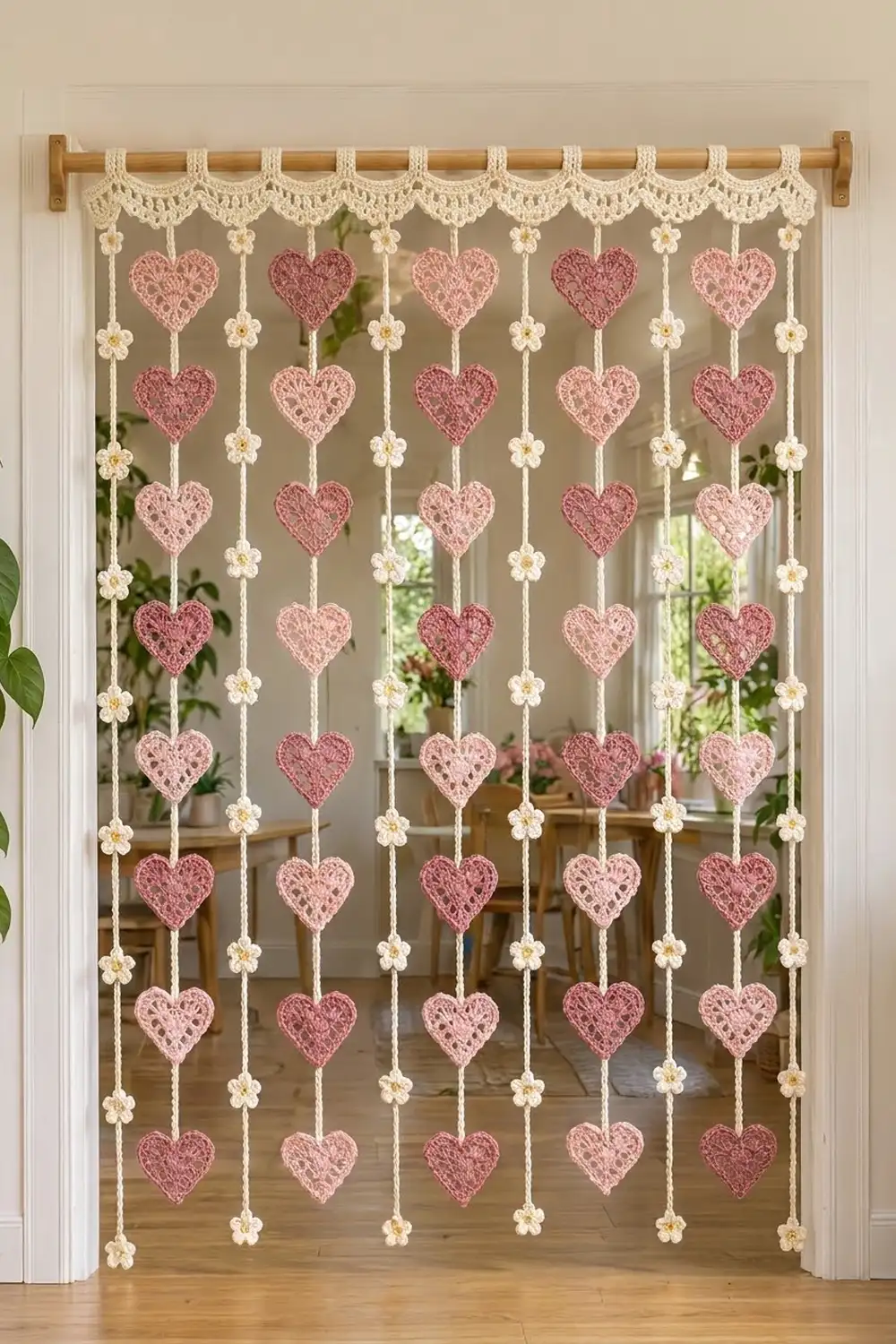
The Rosewater Hearts Door Curtain is a romantic hanging made of lacy pink hearts and small cream daisies on cream cords, all hanging from a scalloped lace header. Hung in a doorway or a wide window, it gives a soft, cottage-style look and lets the light come through.
The palette is a calm cream base with three shades of pink: light pink, dusty rose and a deeper mauve rose. Every flower has a small pale yellow center. Each heart has a solid round of stitches radiating from the middle like a fan, a ring of chain-space lace around it and a solid stitched edge, so it looks good from both sides.
This pattern uses US crochet terms. The finished curtain measures 33.25 in (84.5 cm) wide and 43 in (109.2 cm) long, not counting the rod tabs.
Construction is simple and modular. First you work the header flat in rows and add 12 rod tabs and a scalloped edge. Next you make 40 hearts and 96 flowers. Last, you join them into 11 hanging strands with a chain-and-slip-stitch cord that you work straight from the header.
Finished Size and Construction
- Finished size: 33.25 in (84.5 cm) wide x 43 in (109.2 cm) long, excluding tabs
- Skill level: Intermediate
- Terminology: US crochet terms
- Yarn weight: Worsted (#4) cotton
- Hook: 4.0 mm (G-6)
- Number of pieces: 1 header, 40 hearts, 96 flowers
- Layout: 11 strands, alternating flower and heart (F-H-F-H-F-H-F-H-F-H-F)
- Piece size: heart 3.5 in (8.9 cm) wide x 3.5 in (8.9 cm) tall; flower 1.25 in (3.2 cm) across
- Header size before border: 33.25 in (84.5 cm) x 1.75 in (4.4 cm)
- Border depth: 1.25 in (3.2 cm), for a total header depth of 3 in (7.6 cm)
Materials
Use a smooth, mercerized or combed worsted-weight cotton. Cotton keeps the lace crisp, blocks cleanly and doesn’t stretch much on long cords. The amounts below assume about 85 m per 50 g.
- Cream (MC): 260 g / 442 m (header, tabs, cords, petals)
- Light pink (A): 70 g / 119 m (14 hearts)
- Dusty rose (B): 65 g / 111 m (13 hearts)
- Mauve rose (C): 65 g / 111 m (13 hearts)
- Pale yellow (D): 35 g / 60 m (96 flower centers)
All quantities include a margin of about 20% for gauge differences, swatching and weaving in ends.
Tools:
- 4.0 mm (G-6) crochet hook
- Tapestry needle
- Scissors
- Locking stitch markers
- Measuring tape
- Blocking mats, rust-proof pins and a spray bottle
- Curtain rod up to 1 in (2.5 cm) in diameter
Abbreviations (US Terms)
- ch – chain
- sl st – slip stitch
- sc – single crochet
- hdc – half double crochet
- dc – double crochet
- tr – treble crochet
- sk – skip
- sp(s) – space(s)
- st(s) – stitch(es)
- MR – magic ring
Special stitch – Cord: Chain the stated number, attach to the target stitch with a sl st, then sl st back up the chain into each back bump, ending with a sl st in the starting stitch. This doubles the chain into a firm, round cord.
Gauge and Checkpoints
- Header gauge: 16 dc and 8 dc rows = 4 in (10.2 cm)
- Tab gauge: 18 sc and 20 sc rows = 4 in (10.2 cm)
- Chain gauge: 4 ch = 1 in (2.5 cm)
Make one heart and one flower before you do anything else. Block them lightly and measure.
Checkpoints:
- Heart Rnd 1: 1.5 in (3.8 cm) across
- Heart Rnd 3: 3.25 in (8.3 cm) wide
- Heart Rnd 4: 3.5 in (8.9 cm) wide x 3.5 in (8.9 cm) tall
- Flower: 1.25 in (3.2 cm) across
- Header after Row 4: 33.25 in (84.5 cm) wide x 1.75 in (4.4 cm) deep
If your heart is bigger than 3.5 in (8.9 cm), go down half a hook size. If it’s smaller, go up half a size. A difference of 0.25 in (0.6 cm) per heart adds up to 2 in (5.1 cm) along a strand, so it’s worth fixing at this stage.
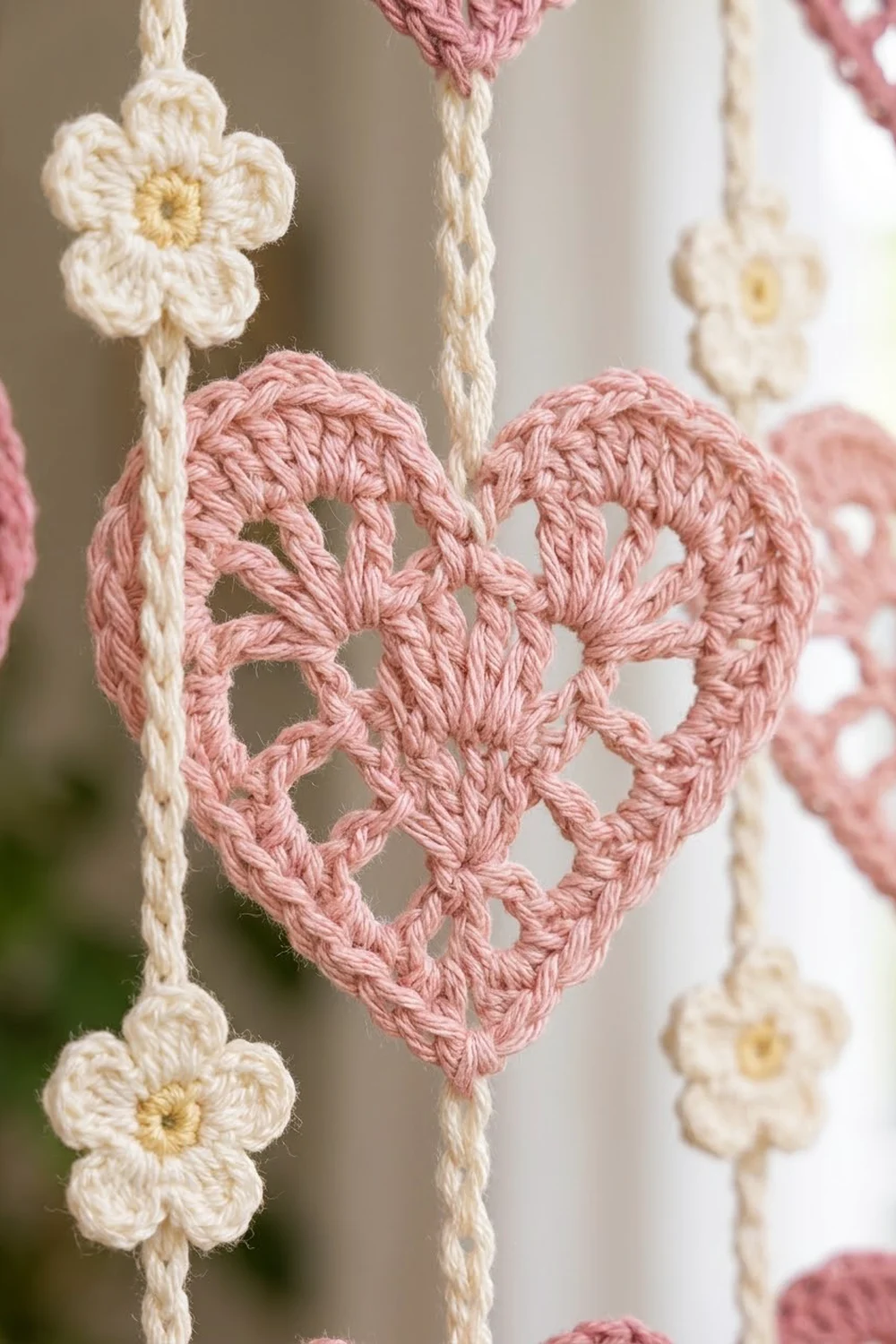
Hearts (Make 40)
Work in rounds with the right side facing. Don’t turn.
Rnd 1: MR, ch 3 (counts as dc), 15 dc in ring, sl st to top of ch-3. Pull ring closed. (16 dc)
Number these sts 1–16 clockwise. St 1 is the top center (the future cleft) and is the ch-3 you just joined into. St 9 is the bottom center (the future point). Place a marker in st 9.
Rnd 2 (shaping lace round): Ch 1, sc in same st (st 1), ch 2; hdc in st 2, ch 2; dc in st 3, ch 2; tr in st 4, ch 2; tr in st 5, ch 2; [dc in next st, ch 2] 3 times (sts 6–8); (dc, ch 3, dc) in st 9; ch 2; [dc in next st, ch 2] 3 times (sts 10–12); tr in st 13, ch 2; tr in st 14, ch 2; dc in st 15, ch 2; hdc in st 16, ch 2; sl st to first sc. (17 sts, 16 ch-2 sps, 1 ch-3 sp)
The taller tr pairs push out the two lobes. The sc at st 1 stays low to form the cleft.
Rnd 3 (solid round): Sl st into first ch-2 sp. Work into each sp in order:
- Right side: 3 hdc, 3 dc, 4 dc, 5 dc (lobe top, between the tr), 4 dc, 3 dc, 3 dc, 3 dc
- Point ch-3 sp: (2 dc, ch 2, 2 dc)
- Left side: 3 dc, 3 dc, 3 dc, 4 dc, 5 dc (lobe top), 4 dc, 3 dc, 3 hdc
- Sl st into the sc at the cleft.
Each side has 28 sts in the ch-2 sps plus 2 dc at the point, so 30 sts per side. (60 sts, 1 ch-2 sp)
Rnd 4 (edge): Ch 1, sc in each of the first 30 sts, 3 sc in point ch-2 sp, sc in each of the last 30 sts, sl st to first sc. Fasten off and weave in ends. (63 sc)
The joining sl st sits right at the cleft. You’ll use it later as the top attachment point. The center sc of the 3-sc group is the bottom attachment point.
Flowers (Make 96)
Rnd 1 (D): MR, ch 1, 10 sc in ring, sl st to first sc. Fasten off. (10 sc)
Rnd 2 (MC): Join MC in any sc. *(hdc, 3 dc, hdc) in next sc, sl st in next sc; repeat from * 4 more times. Fasten off. (5 petals, 25 petal sts, 5 sl sts)
The top attachment point is the center dc of any petal. The bottom attachment point is the sl st between the two petals directly opposite.
Header
Row 1 (RS): With MC, ch 134. Sc in 2nd ch from hook and in each ch across, turn. (133 sc)
Row 2: Ch 3 (counts as dc), dc in each st across, turn. (133 dc)
Row 3 (mesh): Ch 4 (counts as dc + ch 1), sk next st, dc in next st, [ch 1, sk 1, dc in next st] 65 times, turn. (67 dc, 66 ch-1 sps = 133 sts)
Row 4: Ch 3 (counts as dc), dc in each ch-1 sp and each dc across, ending in 3rd ch of turning ch, turn. (133 dc)
Checkpoint: 33.25 in (84.5 cm) x 1.75 in (4.4 cm).
Rod tabs (make 12): With the right side facing, work along the free loops of the foundation chain. Join MC, ch 1, sc in 3 sts, turn. Work 21 more rows of 3 sc, for 22 rows total, 4.4 in (11.2 cm). Fasten off and leave a 12 in (30.5 cm) tail.
Place the tabs over these foundation sts: 1–3, 12–14, 24–26, 36–38, 48–50, 60–62, 72–74, 84–86, 96–98, 108–110, 120–122 and 131–133. Interior tabs are centered on sts 13, 25, 37 and so on, which line up with the scallop junctions below.
Fold each tab to the wrong side and sew its last row to the back of Row 2. This forms a loop that fits a rod up to 1 in (2.5 cm) in diameter.
Make All Pieces
- Hearts: 14 in A, 13 in B, 13 in C (40 total)
- Flowers: 96, all with D centers and MC petals
- Header: 1, with 12 tabs and the scalloped border
Lay the hearts out in this grid before joining. Columns are heart strands 1–5 from left to right, and rows run from top to bottom.
Row 1:  B  A  C  B  A
Row 2:  A  C  B  A  C
Row 3:  C  B  A  C  B
Row 4:  B  A  C  B  A
Row 5:  A  C  B  A  C
Row 6:  C  B  A  C  B
Row 7:  B  A  C  B  A
Row 8:  A  C  B  A  C
Count check: A = 14, B = 13, C = 13. The shades step on a diagonal, so the same color never touches itself across or down.
Border (Scalloped Edge)
Work along the bottom edge (top of Row 4), with the right side facing.
Border gauge: Same as the header, 4 sts per 1 in (2.5 cm). One scallop covers 12 sts, which is 3 in (7.6 cm). Border depth is 1.25 in (3.2 cm).
Border Row 1: Join MC in the first st. Ch 1, sc in same st, [ch 4, sk 3, sc in next st] 33 times, turn. (34 sc, 33 ch-4 loops)
Border Row 2: Ch 1, sc in first sc. *(2 hdc, dc) in next loop, dc in next sc, (3 dc, ch 2, 3 dc) in next loop, dc in next sc, (dc, 2 hdc) in next loop, sc in next sc; repeat from * 10 more times. Fasten off. (11 scallops; 1 + 11 x 15 = 166 sts, plus 11 ch-2 sps)
Why the math works: The header has 133 sts, which is 11 x 12 + 1. Each ch-4 loop uses 4 sts (1 sc plus 3 skipped), so 33 loops x 4 + 1 final sc = 133. Three loops make one scallop, so 33 / 3 = 11 scallops. The junction sc sit on sts 1, 13, 25 … 133, exactly under the 12 tabs. The ch-2 sp at the center of each scallop is its lowest point and the hanging point for one strand.
Joining
Method: Every cord segment is worked from the piece above down to the piece below, using the Cord special stitch in MC.
Stitch-to-stitch logic:
- Strands hang from the scallop ch-2 sps. Scallops 1, 3, 5, 7, 9 and 11 hold flower strands, and scallops 2, 4, 6, 8 and 10 hold heart strands. Strands are 3 in (7.6 cm) apart.
- Heart strand: Join MC in the scallop ch-2 sp. Work a Cord of 6 ch to the cleft sl st of heart 1, 1.5 in (3.8 cm). Fasten off. Join MC in the center point sc of heart 1 and work a 6-ch Cord to the cleft of heart 2. Repeat until all 8 hearts are joined. (8 segments, 8 hearts)
- Flower strand: Join MC in the scallop ch-2 sp. Work a Cord of 5 ch to the center dc of a petal on flower 1, 1.25 in (3.2 cm). Fasten off. Join at the opposite bottom sl st and continue. (16 segments, 16 flowers)
Tension: Chain at your normal tension and keep the sl sts back up the cord loose enough to get into each back bump easily. If the sl sts are tight, the cord shortens and curls.
Size checkpoint: Heart strand: 8 x (1.5 in + 3.5 in) = 40 in (101.6 cm). Flower strand: 16 x (1.25 in + 1.25 in) = 40 in (101.6 cm). Hang each strand and measure. Both should end within 0.5 in (1.3 cm) of each other.
Final Blocking
- Before joining, spray the hearts and flowers until damp. Don’t soak them.
- Pin each heart to 3.5 in (8.9 cm) square. Open the cleft, point the tip and pin out the lobes.
- Pin the flowers to 1.25 in (3.2 cm) and push each petal into shape.
- Pin the header to 33.25 in (84.5 cm) x 3 in (7.6 cm) and pin each scallop point down.
- Let everything dry completely.
- Once all the strands are joined, hang the curtain and lightly mist the cords. The weight of the hearts will straighten them as they dry.
Final Quality-Control Checklist
- 40 hearts with 63 sc each, and all 40 match within 0.25 in (0.6 cm)
- 96 flowers with 5 even petals
- Header measures 133 sts and 33.25 in (84.5 cm) wide
- 12 tabs are sewn securely and line up with the scallop junctions
- 11 scallops, each with a centered ch-2 hanging point
- Heart colors match the layout grid
- All strands are 40 in (101.6 cm) long within 0.5 in (1.3 cm)
- Ends are woven in on the back, and no tails are visible from either side
Troubleshooting
- Heart lobes look flat: Make sure Rnd 2 uses tr at sts 4–5 and 13–14, and 5 dc at each lobe top in Rnd 3.
- Cleft disappears: Rnd 2 must start with sc in st 1. Re-block with a pin pushed into the cleft.
- Point is blunt: Use a ch-3 in Rnd 2 and (2 dc, ch 2, 2 dc) in Rnd 3, and pin it sharply.
- Header ripples: Your foundation chain is too tight. Go up a hook size for the chain only.
- Scallops don’t line up with tabs: Recount Border Row 1. It must have exactly 33 loops.
- Hearts twist on the cord: Join exactly into the cleft sl st and the center point sc, and block the cords while hanging.
- Strands are uneven: Check the chain counts in each segment. One extra ch per segment adds 2 in (5.1 cm) to a heart strand.
Care
Hand wash in cool water with mild soap, then roll in a towel to press out the water. Lay it flat to dry, re-pin the hearts if needed and hang it again once it’s completely dry.
Final Notes
The measurement chain is short and reliable. A 3.5 in (8.9 cm) heart plus a 1.5 in (3.8 cm) cord gives a 5 in (12.7 cm) repeat, and 8 repeats make 40 in (101.6 cm). A 1.25 in (3.2 cm) flower plus a 1.25 in (3.2 cm) cord gives a 2.5 in (6.4 cm) repeat, and 16 repeats also make 40 in (101.6 cm). The 133-st header splits into 11 scallops of 3 in (7.6 cm), so you get 11 evenly spaced strands across 33.25 in (84.5 cm). Add the 3 in (7.6 cm) header and the curtain hangs 43 in (109.2 cm).
Check each link in that chain as you go, and the curtain will hang straight and even.
Happy crocheting!