

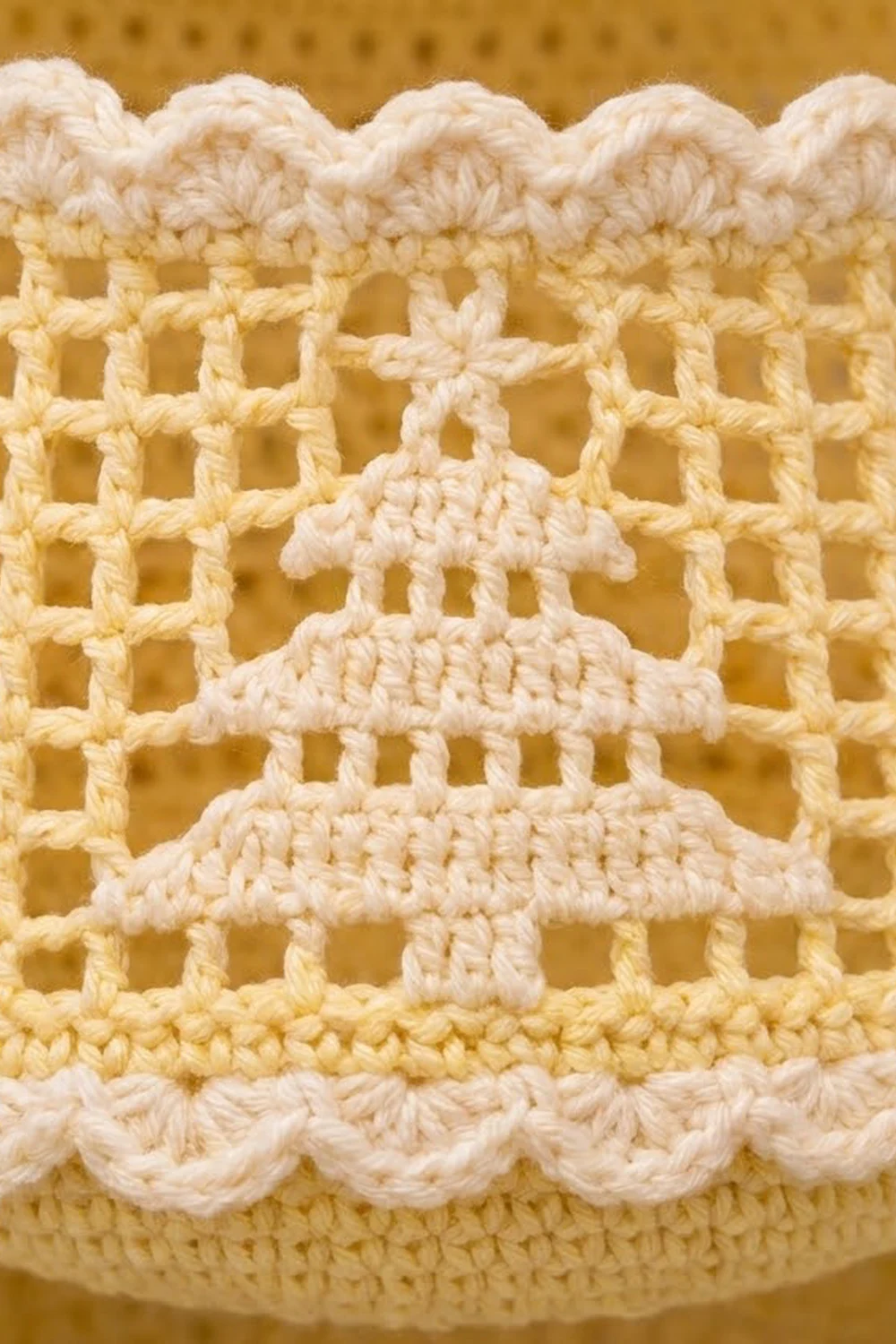
This hanging toilet paper holder has three tapered pockets stacked one above the other. Each pocket holds one roll. The body is an open filet mesh with a stepped Christmas tree worked in solid filled squares. The pockets are soft butter yellow, and the tree and the scalloped edgings are cream. It looks warm and festive and is light enough to hang from a simple bathroom hook.
Each pocket starts with a flat single crochet base. The wall turns up through the back loops, then changes into a filet mesh that narrows slightly toward the rim, which gives each pocket a gentle lampshade shape. Cream scallops trim both the rim and the fold at the base. Two long single crochet straps run down the sides of all three pockets and wrap around a wooden ring at the top.
This pattern uses US crochet terms. Each pocket measures about 5¾ in (14.6 cm) across the base, 5 in (12.7 cm) across the rim and 6½ in (16.5 cm) tall including the edgings. The finished holder hangs about 25 in (63.5 cm) from the ring to the bottom scallop.
How it’s made: you make three identical pockets, add the scallops, make two straps, sew the straps to the sides and fold the strap ends around the ring.
Finished Size and Construction
- Finished size: about 6 in (15.2 cm) wide at the widest point × 25 in (63.5 cm) long, not counting the ring
- Skill level: Intermediate (filet mesh, color changes, simple decreases)
- Terminology: US
- Yarn weight: Worsted (#4) cotton
- Hook: 4.5 mm (US 7)
- Number of pieces: 5 (3 pockets, 2 straps)
- Layout: 3 pockets stacked vertically, 2 in (5.1 cm) apart, hung from one ring
- Pocket size: 5¾ in (14.6 cm) across the base, 5 in (12.7 cm) across the rim
- Size before edging: wall height 5½ in (14.0 cm)
- Edging depth: about ½ in (1.3 cm) at the rim and ½ in (1.3 cm) at the base fold
Materials
Choose a smooth worsted weight cotton or cotton blend. Cotton holds its shape in a humid bathroom and gives clean, crisp mesh. Avoid fuzzy or very stretchy yarns. They blur the tree, and the pockets will sag under the weight of the rolls.
- Butter yellow (Color A): 200 g, about 340 m (372 yd)
- Cream (Color B): 50 g, about 85 m (93 yd)
These quantities include a margin of about 20 percent for gauge differences and swatching.
Tools:
- 4.5 mm (US 7) crochet hook
- 1 wooden ring, 2 in (5.1 cm) across
- Stitch markers
- Tapestry needle
- Scissors
- Measuring tape
- Blocking pins and a spray bottle
Abbreviations (US Terms)
- ch – chain
- sl st – slip stitch
- sc – single crochet
- dc – double crochet
- BLO / FLO – back loop only / front loop only
- inc – 2 sc in the same stitch
- sk – skip
- sp – space
- st(s) – stitch(es)
- mesh – open square: dc in next dc, ch 1, sk next st or ch-1 sp
- fsq – filled square, worked in Color B: dc in next dc, dc in next ch-1 sp
- mdec – mesh decrease (see below)
Mesh decrease (mdec): [Yo, insert hook in next dc, pull up a loop, yo, pull through 2 loops] twice, skipping the ch-1 sp between those 2 dc. Yo, pull through all 3 loops, ch 1. This turns 2 squares into 1.
Working over filled squares: If the stitch below is the second dc of a filled square instead of a ch-1 sp, treat it exactly like a ch-1 sp. Work into it for a fsq, or skip it for a mesh.
Color changes: Finish the last dc before each color change with the new color. In tree rounds, carry Color A inside the cream stitches by working over it. Join Color B at the start of each tree row and cut it at the end, leaving a 4 in (10.2 cm) tail.
Gauge and Checkpoints
- Single crochet: 16 sts and 18 rounds = 4 in (10.2 cm)
- Filet mesh: 8 squares (16 sts) and 8 rounds = 4 in (10.2 cm), so one square is about ½ in (1.3 cm)
Make one complete pocket before you start the others. That pocket is your real gauge swatch.
Checkpoints:
- After Rnd 6, the base is about 2⅞ in (7.3 cm) across.
- After Rnd 12, the base is about 5¾ in (14.6 cm) across.
- After Rnd 16, the pocket is about 18 in (45.7 cm) around.
- After Rnd 26, the rim is about 16 in (40.6 cm) around, and the wall is 5½ in (14.0 cm) tall.
If the pocket is too big, go down one hook size. If it is too small, go up one hook size. A standard roll is about 4½ in (11.4 cm) across and 4¼ in (10.8 cm) tall, and it must slide through the rim easily.
Pocket (Make 3)
Base
With Color A, work in continuous spiral rounds. Mark the first st of each round.
Rnd 1: 6 sc in a magic ring. (6)
Rnd 2: Inc in each st around. (12)
Rnd 3: [Sc 1, inc] 6 times. (18)
Rnd 4: [Sc 1, inc, sc 1] 6 times. (24)
Rnd 5: [Sc 3, inc] 6 times. (30)
Rnd 6: [Sc 2, inc, sc 2] 6 times. (36)
Rnd 7: [Sc 5, inc] 6 times. (42)
Rnd 8: [Sc 3, inc, sc 3] 6 times. (48)
Rnd 9: [Sc 7, inc] 6 times. (54)
Rnd 10: [Sc 4, inc, sc 4] 6 times. (60)
Rnd 11: [Sc 9, inc] 6 times. (66)
Rnd 12: [Sc 5, inc, sc 5] 6 times. (72)
The base should measure 5¾ in (14.6 cm) and lie flat, without ruffling or cupping.
Lower Wall
Rnd 13: Sc in BLO of each st around. (72) The unused front loops of Rnd 12 will hold the base scallops later.
Rnds 14–15: Sc in each st around. (72) Sl st in the next st to smooth the end of the spiral.
Filet Mesh Body
From here on, work joined rounds without turning. Each round starts at the center back.
Rnd 16: Ch 4 (counts as dc and ch 1), sk 1 st, [dc in next st, ch 1, sk 1 st] 35 times, sl st in 3rd ch of beg ch-4. (36 squares, 72 sts)
On every following round, the beg ch-4 counts as the first mesh square.
Rnd 17 (tree row 1, trunk): 17 mesh, 1 fsq, 18 mesh, join. (36 squares, 72 sts)
Rnd 18 (tree row 2, decrease): 1 mesh, mdec, 9 mesh, 11 fsq, 10 mesh, mdec, 1 mesh, join. (34 squares, 68 sts)
Rnd 19 (tree row 3): 13 mesh, 7 fsq, 14 mesh, join. (34 squares, 68 sts)
Rnd 20 (tree row 4): 12 mesh, 9 fsq, 13 mesh, join. (34 squares, 68 sts)
Rnd 21 (tree row 5, decrease): 1 mesh, mdec, 11 mesh, 5 fsq, 12 mesh, mdec, 1 mesh, join. (32 squares, 64 sts)
Rnd 22 (tree row 6): 12 mesh, 7 fsq, 13 mesh, join. (32 squares, 64 sts)
Rnd 23 (tree row 7): 14 mesh, 3 fsq, 15 mesh, join. (32 squares, 64 sts)
Rnd 24 (tree row 8, star): 15 mesh, 1 fsq, 16 mesh, join. (32 squares, 64 sts)
This makes a stepped tree with three tiers (11 and 7, then 9 and 5, then 7 and 3), plus a one-square trunk and a one-square star. Both decreases sit at the back, so they never cut into the tree.
Tree-round tips: Pull about 36 in (91.4 cm) of cream for the 11-square row and about 12 in (30.5 cm) for each one-square row. Keep the carried yellow strand flat against the back of the cream stitches. Work over the cream tails on the next round so there are fewer ends to weave in.
Rim
Rnd 25: Ch 1, sc in each dc and in each ch-1 sp or filled dc around, join. (64)
Rnd 26: Ch 1, sc in each st around, join. (64) Fasten off and weave in the ends.
Make All Pieces
- Pockets: Make 3. Each uses about 45 g of Color A and 10 g of Color B, including both edgings.
- Straps: Make 2 in Color A. Each uses about 12 g.
Strap: Ch 105.
Row 1: Sc in 2nd ch from hook and in each ch across, turn. (104)
Rows 2–4: Ch 1, sc in each st across, turn. (104)
Fasten off. Each strap is about 26 in (66.0 cm) long and ⅞ in (2.2 cm) wide.
Strap map, from the top end (st 1):
- Sts 1–6: ring fold, 1½ in (3.8 cm)
- Sts 7–22: hanger, 4 in (10.2 cm)
- Sts 23–44: Pocket 1, 5½ in (14.0 cm)
- Sts 45–52: gap, 2 in (5.1 cm)
- Sts 53–74: Pocket 2, 5½ in (14.0 cm)
- Sts 75–82: gap, 2 in (5.1 cm)
- Sts 83–104: Pocket 3, 5½ in (14.0 cm)
6 + 16 + 22 + 8 + 22 + 8 + 22 = 104.
Layout grid:
        [ wooden ring ]
         /           \
     strap L       strap R
   [    Pocket 1 (tree)    ]
     |    2 in gap     |
   [    Pocket 2 (tree)    ]
     |    2 in gap     |
   [    Pocket 3 (tree)    ]
Joining
Add both edgings (see Border, below) before you join, so the straps lie neatly over the finished rounds.
Flatten each pocket with the tree centered on the front. The two side folds are where the straps go. Mark them.
Stitch-to-stitch logic: Each 22-st pocket section of the strap covers Rnds 14–26 of the wall:
- Each sc round (Rnds 14, 15, 25 and 26) gets 1 strap st, for 4 sts.
- Each mesh round (Rnds 16–24) gets 2 strap sts, for 18 sts.
- 4 + 18 = 22.
To sew:
- Pin strap st 23 at the top of Rnd 26 of Pocket 1, and pin st 44 at the bottom of Rnd 14.
- With Color A and a tapestry needle, whipstitch both long edges of the strap to the wall, sewing through the dc posts of the side mesh column.
- Repeat for Pocket 2 (sts 53–74) and Pocket 3 (sts 83–104).
- Attach the second strap the same way on the opposite side.
Tension: Pull each stitch just snug. Pulling too hard puckers the mesh. Sewing too loosely lets the strap pull away once a roll is inside.
Ring: Pass sts 1–6 of each strap over the ring from front to back. Fold them down against sts 7–12 and whipstitch them flat.
Checkpoint: Each gap should be 2 in (5.1 cm), and the hanger should be 4 in (10.2 cm) from the ring to the rim of Pocket 1.
Border (Scalloped Edgings)
Edging gauge: Each scallop uses 4 sts and is about 1 in (2.5 cm) wide.
Rim scallops: With the right side facing, join Color B in any st of Rnd 26.
Rnd 1: [Sc in next st, sk 1, 5 dc in next st, sk 1] 16 times, join to the first sc. (16 scallops)
Base scallops: Hold the pocket upside down and join Color B in any unused front loop of Rnd 12.
Rnd 1: Working in the front loops only, [sc in next st, sk 1, 5 dc in next st, sk 1] 18 times, join. (18 scallops)
Why the math works: The rim has 64 sts, and 64 ÷ 4 = 16 scallops. The base fold has 72 loops, and 72 ÷ 4 = 18 scallops. Both counts divide evenly, so each edging closes without a partial repeat. The base edging grows out of the fold, so it flares outward into a frill around the bottom of the pocket.
Final Blocking
- Weave in all ends, hiding cream tails in cream stitches.
- Mist each pocket lightly until it is damp but not wet.
- Slip a toilet roll or a jar about 4½ in (11.4 cm) across into each pocket to shape the walls.
- Use your fingers to straighten the mesh so the columns stand vertical and the tree is centered.
- Pin each scallop open, with the rim scallops pointing up and the base scallops fanned out.
- Pin the straps out flat and straight.
- Let everything dry completely, about 12 hours.
Final Quality-Control Checklist
- Each base lies flat and measures 5¾ in (14.6 cm) across.
- Each pocket has 36 squares at Rnd 16 and 32 squares at Rnd 24.
- The tree is centered on the front, and the decreases are hidden at the back.
- No yellow shows through the cream squares.
- Each pocket has 16 rim scallops and 18 base scallops.
- Both straps have 104 sts and are sewn at matching heights.
- Each gap is 2 in (5.1 cm), and the hanger is 4 in (10.2 cm).
- The holder hangs straight, and a roll slides in easily.
Troubleshooting
- The base cups: Your tension is tight. Go up one hook size for the base only.
- The base ruffles: Your tension is loose. Go down one hook size for the base only.
- The tree is off-center: Recount the mesh squares before the tree, starting from the join.
- Yellow shows through the tree: Keep the carried strand snug against the back of the work.
- The mesh slants: Always start with ch 4 and join into the 3rd ch.
- A roll won’t fit: Work Rnds 25–26 with a hook one size larger.
- The scallops don’t come out even: Recount the rim. It must have 64 sts.
- The holder twists: A strap is sewn off the side fold. Re-pin it on the fold and sew it again.
Care
Hand wash in cool water with mild soap. Press out the water in a towel, then dry flat with rolls inside so the pockets keep their shape.

Final Notes
Every measurement in this pattern builds on the one before it:
- The 72-st base is 5¾ in (14.6 cm) across.
- The mesh starts at 36 squares, or 18 in (45.7 cm) around.
- Two mesh decrease rounds take it to 32 squares, so the rim is 16 in (40.6 cm) around and 5 in (12.7 cm) across.
- The 64 rim sts and 72 base loops each divide evenly into 4-st scallops.
- Each 104-st strap covers exactly a 4 in (10.2 cm) hanger, three 5½ in (14.0 cm) pockets and two 2 in (5.1 cm) gaps.
Check your first pocket against these numbers before you make the other two.
Happy crocheting!