

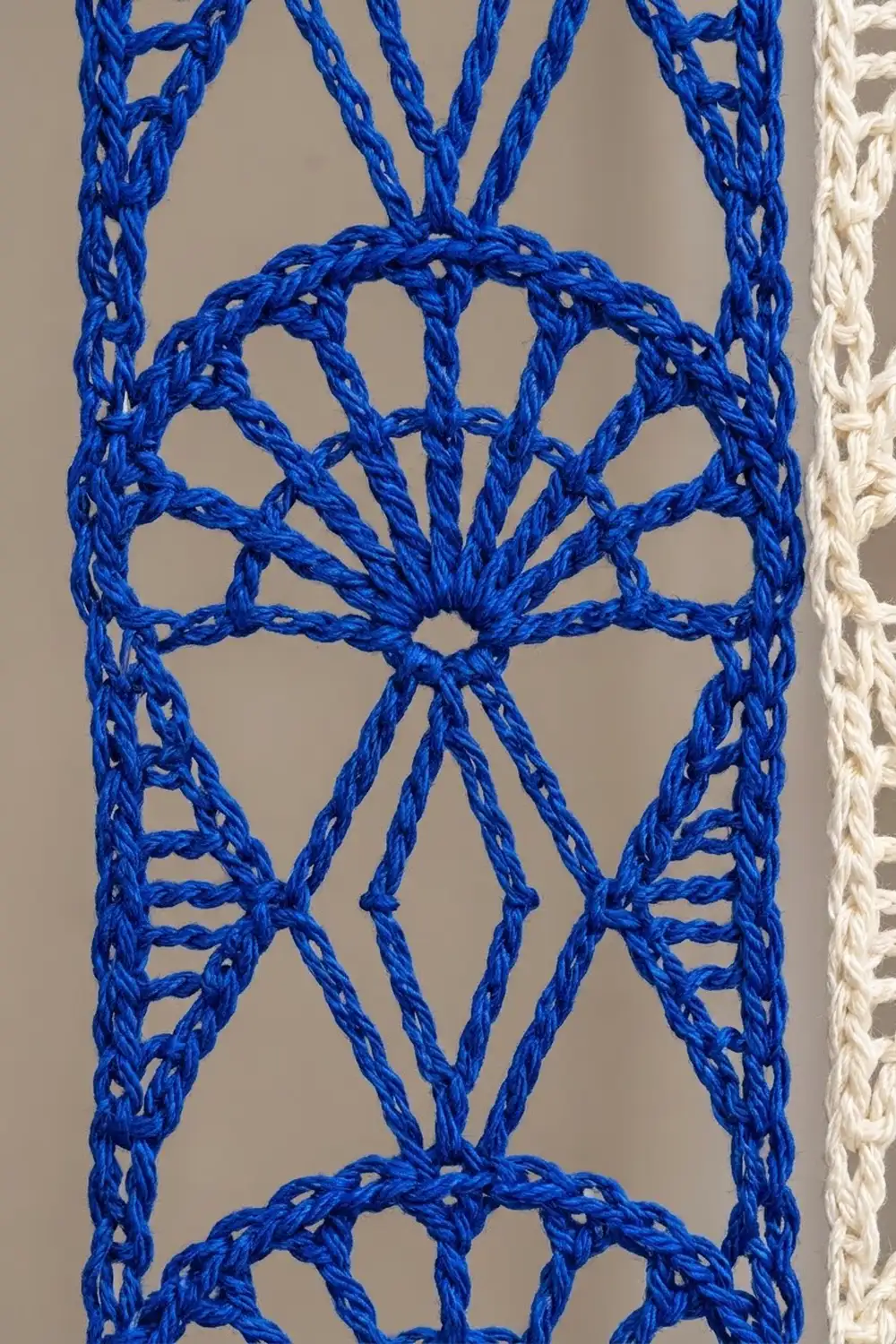
This curtain is made of seven tall, narrow lace strips that hang side by side from a rod. Each strip repeats one simple idea along its length: a half-circle fan of seven long spokes, capped by a solid band, followed by an open lattice panel with a center diamond. The strips are never joined to each other, so they move like a beaded curtain and you can walk straight through them.
The colorway alternates cobalt blue and cream: four blue strips and three cream strips, starting and ending with blue. The look is crisp and graphic, a little Art Deco and a little coastal, and it lets light through without fully closing off the doorway.
All instructions use US crochet terms. Each finished strip measures 6 in (15.2 cm) wide and 77.4 in (196.6 cm) long including the border, plus a 3 in (7.6 cm) folded tab loop at the top. Hung with 0.5 in (1.3 cm) gaps, the full curtain spans 45 in (114.3 cm).
Each strip is worked flat in rows from the bottom up on a 25-stitch base. You work 20 fan-and-diamond repeats, add a two-round border, then work a tab at the top and fold it into a rod loop.
Finished Size and Construction
- Strip size (finished, with border): 6 in x 77.4 in (15.2 cm x 196.6 cm)
- Hanging drop with tab loop: 80.4 in (204.2 cm)
- Skill level: Intermediate (easy stitches, careful counting)
- Terminology: US
- Yarn weight: Sport / fine (#2) cotton
- Hook: 3.5 mm (US E-4)
- Number of pieces: 7 strips (4 blue, 3 cream), not joined
- Layout: 7 strips in one row, Blue-Cream-Blue-Cream-Blue-Cream-Blue
- Strip body size (before border): 5 in x 76.4 in (12.7 cm x 194.1 cm)
- Border depth: 0.5 in (1.3 cm) on every side
- Full curtain width: 45 in (114.3 cm) with 0.5 in (1.3 cm) gaps
Materials
Use a smooth mercerized or combed cotton in sport weight, about 150 m (164 yd) per 50 g. Cotton gives crisp spokes and holds its shape when hanging. Avoid fuzzy or very stretchy yarns, which blur the lattice and grow in length.
- Color A, cobalt blue: 500 g, about 1,500 m (1,640 yd), for 4 strips
- Color B, cream: 400 g, about 1,200 m (1,312 yd), for 3 strips
Each strip uses roughly 110 g. The quantities above include a margin of about 10 to 20 percent for your gauge swatch, tabs, and weaving in.
Tools:
- 3.5 mm (US E-4) crochet hook
- Tapestry needle
- Stitch markers (at least 4)
- Measuring tape
- Rustproof pins and a long blocking surface (foam mats or a clean carpet with a towel)
- Curtain rod up to 1.25 in (3.2 cm) in diameter
Abbreviations (US Terms)
- ch – chain
- sl st – slip stitch
- sc – single crochet
- dc – double crochet
- tr – treble crochet (yarn over twice)
- sk – skip
- sp(s) – space(s)
- st(s) – stitch(es)
- rnd – round
- RS / WS – right side / wrong side
Special stitch – reverse sc (crab stitch): Work from left to right (if you are right-handed). Insert the hook into the next stitch to the right, yarn over, pull up a loop, yarn over, and pull through both loops.
Position counting: Every row in this pattern spans 25 positions. Each stitch or chain counts as one position. Turning ch 3 counts as a dc; turning ch 4 counts as a tr.
Gauge and Checkpoints
Gauge: 20 dc and 10 dc rows = 4 in (10.2 cm). One dc row = 0.4 in (1.0 cm). One tr row = 0.6 in (1.5 cm). In sc, 20 sc = 4 in (10.2 cm) and 4 sc rows = 1 in (2.5 cm).
Make one full strip before you wind all your yarn. It is your real gauge test.
Checkpoints (measure flat, unstretched):
- After Row 1: width 5 in (12.7 cm).
- After the first repeat (Row 8): height 4.2 in (10.7 cm).
- After 5 repeats: 19.4 in (49.3 cm).
- After 10 repeats: 38.4 in (97.5 cm).
- After 20 repeats: 76.4 in (194.1 cm).
- After the border: 6 in x 77.4 in (15.2 cm x 196.6 cm).
If too big: go down to a 3.25 mm hook. If too small: go up to a 3.75 mm hook. If only the length is off, check your tr height first: pull the first loop up to full height before you finish each tr.
Strip Pattern
Each repeat is 7 rows: Row 2 to Row 8. Rows 2, 3, 5, 6, and 7 are tr rows. Rows 4 and 8 are solid dc rows.
Foundation: Ch 27.
Row 1 (RS): Dc in 4th ch from hook (skipped 3 ch count as first dc), dc in each ch across, turn. (25 dc)
Fan Section
Row 2 (fan base): Ch 4 (counts as tr), tr in next st, ch 4, sk next 10 sts, in next st (the center, st 13) work (tr, ch 1) 6 times, then tr in same st; ch 4, sk next 10 sts, tr in last 2 sts, turn. (11 tr: 2 at each edge plus 7 spokes; 6 ch-1 sps; 2 ch-4 sps; 25 positions)
The two ch-4 bridges leave open spaces on each side of the fan, and the 7 tr worked into one stitch form the spokes.
Row 3 (fan spread): Ch 4, tr in next tr, ch 1, sk ch-4 sp, tr in first spoke tr, (ch 2, tr in next spoke tr) 6 times, ch 1, sk ch-4 sp, tr in next tr, tr in top of turning ch, turn. (11 tr; 6 ch-2 sps; 2 ch-1 sps; 25 positions)
Row 4 (fan band): Ch 3 (counts as dc), dc in next tr, dc in ch-1 sp, dc in first spoke tr, (2 dc in next ch-2 sp, dc in next spoke tr) 6 times, dc in ch-1 sp, dc in next tr, dc in top of turning ch, turn. (25 dc)
Check: 2 + 1 + 1 + (6 x 3) + 1 + 2 = 25.
Diamond Section
Row 5 (diamond base): Ch 4, tr in next st, ch 4, sk 4 sts, tr in next st (st 7), ch 5, sk 5 sts, tr in next st (st 13), ch 5, sk 5 sts, tr in next st (st 19), ch 4, sk 4 sts, tr in last 2 sts, turn. (7 tr; 2 ch-4 sps; 2 ch-5 sps; 25 positions)
Row 6 (diamond opens): Ch 4, tr in next tr, ch 4, tr in next tr (st 7), ch 2, tr in 3rd ch of next ch-5 (st 10), ch 5, sk center tr, tr in 3rd ch of next ch-5 (st 16), ch 2, tr in next tr (st 19), ch 4, tr in next tr, tr in top of turning ch, turn. (8 tr; 2 ch-4 sps; 2 ch-2 sps; 1 ch-5 sp; 25 positions)
The center post from Row 5 splits into two posts here, forming the lower half of the diamond.
Row 7 (diamond closes): Ch 4, tr in next tr, ch 4, tr in next tr (st 7), ch 5, tr in 3rd ch of center ch-5 (st 13), ch 5, sk to the next post, tr in that post (st 19), ch 4, tr in next tr, tr in top of turning ch, turn. (7 tr; 2 ch-4 sps; 2 ch-5 sps; 25 positions)
The two posts meet again at st 13, closing the diamond. The posts at st 7 and st 19 frame the long side panels.
Row 8 (closing band): Ch 3, dc in next tr, 4 dc in ch-4 sp, dc in next tr, 5 dc in ch-5 sp, dc in next tr, 5 dc in ch-5 sp, dc in next tr, 4 dc in ch-4 sp, dc in next tr, dc in top of turning ch, turn. (25 dc)
Check: 2 + 4 + 1 + 5 + 1 + 5 + 1 + 4 + 2 = 25.
Repeat Rows 2 to 8 until you have 20 repeats in total. The last row is a Row 8. Total: 141 rows (1 + 20 x 7).
Height per repeat: 5 tr rows x 0.6 in + 2 dc rows x 0.4 in = 3.8 in (9.7 cm). Body length: 0.4 in + 20 x 3.8 in = 76.4 in (194.1 cm).
Do not fasten off. Continue to the border.
Make All Pieces
- Color A, cobalt blue: 4 strips
- Color B, cream: 3 strips
Every strip uses the same 141 rows, border and tab. Label each finished strip with a safety pin noting its color.
Layout (front view, left to right):
[ A ] [ B ] [ A ] [ B ] [ A ] [ B ] [ A ]
 blue cream blue cream blue cream blue
Joining (Hanging Layout)
The strips are not joined to each other. Each one hangs from its own tab loop, which is what lets the curtain part when you walk through it.
Spacing logic: 7 strips x 6 in = 42 in (106.7 cm). Add 6 gaps x 0.5 in (1.3 cm) = 3 in (7.6 cm). Total width: 45 in (114.3 cm). For a narrower doorway, slide the tabs together until the borders just touch: 42 in (106.7 cm).
Tension advice: Keep the same tension on every strip so all seven hang at the same length. Strips worked tightly will hang short and look stiff.
Size checkpoint: Before hanging, lay all seven strips side by side. Their lengths should match within 0.5 in (1.3 cm). If one is longer, re-block it slightly shorter while damp.
Border
Border gauge: 20 sc = 4 in (10.2 cm), the same as the dc gauge, so the border lies flat without ruffling or pulling.
Row-end rule along the long sides: 2 sc into each dc row-end and 3 sc into each tr row-end. This matches the row heights: 0.4 in x 5 sc per in = 2 sc, and 0.6 in x 5 sc per in = 3 sc.
Rnd 1 (sc): After finishing the last row, ch 1 and do not turn.
- Top edge: 3 sc in first st (corner), sc in next 23 sts, 3 sc in last st (corner). (29 sc)
- Long side 1: Work down the row-ends. For each of the 20 repeats, work 3 sc in each tr row-end and 2 sc in each dc row-end. Then work 2 sc in the Row 1 row-end. (382 sc)
- Bottom edge: Working into the foundation ch, 3 sc in first ch (corner), sc in next 23 ch, 3 sc in last ch (corner). (29 sc)
- Long side 2: Work up the row-ends the same way. (382 sc)
Join with sl st to first sc. (822 sc)
Long-side check: 2 (Row 1) + 20 repeats x (5 x 3 + 2 x 2) = 2 + 20 x 19 = 382 sc. That equals 76.4 in x 5 sc per in.
Round total as a conversion: 50 sts worked 1 per existing st (25 top + 25 bottom) + 764 row-end sc + 8 extra corner sc (2 extra at each of 4 corners) = 822.
Rnd 2 (reverse sc): Ch 1, reverse sc in each sc around. Join with sl st. (822 reverse sc) Fasten off and weave in ends.
Why the math works: The short sides keep 25 stitches, the same as the body. On the long sides, the number of sc matches the row heights at 5 sc per in. Each round adds about 0.25 in (0.6 cm), for 0.5 in (1.3 cm) per side. Width: 5 + 0.5 + 0.5 = 6 in (15.2 cm). Length: 76.4 + 0.5 + 0.5 = 77.4 in (196.6 cm).
Hanging Tab
Turn the strip to the WS with the top edge up. On the top edge, divide the 23 sc between the corner groups into 7 + 9 + 7. Join yarn in the back bump of the 8th of these 23 sc.
Tab Row 1: Ch 1, sc in the back bump of the same st and the next 8 sts, turn. (9 sc)
Tab Rows 2 to 24: Ch 1, sc in each sc across, turn. (9 sc)
The tab measures 1.8 in (4.6 cm) wide and 6 in (15.2 cm) long. Fold it to the WS and whipstitch the last row to the WS of Row 141, directly below the tab base. This forms a 3 in (7.6 cm) loop that fits a rod up to 1.25 in (3.2 cm) in diameter.
Final Blocking
- Soak each strip in cool water for 10 minutes.
- Press out the water by rolling the strip in a towel. Do not wring.
- Lay the strip flat and pin the corners to 6 in (15.2 cm) wide.
- Pin the long sides straight to a length of 77.4 in (196.6 cm).
- Open every fan: pull the 7 spokes into an even half circle and pin the band row straight.
- Pin the center diamond open and straighten the posts at st 7 and st 19.
- Leave the tab unpinned so it dries soft.
- Let it dry fully, then unpin. Repeat for all 7 strips.
Final Quality-Control Checklist
- Every row has 25 positions; Rows 1, 4, and 8 have 25 dc.
- Every strip has 20 complete fan-and-diamond repeats (141 rows).
- Each fan shows 7 evenly spaced spokes from one center stitch.
- Each diamond splits from st 13 and closes back on it.
- Border Rnd 1 and Rnd 2 each have 822 sts.
- Width is 6 in (15.2 cm); length is 77.4 in (196.6 cm).
- Tab is 9 sc wide, centered, and securely sewn.
- You have 4 blue and 3 cream strips.
- All ends are woven in at least 2 in (5.1 cm).
Troubleshooting
- Fan cups or ruffles: Your ch-2 spaces in Row 3 are too loose. Chain more firmly.
- Edges pull in at the ch-4 bridges: Chain more loosely there, or work those chains with a hook one size up.
- Diamond looks lopsided: Check that the Row 6 tr go into the 3rd ch of each ch-5, not the 2nd or 4th.
- Strip ruffles along the sides: There are too many sc in the border. Recount: 2 per dc row and 3 per tr row.
- Border ruffles at the corners: Use exactly 3 sc per corner.
- Strips hang at different lengths: Re-block the long ones while damp and let them dry flat.
- Tab twists on the rod: Make sure it is centered on the 9 middle sc and sewn straight.
Care
Hand wash in cool water with mild soap and dry flat so the length stays true. Do not hang the strips wet, or the weight of the water will stretch them.

Final Notes
Here is the full measurement chain. A gauge of 20 sts per 4 in (10.2 cm) gives a 25-st body 5 in (12.7 cm) wide. Each 7-row repeat adds 3.8 in (9.7 cm), and Row 1 plus 20 repeats make 76.4 in (194.1 cm). The two-round border adds 0.5 in (1.3 cm) per side, for 6 in x 77.4 in (15.2 cm x 196.6 cm), and the tab adds a 3 in (7.6 cm) loop. Check each stage, and all seven strips will hang evenly in your doorway.
Happy crocheting!