

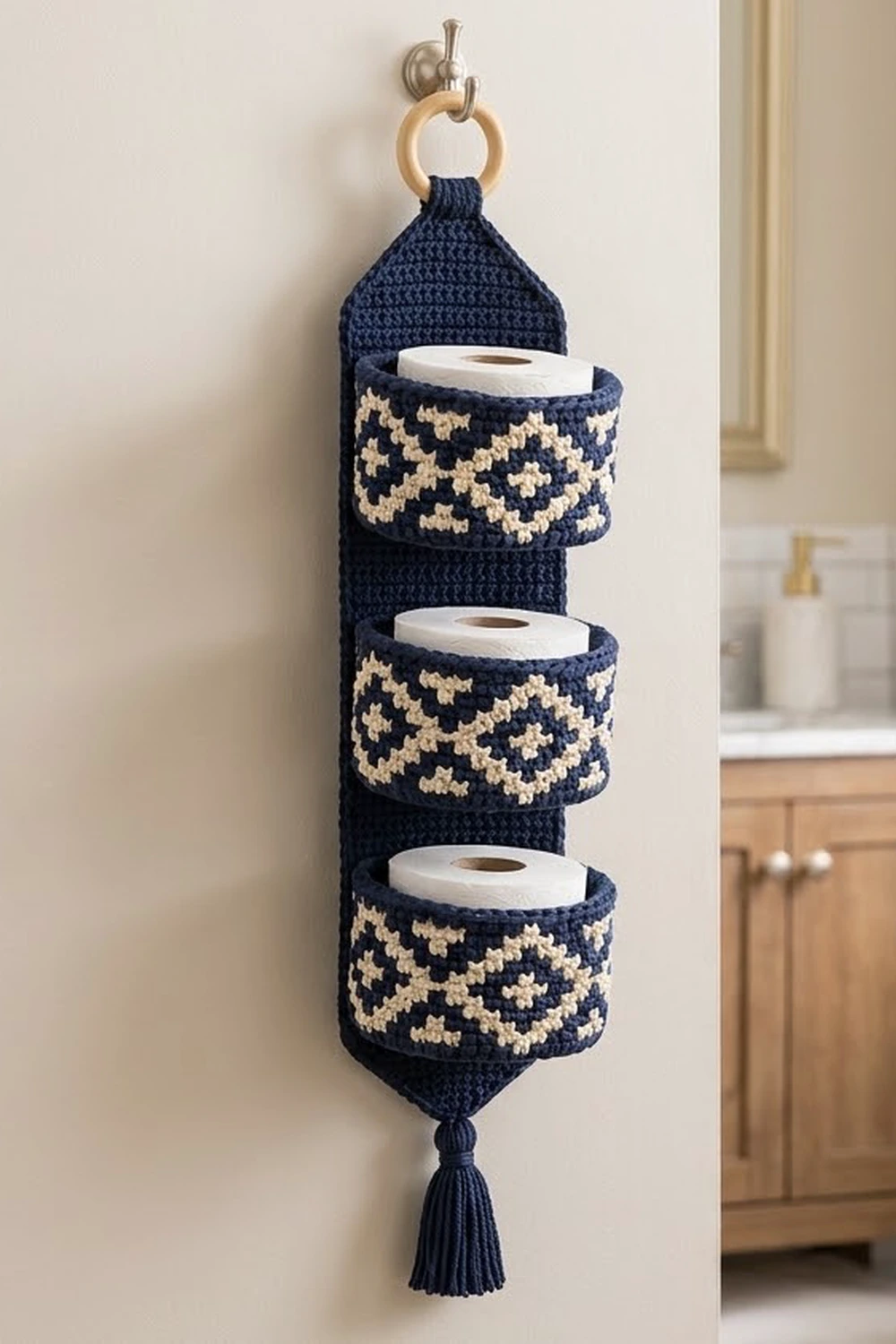
This hanging organizer stores three spare rolls in a stack of oval baskets on a slim navy backing panel. A wooden ring at the top hangs it from a hook, and a tassel finishes the bottom point.
The palette is deep navy and soft cream. Each basket wall has a band of tapestry-crochet diamonds with a small cream cross at the center of each one, which gives the piece a Nordic, knit-sweater look. The bases, panel, rims and tassel are solid navy, so the diamond bands stand out.
The pattern uses US crochet terms. Hung up, the holder measures about 5.7 in (14.5 cm) wide at the panel and 20 in (50.8 cm) long from the top of the ring tab to the bottom point. The tassel adds 4 in (10.2 cm). Each basket is 6.25 in (15.9 cm) wide and 3.75 in (9.5 cm) tall.
Construction is simple. You make three oval baskets from the base up, turn the walls with a back-loop round, and work the diamond band in tapestry single crochet. Next you work the backing panel in rows from the bottom point to the top tab and add a two-round border. Last, you sew the baskets on, fold the tab around the ring and attach the tassel.
Finished Size and Construction
- Finished size: 5.7 in (14.5 cm) wide panel × 20 in (50.8 cm) hanging length, plus a 4 in (10.2 cm) tassel
- Skill level: Intermediate (tapestry crochet, shaping)
- Terminology: US
- Yarn weight: Worsted (#4), cotton or cotton blend
- Hook: 4.0 mm (G-6)
- Number of pieces: 3 baskets, 1 backing panel, 1 tassel, plus 1 wooden ring
- Layout: 1 column of 3 baskets, stacked vertically on the panel
- Basket size: base 6.25 × 4.75 in (15.9 × 12.1 cm); wall height 3.75 in (9.5 cm)
- Panel size before border: 4.9 in (12.4 cm) wide × 20.9 in (53.1 cm) long, tab unfolded
- Border depth: 0.4 in (1.0 cm) per edge
Materials
Use a smooth, firm worsted cotton. Cotton holds the basket shape and shows the tapestry pattern clearly. Soft acrylic will give floppy walls.
- Navy: 250 g, about 425 m (465 yd)
- Cream: 75 g, about 128 m (140 yd)
These quantities include a margin of roughly 15–20% for gauge swatches and differences in tension.
Tools:
– 4.0 mm (G-6) crochet hook
– Wooden ring, 2 in (5.1 cm) outer diameter
– Stitch markers (at least 4)
– Tapestry needle
– Scissors
– Stiff card, 4.5 in (11.4 cm) tall, for the tassel
– Blocking pins and a spray bottle
Abbreviations (US Terms)
- ch: chain
- sc: single crochet
- sc2tog: single crochet 2 together
- BLO: back loop only
- rev sc: reverse single crochet (crab stitch)
- sl st: slip stitch
- st(s): stitch(es)
- rnd(s): round(s)
- N / C: navy / cream
Tapestry sc: Work sc while laying the unused color along the tops of the stitches below, so it is enclosed inside each new stitch. To change color, work the last yarn over of the previous stitch with the new color. Carry both colors all the way around every chart round.
Rev sc: Work sc from left to right (right-handed). Insert the hook into the next stitch to the right, pull up a loop, yarn over and pull through both loops. This makes the rope-like rim.
Gauge and Checkpoints
Gauge: 18 sc and 18 rows = 4 in (10.2 cm), which is 4.5 sts and 4.5 rows per inch. The square gauge matters: the oval base lies flat, and the border can work 1 sc into each row-end.
Make one full basket before starting the others, and measure it at each stage:
- After base Rnd 11: 6.25 × 4.75 in (15.9 × 12.1 cm), lying flat
- Wall circumference: 78 sts = 17.3 in (43.9 cm)
- Finished wall height: 3.75 in (9.5 cm)
- Panel width: 22 sts = 4.9 in (12.4 cm)
If your piece is too big, go down 0.5 mm in hook size. If it is too small, go up 0.5 mm. Tapestry rounds often come out tighter than plain rounds. If the diamond band pulls in, switch to a hook 0.25–0.5 mm larger for those rounds only.
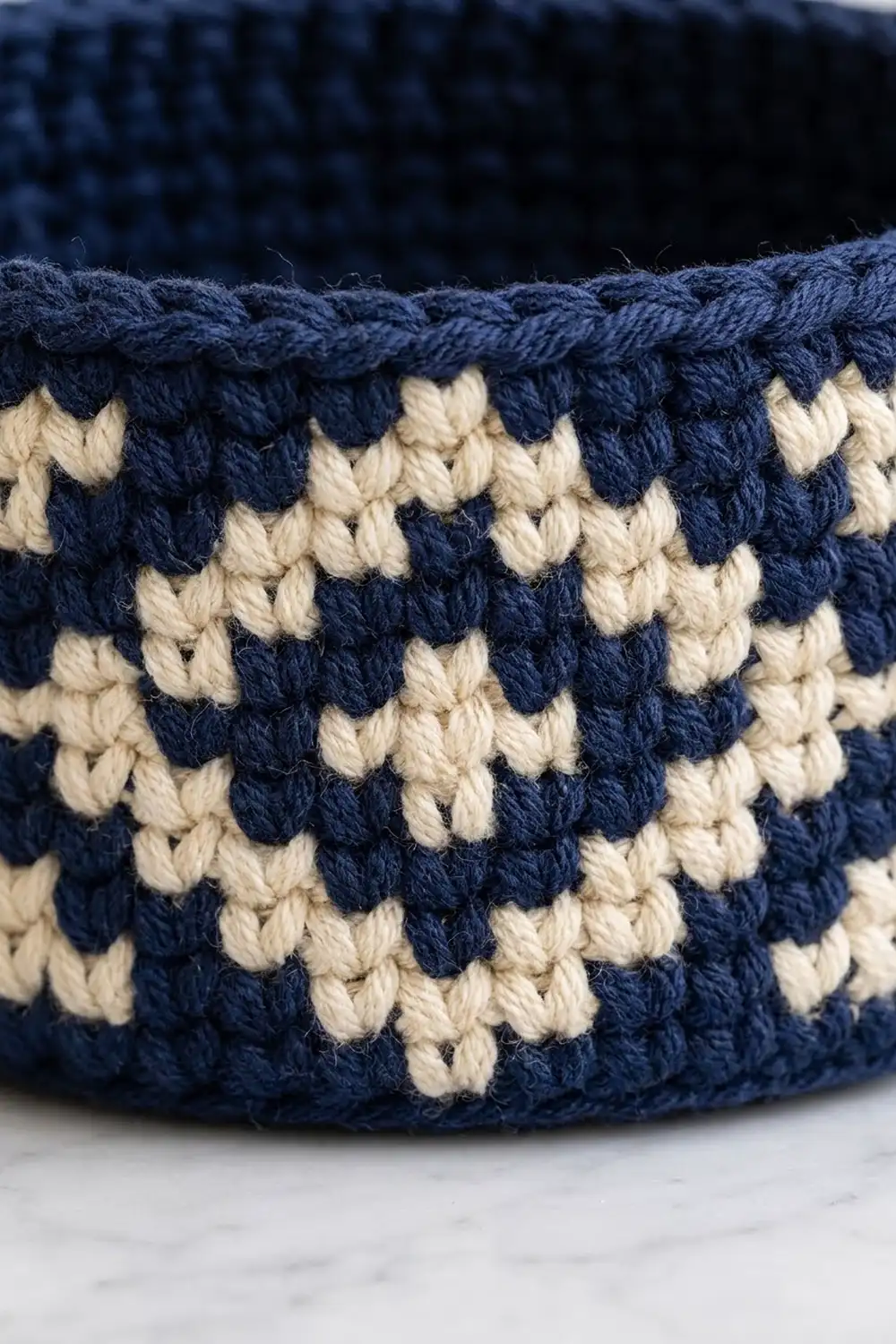
Basket (Make 3)
Oval Base
Use navy. Work in continuous rounds without joining, and move a marker up to the first stitch of each round.
Rnd 1: Ch 9. Work 3 sc in the 2nd ch from hook (End A), sc in each of the next 6 ch, 3 sc in the last ch (End B). Rotate the work and sc in each of the next 6 ch along the underside. (18 sts)
The base is now made of 4 sections: End A, a straight side, End B, and a second straight side. The straight sides stay at 6 sts each in every round.
Rnd 2: [2 sc in each of next 3 sts, sc in next 6] 2 times. (24 sts)
Rnd 3: [(2 sc in next st, sc in next st) 3 times, sc in next 6] 2 times. (30 sts)
Rnds 4–11: In every round, each end grows by 3 sts. For Rnd n: [(2 sc in next st, sc in next (n − 2) sts) 3 times, sc in next 6] 2 times. The total for Rnd n is 6n + 12.
- Rnd 4: (36 sts)
- Rnd 5: (42 sts)
- Rnd 6: (48 sts)
- Rnd 7: (54 sts)
- Rnd 8: (60 sts)
- Rnd 9: (66 sts)
- Rnd 10: (72 sts)
- Rnd 11: (78 sts)
In Rnd 11, each end has 33 sts and each straight side has 6 sts: 33 + 6 + 33 + 6 = 78.
Checkpoint: The base measures 6.25 × 4.75 in (15.9 × 12.1 cm). Sl st to the first st to join.
Mark the back: Place a marker in sts 65 and 8 of Rnd 11. The 22 sts from st 65 to st 78, then on to st 8, form the back. That is the last 8 sts of End B, the second straight side (sts 73–78) and the first 8 sts of End A. This section will sit flat against the panel, so the joining jog of the walls stays hidden.
Walls
Work in joined rounds. Ch 1 at the start of each round does not count as a stitch. Join each round with a sl st to the first st, using the color the next round starts with.
Rnd 12 (turning round): Ch 1, sc in BLO of each st around. (78 sts) This makes the crisp ridge where the base meets the wall.
Rnds 13–14: Ch 1, sc in each st around. (78 sts)
Join cream and start carrying it.
Rnds 15–25 (diamond band): Work tapestry sc. Each round repeats a 13-st section 6 times (6 × 13 = 78).
- Rnd 15: *6 N, 1 C, 6 N; rep from * around.
- Rnd 16: *5 N, 1 C, 1 N, 1 C, 5 N; rep from * around.
- Rnd 17: *4 N, 1 C, 3 N, 1 C, 4 N; rep from * around.
- Rnd 18: *3 N, 1 C, 5 N, 1 C, 3 N; rep from * around.
- Rnd 19: *2 N, 1 C, 3 N, 1 C, 3 N, 1 C, 2 N; rep from * around.
- Rnd 20: *1 N, 1 C, 3 N, 3 C, 3 N, 1 C, 1 N; rep from * around.
- Rnd 21: Repeat Rnd 19.
- Rnd 22: Repeat Rnd 18.
- Rnd 23: Repeat Rnd 17.
- Rnd 24: Repeat Rnd 16.
- Rnd 25: Repeat Rnd 15.
Each round has 78 sts. Rnds 19–21 build the small cream cross at the center of each diamond outline. Cut cream, leaving a 6 in (15.2 cm) tail.
Rnds 26–27: With navy, ch 1, sc in each st around. (78 sts)
Rnd 28: Ch 1, rev sc in each st around. (78 sts) Fasten off and weave in the ends.
Checkpoint: The wall is 17 rounds tall (Rnds 12–28), which comes to 3.75 in (9.5 cm).
Backing Panel
Work in navy, in rows, from the bottom point up. Ch 1 at the start of each row does not count as a stitch. Turn at the end of every row.
Bottom Point
Row 1: Ch 3, sc in the 2nd ch from hook and in the next ch. (2 sts)
Rows 2–11: Ch 1, 2 sc in the first st, sc across to the last st, 2 sc in the last st. Row n has 2n sts.
- Row 2: (4 sts)
- Row 6: (12 sts)
- Row 11: (22 sts)
Checkpoint: The point is 2.4 in (6.1 cm) tall and 4.9 in (12.4 cm) wide at Row 11.
Straight Section
Rows 12–74: Ch 1, sc in each st across. (22 sts) These 63 rows measure 14 in (35.6 cm).
Top Taper
Rows 75–82: Ch 1, sc2tog, sc across to the last 2 sts, sc2tog. Each row loses 2 sts.
- Row 75: (20 sts)
- Row 78: (14 sts)
- Row 82: (6 sts)
The taper is 1.8 in (4.6 cm) tall.
Ring Tab
Rows 83–94: Ch 1, sc in each st across. (6 sts) The tab is 2.7 in (6.9 cm) long. Do not fasten off; go straight into the border.
Checkpoint: The panel before the border is 94 rows, 20.9 in (53.1 cm) long.
Make All Pieces
- Baskets: 3, each using about 40 g navy and 20 g cream
- Panel: 1, about 60 g navy including the border
- Tassel: 1, about 10 g navy
Layout grid (front view, top to bottom):
      [ ring ]
      [ tab  ]
      [taper ]
Rows 71–74   panel only (top margin)
Rows 54–70   [ BASKET 3 ]
Rows 51–53   gap
Rows 34–50   [ BASKET 2 ]
Rows 31–33   gap
Rows 14–30   [ BASKET 1 ]
Rows 12–13   panel only (bottom margin)
      [point ]
      [tassel]
Check the rows: 2 + 17 + 3 + 17 + 3 + 17 + 4 = 63 rows, which is exactly the straight section. Each basket wall is 17 rounds tall and covers 17 panel rows. The gaps are 0.75 in (1.9 cm) each.
Joining
Method: Whipstitch with navy yarn and a tapestry needle, working through the basket’s back wall and into the panel fabric.
Stitch-to-stitch logic: The marked back section of each basket is 22 sts wide. That matches the panel’s 22 sts across, so you sew 1 basket stitch to 1 panel column.
- Lay the panel flat, right side up. Pin Basket 1 so the back-loop ridge (Rnd 12) lines up with panel Row 14, and the rev sc rim lines up with Row 30.
- Sew the base edge first. Whipstitch each of the 22 back stitches of Rnd 12 to the matching panel column along Row 14.
- Sew the rim. Tack each of the 22 back rim stitches to Row 30.
- Sew the 2 vertical side lines, at the marked sts 65 and 8. Make 1 whipstitch per wall round, 17 stitches on each side.
- Repeat with Basket 2 (Rows 34–50) and Basket 3 (Rows 54–70).
Tension: Pull each stitch snug but not tight. If the panel puckers, the stitches are too tight. If the basket sags away from the panel, add a second pass along the rim.
Size checkpoint: The front curve of each basket (56 sts) stands out from the panel. With the back flattened, each basket should measure 6.25 in (15.9 cm) across.
Border
Border gauge: 1 sc per row-end along the panel’s edges. Because the gauge is square (4.5 sts and 4.5 rows per inch), 1 sc per row-end keeps the edges flat with no ruffling or pulling.
Work the border before attaching the baskets, starting from the last stitch of Row 94.
Rnd 1: Ch 1, then work sc around the whole panel:
| Section | Stitches |
|---|---|
| Tab top (Row 94): 2 sc in first st, sc in next 4, 2 sc in last st | 8 |
| Right tab side (Rows 94–83, row-ends) | 12 |
| Right taper (Rows 82–75) | 8 |
| Right straight side (Rows 74–12) | 63 |
| Right bottom slope (Rows 11–2) | 10 |
| Bottom tip (Row 1): 2 sc in each of the 2 sts | 4 |
| Left bottom slope (Rows 2–11) | 10 |
| Left straight side (Rows 12–74) | 63 |
| Left taper (Rows 75–82) | 8 |
| Left tab side (Rows 83–94) | 12 |
Join with a sl st to the first sc. (198 sts)
Rnd 2: Ch 1, rev sc in each st around. (198 sts) Join and fasten off.
Why the math works: Each long side gets 1 sc per row, so 63 rows give 63 sts. The increases at the tips (4 at the bottom, 8 across the tab top) let the border turn the points without cupping. Rev sc adds no stitches, so Rnd 2 matches Rnd 1 at 198. The two rounds add 0.4 in (1.0 cm) per edge, so the panel width goes from 4.9 in (12.4 cm) to 5.7 in (14.5 cm).
Assembly Finish
- Ring: Fold the tab through the wooden ring toward the back of the panel. Sew the edge of Row 94 to the back of Row 82. The loop around the ring is about 1.3 in (3.3 cm) tall.
- Tassel: Wrap navy 40 times around the 4.5 in (11.4 cm) card. Tie the top with a 12 in (30.5 cm) strand and cut the loops at the bottom. Wrap the neck 0.5 in (1.3 cm) below the top. Trim the strands to 4 in (10.2 cm). Sew the tassel to the bottom tip.
Final Blocking
- Lightly mist the panel and each basket.
- Pin the panel flat to 5.7 × 20 in (14.5 × 50.8 cm) with the tab folded, keeping the points sharp and symmetrical.
- Stuff each basket snugly with a toilet roll or a towel so the walls dry straight.
- Let everything air-dry completely.
- Steam the tassel and comb it straight.
Final Quality-Control Checklist
- [ ] Each base has 78 sts and lies flat
- [ ] Each wall has 78 sts in every round
- [ ] Diamonds line up with no extra or missing stitches (6 repeats)
- [ ] Every wall is 3.75 in (9.5 cm) tall
- [ ] The panel is 22 sts wide and 94 rows long
- [ ] The border has 198 sts in both rounds
- [ ] The gaps between baskets are an even 0.75 in (1.9 cm)
- [ ] The ring tab is firmly sewn
- [ ] All ends are woven in
Troubleshooting
- The base ruffles: Your gauge is looser across than in height. Go down a hook size for the base.
- The base cups upward too early: Check that each end grows by 3 sts per round.
- The diamonds slant: That is normal for tapestry sc worked in the round. Rnd 12’s alignment and joined rounds keep the slant small.
- Cream shows through the navy: Keep the carried strand flat along the stitch tops and tighten your tension slightly.
- The basket is too small for the rolls: Go up a hook size, or add a plain Rnd 12a in navy before the band.
- The panel edge waves: You worked more than 1 sc per row-end. Rip back and count again.
Care
Hand wash in cool water, roll the pieces in a towel and lay them flat to dry. Reshape the baskets over a roll while they are still damp.
Final Notes
The sizes all depend on each other, in this order:
- The gauge of 18 sc and 18 rows = 4 in (10.2 cm) sets every measurement.
- Eleven base rounds give 78 sts and a base of 6.25 × 4.75 in (15.9 × 12.1 cm).
- Seventeen wall rounds give a 3.75 in (9.5 cm) wall that matches 17 panel rows.
- The panel’s 22 sts take each basket’s 22 flattened back sts, 1 to 1.
- The 63-row straight section holds three baskets, two gaps and the margins.
- The 198-st border brings the panel to 5.7 in (14.5 cm) wide.
Measure at every checkpoint and the pieces will fit together.
Happy crocheting!