

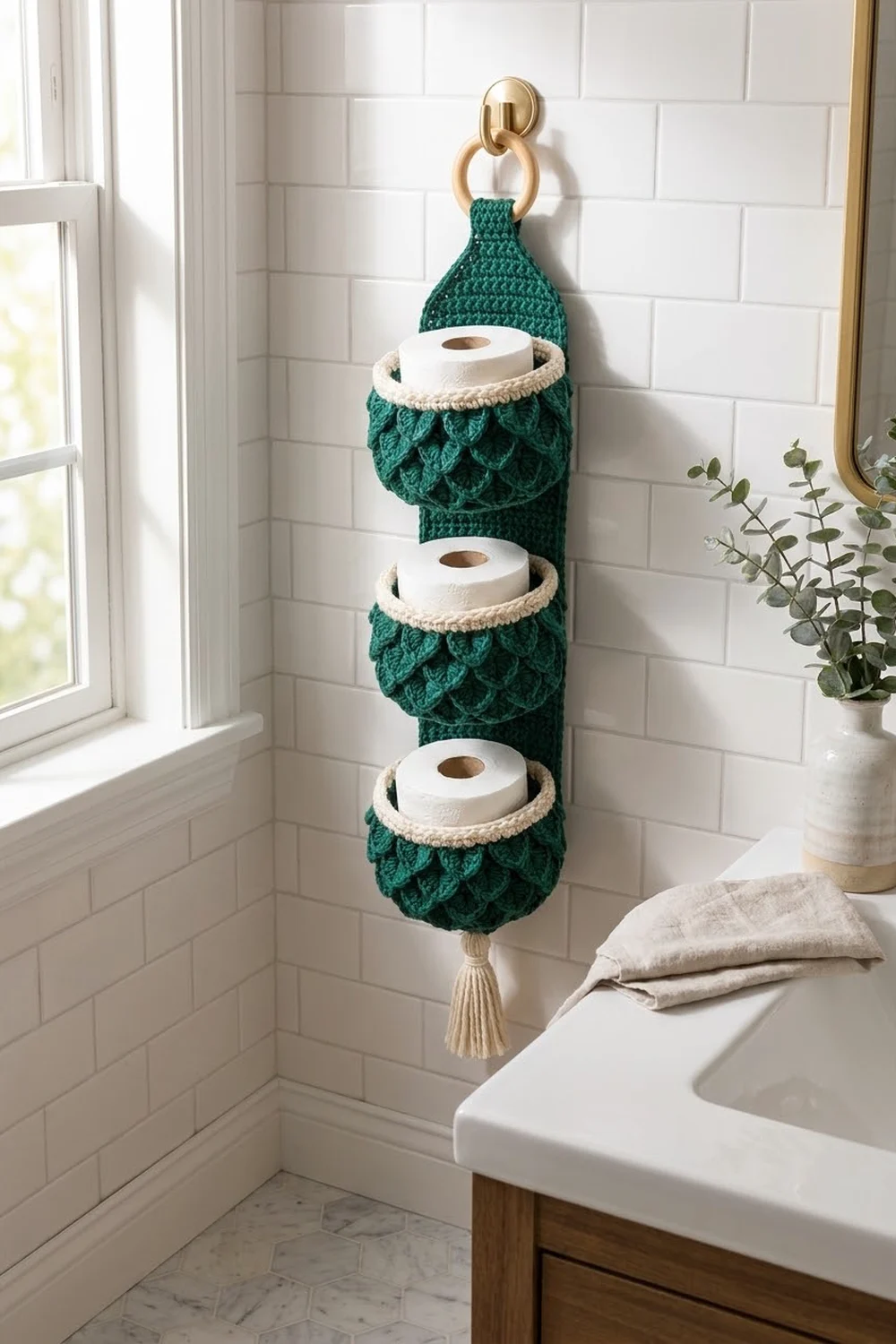
This hanging holder keeps three spare toilet rolls tidy and in easy reach. It is made from three textured pockets stacked on a long backing strip. A wooden ring at the top hangs it on a hook, and a cream tassel finishes the bottom.
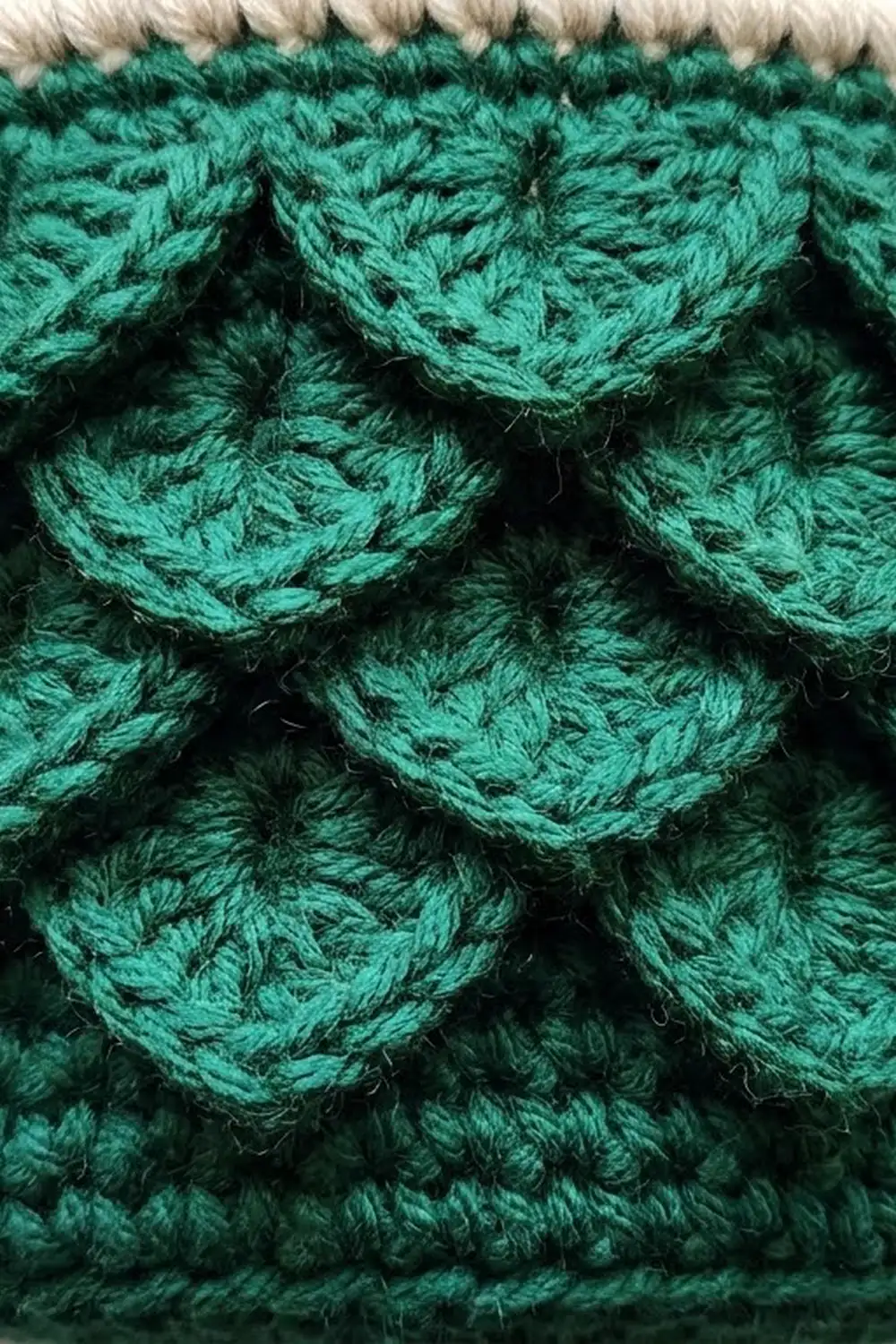
Each pocket starts with a flat oval base in deep emerald green. The wall is covered in three tiers of crocodile-stitch scales and finished with a cream rim that looks like a cord. The two colors give a calm, spa-like look that works in modern or boho bathrooms.
The pattern uses US crochet terms. The holder measures about 7.25 in (18.4 cm) across at the pockets. The backing strip hangs about 19.5 in (49.5 cm), and the whole piece is roughly 26 in (66.0 cm) long including the ring and tassel.
Construction overview: each pocket is worked in the round in one piece, from the oval base up through the scale wall to the cream rim. The backing strip is worked in rows from the bottom tab to the top tab. You then sew the pockets to the strip, fold the top tab around the ring and tie on the tassel.
Finished Size and Construction
- Finished size: about 7.25 in (18.4 cm) wide x 26 in (66.0 cm) long overall
- Skill level: Intermediate (crocodile stitch, oval base, seaming)
- Terminology: US crochet terms
- Yarn weight: worsted (#4) cotton or cotton blend
- Hook: 5.0 mm (H-8)
- Number of pieces: 3 pockets, 1 backing strip, 1 tassel, plus 1 wooden ring
- Layout: 3 pockets stacked vertically on 1 strip, 1 x 3
- Pocket size: base 7.25 x 4.5 in (18.4 x 11.4 cm); height 4 in (10.2 cm)
- Pocket height before rim: 3.25 in (8.3 cm)
- Rim depth: 0.75 in (1.9 cm)
- Backing strip: 4 in (10.2 cm) wide x 21 in (53.3 cm) long before folding
Materials
Choose a firm, smooth worsted cotton. It holds the scales crisply, stands up to bathroom humidity and washes well. Avoid splitty or very soft yarns, because the scales will droop.
- Color A, emerald green: 250 g, about 425 m
- Color B, cream: 60 g, about 100 m
Both quantities include a margin of roughly 15 to 20 percent. Crocodile stitch uses a lot of yarn, so don’t cut it close.
Tools:
– 5.0 mm (H-8) crochet hook
– Wooden ring, 2.75 in (7.0 cm) outer diameter
– Tapestry needle
– 4 stitch markers
– Stiff card 5.5 in (14.0 cm) tall, for the tassel
– Scissors and measuring tape
– Rust-proof pins and a blocking mat
Abbreviations (US Terms)
- ch: chain
- sc: single crochet
- dc: double crochet
- sl st: slip stitch
- st(s): stitch(es)
- sk: skip
- inc: 2 sc in the same st
- dec: sc2tog
- BLO: back loop only
- rev sc: reverse single crochet (crab stitch)
- V: 2 dc in the same st or space
Scale (special stitch): rotate the work so the V’s posts lie sideways. Work 5 dc around the post of the first dc of the V, from top to bottom. Ch 1, then work 5 dc around the post of the second dc, from bottom to top. That makes 10 dc and 1 ch, forming a rounded scale that hangs down over the round below.
Gauge and Checkpoints
Gauge: 14 sc and 16 rows = 4 in (10.2 cm) in single crochet.
Make one full pocket before anything else and check it at each stage:
- After Rnd 9 (base): 7.25 x 4.5 in (18.4 x 11.4 cm), lying flat.
- After Rnd 12: the wall stands 0.75 in (1.9 cm) tall.
- After Rnd 18: the wall measures 3 in (7.6 cm) from the base fold.
- After Rnd 22: total height 4 in (10.2 cm). A standard roll should drop in easily.
If too big: go down 0.5 mm in hook size. If too small: go up 0.5 mm in hook size, or the roll won’t fit. Don’t change stitch counts. Every round depends on the 72-stitch circumference.
Pocket (Make 3)
With Color A, ch 12.
Rnd 1: Sc in 2nd ch from hook and in next 9 ch (10 sc), 3 sc in last ch. Working along the opposite side of the chain, sc in next 9 ch, then 2 sc in the same ch as the first sc. Join with sl st to first sc. (24 sts: 2 straight sides of 9 sts, 2 rounded ends of 3 sts)
Ch 1 at the start of every base round. Don’t count it as a stitch.
Rnd 2: Inc, sc 9, inc 3 times, sc 9, inc 2 times; join. (30 sts)
Rnd 3: (Sc 1, inc), sc 9, (sc 1, inc) 3 times, sc 9, (sc 1, inc) 2 times; join. (36 sts)
Rnd 4: (Sc 2, inc), sc 9, (sc 2, inc) 3 times, sc 9, (sc 2, inc) 2 times; join. (42 sts)
Rnd 5: (Sc 3, inc), sc 9, (sc 3, inc) 3 times, sc 9, (sc 3, inc) 2 times; join. (48 sts)
Rnd 6: (Sc 4, inc), sc 9, (sc 4, inc) 3 times, sc 9, (sc 4, inc) 2 times; join. (54 sts)
Rnd 7: (Sc 5, inc), sc 9, (sc 5, inc) 3 times, sc 9, (sc 5, inc) 2 times; join. (60 sts)
Rnd 8: (Sc 6, inc), sc 9, (sc 6, inc) 3 times, sc 9, (sc 6, inc) 2 times; join. (66 sts)
Rnd 9: (Sc 7, inc), sc 9, (sc 7, inc) 3 times, sc 9, (sc 7, inc) 2 times; join. (72 sts)
Each round adds exactly 6 stitches, 3 at each rounded end. The two straight sides stay at 9 stitches. Check the base against Checkpoint 1.
Wall
Rnd 10: Ch 1, sc in BLO of each st around; join. (72 sts) This turns the wall up.
Rnds 11–12: Ch 1, sc in each st around; join. (72 sts)
Rnd 13 (V round): Ch 3 (counts as dc), dc in same st, ch 1, sk 2 sts. *2 dc in next st, ch 1, sk 2 sts; rep from * 22 more times; join to top of ch-3. (24 V’s) Each V uses 3 stitches (1 worked, 2 skipped), and 24 x 3 = 72.
Rnd 14 (scale round): Number the V’s 1 to 24, starting with the joined V. Work a scale over V1, starting down the ch-3 post and then up the dc post. Sl st in the center of V2. *Scale over next V, sl st in center of next V; rep from * 10 more times. The last sl st goes in the center of V24. (12 scales, 12 sl sts)
Rnd 15 (offset V round): Ch 3, dc in same sl st, ch 1. *2 dc in the center of the next scale (between its 5th and 6th dc), ch 1, 2 dc in next sl st, ch 1; rep from * around. End with 2 dc in the center of the last scale, ch 1, and join to top of ch-3. (24 V’s: 12 sitting on sl sts, 12 on scale centers)
Rnd 16 (scale round): Scale over the joined V (it sits on a sl st), then sl st in the center of the next V (it sits on a scale center). *Scale over next V, sl st in center of next V; rep from * 10 more times. (12 scales, 12 sl sts) The new scales sit halfway between the scales below, which gives the brick-staggered look.
Rnd 17: Repeat Rnd 15. (24 V’s)
Rnd 18: Repeat Rnd 16. (12 scales, 12 sl sts) Check against Checkpoint 3.
Rnd 19: Ch 1. Working behind the scales into the tops of Rnd 17, sc in each dc and each ch-1 space; join. (24 V’s x 3 = 72 sts) Fasten off Color A.
Backing Strip (Make 1)
With Color A, ch 7.
Row 1: Sc in 2nd ch from hook and in each ch across; turn. (6 sts)
Rows 2–4: Ch 1, sc across; turn. (6 sts) This is the bottom tab.
Row 5: Ch 1, inc in first st, sc 4, inc in last st; turn. (8 sts)
Row 6: Ch 1, sc across; turn. (8 sts)
Row 7: Ch 1, inc, sc 6, inc; turn. (10 sts)
Row 8: Ch 1, sc across; turn. (10 sts)
Row 9: Ch 1, inc, sc 8, inc; turn. (12 sts)
Row 10: Ch 1, sc across; turn. (12 sts)
Row 11: Ch 1, inc, sc 10, inc; turn. (14 sts)
Row 12: Ch 1, sc across; turn. (14 sts) Checkpoint: 4 in (10.2 cm) wide, 3 in (7.6 cm) long.
Rows 13–64: Ch 1, sc across; turn. (14 sts) These 52 rows make 13 in (33.0 cm) of straight body.
Row 65: Ch 1, dec, sc 10, dec; turn. (12 sts)
Row 66: Ch 1, sc across; turn. (12 sts)
Row 67: Ch 1, dec, sc 6, dec; turn. (8 sts)
Wait, that’s wrong: 12 – 2 = 10, so Row 67 is: Ch 1, dec, sc 6, dec; turn. (10 sts)
Row 68: Ch 1, sc across; turn. (10 sts)
Row 69: Ch 1, dec, sc 4, dec; turn. (8 sts)
Row 70: Ch 1, sc across; turn. (8 sts)
Row 71: Ch 1, dec, sc 2, dec; turn. (6 sts)
Row 72: Ch 1, sc across; turn. (6 sts)
Rows 73–84: Ch 1, sc across; turn. (6 sts) This is the top tab. Fasten off and leave a 12 in (30.5 cm) tail.
Checkpoint: 21 in (53.3 cm) long; tabs 1.75 in (4.4 cm) wide.
Make All Pieces
- Pockets: 3, each using about 55 g Color A and 8 g Color B
- Backing strip: 1, using about 45 g Color A
- Tassel: 1, using about 15 g Color B
Before joining, mark the pocket zones on the strip with stitch markers. Rows are counted from the bottom.
Rows 73–84  | top tab (folds around ring)
Rows 65–72  | top taper
Rows 49–64  | POCKET 3 (top)
Rows 47–48  | gap 0.5 in (1.3 cm)
Rows 31–46  | POCKET 2 (middle)
Rows 29–30  | gap 0.5 in (1.3 cm)
Rows 13–28  | POCKET 1 (bottom)
Rows 5–12   | bottom taper
Rows 1–4    | bottom tab (tassel)
Each zone is 16 rows, which at 4 rows per inch is 4 in (10.2 cm) and matches the pocket height exactly.
Cream Rim (Border)
Border gauge: the rim stays at 3.5 sts per inch, the same as the base. That gives 72 sts, or about 20.5 in (52.1 cm) around.
With Color B, work on each pocket:
Rnd 20: Join Color B at the center back of the pocket. To find it, fold the base flat and find the middle of a straight side. Ch 1, sc in each st around; join. (72 sts: 36 on the front half, 36 on the back half)
Rnd 21: Ch 1, sc in each st around; join. (72 sts: 36 front, 36 back)
Rnd 22: Ch 1, rev sc in each st around; join. (72 sts) Fasten off and weave in the ends.
Why the math works: the base ends at 72, every wall round returns to 72, and Rnd 19 converts 24 V’s back into 72 sc. So the rim starts on 72 sts and stays at 72, and it neither flares nor pulls in. Of the 36 back-half stitches, the center 14 are seamed to the strip. That’s 14 strip stitches to 14 rim stitches, one to one, with no extra stitches added.
Joining
Method: whipstitch with Color A and a tapestry needle, through both loops.
- Base seam: on Rnd 9 of a pocket, mark the center back stitch and count 7 sts to each side, for 14 sts total. Lay the pocket on the strip with its base along the bottom row of its zone. Whipstitch those 14 base stitches to the 14 stitches of that row, one to one.
- Rim seam: whipstitch the center 14 back stitches of Rnd 21 to the 14 stitches of the top row of the zone (row 28, 46 or 64).
- Side tacks: tack the pocket wall to each strip edge halfway up the zone, at row 20, 38 or 56.
Join Pocket 1 first, then Pocket 2, then Pocket 3.
Tension: pull each stitch snug but not tight. If you pull too hard, the strip puckers behind the pocket. If the stitches are too loose, the pockets tip forward when a roll goes in.
Size checkpoint: each pocket’s rim should sit level with the top of its zone, and the 0.5 in (1.3 cm) gaps should stay even.
Ring and tassel:
- Pass the top tab through the ring from front to back. Fold rows 79–84 down behind the strip and sew row 84 to row 73. This leaves a 1.5 in (3.8 cm) loop.
- Tassel: wrap Color B 30 times around the 5.5 in (14.0 cm) card. Tie the loops at the top, cut the bottom, and wrap the neck 0.75 in (1.9 cm) below the top. Trim the tassel to 5 in (12.7 cm). Sew its tie to the center of rows 1–4.
Final Blocking
- Mist the whole piece lightly with water.
- Lay the strip flat, face up, and pin it to 4 x 19.5 in (10.2 x 49.5 cm). Measure from the bottom edge to the fold at the ring.
- Stuff each pocket with a toilet roll or a rolled towel to set its oval shape.
- Press each scale gently downward with your fingers so the tiers lie evenly.
- Steam the tassel and comb it straight.
- Let everything dry completely, about 24 hours.
Final Quality-Control Checklist
- Each base measures 7.25 x 4.5 in (18.4 x 11.4 cm) and lies flat.
- Each pocket has 3 tiers of 12 scales, staggered like bricks.
- The rims are 72 stitches and 0.75 in (1.9 cm) deep, with no ruffling.
- The pockets are 4 in (10.2 cm) tall, with 0.5 in (1.3 cm) gaps between them.
- The strip is 4 in (10.2 cm) wide and its tapers are symmetrical.
- The ring loop is secure and the tassel is 5 in (12.7 cm).
- All ends are woven in at least 2 in (5.1 cm).
Troubleshooting
- Base cups or ruffles: check that you added exactly 6 stitches per round. Cupping means your tension is too tight; try a larger hook.
- Scales overlap unevenly: make sure Rnds 16 and 18 start with the joined V, so they stay offset.
- The V count is off: recount Rnd 12. It must be 72, because 72 divided by 3 gives the 24 V’s.
- The roll won’t fit: your gauge is tight. Go up a hook size and remake the pocket.
- The strip curls: block it firmly. Curling is normal with sc in cotton.
- The pockets sag: add a second tack at row 16, 34 or 52.
Care
Hand wash in cool water and lay flat to dry. Reshape the scales and pockets while the piece is damp.
Final Notes
The measurements all build on each other. A gauge of 14 sc per 4 in (10.2 cm) produces a 72-stitch base, 7.25 x 4.5 in (18.4 x 11.4 cm). The wall alternates between 72 sts and 24 V’s, so 12 scales fit every tier, and the cream rim keeps all 72. On the strip, rows match pocket heights 16 to 16, and the seams join 14 stitches to 14. If each checkpoint matches, the finished holder will hang straight, hold three rolls and look like the photo.
Happy crocheting!