

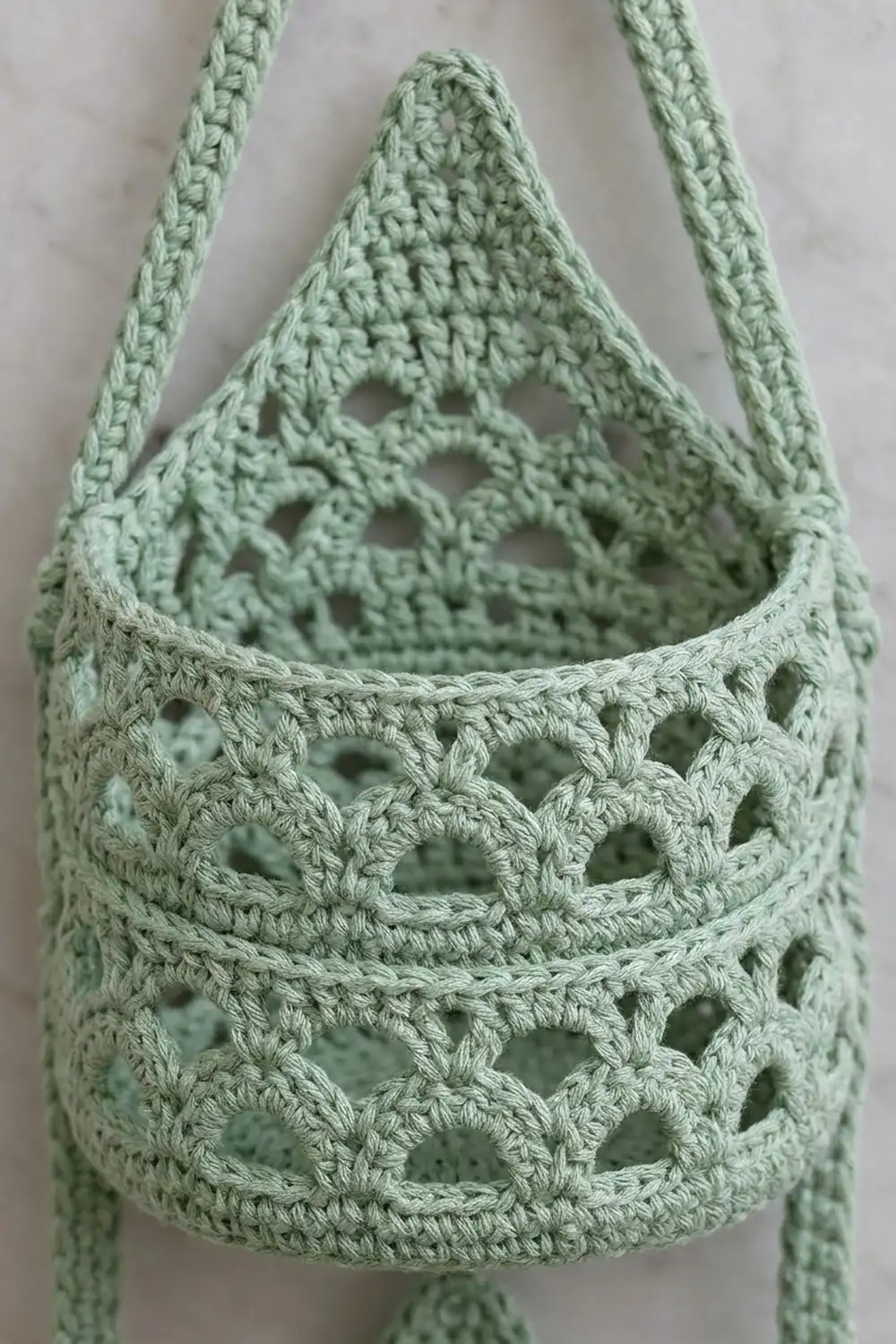
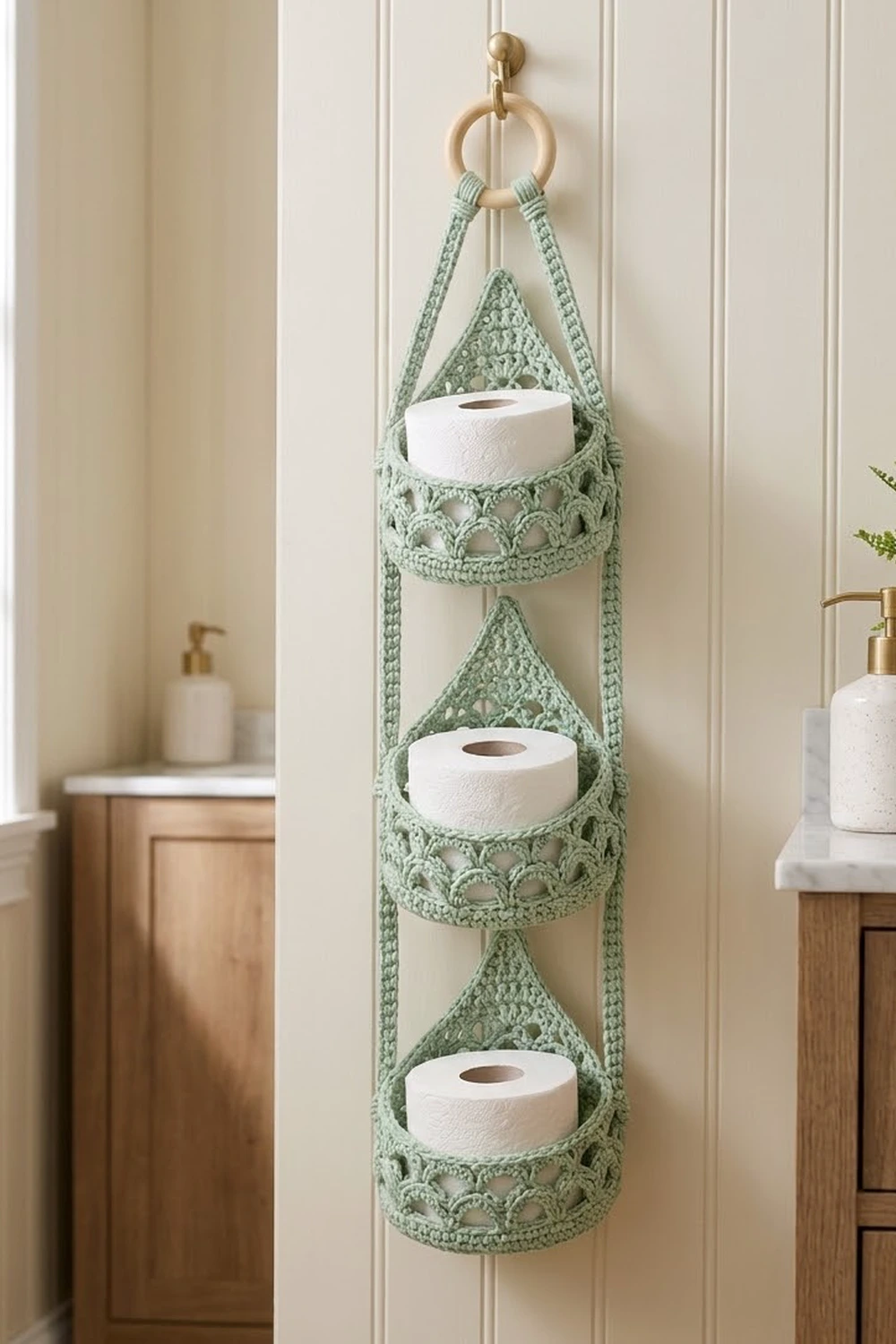
This hanging organizer stacks three small baskets on two crocheted straps that meet at a natural wooden ring. Each basket has a slightly oval base and a lacy wall with two bands of open scallop arches. A pointed teardrop back panel rises above the rim. The whole piece is one soft sage green, so the texture does the decorating.
The style is calm and a little vintage. It suits a bathroom, a laundry nook, or a craft corner. Each basket holds one standard toilet roll, and the top of the roll sits just above the rim.
The pattern uses US crochet terms. Each basket is about 5.75 in (14.6 cm) wide, 5 in (12.7 cm) deep, and 6 in (15.2 cm) tall to the tip of the back panel. The finished hanger is about 23 in (58.4 cm) long including the ring, and about 7 in (17.8 cm) wide across the straps.
Construction is simple:
– Crochet an oval base in joined rounds.
– Build the wall straight up.
– Work the back panel in rows from the back of the rim, decreasing to a point.
– Finish the opening with a two-round edging.
– Sew two flat straps to the sides of all three baskets and wrap them around the ring.
Finished Size and Construction
- Finished size (hanger): about 23 in (58.4 cm) long x 7 in (17.8 cm) wide
- Skill level: Intermediate
- Terminology: US
- Yarn weight: Worsted (#4) cotton
- Hook: 5.0 mm (H-8)
- Number of pieces: 3 baskets + 2 straps + 1 wooden ring
- Layout: 3 baskets stacked in one vertical column
- Basket size: 5.75 in (14.6 cm) wide x 5 in (12.7 cm) deep x 6 in (15.2 cm) tall
- Basket before edging: wall 3.1 in (7.9 cm) tall; panel tip about 2.7 in (6.9 cm) above the rim
- Edging depth: 2 rounds, about 0.4 in (1.0 cm)
- Strap size: 22.5 in (57.2 cm) x 0.7 in (1.8 cm)
Materials
Choose a smooth worsted-weight cotton or cotton blend. Cotton holds the basket shape and handles bathroom humidity. Avoid drapey bamboo or soft acrylic blends, because the walls will slump.
- Sage green worsted cotton: about 140 g / 250 yd (229 m)
The quantity includes a margin of about 20 percent for gauge differences and sewing tails.
Tools
- 5.0 mm (H-8) crochet hook
- Wooden ring, 2.75 in (7.0 cm) outer diameter
- Tapestry needle
- 4 locking stitch markers
- Scissors and a tape measure
- Pins and a blocking mat
- A toilet roll or a 4.5 in (11.4 cm) jar to shape the baskets
Abbreviations (US Terms)
- ch – chain
- sl st – slip stitch
- sc – single crochet
- dc – double crochet
- BLO – back loop only
- sc2tog – single crochet 2 together
- sc3tog – single crochet 3 together
- sp – space
- st(s) – stitch(es)
- rev sc – reverse single crochet
Special stitch – reverse single crochet (crab stitch): If you crochet right-handed, work from left to right. Insert the hook into the next stitch to the right, yarn over, and pull up a loop. Yarn over again and pull through both loops. This makes the rope-like edge on the rim and panel.
Gauge and Checkpoints
Gauge: 16 sc and 18 rows = 4 in (10.2 cm) in sc worked flat.
Make one complete basket and measure it before you start the others. The baskets must match, or the straps will pull unevenly.
Checkpoints:
- After Rnd 11 of the base: 5 in (12.7 cm) front to back and 5.75 in (14.6 cm) side to side.
- After Rnd 21 of the wall: 3.1 in (7.9 cm) from the base ridge to the rim.
- After the back panel: tip about 2.7 in (6.9 cm) above the rim.
- After the edging: total basket height 6 in (15.2 cm).
If your base is too big, go down one hook size. If it is too small, go up one hook size. Do not add or remove rounds, because the wall and panel counts depend on 72 stitches.
Basket (Make 3)
Join every round with a sl st to the first sc. The ch 1 at the start of a round does not count as a stitch.
Oval Base
Ch 6.
Rnd 1: 3 sc in 2nd ch from hook, sc in next 3 ch, 3 sc in last ch. Working along the opposite side of the foundation chain, sc in next 3 ch; join. (12 sts)
This round sets up two curved ends of 3 sts each and two straight sides of 3 sts each.
Rnd 2: Ch 1, [2 sc in next st] 3 times, sc in next 3 sts; rep from * once; join. (18 sts)*
Rnd 3: Ch 1, [2 sc in next st, sc in next st] 3 times, sc in next 3 sts; rep from * once; join. (24 sts)*
Rnds 4–11: Ch 1, *[2 sc in next st, sc in next X sts] 3 times, sc in next 3 sts; rep from * once; join. X is the round number minus 2, so X = 2 on Rnd 4 and X = 9 on Rnd 11.
Round totals: Rnd 4 (30), Rnd 5 (36), Rnd 6 (42), Rnd 7 (48), Rnd 8 (54), Rnd 9 (60), Rnd 10 (66), Rnd 11 (72).
Each round adds exactly 6 stitches, 3 on each curved end, so the base stays flat. If the ends start to look pointed, shift the increases over by one stitch on alternate rounds. The counts stay the same.
Check the base now: 5 in (12.7 cm) x 5.75 in (14.6 cm).
Wall
Rnd 12: Ch 1, sc in BLO of each st around; join. (72 sts) The unused front loops make a crisp ridge where the wall turns upward.
Rnd 13: Ch 1, sc in each st; join. (72 sts)
Rnd 14 (shells): Ch 1, sc in first st, skip 2 sts, 5 dc in next st, skip 2 sts, sc in next st; rep from * 10 more times, skip 2 sts, 5 dc in next st, skip 2 sts; join to first sc. (12 shells)* Each repeat uses 6 sts, and 12 x 6 = 72.
Rnd 15 (arches): Sl st in next 3 dc to reach the center dc of the first shell. Ch 1, sc in same st, ch 5, sc in center dc of next shell; rep from * 10 more times, ch 5; join. (12 sc, 12 ch-5 arches)* The arches sit over the low points between shells and form the open scallop windows.
Rnd 16 (conversion): Sl st in first ch-5 sp, ch 1, 6 sc in each ch-5 sp around; join. (12 arches x 6 sc = 72 sts) Skip the sc on top of each shell.
Rnd 17: Ch 1, sc in each st; join. (72 sts)
Rnds 18–20: Repeat Rnds 14–16. (72 sts)
Rnd 21: Ch 1, sc in each st; join. (72 sts)
The wall now has two bands of scallop arches separated by solid sc. Check the height: 3.1 in (7.9 cm).
Placing the Markers
Flatten the basket so the long axis runs side to side. Place a marker in the rim stitch at each side fold. These are the strap positions, with 36 sts on each half between them.
Choose one half as the back. Find the center of the back half and mark the center 24 sts. There should be 6 rim sts between each side marker and the panel.
Teardrop Back Panel
Fasten off. With the inside of the basket facing you, join yarn in the first of the 24 marked back stitches.
Row 1: Ch 1, sc in each of the 24 marked sts. (24 sts)
Row 2: Ch 1, turn, sc2tog, sc in next 20 sts, sc2tog. (22 sts)
Row 3 (mesh): Ch 1, turn, sc2tog, [ch 1, skip 1 st, sc in next st] 9 times, sc2tog. (20 sts, ch-1 sps counted)
Row 4: Ch 1, turn, sc2tog, sc in each st and ch-1 sp across to last 2 sts, sc2tog. (18 sts)
Row 5 (mesh): Ch 1, turn, sc2tog, [ch 1, skip 1 st, sc in next st] 7 times, sc2tog. (16 sts)
Row 6: Work as Row 4. (14 sts)
Row 7 (mesh): Ch 1, turn, sc2tog, [ch 1, skip 1 st, sc in next st] 5 times, sc2tog. (12 sts)
Row 8: Work as Row 4. (10 sts)
Row 9 (mesh): Ch 1, turn, sc2tog, [ch 1, skip 1 st, sc in next st] 3 times, sc2tog. (8 sts)
Row 10: Work as Row 4. (6 sts)
Row 11: Ch 1, turn, sc2tog 3 times. (3 sts)
Row 12: Ch 1, turn, sc3tog. (1 st) Do not fasten off. Go straight on to the Border.
Rows 2–10 each lose 2 stitches, one at each edge, so the panel narrows evenly. Rows 11 and 12 close it into a teardrop point. The mesh rows add small eyelets that echo the lace wall. The panel should stand about 2.7 in (6.9 cm) above the rim.
Make All Pieces
Baskets: Make 3 in sage green, about 35 g / 60 yd (55 m) each.
Straps (make 2): In sage green, ch 91.
Row 1: Sc in 2nd ch from hook and each ch across. (90 sts)
Rows 2–3: Ch 1, turn, sc in each st. (90 sts)
Fasten off and leave a 24 in (61.0 cm) tail. Each strap is 22.5 in (57.2 cm) long and 0.7 in (1.8 cm) wide, and uses about 6 g / 12 yd (11 m).
Layout (front view):
        [ ring ]
       /        \
  strap          strap
  |  [ Basket 3 ]  |
  |  [ Basket 2 ]  |
  |  [ Basket 1 ]  |
Basket 1 is the bottom tier. Each basket hangs with its back panel against the wall and its open front facing out.
Joining
Finish the Border on all three baskets and block them before you join anything.
Method: Whipstitch with the strap tail. Go through both loops of the strap edge and through the basket wall at the side marker.
Stitch-to-stitch logic: Number the strap stitches 1 to 90 from the bottom. The wall is 3.1 in (7.9 cm) tall, which is about 12 strap stitches at gauge. Space those 12 strap stitches evenly over the 10 wall rounds, catching each solid sc round and the top of each shell. The tiers are 26 strap sts apart, which is 6.5 in (16.5 cm).
- Strap sts 1–12: Sew to Basket 1, from the base ridge (Rnd 12) up to the rim (Rnd 21).
- Strap sts 13–26: Leave free. This 3.5 in (8.9 cm) gap leaves room for Basket 1’s panel tip.
- Strap sts 27–38: Sew to Basket 2.
- Strap sts 39–52: Leave free.
- Strap sts 53–64: Sew to Basket 3.
- Strap sts 65–82: Leave free. This 4.5 in (11.4 cm) section runs up to the ring.
- Strap sts 83–90: Fold over the ring and sew flat onto sts 75–82, which is 2 in (5.1 cm).
Sew the second strap to the opposite side markers the same way.
Tension advice: Pull each whipstitch snug but not tight. The strap should lie flat against the wall with no puckers. If it gathers or bubbles, re-space the stitches so that 12 strap sts cover exactly 3.1 in (7.9 cm) of wall.
Size checkpoint: From the bottom of Basket 1 to the top of the ring, the hanger should measure about 23 in (58.4 cm). Each panel tip should sit about 0.5 in (1.3 cm) below the base of the basket above it.
Border (Rim and Panel Edging)
Work this edging on each basket straight after Row 12 of the panel. It goes around the whole opening: down one side of the panel, along the front rim, up the other side, and around the tip.
Border gauge: The same as the body, 4 sc per 1 in (2.5 cm).
Rnd 1: Ch 1, 3 sc in the Row 12 st (the tip).
– Left panel edge: Working down over Rows 11 to 1, [2 sc in next row-end, sc in next 2 row-ends] 3 times, 2 sc in next row-end, sc in last row-end. (15 sc)
– Front rim: Sc in each of the 48 front rim sts.
– Right panel edge: Working up from Row 1 to Row 11, sc in first row-end, 2 sc in next row-end, then [sc in next 2 row-ends, 2 sc in next row-end] 3 times. (15 sc)
– Join to first sc. (3 + 15 + 48 + 15 = 81 sts)
Rnd 2: Ch 1, rev sc in each st around; join and fasten off. (81 sts)
Why the math works: The front rim is 72 − 24 = 48 stitches already at gauge, so it takes 1 sc per stitch. The panel edges are diagonal. Each row rises 0.22 in (0.6 cm) and steps in 0.25 in (0.6 cm), so each row-end covers about 0.33 in (0.8 cm) of edge. Eleven row-ends add up to about 3.7 in (9.4 cm), which needs 15 sc at 4 per inch. The 3 sc at the tip turn the point without cupping it.
Final Blocking
- Weave in all ends except the strap tails.
- Mist each basket with a spray bottle until it is evenly damp.
- Slide a toilet roll or a 4.5 in (11.4 cm) jar inside to shape the wall.
- Pin the back panel flat, with the tip centered over the base.
- Check that each basket measures 5.75 in (14.6 cm) wide and 6 in (15.2 cm) tall.
- If the straps twist, steam them flat.
- Let everything dry completely before joining.
Final Quality-Control Checklist
- All three bases have 72 sts and match within 0.25 in (0.6 cm).
- Each wall has 12 shells and 12 open arches in each band.
- Each panel ends in one centered point.
- Each edging has 81 sts and lies flat.
- Both straps are sewn at matching heights on every tier.
- The ring is centered, and the hanger hangs straight.
Troubleshooting
Base cups upward: Your increases are too tight. Go up a hook size or loosen your tension.
Base ruffles: Recount. You probably added extra increases. Every round grows by exactly 6.
Arches look closed: Skip 2 sts on each side of every shell and keep the ch-5 loose.
Panel leans sideways: The panel is off-center. Recount the 6 rim sts on each side.
Edging ruffles on the panel: On each side, change one of the 2-sc row-ends to a single sc.
Hanger tilts: One strap is sewn higher than the other. Check the strap stitch numbers against the list.
Care
Hand wash in cool water and press out the water in a towel. Dry flat with a roll inside each basket, and do not tumble dry.
Final Notes
Here is how the measurements build on each other:
– A 72-stitch base at 16 sc per 4 in (10.2 cm) gives a 5 in x 5.75 in (12.7 cm x 14.6 cm) oval.
– Ten wall rounds build 3.1 in (7.9 cm) of lace.
– Twelve panel rows rise to a point, and an 81-stitch edging frames the opening.
– Three matching baskets placed every 26 strap stitches make a hanger about 23 in (58.4 cm) long.
Check each stage before you move on, and the finished holder will hang straight and keep its shape.
Happy crocheting!