

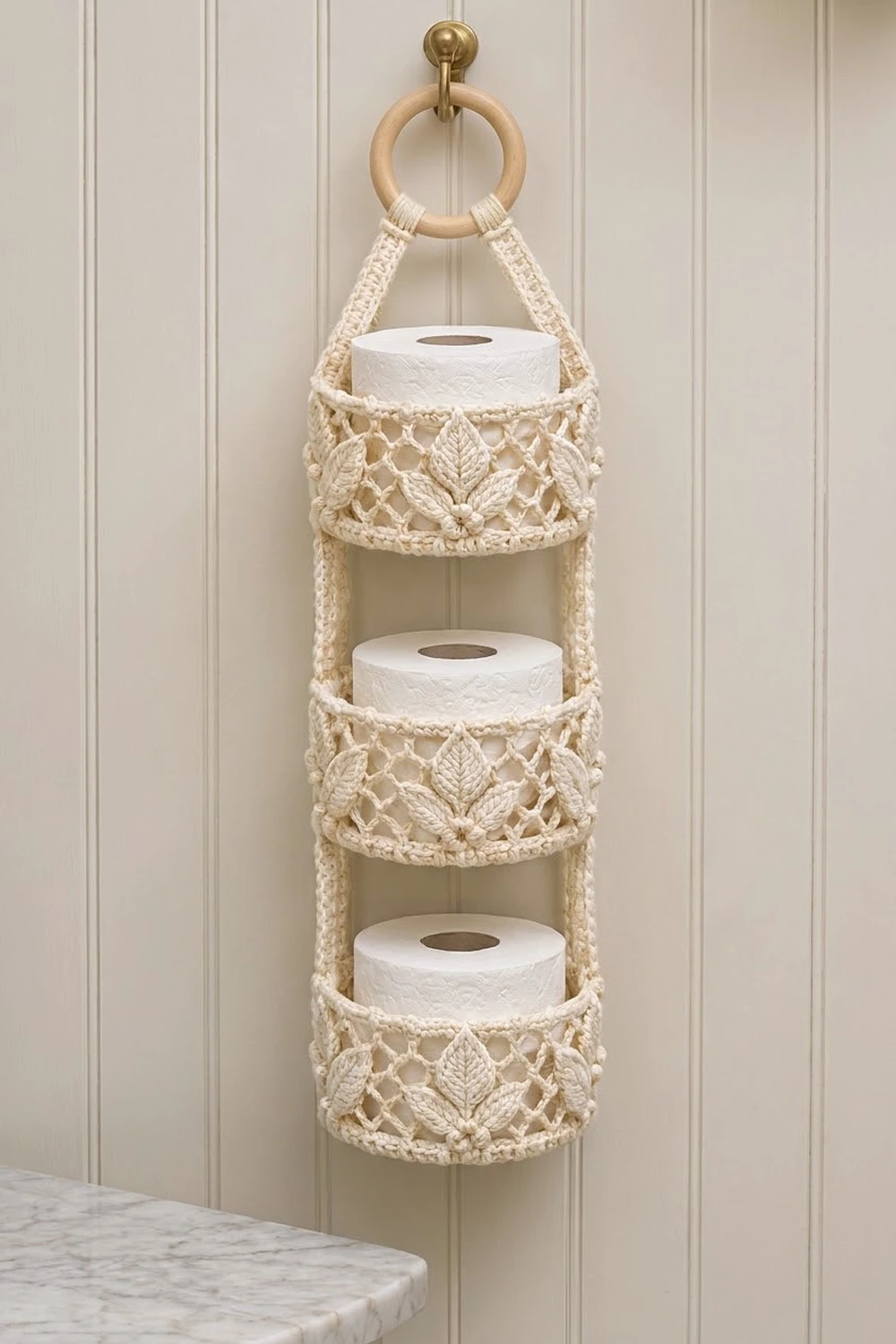
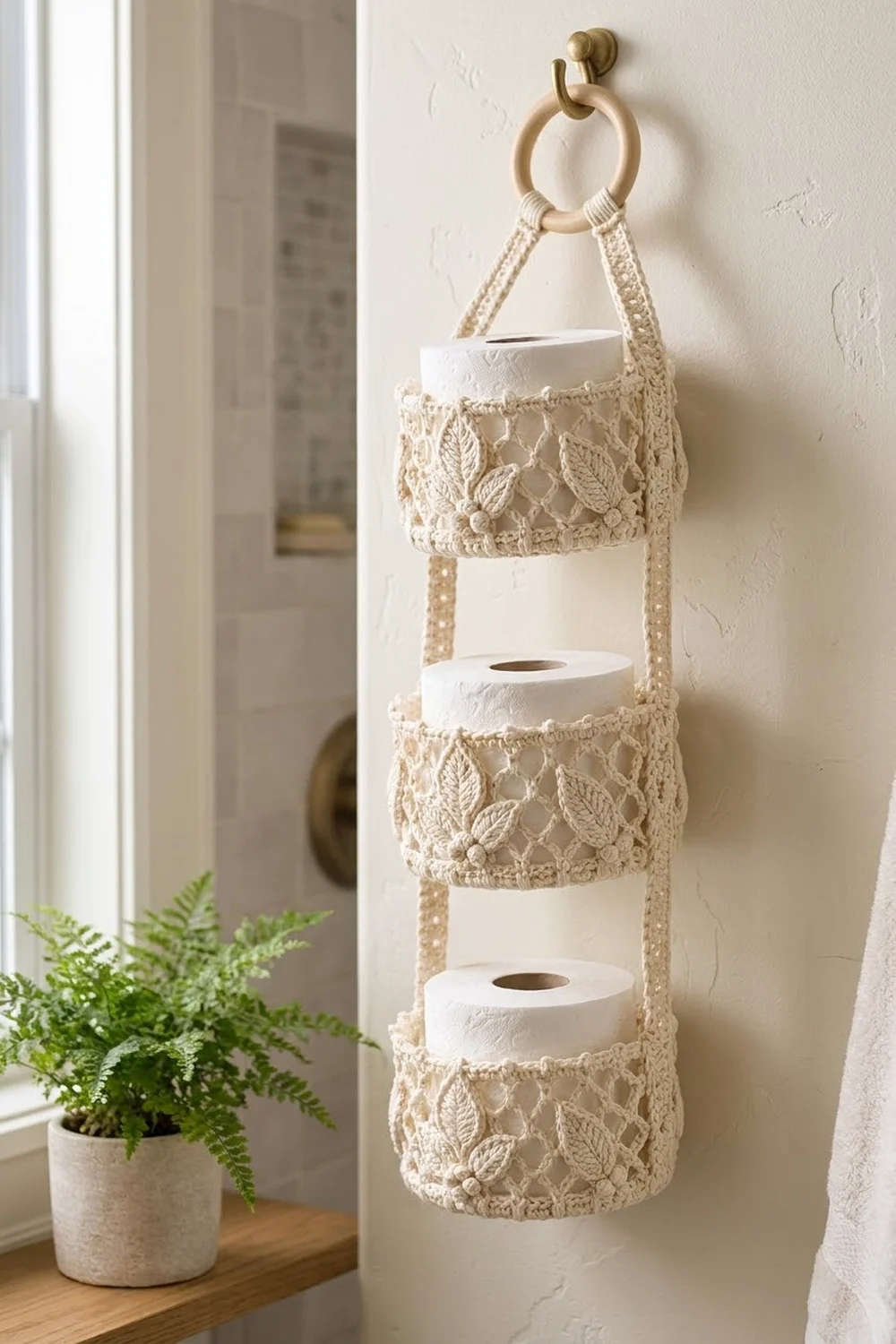
This hanging holder has three round mesh baskets stacked on two long straps, and the straps meet at a wooden ring. Each basket has a flat single crochet base, an open diamond-mesh wall and a picot rim. Raised leaf appliqués and small berry bobbles decorate the lower band.
The whole piece uses one soft ivory cotton, so the texture does the decorating: solid bands, open net, sculpted leaves and round berries. The style is farmhouse-romantic, and it looks good on a bathroom wall next to a towel or a small vase of flowers.
All terms are US crochet terms. The holder hangs about 23 in (58.4 cm) from the top of the ring to the bottom basket and is about 6 in (15.2 cm) wide. Each basket is 5.5 in (14.0 cm) across and 3 in (7.6 cm) tall. It holds one standard roll up to about 4.5 in (11.4 cm) wide.
You crochet three identical baskets from the center of the base upward, add a two-round rim border and sew on the appliqués. Then you make two straps lengthwise, sew them to the sides of the baskets and loop them over the ring.
Finished Size and Construction
- Finished size: about 23 in (58.4 cm) tall including the ring x 6 in (15.2 cm) wide
- Skill level: Intermediate
- Terminology: US crochet terms
- Yarn weight: worsted (#4) cotton
- Hook: 4.0 mm (US G-6)
- Number of pieces: 3 baskets, 2 straps, 6 large leaves, 18 small leaves, 18 berries, plus 1 wooden ring
- Layout: 3 baskets stacked vertically, 5.5 in (14.0 cm) apart base to base, held by 2 side straps
- Piece size (one basket): 5.5 in (14.0 cm) diameter x 3 in (7.6 cm) tall
- Basket size before border: 5.5 in (14.0 cm) diameter x 2.75 in (7.0 cm) tall
- Border depth: 2 rounds, about 0.25 in (0.6 cm) including picots
Materials
Choose a firm, smooth worsted-weight cotton or cotton blend. Cotton holds the basket shape, shows the leaf texture clearly and handles bathroom humidity well. Avoid soft or splitty yarns, because the mesh will sag.
- Ivory/cream: 350 g (about 595 m) of worsted cotton at roughly 170 m per 100 g
Tools:
- 4.0 mm (US G-6) crochet hook
- 1 wooden ring, 2.5 in (6.4 cm) outer diameter
- Tapestry needle
- Locking stitch markers (at least 6)
- Scissors and tape measure
- Rustproof pins and a spray bottle
The yarn amount includes a margin of about 15% for your test basket, sewing and differences in tension.
Abbreviations (US Terms)
- ch – chain
- sl st – slip stitch
- sc – single crochet
- hdc – half double crochet
- dc – double crochet
- tr – treble crochet
- inc – 2 sc in the same stitch
- BLO – back loop only
- sk – skip
- sp – space
- st(s) – stitch(es)
Picot: ch 3, sl st in the 3rd ch from the hook. A picot does not count as a stitch.
Berry: Make a magic ring, ch 2 and work 4 dc into the ring. Pull the ring tightly closed and sl st to the top of the ch-2. Fasten off, leaving a 6 in (15.2 cm) tail.
Gauge and Checkpoints
Gauge: 16 sc x 18 rounds = 4 in (10.2 cm). Work firmly so the basket can stand on its own.
Make one complete basket body (Rounds 1–19) before you start the others. This basket is your real gauge test:
- After Round 6 (36 sts): the base measures 2.75 in (7.0 cm) across.
- After Round 12 (72 sts): the base measures 5.5 in (14.0 cm) across and lies flat.
- After Round 14: the wall stands upright and is about 0.5 in (1.3 cm) tall.
- After Round 18: each mesh round adds about 0.5 in (1.3 cm), so the wall is about 2.5 in (6.4 cm) tall.
- After Round 19: the wall is 2.75 in (7.0 cm) tall.
If your base is larger than 5.5 in (14.0 cm), go down to a 3.75 mm hook. If it is smaller, go up to a 4.5 mm hook. Change the hook, not the stitch counts, because the mesh, the border and the strap placement all depend on the 72-stitch count.
Basket (make 3)
Work in joined rounds. At the end of each round, sl st to the first sc. Start each round with ch 1, which does not count as a stitch.
Base
Round 1: Make a magic ring, ch 1, work 6 sc in the ring. Join. (6 sts)
Round 2: Inc in each st around. (12 sts)
Round 3: (Sc in next st, inc) 6 times. (18 sts)
Round 4: (Sc in next 2 sts, inc) 6 times. (24 sts)
Round 5: (Sc in next 3 sts, inc) 6 times. (30 sts)
Round 6: (Sc in next 4 sts, inc) 6 times. (36 sts)
Keep going the same way, working 1 more sc between increases on each round:
Round 7: 42 sts. Round 8: 48 sts. Round 9: 54 sts. Round 10: 60 sts. Round 11: 66 sts.
Round 12: (Sc in next 10 sts, inc) 6 times. (72 sts)
From Round 7 on, move the increases to a different spot each round. This keeps the base round instead of hexagonal.
Wall
Round 13 (turning round): Sc in BLO of each st around. (72 sts) The unused front loops make a neat ridge, and the wall turns upward.
Round 14: Sc in each st around. (72 sts)
Round 15 (mesh setup): Sc in first st, (ch 4, sk 2 sts, sc in next st) 23 times, ch 4, sk 2 sts, join. (24 sc, 24 ch-4 loops)
Round 16: Sl st in the first 2 ch of the next loop, ch 1, sc in the same loop, (ch 4, sc in next loop) 23 times, ch 4, join. (24 ch-4 loops)
Rounds 17–18: Repeat Round 16. (24 ch-4 loops in each round)
Each round sits over the centers of the loops below, which makes the diamond net.
Round 19 (conversion round): Work 3 sc in each ch-4 loop around. Join. (24 loops x 3 sc = 72 sts, the same as Round 14)
Marking: On Round 14, call the first st after the join st 1. Place a marker between sts 72 and 1 and another between sts 36 and 37. These mark the center lines for the straps. The front half is sts 1–36 and the back half is sts 37–72.
Now work the Border (Rounds 20–21, below) on each basket, before joining.
Appliqués
Large Leaf (make 6)
Ch 11.
Side A: Starting in the 2nd ch from the hook: sc, hdc, dc, tr, tr, dc, dc, hdc, sc. (9 sts)
Tip: In the last ch, work (sc, ch 2, sc).
Side B: Working in the free loops on the other side of the chain: sc, hdc, dc, dc, tr, tr, dc, hdc, sc. (9 sts) Sl st to the first sc.
Total: 20 sts plus the ch-2 tip. Fasten off, leaving a 12 in (30.5 cm) tail. Surface sl st a center vein from the stem to the tip. Size: 2.5 in (6.4 cm) long x 1.25 in (3.2 cm) wide.
Small Leaf (make 18)
Ch 7.
Side A: Starting in the 2nd ch from the hook: sc, hdc, dc, hdc, sc. (5 sts)
Tip: In the last ch, work (sc, ch 2, sc).
Side B: In the free loops: sc, hdc, dc, hdc, sc. (5 sts) Sl st to the first sc.
Total: 12 sts plus the ch-2 tip. Fasten off, leaving a 10 in (25.4 cm) tail, and add a short surface sl st vein. Size: 1.5 in (3.8 cm) long x 0.75 in (1.9 cm) wide.
Berries (make 18)
Work as defined in the Abbreviations section. Each berry is about 0.4 in (1.0 cm) across.
Placing the Appliqués
Each basket gets 2 leaf clusters and 2 accent leaves:
- Front cluster: Center the stem of 1 large leaf between sts 18 and 19 of Round 14. The leaf points straight up over the mesh, and its tip reaches Round 19. Sew 2 small leaves at the same point, angled down and outward at about 45 degrees. Sew 3 berries side by side across sts 17–20 of Round 14 so they cover the stems, with the middle berry on the center line.
- Back cluster: Repeat, centered between sts 54 and 55.
- Accent leaves: Sew 1 small leaf at st 8 and 1 at st 29, with the stem on Round 14 and the leaf tilted toward the nearest strap line.
Whipstitch around the leaf edges through the outer layer only. Leave the centers of the leaves unsewn so they stay raised.
Strap (make 2)
Work in rows along the length of the strap.
Foundation: Ch 98.
Row 1: Sc in 2nd ch from hook and in each ch across. Turn. (97 sts)
Row 2: Ch 4 (counts as dc and ch 1), sk next st, (dc in next st, ch 1, sk next st) across, ending with dc in the last st. Turn. (49 dc and 48 ch-1 sps)
Row 3: Ch 1, sc in each dc and each ch-1 sp across. (49 + 48 = 97 sts) Do not turn.
Round 4 (edging): Work 5 sc across the short end (1 in the sc row end, 3 around the dc post, 1 in the sc row end) to round it. Sl st in each free loop of the foundation chain (97 sts). Work 5 sc across the other short end, then sl st in each st of Row 3 (97 sts). Join. (97 + 5 + 97 + 5 = 204 sts)
The strap measures 24.25 in (61.6 cm) long x 1 in (2.5 cm) wide, with a row of eyelets down the center.
Strap map (4 sts per inch, counting from the bottom end):
- Sts 1–12: bottom basket, 3 in (7.6 cm)
- Sts 13–22: gap, 2.5 in (6.4 cm)
- Sts 23–34: middle basket, 3 in (7.6 cm)
- Sts 35–44: gap, 2.5 in (6.4 cm)
- Sts 45–56: top basket, 3 in (7.6 cm)
- Sts 57–85: diagonal up to the ring, 7.25 in (18.4 cm)
- Sts 86–97: ring loop, 3 in (7.6 cm)
Check: 12 + 10 + 12 + 10 + 12 + 29 + 12 = 97. Mark sts 12, 23, 34, 45, 56 and 85.
Make All Pieces
Every piece uses the same ivory color:
- 3 baskets (Rounds 1–21, with appliqués sewn on)
- 2 straps
- 6 large leaves (2 per basket)
- 18 small leaves (6 per basket)
- 18 berries (6 per basket)
- 1 wooden ring
Layout, front view:
          ( O )        <- wooden ring
          /   \        <- strap sts 57-85
        |[TOP  ]|      <- strap sts 45-56
        |       |      <- gap, sts 35-44
        |[MID  ]|      <- strap sts 23-34
        |       |      <- gap, sts 13-22
        |[BOTTM]|      <- strap sts 1-12
Joining
Whipstitch with the same yarn. Pin everything first, then sew.
- Center a strap over the marker between sts 72 and 1 of the bottom basket. It covers about 4 sts (71, 72, 1 and 2).
- Line up strap st 1 with Round 13 (the base ridge) and strap st 12 with Round 21.
- Stitch-to-stitch logic: The wall has 9 rounds (Rounds 13–21) and is 3 in (7.6 cm) tall, which matches 12 strap sts. Sew 4 strap sts to every 3 rounds. In the mesh section, anchor into each sc where the loops meet.
- Sew down both long edges of the strap. Repeat on the opposite side, centered between sts 36 and 37.
- Join the middle basket at strap sts 23–34 and the top basket at strap sts 45–56 in the same way.
- Pass strap sts 86–97 through the ring from front to back. Fold the end down behind so st 97 lies on st 86, then sew across and along both edges.
Tension: Pull each stitch snug but not tight. If the strap gathers between markers, sew more loosely.
Size checkpoint: The baskets should be 5.5 in (14.0 cm) apart base to base. There should be a 2.5 in (6.4 cm) gap between each rim and the base above it. Held by the ring, the holder hangs about 23 in (58.4 cm) and the baskets sit level.
Border
The border is the rim of each basket. Work it right after Round 19, before joining.
Border gauge: 4 sc per inch, the same as the base. One picot repeat (3 sc plus a picot) covers 0.75 in (1.9 cm).
For counting, the strap lines divide each basket into 2 sides: front (sts 1–36) and back (sts 37–72).
Round 20: Sc in each st around. Join. (Front 36 + back 36 = 72 sts)
Round 21: (Sc in next 3 sts, picot) 24 times. Join and fasten off. (72 sts and 24 picots: each side has 36 sc + 12 picots)
Why the math works: Round 19 turns 24 loops x 3 sc into 72 sts, and Round 20 keeps 72. That means the rim matches the base circumference of 18 in (45.7 cm) and the wall stays straight. Each side has 36 sts, and 36 ÷ 3 = 12 picot repeats. The picots are spaced evenly on both sides, and one picot ends exactly at each strap line.
Final Blocking
- Weave in all remaining ends on the inside of the baskets.
- Spray the holder until it is damp but not soaked.
- Slide a toilet roll (or a can about 4.5 in / 11.4 cm wide) into each basket to set the round shape.
- Gently ease each mesh round upward so the diamonds open evenly.
- Press the leaves flat and pin the tips in place.
- Hang the holder by the ring so the straps dry straight and the baskets dry level.
- Let it dry completely, then remove the rolls and pins.
Final Quality-Control Checklist
- Each base is 5.5 in (14.0 cm) across and lies flat.
- Each wall is 3 in (7.6 cm) tall, with 72 sts in Rounds 14, 19, 20 and 21.
- Every mesh round has 24 ch-4 loops.
- Each rim has 24 picots, 12 per side.
- Each basket has 2 large leaves, 6 small leaves and 6 berries.
- Both straps are 97 sts long and are sewn at the same markers.
- The baskets are 5.5 in (14.0 cm) apart base to base.
- The ring loop is sewn on firmly.
Troubleshooting
- Base ruffles: Your tension is loose. Go down a hook size.
- Base cups: Your tension is tight, or the increases are stacking. Go up a hook size and move the increases around.
- Wall flares out: Recount Round 19. It must have exactly 72 sts.
- Mesh sags: Your chains are too loose. Tighten them, or use ch 3 if the wall is clearly taller than 2.5 in (6.4 cm) after Round 18.
- Baskets tilt: The straps were sewn at different heights. Re-pin them at the markers and sew again.
- Leaves curl: Steam them lightly and pin them flat to dry.
- Rolls don’t fit: The base is too small. Go up a hook size.
Care
Hand wash in cool water with mild soap. Reshape, then dry flat or hang by the ring. Do not tumble dry.
Final Notes
Each measurement leads to the next. A gauge of 16 sc = 4 in (10.2 cm) gives a 72-stitch base that is 5.5 in (14.0 cm) across. Those 72 stitches carry up the wall, become 24 mesh loops, and go back to 72 for a border with 12 picots per side. Each strap has 97 stitches and is 24.25 in (61.6 cm) long. That length covers three 3 in (7.6 cm) baskets, two 2.5 in (6.4 cm) gaps, a 7.25 in (18.4 cm) diagonal and a 3 in (7.6 cm) ring loop. Check each measurement as you go, and your holder will hang straight and hold its rolls neatly.
Happy crocheting!