
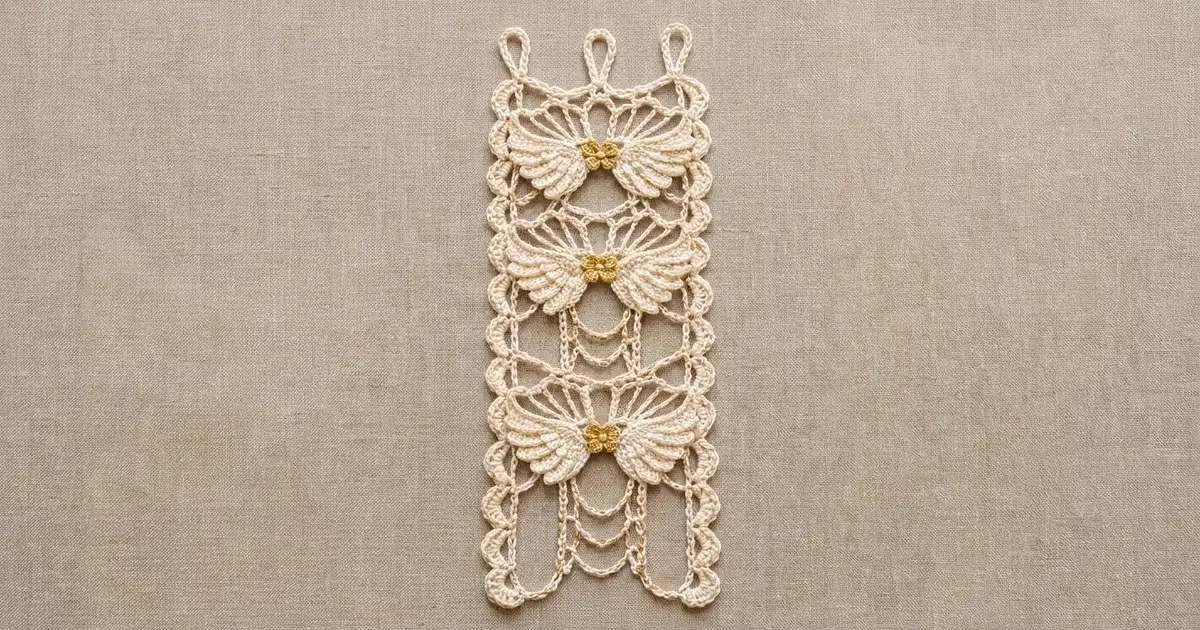
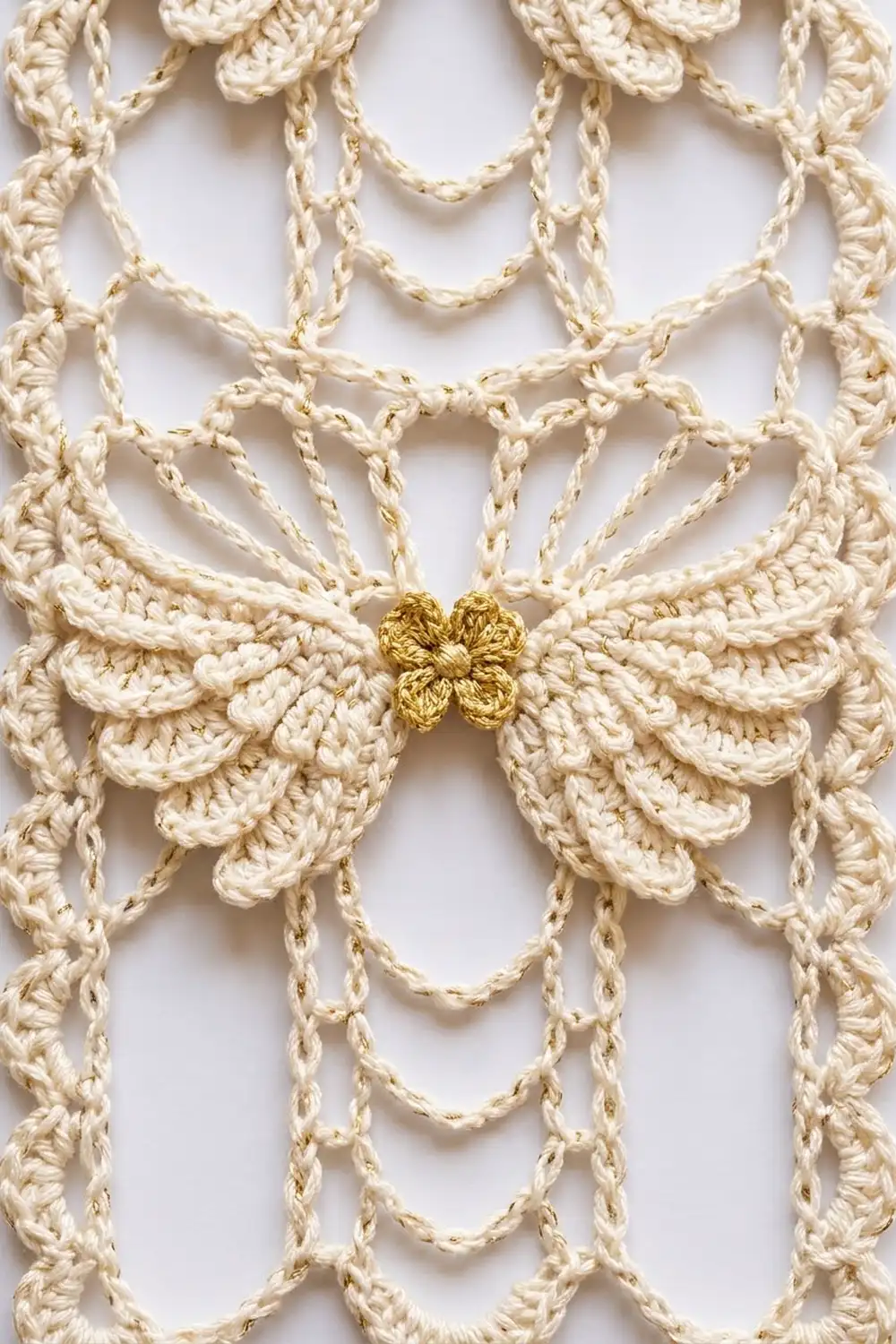
This vertical lace strip shows four angels stacked one above the other. In each repeat, a fan of chain spokes opens up from a small gold flower, and a pair of layered, feathered wings sits over the fan. A band of chain arches runs across the top of each repeat, and three nested chain swags hang below the wings. Small chain-loop scallops run down both sides and across the bottom. Three teardrop loops at the top let the strip hang from a curtain rod.
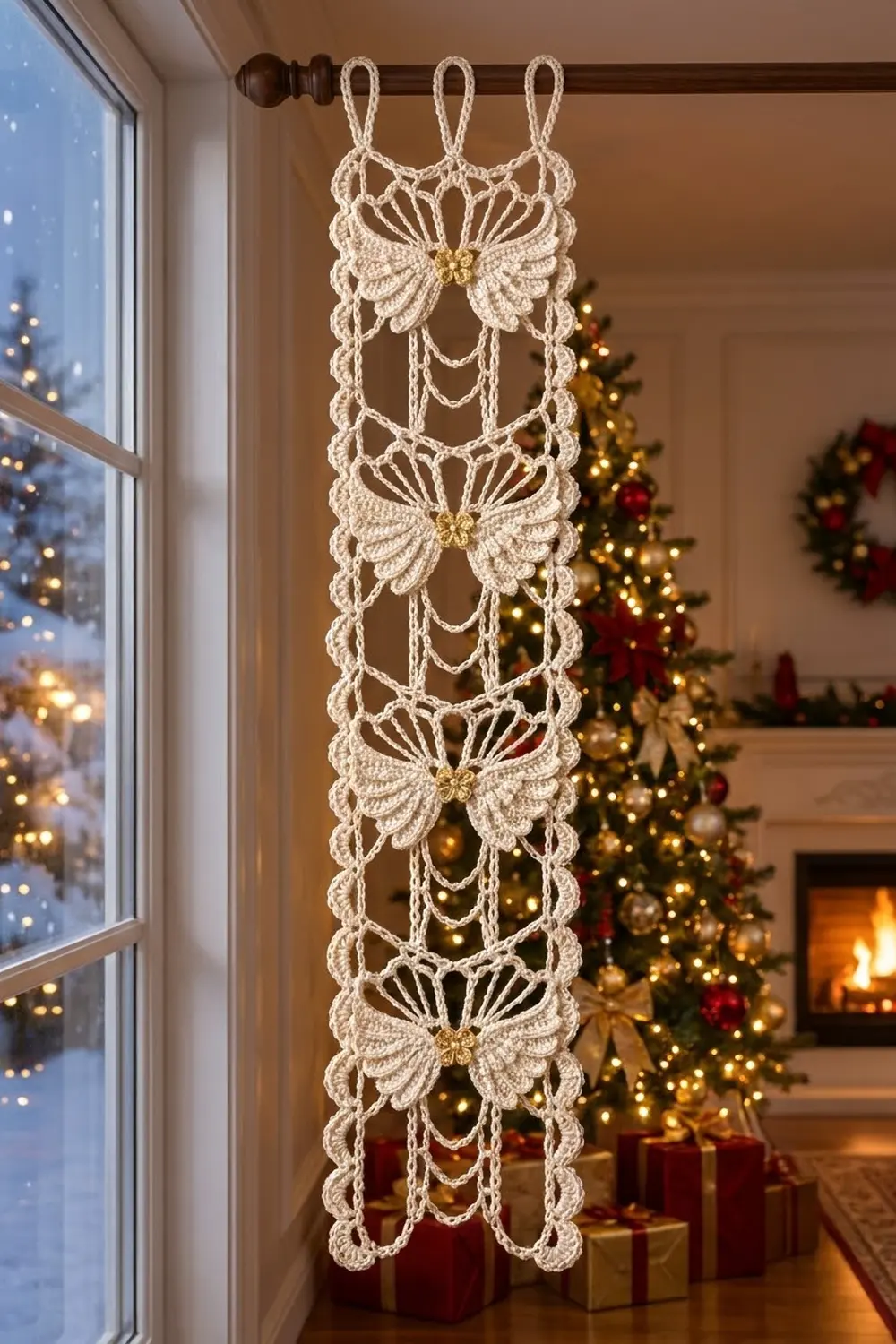
The strip is worked in soft ivory cotton. The flower at the center of each pair of wings is metallic gold. The look is airy and a little vintage, and it works well as a holiday or wedding piece. Hang one strip by itself, or hang several side by side on a rod.
This pattern uses US crochet terms. The finished strip measures 5 in (12.7 cm) wide and 16¾ in (42.5 cm) long. The hanging loops add another 1¼ in (3.2 cm), for a total length of 18 in (45.7 cm).
You work the strip in rows from the bottom up, with two-stitch “rails” at each side holding the lace in place. The wings and flowers are made separately and sewn on. A two-row border adds the scalloped edge last.
Finished Size and Construction
- Finished size: 5 in × 16¾ in (12.7 cm × 42.5 cm) plus 1¼ in (3.2 cm) loops
- Skill level: Intermediate
- Terminology: US
- Yarn weight: Fingering (#1) mercerized cotton
- Hook: 2.75 mm (US C-2)
- Number of pieces: 1 strip, with 8 wing appliqués (3 layers each) and 4 flowers sewn on
- Layout: 4 angel repeats stacked vertically, each 4 in (10.2 cm) tall
- Strip width before border: 27 sts = 4½ in (11.4 cm)
- Size before border: 4½ in × 16½ in (11.4 cm × 41.9 cm)
- Border depth: about ¼ in (0.6 cm) on each side and along the bottom
Materials
Mercerized cotton holds its shape, shows the stitches clearly and stays firm when it hangs. Avoid fuzzy or very stretchy fibers, because the swags will sag and the arches will blur.
- Ivory (main color): 40 g / 140 m (153 yd) of fingering cotton
- Metallic gold: 3 g / 12 m (13 yd) of fingering-weight metallic or gold cotton
Both quantities include about a 20% margin for your gauge swatch and for differences in tension.
Tools:
- 2.75 mm (US C-2) hook
- Tapestry needle
- Stitch markers
- Rustproof pins and a blocking board
- Spray bottle
- Measuring tape
Abbreviations (US Terms)
- ch: chain
- sl st: slip stitch
- sc: single crochet
- hdc: half double crochet
- dc: double crochet
- tr: treble crochet
- dtr: double treble crochet
- sk: skip
- sp: space
- st(s): stitch(es)
- RS / WS: right side / wrong side
Special stitch, rail: the first 2 and last 2 stitches of every row. They are always worked into the 2 rail stitches of the row below, and the turning chain counts as the first stitch.
Gauge and Checkpoints
Gauge: 6 dc = 1 in (2.5 cm).
Each row type has its own height:
- 1 dc row = ⅜ in (1.0 cm)
- 1 tr row = ½ in (1.3 cm)
- 1 dtr row = ¾ in (1.9 cm)
Test first: Before you commit to the whole strip, work Rows 1–9 (the foundation row and one repeat) and measure. You should have:
- Width: 4½ in (11.4 cm)
- Height: 4⅜ in (11.1 cm)
If your test is too big, go down 0.25 mm in hook size. If it is too small, go up 0.25 mm. Width matters most, because every chain length in the pattern is based on 27 stitches. Your measurements should be within ⅛ in (0.3 cm).
Stage checkpoints:
- After Row 9: 4⅜ in (11.1 cm)
- After Row 17: 8⅜ in (21.3 cm)
- After Row 25: 12⅜ in (31.4 cm)
- After Row 33: 16⅜ in (41.6 cm)
- After Row 34: 16½ in (41.9 cm)
Strip
Use Ivory.
Foundation: Ch 29.
Row 1: Dc in 4th ch from hook (the skipped 3 ch count as the first dc) and in each ch across. Turn. (27 dc)
Angel Repeat (8 rows)
Work Rows A through H once to complete one repeat.
Row A (swag 1): Ch 4 (counts as tr), tr in next st, ch 25, sk next 23 sts, tr in last 2 sts. Turn. (4 tr, 1 ch-25 swag)
Row B (swag 2): Ch 4, tr in next tr, ch 25, tr in last 2 sts. Turn. (4 tr, 1 ch-25 swag)
Row C (swag 3): Repeat Row B. (4 tr, 1 ch-25 swag)
The 25 chains span a gap only 23 stitches wide, so each swag dips about ½ in (1.3 cm). Because all three swags are the same length, they hang as parallel, nested arcs.
Row D (bar): Ch 4, tr in next tr, ch 23, tr in last 2 sts. Turn. (4 tr, 1 ch-23 bar)
This chain is the same width as the gap, so it pulls taut and becomes the straight base for the fan.
Row E (fan): Ch 5 (counts as dtr), dtr in next tr, ch 4, sk first 11 ch of bar. In the next (12th) ch, work (dtr, ch 3) 6 times, then dtr in the same ch. Ch 4, sk last 11 ch of bar, dtr in last 2 sts. Turn. (4 rail dtr, 7 fan dtr, 6 ch-3 sps, 2 ch-4 sps)
Check the bar count: 11 + 1 + 11 = 23 ch.
Row F (arches): Ch 4, tr in next dtr, ch 3, sc in next ch-4 sp, (ch 5, sc in next ch-3 sp) 6 times, ch 5, sc in next ch-4 sp, ch 3, tr in last 2 sts. Turn. (4 tr, 8 sc, 7 ch-5 arches, 2 ch-3 sps)
Row G (band 1): This is a conversion row. Ch 3 (counts as dc), dc in next tr, dc in ch-3 sp, 3 dc in each of the next 7 ch-5 arches, dc in ch-3 sp, dc in last 2 sts. Do not work into the sc. Turn.
(27 dc: 4 rail dc + 2 dc in the ch-3 sps + 21 dc in the arches)
Row H (band 2): Ch 3, dc in each st across. Turn. (27 dc)
One repeat is 4 in (10.2 cm) tall:
- 4 tr rows (Rows A–D): 2 in (5.1 cm), for a total of 2 in (5.1 cm)
- 1 dtr row (Row E): ¾ in (1.9 cm), for a total of 2¾ in (7.0 cm)
- 1 tr row (Row F): ½ in (1.3 cm), for a total of 3¼ in (8.3 cm)
- 2 dc rows (Rows G–H): ¾ in (1.9 cm), for a total of 4 in (10.2 cm)
Rows 2–33: Work Rows A–H a total of 4 times. Rows 2–9 are the first repeat, Rows 10–17 the second, Rows 18–25 the third, and Rows 26–33 the fourth.
Hanging Loops
Row 34: Ch 1, sc in first 2 sts, ch 16, sl st in last sc made (loop made). Sc in next 12 sts, ch 16, sl st in last sc made. Sc in next 12 sts, ch 16, sl st in last sc made. Sc in last st. Fasten off.
(27 sc, 3 loops) The loops sit above sts 2, 14 and 26, so the center loop is exactly in the middle. Each loop stands about 1¼ in (3.2 cm) tall.
Wings (make 8 identical)
Use Ivory. Each wing has three layers. Every layer has a straight top edge (the “wing bone”) with feather scallops hanging from it.
Back Layer (primary feathers)
Foundation: Ch 14.
Row 1: Sc in 2nd ch from hook and in each ch across. Turn. (13 sc)
Row 2: Ch 1, sc in first st, sk 1, 5 dc in next st, sk 1, sc in next st, sk 1, 7 dc in next st, sk 1, sc in next st, sk 1, 9 tr in next st, sk 1, sc in last st. Fasten off, leaving a 12 in (30.5 cm) tail.
(3 feathers, which grow from 5 dc to 7 dc to 9 tr; 25 sts total: 4 sc + 21 feather sts) The largest feather sits at the wingtip.
Middle Layer
Foundation: Ch 10.
Row 1: Sc in 2nd ch from hook and in each ch across. Turn. (9 sc)
Row 2: Ch 1, sc in first st, (sk 1, 5 dc in next st, sk 1, sc in next st) 2 times. Fasten off. (13 sts: 3 sc + 10 dc)
Front Layer
Foundation: Ch 6.
Row 1: Sc in 2nd ch from hook and in each ch across. Turn. (5 sc)
Row 2: Ch 1, sc in first st, sk 1, 5 hdc in next st, sk 1, sc in last st. Fasten off. (7 sts: 2 sc + 5 hdc)
Stack the Layers
- Lay the back layer flat with its small 5-dc feather on the left.
- Place the middle layer on top. Line up its straight top edge and left (inner) end with the back layer.
- Place the front layer on top in the same way.
- Whipstitch the three layers together along the top edge and the inner end only. The feathers stay free, so each tier overlaps the one below like real plumage.
The finished wing is about 2¼ in (5.7 cm) long and 1¼ in (3.2 cm) deep.
Flowers (make 4)
Use Gold.
Rnd 1: Make a magic ring, ch 1, 5 sc in ring, sl st to first sc. (5 sc)
Rnd 2: (Ch 2, 2 dc, ch 2, sl st) in next sc. Repeat from * 4 more times. Fasten off, leaving a tail. (5 petals)
The finished flower is about ¾ in (1.9 cm) across.
Attach the Appliqués
Choose the neater side of the strip as the RS.
For each repeat:
- Center 2 wings over the fan with their inner ends meeting at the base of the fan (the center ch of the bar).
- Turn the left wing WS up so the pair mirrors.
- Angle each wing slightly upward so the wingtips point toward the corners of the arch row. The wings will cover the lower half of the spokes.
- Sew each wing along its top edge and inner end.
- Sew a flower over the point where the wings meet, covering their inner ends.
Border
Use Ivory. The border is worked as two rows that run down one side, across the bottom and up the other side. Leave the top edge free, because it carries the loops.
Border gauge: 6 sc = 1 in (2.5 cm) along every edge. That works out to 24 sc per 4 in (10.2 cm) repeat and 27 sc across the 4½ in (11.4 cm) bottom.
Border Row 1: With RS facing, join yarn at the row-end of Row 33 on the right edge. Skip the Row 34 row-end. Ch 1.
- Right side (96 sc): Work down the right side, placing sc in each repeat as follows:
- 3 sc in each tr row-end (Rows A, B, C, D and F): 15 sc
- 5 sc in the dtr row-end (Row E): 5 sc
- 2 sc in each dc row-end (Rows G and H): 4 sc
That’s 24 sc per repeat, and 24 × 4 = 96 sc.
2. Bottom right corner: 1 sc in the Row 1 row-end. Mark this sc.
3. Bottom edge: 1 sc in the base of each of the 27 foundation sts. (27 sc)
4. Bottom left corner: 1 sc in the Row 1 row-end. Mark this sc.
5. Left side (96 sc): Work up the left side, repeating the same 24-sc sequence 4 times. Turn.
(221 sc: 96 + 1 + 27 + 1 + 96)
Border Row 2: Ch 1, sc in first sc, ch 5, sk 3 sc, sc in next sc. Repeat from * 54 more times. Fasten off.
(55 scallops: 24 on each side, 7 across the bottom)
Why the math works: Each scallop uses 4 sts, so a run of scallops needs a multiple of 4 plus 1 sts. The total is 221 = (4 × 55) + 1. The marked corner sc are st 97 = (4 × 24) + 1 and st 125 = (4 × 31) + 1, so a scallop sc lands exactly on each corner. The bottom edge, counting both corners, is 29 sts = (4 × 7) + 1. Nothing is added or fudged at the corners.
The border adds about ¼ in (0.6 cm) on each long side and along the bottom, for a finished size of 5 in × 16¾ in (12.7 cm × 42.5 cm).
Final Blocking
- Weave in all ends, except leave the flower tails until after blocking in case a flower needs to shift.
- Soak the strip in cool water for 10 minutes, then press out the water in a towel. Don’t wring it.
- Pin the strip WS up to a 5 in × 16¾ in (12.7 cm × 42.5 cm) rectangle. Put one pin in each scallop along the sides and the bottom.
- Pin each swag into a smooth, even arc so all three swags in a repeat are parallel.
- Pin each hanging loop into a teardrop shape 1¼ in (3.2 cm) tall.
- Let the strip dry completely. Don’t press the wings flat. If the feathers have curled, mist them and shape them with your fingers.
Final Quality-Control Checklist
- Every band row has 27 dc.
- Each repeat measures 4 in (10.2 cm).
- Each fan has 7 spokes and 7 arches.
- The three swags in each repeat hang parallel without crossing.
- Every wing has 3 layers, and the feathers lie free.
- Wings mirror each other, and a flower covers the joint.
- The border has 221 sc and 55 scallops, with a scallop on each corner.
- The finished size is 5 in × 16¾ in (12.7 cm × 42.5 cm), and the loops are evenly spaced.
Troubleshooting
- Strip wider than 4½ in (11.4 cm): Your dc tension is loose. Go down a hook size and start again from Row 1.
- Swags cross or tangle: Recount the chains. All three swags must be ch 25.
- Bar sags: The bar must be exactly ch 23. Tighten your chain tension.
- Fan looks lopsided: Make sure you skipped exactly 11 ch on each side of the center ch.
- Wings curl upward: Steam-block them before sewing, and sew them along the full top edge.
- Border ruffles: You have too many sc. Recheck the 24-per-repeat count.
- Border pulls in: You have too few sc. Recheck the 24-per-repeat count.
Care
Hand wash in cool water with mild soap, roll the strip in a towel, and dry it flat, pinned to shape. Store it flat or rolled, not folded across the wings.
Final Notes
Everything in this pattern comes back to the 27-stitch width:
- 6 dc per inch gives 4½ in (11.4 cm).
- Each 8-row repeat adds 4 in (10.2 cm), so four repeats plus Rows 1 and 34 give 16½ in (41.9 cm).
- 24 sc per repeat on each side plus 27 sc across the bottom gives exactly 221 border stitches.
- The ¼ in (0.6 cm) border brings the strip to 5 in × 16¾ in (12.7 cm × 42.5 cm), and the loops bring the total length to 18 in (45.7 cm).
Check your gauge first and the rest of the measurements follow.
Happy crocheting!