

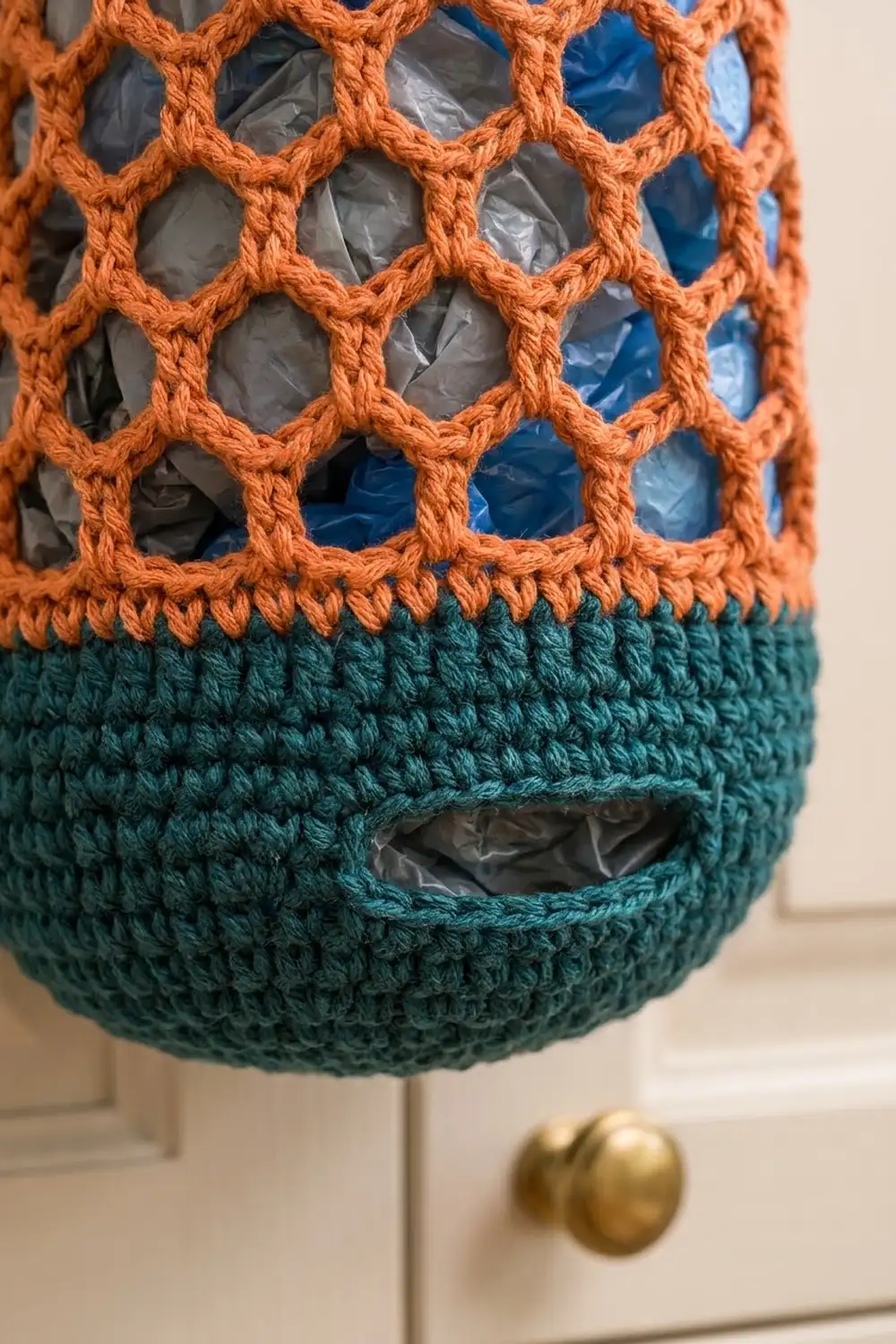
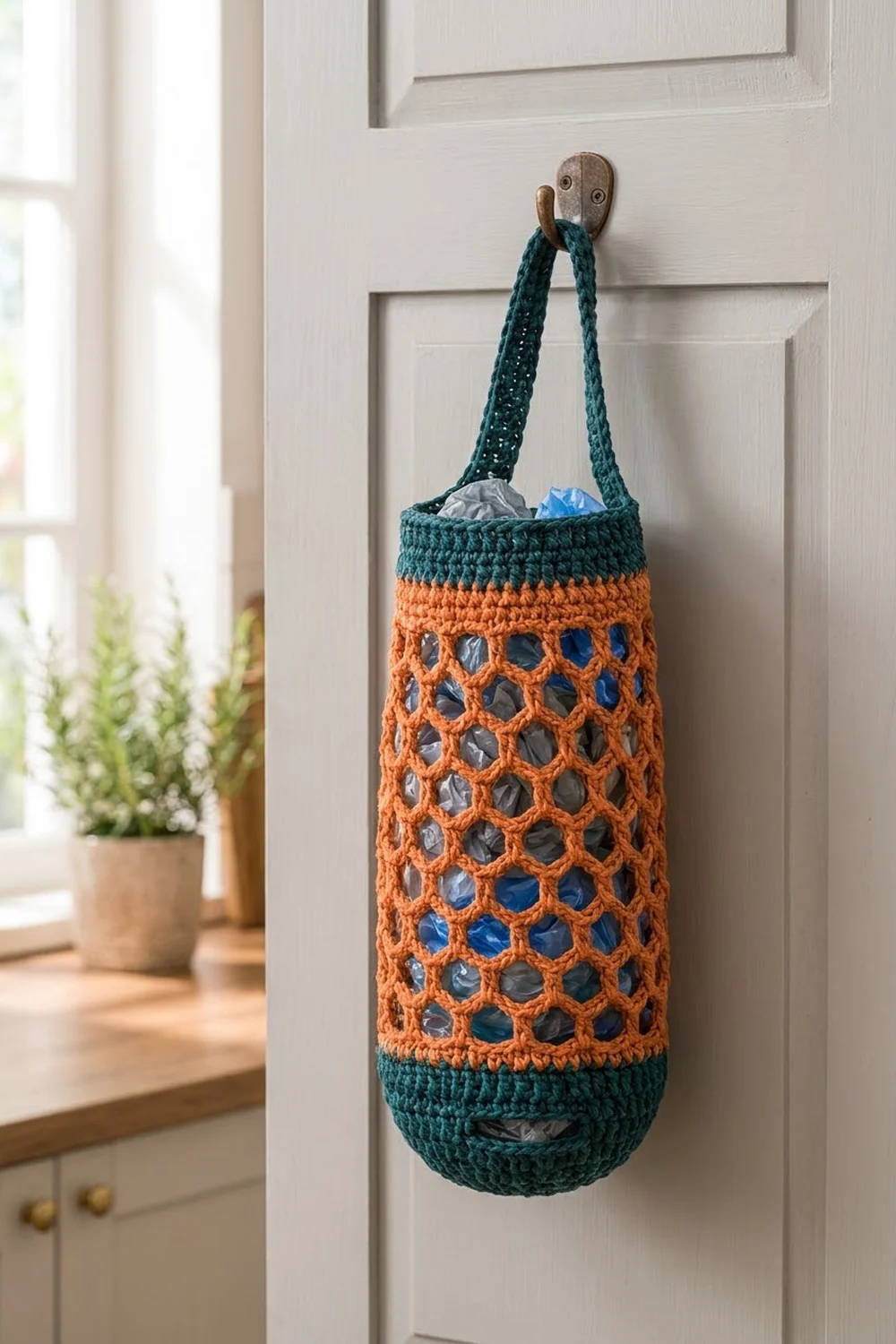
The Harbor Honeycomb Bag Holder is a tall, hanging tube that keeps loose grocery bags in one tidy spot. You stuff bags in at the top and pull them out one at a time through a slot near the bottom. The open honeycomb mesh lets you see how many bags are left.
The main colorway uses deep teal for the solid base, the top band, and the strap. Bright burnt orange fills the mesh body and the two thin solid stripes around it. If you swap the colors, you get a teal mesh with orange bands, which is just as striking.
This pattern uses US crochet terms. The finished holder is about 13.5 in (34.3 cm) tall without the strap. It is about 6.9 in (17.5 cm) wide near the bottom when laid flat and about 5.7 in (14.5 cm) wide at the top. It hangs about 19 in (48.3 cm) from the base to the top of the strap.
You make it in one piece, from the bottom up. A flat circle forms the base. Solid rounds build the lower wall, which has a built-in slot for pulling bags out. Next come the mesh rounds, a decrease round that narrows the top, and a solid top band. Last, you work a strap in rows and attach it to the opposite side of the rim. A simple single crochet edging finishes the strap edges.
Finished Size and Construction
- Finished size: 13.5 in (34.3 cm) tall body; 6.9 in (17.5 cm) lower width flat; 5.7 in (14.5 cm) top width flat
- Hanging length: about 19 in (48.3 cm) including strap
- Skill level: Easy / advanced beginner
- Terminology: US
- Yarn weight: Worsted (#4), cotton or cotton blend
- Hook: 5.0 mm (H-8)
- Number of pieces: 1 (worked seamlessly; strap attached at the end)
- Layout: Vertical tube; slot at the center front; strap ends at the left and right sides
- Base diameter: about 4.4 in (11.2 cm)
- Strap width before border: 1.1 in (2.8 cm)
- Border depth: 0.25 in (0.6 cm) on each strap edge; finished strap width 1.6 in (4.1 cm)
Materials
Use a smooth, firm worsted-weight cotton. It holds its shape, doesn’t fuzz, and is easy to wash. Acrylic also works, but it stretches more, so the mesh will hang longer. A yarn with about 170 m per 100 g is ideal.
- Color A, deep teal: 85 g (145 m)
- Color B, burnt orange: 65 g (110 m)
These amounts include a margin of about 15% for your gauge check and yarn tails.
Tools:
- 5.0 mm (H-8) crochet hook
- 4 stitch markers
- Tapestry needle
- Scissors
- Measuring tape
- Rolled towel or an empty 2 L bottle for blocking
Abbreviations (US Terms)
- ch – chain
- sc – single crochet
- dc – double crochet
- sl st – slip stitch
- st(s) – stitch(es)
- sk – skip
- BLO – back loop only
- sc2tog – single crochet 2 together. Insert hook in next st, yarn over, and pull up a loop. Insert hook in following st, yarn over, and pull up a loop. Yarn over and pull through all 3 loops (1 st made from 2).
- Mesh closing (ch 2, dc): At the end of a ch-5 mesh round, ch 2, then dc in the first sc. Together, the ch 2 and the dc are as tall as a ch-5 loop, so they finish the last loop. They also leave your hook at the center of that loop, ready for the next round. On ch-4 rounds, use ch 1, dc instead.
Gauge and Checkpoints
Gauge: 14 sc and 16 rounds = 4 in (10.2 cm), worked in joined rounds.
The base doubles as your gauge swatch. When you finish Round 8, measure across the circle.
- Checkpoint 1 (Round 8): base diameter about 4.4 in (11.2 cm).
- Checkpoint 2 (Round 17): tube about 6.9 in (17.5 cm) wide when flattened; solid wall about 2.25 in (5.7 cm) tall from the base edge.
- Checkpoint 3 (Round 25): ch-5 mesh section about 5 in (12.7 cm) tall, measured with a light downward stretch.
- Checkpoint 4 (Round 33): total mesh about 9 in (22.9 cm) tall.
- Checkpoint 5 (Round 42): body about 13.5 in (34.3 cm) tall; top about 5.7 in (14.5 cm) wide flat.
If your base is wider than 4.6 in (11.7 cm), switch to a 4.5 mm hook. If it is narrower than 4.2 in (10.7 cm), switch to a 5.5 mm hook. Don’t add or remove stitches, because the mesh math depends on exactly 48 sts.
Pattern
Join every round with a sl st to the first sc. The ch 1 at the start of each round doesn’t count as a stitch.
Base (Color A)
Round 1: Make a magic ring, ch 1, 6 sc in ring. (6 sts)
Round 2: 2 sc in each st. (12 sts)
Round 3: (Sc 1, 2 sc in next) 6 times. (18 sts)
Round 4: (Sc 2, 2 sc in next) 6 times. (24 sts)
Round 5: (Sc 3, 2 sc in next) 6 times. (30 sts)
Round 6: (Sc 4, 2 sc in next) 6 times. (36 sts)
Round 7: (Sc 5, 2 sc in next) 6 times. (42 sts)
Round 8: (Sc 6, 2 sc in next) 6 times. (48 sts)
Check Checkpoint 1 now. The circle should lie flat, with no ruffling or cupping.
Lower Wall and Dispensing Slot (Color A)
Round 9: Sc in BLO of each st. (48 sts) This turns the edge up into a crisp wall.
Rounds 10–11: Sc in each st. (48 sts)
Round 12 (slot round): Sc 19, ch 10, sk 10, sc 19. (38 sc + 10 ch = 48 sts)
Round 13: Sc 19, sc in each of the 10 ch, sc 19. (48 sts)
Rounds 14–15: Sc in each st. (48 sts)
The slot is about 2.9 in (7.4 cm) wide. It sits at the center front, and each round starts at the center back.
Lower Stripe (Color B)
Rounds 16–17: Change to B. Sc in each st. (48 sts) Fasten off A, leaving a tail to weave in.
Check Checkpoint 2 now.
Honeycomb Mesh (Color B)
Round 18: Ch 1, sc in first st, (ch 5, sk 2, sc in next st) 15 times, ch 2, sk 2, dc in first sc. (16 ch-5 loops)
The 15 repeats use sts 1–46, and the closing ch 2 skips sts 47–48. That makes 16 loops × 3 sts = 48 sts.
Rounds 19–25: Ch 1, sc around the post of the closing dc, (ch 5, sc in next ch-5 loop) 15 times, ch 2, dc in first sc. (16 ch-5 loops each round)
Check Checkpoint 3 now.
Round 26: Ch 1, sc around the post of the closing dc, (ch 4, sc in next ch-5 loop) 15 times, ch 1, dc in first sc. (16 ch-4 loops)
Rounds 27–32: Ch 1, sc around the post of the closing dc, (ch 4, sc in next ch-4 loop) 15 times, ch 1, dc in first sc. (16 ch-4 loops each round)
Round 33: Ch 1, sc around the post of the closing dc, (ch 4, sc in next ch-4 loop) 15 times, ch 4, sl st in first sc. (16 ch-4 loops, 16 sc)
The shorter ch-4 loops in Rounds 26–33 pull the upper mesh in a little, which gives the holder its gentle taper. Each sc sits in the middle of a loop from the round below, so the openings stagger into a honeycomb pattern. Check Checkpoint 4 now.
Upper Stripe (Color B)
Round 34 (conversion round): Ch 1, sc in each mesh sc and 2 sc in each ch-4 loop. (16 sc worked 1-per-existing-sc + 32 sc added in loops = 48 sts)
Round 35 (decrease round): (Sc 4, sc2tog) 8 times. (40 sts)
Round 36: Sc in each st. (40 sts)
Top Band (Color A)
Rounds 37–42: Change to A. Sc in each st. (40 sts) Fasten off B after Round 37. Fasten off A at the end of Round 42.
Check Checkpoint 5 now. Lay the holder flat with the slot centered at the front. Count around from the first st of the round (st 1, at the center back). Place markers in sts 9 and 12 on one side, and in sts 29 and 32 on the other. Each group of 4 sts sits at one side of the holder.
Strap (Color A)
Row 1: Join A in st 9, ch 1, sc in sts 9–12, turn. (4 sts)
Rows 2–48: Ch 1, sc in each st, turn. (4 sts)
The strap is about 12 in (30.5 cm) long. Make sure it isn’t twisted. Hold the last row against sts 29–32 on the inside of the rim. Sl st through both layers in each of the 4 sts, then fasten off.
Border (Strap Edging)
Border gauge: 14 sc = 4 in (10.2 cm) along an edge, the same as the main gauge.
The strap divides the top opening into two sections. Each section is bounded by part of the rim and one long edge of the strap. Edge each section separately with Color A.
- Rim section 1: sts 13–28 = 16 sts
- Rim section 2: sts 33–40 plus sts 1–8 = 16 sts
- Each strap edge: 48 row-ends
Border Round A: Join A in st 13. Sc in each rim st from 13 to 28 (16 sc). Continue along the strap edge, working 7 sc evenly across every 8 row-ends, for 42 sc along the 48 row-ends. Sl st in st 13. (16 + 42 = 58 sc) Fasten off.
Border Round B: Join A in st 33. Sc in sts 33–40 and sts 1–8 (16 sc). Work 42 sc along the other strap edge in the same way. Sl st in st 33. (16 + 42 = 58 sc) Fasten off.
Don’t add extra stitches where the strap meets the rim. The 16 rim sts already run right up to the strap.
Why the math works: Each sc row is 0.25 in (0.6 cm) tall, so 48 rows make 12 in (30.5 cm). Each sc is about 0.29 in (0.7 cm) wide. If you worked 1 sc in every row-end, you’d get 48 × 0.29 ≈ 13.7 in (34.8 cm) of edging on a 12 in (30.5 cm) strap, and the edge would ruffle. With 42 sc, you get 42 ÷ 14 × 4 = 12 in (30.5 cm), which matches the strap exactly. The rim sts are worked 1 to 1, so the top width stays the same.
Final Blocking
- Weave in all tails through solid sc sections, never through the mesh.
- Soak the holder in cool water for 10 minutes. Gently press out the water without wringing.
- Roll it in a towel to remove extra moisture.
- Slide a rolled towel or an empty 2 L bottle inside the tube to shape it.
- Gently pull the mesh into even, open hexagons, with the openings lined up in vertical columns.
- Flatten the slot into a straight horizontal opening.
- Hang the holder by its strap with the form still inside so the mesh settles at its natural length.
- Let it dry completely. Check that it measures 13.5 in (34.3 cm) tall and 6.9 in (17.5 cm) wide at the bottom.
Final Quality-Control Checklist
- The base lies flat and is about 4.4 in (11.2 cm) across.
- The BLO ridge from Round 9 makes a clean edge around the bottom.
- The slot is 10 sts wide and centered at the front, with no loose chains.
- Every mesh round has exactly 16 loops.
- The openings stagger evenly and don’t spiral.
- Round 34 has 48 sts and Round 35 has 40 sts.
- The strap has 48 rows, isn’t twisted, and is attached directly opposite where it started.
- Each border round has 58 sc, and the strap edges lie flat.
- All tails are secure and hidden.
Troubleshooting
The mesh spirals to one side. You probably skipped the ch 2, dc closing, or worked the first sc into the wrong loop. Always start each round around the post of the closing dc.
The loops look uneven. Count your chains carefully and keep your tension the same for every chain.
Bags slip through the mesh. Use ch-4 loops for all the mesh rounds, with the ch 1, dc closing throughout. The holder will come out about 1 in (2.5 cm) shorter.
The slot is too tight. Rework Rounds 12–13 with ch 12 and sk 12. Work 18 sc on each side so the total stays at 48.
The strap stretches. Use a 4.5 mm hook for the strap only, or add a second border round.
The top flares. Check that Round 35 ends with exactly 40 sts.
The base cups. Your tension is too tight. Go up one hook size for Rounds 1–8 only.
Care
Hand wash, or machine wash on a gentle cycle in cool water. Reshape the holder and hang it by its strap to dry.
Final Notes
Here is how the measurements build on each other:
- Base: 48 sts, 4.4 in (11.2 cm) across.
- Solid wall: 6.9 in (17.5 cm) wide flat and 2.25 in (5.7 cm) tall.
- Mesh: 16 loops per round. The ch-5 section adds 5 in (12.7 cm) and the ch-4 section adds 4 in (10.2 cm), for 9 in (22.9 cm) of mesh.
- Upper stripe: The conversion round brings the count back to 48 sts. The decrease round takes it to 40 sts for a top 5.7 in (14.5 cm) wide.
- Top band: Brings the body to 13.5 in (34.3 cm).
- Strap: 12 in (30.5 cm) long, with 58 sc in each border round.
Check each stage as you go. Your holder will hang straight, with a neat honeycomb body and a slot that gives out one bag at a time.
Happy crocheting!