

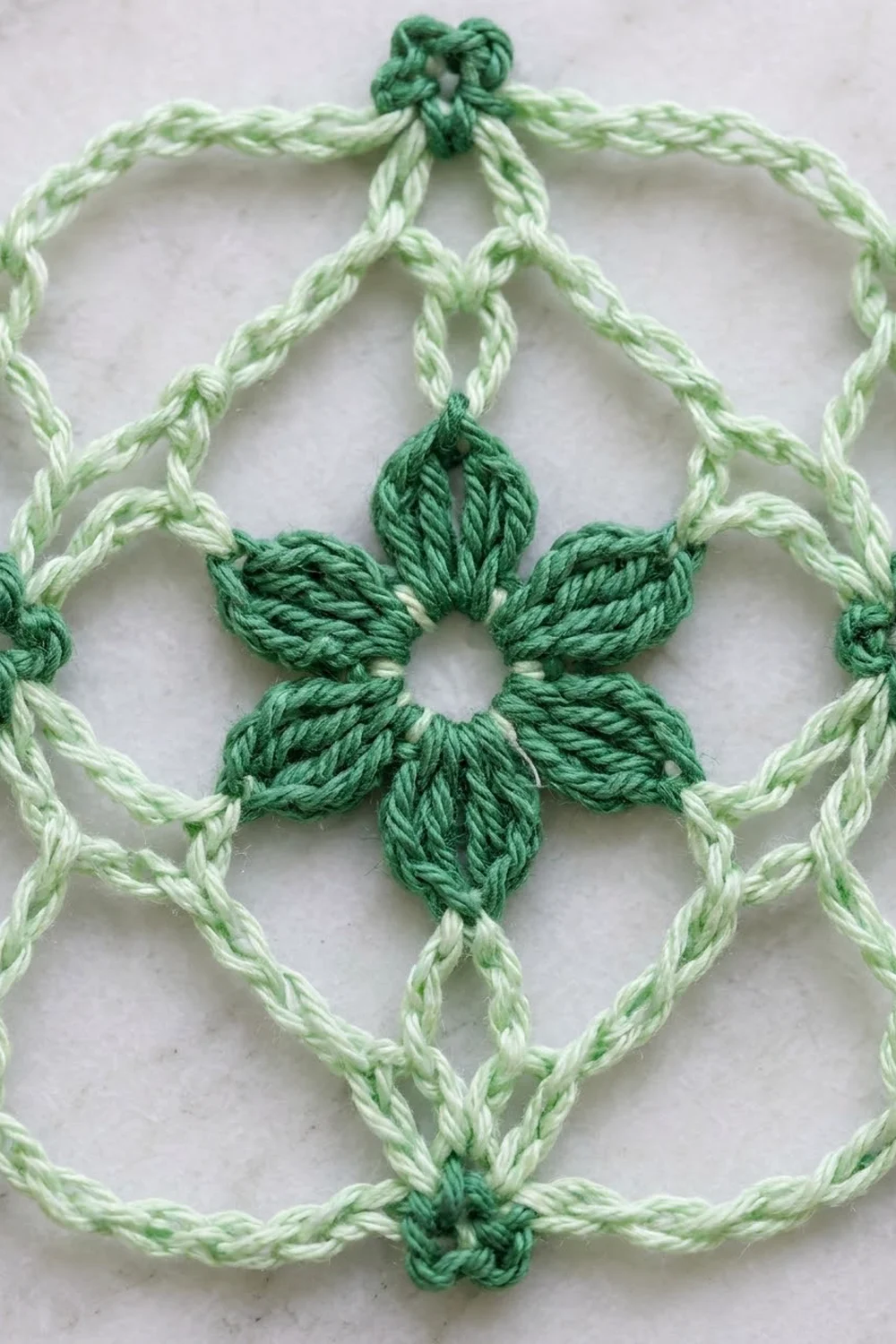
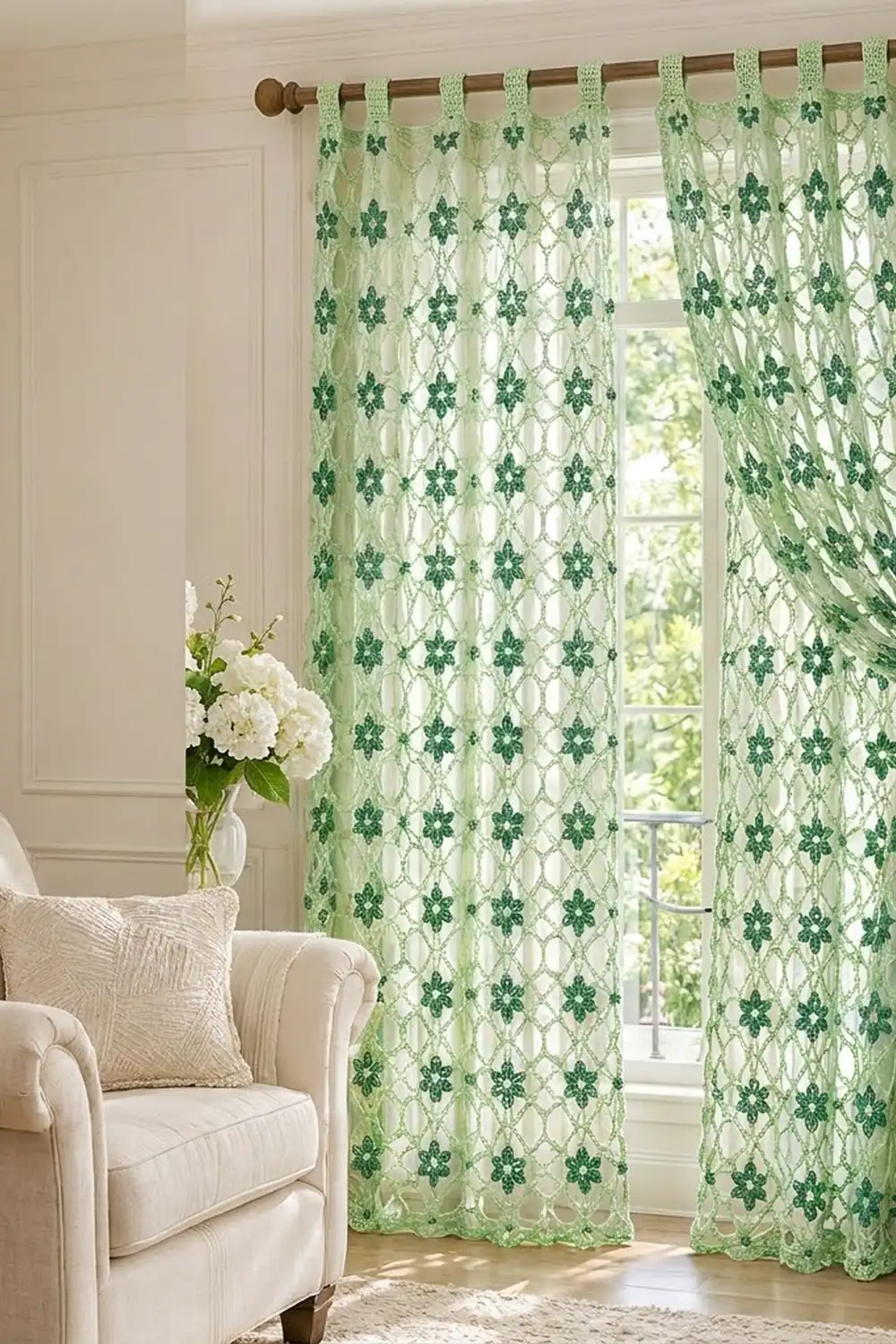
This curtain is a light, airy diamond net in soft mint green, scattered with dark forest green six-petal flowers and tiny round knots. The net is all chain loops, so daylight comes straight through while the flowers give it a crisp pattern from across the room.
The look is vintage cottage lace with a fresh two-tone palette: pale mint for the lattice and deep green for the appliqués. Each flower has an open ring center and six pointed petals, and the small knots sit on the net junctions between and above the flowers.
This pattern uses US crochet terms. One finished panel measures 45¼ in (114.9 cm) wide by 80½ in (204.5 cm) long, not counting the tabs. With tabs, it hangs about 84 in (213.4 cm) from the top of the rod. The photo shows two identical panels hung as a pair, so make two.
Construction is simple. You work the net as one piece in rows, add two rounds of border and the tabs, then sew the flower and knot appliqués on top in a planned grid.
Finished Size and Construction
- Finished size (one panel): 45¼ in x 80½ in (114.9 cm x 204.5 cm), plus tabs
- Skill level: Easy-intermediate (simple stitches, lots of repetition)
- Terminology: US
- Yarn weight: DK / light worsted (#3) cotton
- Hook: 4.5 mm (US 7)
- Number of pieces: 1 net panel, plus 91 flowers and 176 knots sewn on (make 2 panels for a pair)
- Layout: 13 flower rows of 7 flowers, with knots between and above the flowers
- Flower size: 3 in (7.6 cm) across; knot 0.75 in (1.9 cm)
- Size before border: 44¼ in x 79½ in (112.4 cm x 201.9 cm)
- Border depth: ½ in (1.3 cm) on every side
Materials
Use a smooth mercerized or matte cotton in DK weight, about 115 m per 50 g. Cotton holds its shape on a window and doesn’t fuzz in sunlight. Stay away from very stretchy acrylic, because a long chain net will sag under its own weight.
Per panel:
- Light green (net, border, tabs): 300 g, about 690 m
- Dark green (flowers and knots): 250 g, about 575 m
For a pair: 600 g (1,380 m) light green and 500 g (1,150 m) dark green.
All quantities include a safety margin of roughly 15-35%.
Tools:
- 4.5 mm (US 7) hook
- Tapestry needle
- Rust-proof pins and blocking mats or a sheeted carpet
- Measuring tape
- Removable stitch markers (about 20)
- Spray bottle
Abbreviations (US Terms)
- ch – chain
- sl st – slip stitch
- sc – single crochet
- hdc – half double crochet
- dc – double crochet
- tr – treble crochet
- sp(s) – space(s)
- st(s) – stitch(es)
- RS / WS – right side / wrong side
Special stitch: Leaf Petal. Work (sc, hdc, dc, tr, ch 2, tr, dc, hdc, sc) all into the same ch-3 sp. This makes 8 stitches plus a ch-2 tip, and the stitch posts give the petal its ribbed, pointed-leaf look.
Gauge and Checkpoints
Gauge: 16 sc = 4 in (10.2 cm). In the net, one ch-7 loop plus its sc spans 2 in (5.1 cm), and 4 net rows measure 4 in (10.2 cm) tall when lightly stretched.
Test piece first. Ch 34. Sc in the 2nd ch from the hook and in each ch across (33 sc). Then work Rows 2-9 of the net below, so you end with 4 loops. The swatch should measure 8¼ in (21.0 cm) wide by about 8¼ in (21.0 cm) tall after light pinning. Make one flower too, and check that it measures 3 in (7.6 cm) across.
Checkpoints:
- After Row 1: 44¼ in (112.4 cm) wide
- After Row 11: about 10¼ in (26.0 cm) long
- After Row 81: 79½ in (201.9 cm) long
- After the border: 45¼ in x 80½ in (114.9 cm x 204.5 cm)
Too big? Go down a hook size, or chain more firmly. Too small? Go up a hook size. If only the net is off, you can switch the loops to ch 6 or ch 8, but then recheck the full width before going further.
The Net Panel
With light green, ch 178.
Row 1 (RS): Sc in the 2nd ch from the hook and in each ch across. Turn. (177 sc)
Row 2 (Row B type): Ch 1, sc in the first sc, ch 7, skip 7 sc, sc in next sc. Repeat from * across. Turn. (23 sc, 22 ch-7 loops)
Row 3 (Row A type): Ch 5 (counts as dc + ch 2), sc in the center (4th) ch of the first ch-7 loop, ch 7, sc in the center ch of the next loop. Repeat from * across, ch 2, dc in the last sc. Turn. (22 sc, 21 ch-7 loops, plus 2 edge half-loops)
Row 4 (Row B type): Ch 1, sc in the first dc, ch 7, sc in the center ch of the next ch-7 loop. Repeat from * across to the last full loop, ch 7, sc in the 3rd ch of the turning ch-5. Turn. (23 sc, 22 ch-7 loops)
Rows 5-80: Repeat Rows 3 and 4 thirty-eight more times. Odd rows are Row A type and even rows are Row B type. Row 80 is a Row B type row with 23 sc and 22 loops.
Each sc lands in the middle of a loop from the row below. That is what forms the diamond openings: each opening is bounded by two loops of one row and two loops of the next.
Row 81 (closing row): Ch 1, sc in the first sc, 7 sc in the next ch-7 loop, sc in next sc. Repeat from * across. Count: 23 sc worked 1-per-existing-sc + 154 sc worked into the 22 loops (7 each) = 177 sc. This matches Row 1 so the bottom edge hangs straight. Do not fasten off, and do not turn.
Checkpoint: The panel measures 44¼ in x 79½ in (112.4 cm x 201.9 cm).
Border
Border gauge: 4 sc per inch along every edge. On the sides, each net row is 1 in (2.5 cm) tall, so it gets 4 sc.
Round 1: Ch 2 (corner) and rotate to work down the side.
- First side: Work 4 sc around the edge post (the dc and ch-2 half-loop, or the end sc) of each net row from Row 80 to Row 2. Skip the row-ends of Rows 81 and 1, because their end stitches sit at the corners. That’s 79 x 4 = 316 sc. Ch 2 (corner).
- Top: Work 1 sc into the free loop of each foundation ch (177 sc). Ch 2 (corner).
- Second side: Work 316 sc as before. Ch 2 (corner).
- Bottom: Work 1 sc in each st of Row 81 (177 sc).
Join with a sl st to the first ch of the starting ch-2. (986 sc + 4 ch-2 corners)
In this round, the side counts don’t include corner stitches, because each corner is its own ch-2 sp.
Round 2: Ch 1. Sc in each sc around, and work (sc, ch 2, sc) in each corner ch-2 sp. Join with a sl st.
- Top and bottom: 177 (1 per existing st) + 2 (one from each corner group) = 179 sc
- Each side: 316 + 2 = 318 sc
- Total: 986 + 8 = 994 sc + 4 ch-2 corners
Why the math works: 177 sc at 4 per inch gives the 44¼ in (112.4 cm) width, and 316 sc at 4 per inch gives the 79 in (200.7 cm) of net. Every edge is worked at the same gauge as the body, so the border lies flat instead of rippling or pulling in. Each round adds ¼ in (0.6 cm), which makes ½ in (1.3 cm) per side, for a total of 45¼ in x 80½ in (114.9 cm x 204.5 cm). Fasten off.
Tabs
There are 8 tabs, each 11 sts wide, with 13 sts between tabs: 8 x 11 + 7 x 13 = 88 + 91 = 179, which is exactly the top edge count.
With RS facing, join light green in the first sc of the top edge (the sc just after the corner ch-2).
- Row 1: Ch 1, sc in the same st and next 10 sts. (11 sc)
- Rows 2-28: Ch 1, turn, sc in each sc. (11 sc)
Fasten off, leaving a 12 in (30.5 cm) tail. Skip 13 sts, join in the next st, and repeat. The last tab ends in the final top sc before the corner.
Each tab is 2¾ in (7.0 cm) wide and 7 in (17.8 cm) long. Fold it to the WS and whipstitch the last row along the base of the tab, just below border Round 1. That makes a 3½ in (8.9 cm) loop.
Flowers and Knots
Flower (make 91 per panel, dark green):
- Round 1: Ch 6, sl st to the first ch to form a ring. Ch 1, 12 sc in the ring, join with a sl st to the first sc. (12 sc)
- Round 2: Ch 1, sc in the same st, ch 3, skip next sc, sc in next sc, ch 3, skip next sc. Repeat from * 4 more times and join. (6 sc, 6 ch-3 sps)
- Round 3: Sl st into the first ch-3 sp. Work a Leaf Petal in each ch-3 sp around and join to the first sc. (6 petals = 48 sts + 6 ch-2 tips)
Fasten off, leaving a 10 in (25.4 cm) tail. The ring keeps the center open, and each ch-2 tip becomes a tacking point.
Knot (make 176 per panel, dark green): Ch 4, sl st to form a ring. Ch 1, 8 sc in the ring, join. (8 sc) Fasten off, leaving an 8 in (20.3 cm) tail.
Counts per panel: 13 flower rows x 7 flowers = 91 flowers. Knots: 13 flower rows x 6 + 14 knot rows x 7 = 78 + 98 = 176. Double these for a pair.
Make All Pieces and Layout
Measure positions from the left edge of the net in inches, from 0 to 44.
- Flower rows are net Rows 5, 11, 17 … 77 (13 rows). Center each flower over the diamond opening at 4, 10, 16, 22, 28, 34 and 40 in. Knots go on the Row A sc junctions at 7, 13, 19, 25, 31 and 37 in.
- Knot rows are net Rows 2, 8, 14 … 80 (14 rows). Knots go on the Row B sc junctions at 4, 10 … 40 in, directly above and below the flowers.
Knot row:    .  K  .  K  .  K  .  K  .  K  .  K  .  K  .
Flower row:  .  F  K  F  K  F  K  F  K  F  K  F  K  F  .
Knot row:    .  K  .  K  .  K  .  K  .  K  .  K  .  K  .
(repeat to Row 80; F = flower, K = knot)
The flowers sit 6 in (15.2 cm) apart center to center in both directions, with a 4 in (10.2 cm) margin on each side.
Attaching the Appliqués
Lay the panel flat, RS up, and mark the 13 flower rows with stitch markers.
Flowers: Center each flower over its diamond opening, with one petal pointing straight up. Use the tail to tack each ch-2 petal tip to the nearest chain or junction with 2-3 small stitches. Run the yarn through the back of the petal between tips so nothing shows. You get 6 tacks per flower.
Knots: Lay each knot over its sc junction. Stitch through the center ring and around the junction, then weave in the tail.
Tension: Tack loosely enough that the net doesn’t pucker behind the flower, but firmly enough that petals don’t flip over when the curtain moves. Check the width of each flower row as you finish it. It should still be 44¼ in (112.4 cm) inside the border.
Final Blocking
- Soak the panel in cool water for 10 minutes, then press the water out in a towel. Don’t wring it.
- Lay it RS up on mats or a sheeted carpet.
- Pin the corners to 45¼ in x 80½ in (114.9 cm x 204.5 cm).
- Pin along every edge every 4 in (10.2 cm).
- Ease the diamonds open so the loops form even shapes, and smooth each flower flat.
- Let it dry completely, then hang it for a day so gravity evens out the chains.
Final Quality-Control Checklist
- Row 1 and Row 81 both have 177 sc
- Every net row has 22 ch-7 loops (or 21 loops plus 2 half-loops)
- After border Round 2, the sides have 318 sc and the top and bottom have 179 sc
- There are 8 tabs, evenly spaced and all the same length
- Each panel has 91 flowers and 176 knots, all in grid position
- All tails are woven in on the WS
- The blocked size is 45¼ in x 80½ in (114.9 cm x 204.5 cm)
Troubleshooting
- Net slants to one side: You probably dropped an edge half-loop. Count 22 sc in every Row A type row.
- Diamonds look tall and narrow: Your chains are too tight. Go up a hook size for the chains only.
- Bottom edge flares: Row 81 has too many stitches. Work exactly 7 sc per loop.
- Border ripples: You have too many sc per row-end. Keep it to 4.
- Flowers cup: Your Round 1 ring is too tight. Use a ch-7 ring instead.
- Panel grows after hanging: Cotton relaxes over time. Rewash it and block it back to size.
Care
Hand wash in cool water with a mild detergent and dry flat. If it needs it, press lightly on a low setting through a cloth.
Final Notes
The measurement chain is short and reliable. At 16 sc to 4 in (10.2 cm), 177 sc gives 44¼ in (112.4 cm). Each 2 in (5.1 cm) loop, repeated 22 times, keeps the net exactly that wide, and seventy-nine 1 in (2.5 cm) rows give the length. The ½ in (1.3 cm) border then brings one panel to 45¼ in x 80½ in (114.9 cm x 204.5 cm), and the flowers drop neatly into a 6 in (15.2 cm) grid. Check your swatch and count at each checkpoint, and your pair of curtains will hang straight and even.
Happy crocheting!