
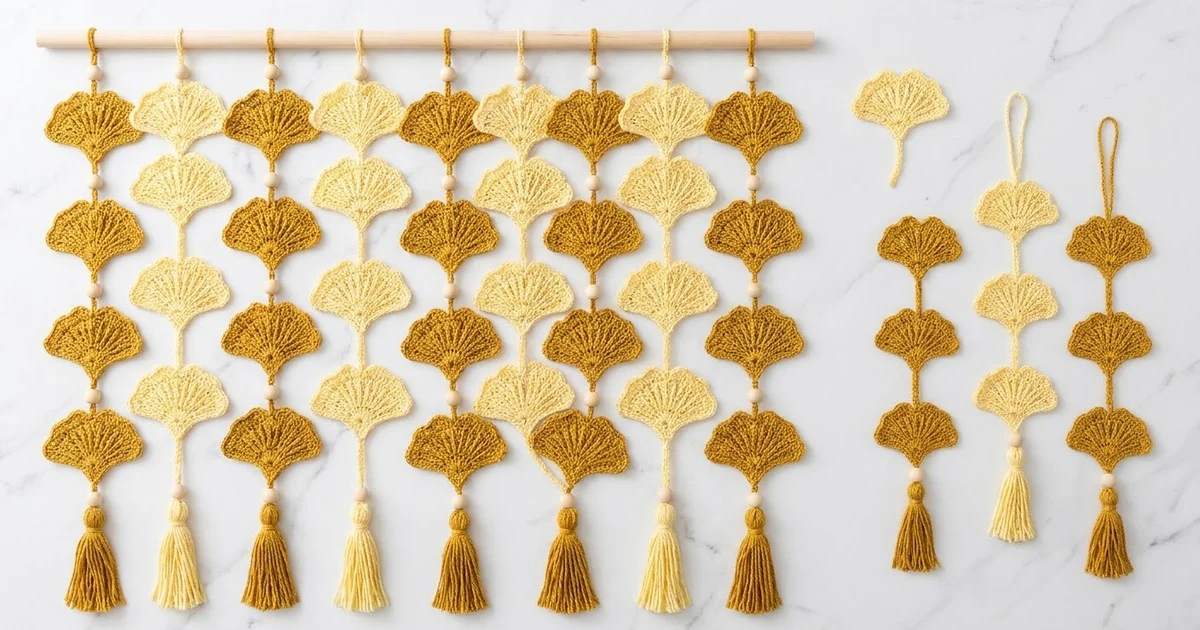
This curtain is made from lacy ginkgo leaves hung in long vertical strands. Each leaf has a small solid fan at the base, a ring of open spokes, and a two-lobed scalloped edge with a small notch at the top center, like a real ginkgo leaf. Chain links with natural wooden beads join the leaves, and every strand ends in a full yarn tassel.
The curtain uses two warm yellows: a soft pale yellow and a deep mustard gold. Every strand is one color, and the strands alternate across the rod. The look is light, cheerful, and a little botanical. It works well in a window, a doorway, or a reading nook, and lets light through every spoke.
This pattern uses US crochet terms. The finished curtain is 9 strands wide, about 40 in (101.6 cm) across the rod. Each strand hangs about 39 3/4 in (101.0 cm) from the rod to the tassel tip. Each leaf measures 4 in (10.2 cm) wide and 2 1/4 in (5.7 cm) tall, plus a 1 in (2.5 cm) stem.
Construction is simple. You crochet each leaf flat in 5 short rows, starting at the stem. Then you link the leaves top to bottom with beaded chains and add a hanging loop and a tassel to each strand.
Finished Size and Construction
- Finished curtain: about 40 in (101.6 cm) wide × 39 3/4 in (101.0 cm) long
- Skill level: Easy
- Terminology: US crochet terms
- Yarn weight: DK / light worsted (#3) cotton
- Hook: 4.0 mm (US G-6)
- Number of pieces: 63 leaves, 9 tassels, 63 beads
- Layout: 9 strands × 7 leaves, colors alternating by strand
- Leaf size: 4 in (10.2 cm) wide × 2 1/4 in (5.7 cm) tall, plus 1 in (2.5 cm) stem
- Leaf size before edging (border): 3 1/2 in (8.9 cm) wide × 1 3/4 in (4.4 cm) tall
- Edging depth: 1/2 in (1.3 cm) at the lobe peaks, 1/4 in (0.6 cm) at each outer corner, 0 at the center notch
Materials
Choose a smooth mercerized or combed cotton in DK weight. Cotton shows the spokes clearly and hangs straight without stretching. Avoid fuzzy or very soft acrylic, because it can close up the open spaces and stretch under the weight of the beads.
- Pale yellow (Color A): 150 g, about 360 m (5 strands: 35 leaves, 5 tassels)
- Mustard gold (Color B): 100 g, about 240 m (4 strands: 28 leaves, 4 tassels)
These quantities include about 30–40% extra for gauge differences, tassels, and a test leaf.
Tools:
- 4.0 mm (US G-6) crochet hook
- 1.0 mm steel hook or a dental floss threader (for pulling chains through beads)
- 63 natural wooden beads, 12 mm (about 1/2 in / 1.3 cm), hole at least 3 mm
- Stiff card, 4 in (10.2 cm) tall, for tassels
- Tapestry needle and scissors
- Rust-proof pins, blocking mat, spray bottle
- Curtain rod at least 42 in (106.7 cm) long
Abbreviations (US Terms)
- ch – chain
- sl st – slip stitch
- sc – single crochet
- hdc – half double crochet
- dc – double crochet
- tr – treble crochet (yarn over twice, insert hook, pull up a loop, [yarn over, pull through 2 loops] 3 times)
- sp – space
- st(s) – stitch(es)
- rep – repeat
Special technique – inline bead: Take the hook out of the working loop. Push the 1.0 mm hook (or floss threader) through the bead, catch the loop, and pull it through so the bead sits on the chain. Put your 4.0 mm hook back in the loop and keep chaining.
Gauge and Checkpoints
Gauge: 18 dc = 4 in (10.2 cm); 6 ch = 1 in (2.5 cm). Leaf size matters more than swatch gauge, so make one full test leaf first and measure it.
Checkpoints for one leaf (measured flat, without stretching):
- After Row 1: fan about 1 in (2.5 cm) wide
- After Row 2: about 1 3/4 in (4.4 cm) wide
- After Row 3: about 3 in (7.6 cm) wide
- After Row 4: 3 1/2 in (8.9 cm) wide × 1 3/4 in (4.4 cm) tall
- After Row 5: 4 in (10.2 cm) wide × 2 1/4 in (5.7 cm) tall
If your leaf is too big: Change to a 3.5 mm hook, or check that your ch-2 spaces aren’t loose.
If your leaf is too small: Change to a 4.5 mm hook. Small leaves make every strand shorter, so fix this before you make all 63.
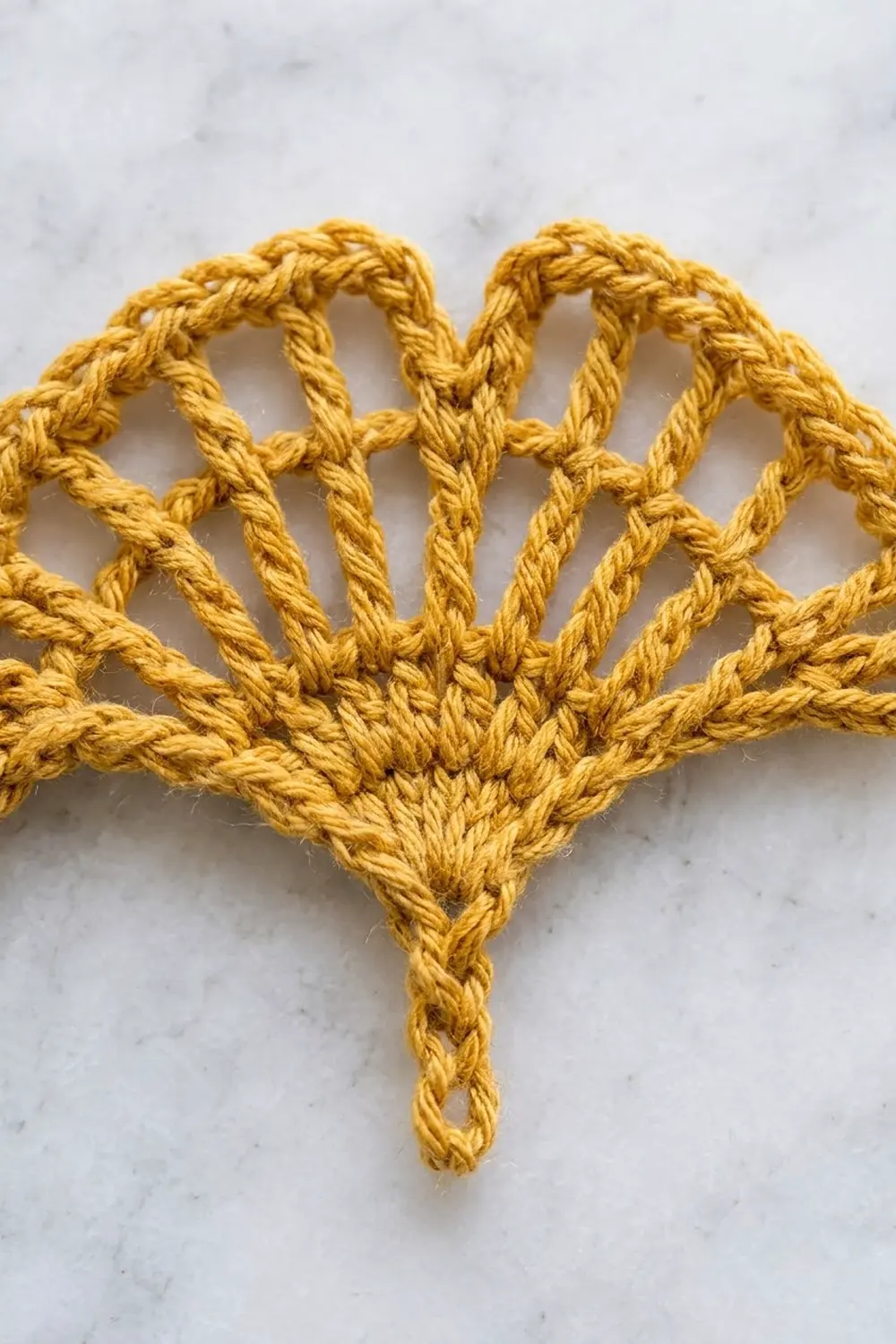
Ginkgo Leaf (make 63)
The leaf is worked flat in rows, turning after each row. The beginning chain becomes the stem.
Row 1: Ch 10. Work 5 dc in 4th ch from hook. Turn. (6 dc. The 3 skipped ch count as the first dc, and the other 6 ch form the stem.)
Row 2: Ch 3 (counts as dc), dc in same st, 2 dc in each remaining st across, working the last 2 dc into the top of the beginning skipped ch. Turn. (12 dc)
This row is the solid inner fan at the base of the leaf.
Row 3 (spokes): Ch 6 (counts as tr + ch 2), tr in next dc, *ch 2, tr in next dc; rep from * across, ending in the top of the turning ch. Turn. (12 tr, 11 ch-2 sps)
These 12 tall stitches are the spokes. Keep the ch-2 spaces even so the spokes fan out evenly.
Row 4 (frame): Ch 1, sc in first tr, *2 sc in next ch-2 sp, sc in next tr; rep from * 11 times, working the last sc in the 4th ch of the beginning ch-6. Turn. (34 sc: 12 sc worked 1 per tr + 22 sc worked 2 per space)
Check your size: the leaf should now be 3 1/2 in (8.9 cm) wide and 1 3/4 in (4.4 cm) tall. This is the size before the edging. Work Row 5 (see Border) on every leaf before you join anything.
Make All Pieces
Make each strand in one color. Finish one complete strand and measure it before making the rest.
- Color A (pale yellow): 35 leaves, 5 tassels, 5 hanging loops and connector sets
- Color B (mustard gold): 28 leaves, 4 tassels, 4 hanging loops and connector sets
- Beads: 7 per strand, 63 total
Layout grid (strands left to right, A = pale yellow, B = mustard):
Strand:  1  2  3  4  5  6  7  8  9
Leaf 1:  A  B  A  B  A  B  A  B  A
Leaf 2:  A  B  A  B  A  B  A  B  A
Leaf 3:  A  B  A  B  A  B  A  B  A
Leaf 4:  A  B  A  B  A  B  A  B  A
Leaf 5:  A  B  A  B  A  B  A  B  A
Leaf 6:  A  B  A  B  A  B  A  B  A
Leaf 7:  A  B  A  B  A  B  A  B  A
Joining
The leaves are joined in a vertical line with beaded chains. Each connector runs from the stem tip of one leaf to the center notch of the leaf below.
Where to join: The stem tip is the first ch of the Row 1 beginning chain (the one with the slip knot). The center notch is the gap between the two center sl sts of Row 5 (sts 17 and 18). That gap is directly above the center ch-2 space of Row 3, so each leaf hangs straight.
Hanging loop and neck (top of strand): Ch 24, sl st in first ch to form a loop. Ch 6, sl st into the center notch of Leaf 1. Fasten off. (The loop hangs down 2 in / 5.1 cm, and the neck is 1 in / 2.5 cm.)
Connector (between leaves, make 6 per strand): Join yarn with a sl st in the stem tip of the leaf above. Ch 3, add an inline bead, ch 3, sl st into the center notch of the next leaf. Fasten off. (Each connector is about 1 1/2 in / 3.8 cm long.)
Bottom finish: Join yarn in the stem tip of Leaf 7. Ch 3, add an inline bead, ch 3. Fasten off, leaving a 6 in (15.2 cm) tail to tie on the tassel.
Tassel (make 9): Wrap yarn 30 times around the 4 in (10.2 cm) card. Tie the top with the bottom-finish tail. Slide the wraps off the card. Wrap a separate piece of yarn 6 times around the bundle 3/8 in (1.0 cm) below the top, and knot it. Cut the bottom loops and trim the tassel evenly to 4 in (10.2 cm).
Tension advice: Chain at the same tension you use for the leaves. Tight connectors pull the notch into a sharp V, and loose ones let the beads slide and twist.
Strand checkpoint:
- Hanging loop drop: 2 in (5.1 cm)
- Neck: 1 in (2.5 cm)
- 7 leaves × 2 1/4 in (5.7 cm) = 15 3/4 in (40.0 cm)
- 7 stems × 1 in (2.5 cm) = 7 in (17.8 cm)
- 6 connectors × 1 1/2 in (3.8 cm) = 9 in (22.9 cm)
- Bottom chain, bead, and tassel: 5 in (12.7 cm)
- Total: about 39 3/4 in (101.0 cm)
Hanging: Slide the loops onto the rod in grid order, with 4 1/2 in (11.4 cm) between strand centers. The leaves are 4 in (10.2 cm) wide, so this leaves a 1/2 in (1.3 cm) gap between neighboring leaves. Width across all 9 strands: 8 × 4 1/2 in + 4 in = 40 in (101.6 cm).
Border (Leaf Edging)
In this design, the border is the scalloped edging (Row 5) worked on every leaf. It turns the flat frame into the two rounded lobes and center notch of a ginkgo leaf.
Border gauge: The dc at the lobe peaks add 1/2 in (1.3 cm), the sc at the outer corners add 1/4 in (0.6 cm), and the sl sts at the center add nothing.
Row 5: Ch 1. Then work 1 st into each Row 4 sc as follows:
Left lobe (17 sts): sc in first 2 sts, hdc in next 2 sts, dc in next 9 sts, hdc in next 2 sts, sc in next st, sl st in next st.
Right lobe (17 sts): sl st in next st, sc in next st, hdc in next 2 sts, dc in next 9 sts, hdc in next 2 sts, sc in last 2 sts.
(34 sts: 17 per lobe.) Fasten off and weave in this end. Leave the starting tail at the stem tip until the leaf is joined.
Why the math works: Row 4 has 34 sc, and Row 5 works 1 stitch into each one, so the count stays at 34 with nothing added. The 2 center sc (sts 17 and 18) sit in the 6th ch-2 space, which is the middle of the 11 spaces. Placing the 2 sl sts there puts the notch exactly on the center line. Both lobes have the same 17 stitches in mirror order, so they rise to the same height and the leaf hangs level.
Final Blocking
- Weave in all leaf ends except the stem tails if they aren’t joined yet.
- Lay each leaf flat on a blocking mat, right side up.
- Pin the stem straight down, then pin the two outer corners so the leaf is 4 in (10.2 cm) wide.
- Pin each lobe peak so the leaf is 2 1/4 in (5.7 cm) tall, and pin the notch slightly lower than the peaks.
- Open each spoke space evenly with your fingers so all 11 spaces match.
- Spray with water until damp, not soaked.
- Let the leaves dry completely, about 6–8 hours.
- After joining, hang each strand and lightly steam the tassels and connectors so they fall straight.
Final Quality-Control Checklist
- Every leaf has 12 spokes and 34 edge stitches.
- Every leaf measures 4 in (10.2 cm) × 2 1/4 in (5.7 cm), plus a 1 in (2.5 cm) stem.
- Each center notch lines up directly above the stem.
- Each strand has 7 leaves, 7 beads, 1 hanging loop, and 1 tassel.
- Each strand is about 39 3/4 in (101.0 cm) long, within 1/2 in (1.3 cm) of the others.
- Colors alternate A, B, A across the rod, with A at both ends.
- All tassels are trimmed to 4 in (10.2 cm).
- All ends are woven in and trimmed.
Troubleshooting
Leaf ruffles at the edge: Your Row 4 sc are loose. Use a hook half a size smaller for Rows 4–5 only, or block more firmly.
Leaf cups instead of lying flat: Your Row 3 chains are too tight. Loosen the ch-2 spaces or use a slightly larger hook for that row.
Notch is off-center: Recount Row 4. The 2 center sl sts must land on sts 17 and 18.
Leaves twist on the strand: Join each connector exactly in the notch and the stem tip, not beside them. Light steam also helps.
Bead won’t go on: Use beads with larger holes, or pull through a single loop instead of a doubled one.
Strands are different lengths: Measure each strand against the checkpoint list, and add or remove 1 ch in a connector if needed.
Care
Dust gently, or hand wash in cool water with mild soap and keep the wooden beads as dry as you can. Lay flat to dry, reshape the leaves, and comb the tassels straight.
Final Notes
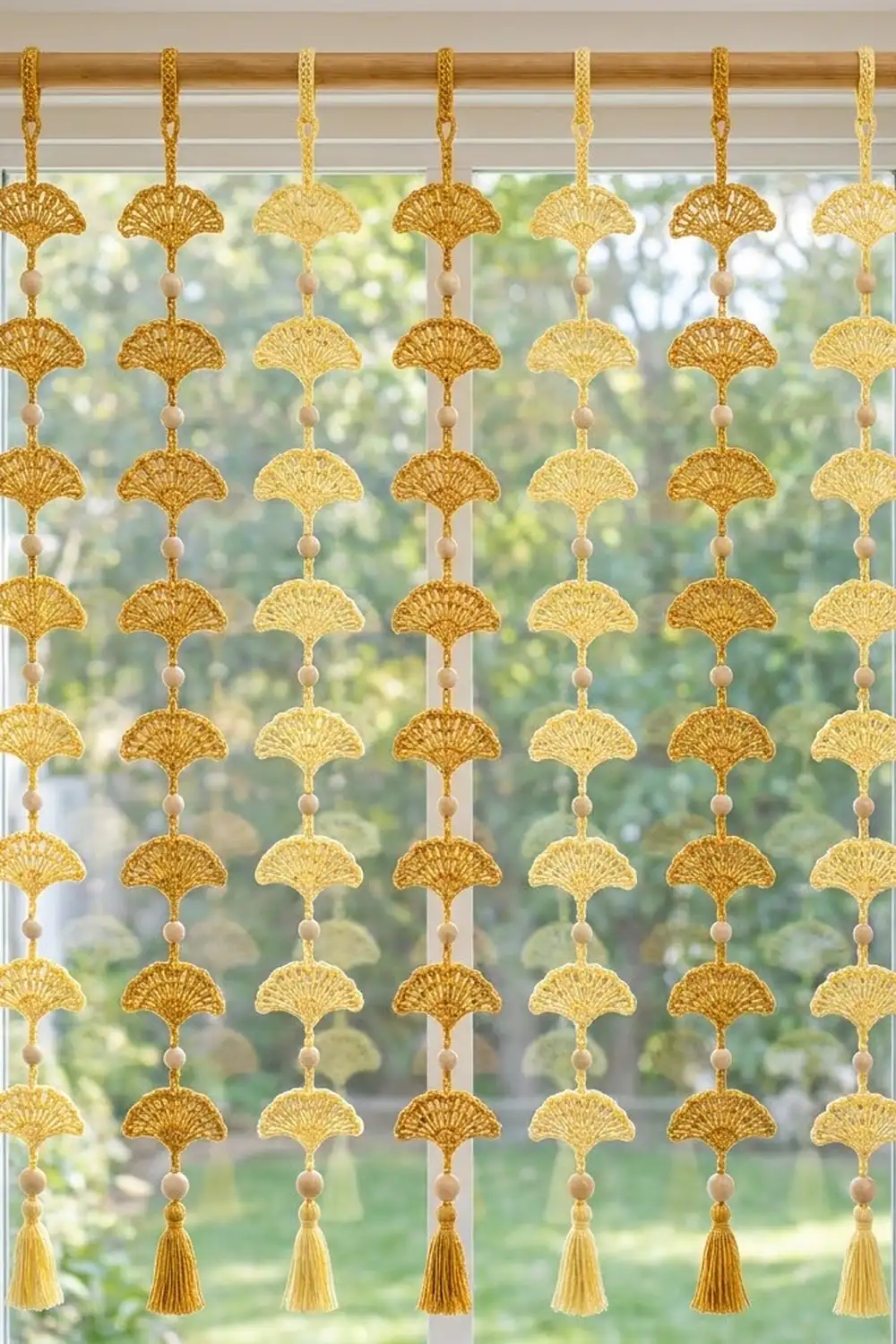
Here is how the measurements build up. A leaf that is 3 1/2 in (8.9 cm) wide before edging becomes 4 in (10.2 cm) wide after edging. Seven leaves with stems and beaded connectors make a strand about 39 3/4 in (101.0 cm) long. Nine strands spaced 4 1/2 in (11.4 cm) apart span 40 in (101.6 cm) of rod. Check one leaf, then one strand, and the rest of the curtain will match.
Happy crocheting!