

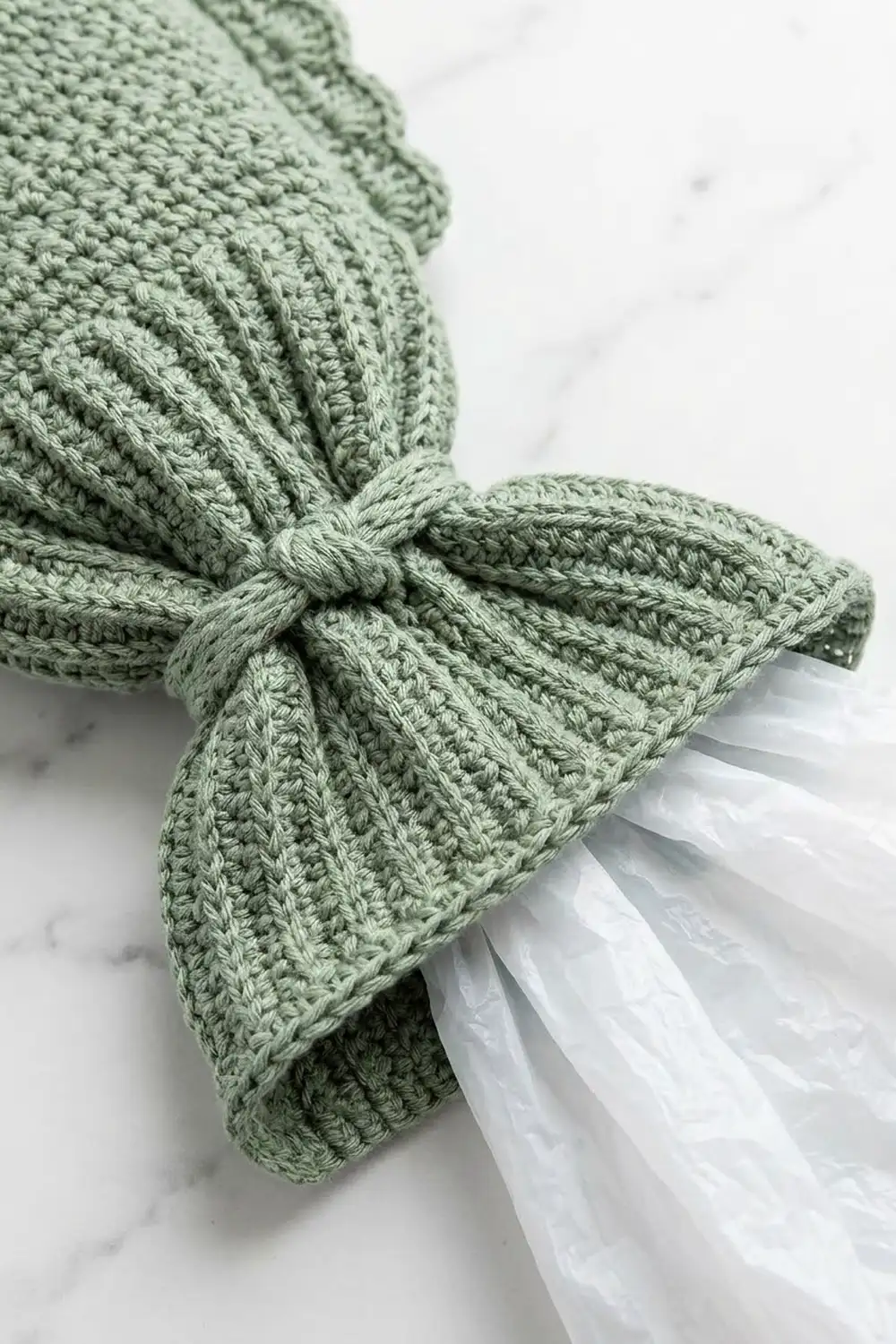
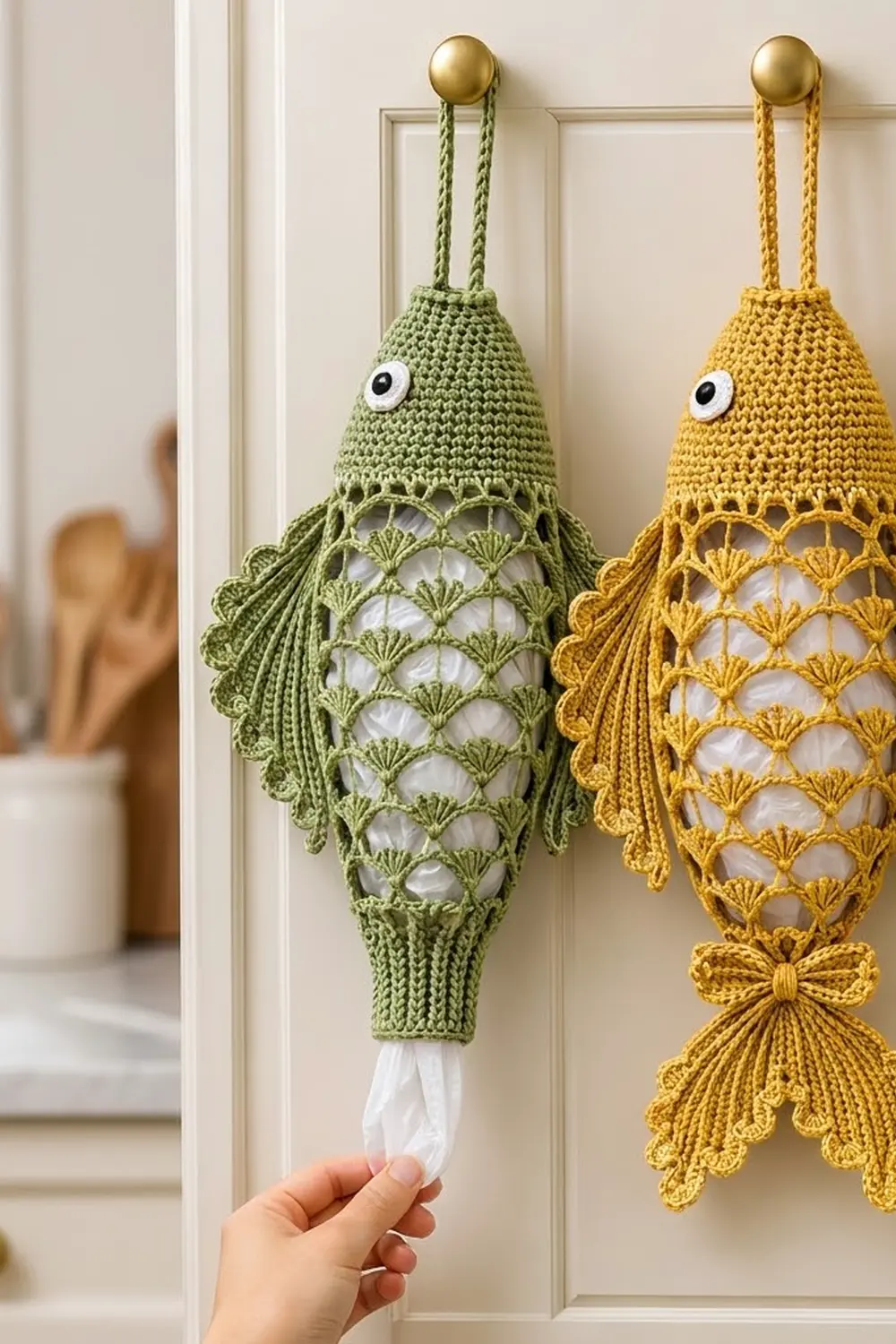
This fish keeps plastic grocery bags tidy. Its body is an openwork tube with eight tiers of fan-shaped scales, a solid head and a ribbed cuff at the tail end. It also has two ridged side fins, a bow-shaped tail and two hanging loops. You stuff bags in through the mouth and pull them out one at a time through the cuff.
The sample is a soft sage green with a white-and-black eye. A mustard-yellow twin is made exactly the same way, so one pattern gives you a matching pair. The style is botanical and a little vintage, and it suits a kitchen or pantry door.
This pattern uses US crochet terms. The finished fish is about 17 in (43.2 cm) long from the mouth rim to the tail tips, not counting the loops. The body is about 6.4 in (16.3 cm) wide when flat, and the fish is about 10 in (25.4 cm) wide across the fins.
You work the body in one piece in joined rounds, from the cuff up to the mouth. The fins and tail are worked flat in rows and finished with a scalloped edge. Then you make the eyes and chain cords and sew everything on.
Finished Size and Construction
- Finished size: 17 in (43.2 cm) long × 10 in (25.4 cm) wide across the fins
- Skill level: Intermediate
- Terminology: US
- Yarn weight: DK (#3) cotton
- Hook: 3.5 mm (E-4)
- Number of pieces: 8 (1 body, 2 fins, 1 tail, 2 eyes, 2 hanging cords)
- Layout: body vertical; one fin on each side below the head; tail centered over the cuff; cords at the mouth rim
- Body size: 14 in (35.6 cm) long × 6.4 in (16.3 cm) wide at the widest point
- Fin size before border: 5.75 in (14.6 cm) × 1.6 in (4.1 cm)
- Tail size before border: 3.1 in (7.9 cm) tall; 5 in (12.7 cm) wide at the top edge and 6.6 in (16.8 cm) at the bottom edge
- Border depth: the scallops add 0.4 in (1.0 cm) to each edge they’re worked on
Materials
Use a smooth mercerized or combed cotton in DK weight, about 113 m (124 yd) per 50 g. Cotton keeps the fan scales crisp and won’t stretch much under the weight of the bags. Acrylic works too, but the mesh will sag more.
- Sage green (main color): 110 g, about 249 m (272 yd)
- White (eyes): 3 g, about 7 m (8 yd)
- Optional second fish in mustard yellow: 110 g, about 249 m (272 yd)
Tools:
- 3.5 mm (E-4) crochet hook
- 2 black safety eyes (9 mm) or 2 black shank buttons
- Tapestry needle
- Stitch markers
- Rust-proof pins and a blocking board
- Measuring tape
The quantities include a margin of about 10% for swatching and sewing tails.
Abbreviations (US Terms)
- ch – chain
- sl st – slip stitch
- sc – single crochet
- hdc – half double crochet
- dc – double crochet
- sc2tog – single crochet 2 together
- fpdc – front post double crochet
- bpdc – back post double crochet
- BLO – back loop only
- sk – skip
- st(s) – stitch(es)
- sp – space
Special stitch – Fan: Work the stated number of dc (5, 7 or 9) into the same ch-loop.
Special stitch – Scallop: Sk 1 st, 5 dc in next st, sk 1 st, sc in next st. Each Scallop uses 4 sts.
Gauge and Checkpoints
Gauge: 20 sc × 22 rounds = 4 in (10.2 cm) in sc worked in rounds. In dc, 20 sts × 10 rows = 4 in (10.2 cm).
Make the body first, because it’s the piece most affected by gauge. Check it at these points:
- After Rnd 4 (cuff): 3.2 in (8.1 cm) wide when flat and 1.75 in (4.4 cm) tall.
- After Rnd 12: One Fan plus its sc measures about 1.6 in (4.1 cm). The body is about 6.4 in (16.3 cm) wide when flat.
- After Rnd 21: About 10.5 in (26.7 cm) from the bottom edge.
- After Rnd 23: 4.8 in (12.2 cm) wide when flat and about 11.5 in (29.2 cm) long.
- After Rnd 38: 14 in (35.6 cm) long, with the mouth 3 in (7.6 cm) wide when flat.
If the cuff is more than 0.25 in (0.6 cm) too wide, go down half a hook size. If it’s too narrow, go up half a size. If the width is right but the mesh is too short, make your dc a little taller rather than changing hooks.
Body
Work in joined rounds with the right side facing you. The starting ch-1 and ch-2 never count as stitches. A starting ch-3 or ch-4 counts only where the pattern says so.
Cuff
Ch 32 and join with a sl st to form a ring, taking care not to twist the chain.
Rnd 1: Ch 1, sc in each ch around, join. (32 sc)
Rnd 2: Ch 2, dc in each st around, join. (32 dc)
Rnds 3–4: Ch 2, fpdc around next st, bpdc around next st; repeat around, join. (32 sts)
Scale Mesh
Rnd 5: Ch 1, sc in first st, ch 5, sk 3, sc in next st, ch 5, sk 3; repeat 6 more times, join to first sc. (8 sc, 8 ch-5 loops)
Rnd 6: Sl st into first loop, ch 3 (counts as dc), 4 dc in same loop, sc in next sc, 5-dc Fan in next loop, sc in next sc; repeat 6 more times, join to top of ch-3. (40 dc + 8 sc = 48 sts)
Rnd 7: Sl st in next 2 dc, ch 1, sc in same st (the center dc of the Fan), ch 6, sc in center dc of next Fan, ch 6; repeat 6 more times, join. (8 sc, 8 ch-6 loops)
Each loop passes over the sc between two fans. That’s why every new tier of fans sits between the fans below, like real scales.
Rnd 8: Sl st into loop, ch 3, 6 dc in same loop, sc in next sc, 7-dc Fan in next loop, sc in next sc; repeat 6 more times, join. (56 dc + 8 sc = 64 sts)
Rnd 9: Sl st in next 3 dc, ch 1, sc in same st (4th dc), ch 7, sc in 4th dc of next Fan, ch 7; repeat 6 more times, join. (8 sc, 8 ch-7 loops)
Rnd 10: Sl st into loop, ch 3, 8 dc in same loop, sc in next sc, 9-dc Fan in next loop, sc in next sc; repeat 6 more times, join. (72 dc + 8 sc = 80 sts)
Rnd 11: Sl st in next 4 dc, ch 1, sc in same st (5th dc), ch 8, sc in 5th dc of next Fan, ch 8; repeat 6 more times, join. (8 sc, 8 ch-8 loops)
Rnds 12, 14 and 16: Repeat Rnd 10. (80 sts each)
Rnds 13 and 15: Repeat Rnd 11. (8 sc, 8 ch-8 loops each)
Rnd 17: Work as for Rnd 11, but ch 7 between the sc. (8 sc, 8 ch-7 loops)
Rnd 18: Repeat Rnd 8. (64 sts)
Rnd 19: Sl st in next 3 dc, ch 1, sc in same st (4th dc), ch 6, sc in 4th dc of next Fan, ch 6; repeat 6 more times, join. (8 sc, 8 ch-6 loops)
Rnd 20: Repeat Rnd 8. (64 sts)
You now have eight tiers of fans, one on each even round from Rnd 6 to Rnd 20. The mesh widens through Rnd 10, stays full width through Rnd 16 and then narrows toward the head.
Rnd 21: Sl st in next 3 dc, ch 1, sc in same st (4th dc), ch 5, sc in 4th dc of next Fan, ch 5; repeat 6 more times, join. (8 sc, 8 ch-5 loops)
Eyelet Band (conversion)
Rnd 22: Ch 4 (counts as dc + ch 1), [dc, ch 1] twice in next loop, dc in next sc, ch 1, [dc, ch 1] twice in next loop; repeat 6 more times, join to 3rd ch of ch-4.
Count: 8 dc worked 1-per-sc + 16 dc added in the loops = 24 dc, plus 24 ch-1 sps = 48 sts.
Rnd 23: Ch 1, sc in each dc and in each ch-1 sp, join. (24 sc in dc + 24 sc in sps = 48 sc)
Head
Rnds 24–27: Ch 1, sc in each st, join. (48 sc)
Rnd 28: Ch 1, sc in next 6 sts, sc2tog; repeat 5 more times, join. (42 sc)
Rnds 29–30: Sc around. (42 sc)
Rnd 31: Ch 1, sc in next 5 sts, sc2tog; repeat 5 more times, join. (36 sc)
Rnds 32–33: Sc around. (36 sc)
Rnd 34: Ch 1, sc in next 4 sts, sc2tog; repeat 5 more times, join. (30 sc)
Rnds 35–37: Sc around. (30 sc)
Rnd 38 is worked in the Border section. The head is about 2.5 in (6.4 cm) tall and tapers from 4.8 in (12.2 cm) to 3 in (7.6 cm) wide when flat.
Fins (make 2)
Foundation: Ch 30.
Row 1 (RS): Sc in 2nd ch from hook, hdc in next 3 ch, dc in next 21 ch, hdc in next 3 ch, sc in last ch, turn. (29 sts)
Row 2: Ch 1, sc BLO in each st across, turn. (29 sc)
Row 3: Ch 1. Working in BLO: sc in first st, hdc in next 3, dc in next 21, hdc in next 3, sc in last, turn. (29 sts)
Rows 4–5: Repeat Rows 2–3. (29 sts)
Working in the back loop leaves raised ridges along the length of the fin. The short stitches at each end taper it into a curved leaf shape. At this stage the fin measures 5.75 in (14.6 cm) × 1.6 in (4.1 cm). Don’t fasten off. The scallops are worked along Row 5 in the Border section.
Tail (make 1)
Foundation: Ch 26.
Row 1: Sc in 2nd ch from hook and in each ch across, turn. (25 sc)
Row 2: Ch 3 (counts as dc), dc BLO in each st across, turn. (25 dc)
Row 3: Ch 1, sc BLO across, turn. (25 sc)
Row 4: Ch 3, dc BLO in same st, dc BLO in each st across to last st, 2 dc BLO in last st, turn. (27 dc)
Row 5: Ch 1, sc BLO across, turn. (27 sc)
Rows 6–7: Repeat Rows 4–5. (29 sts)
Rows 8–9: Repeat Rows 4–5. (31 sts)
Rows 10–11: Repeat Rows 4–5. (33 sts)
Fasten off. The tail is now a trapezoid 3.1 in (7.9 cm) tall, 5 in (12.7 cm) wide at the top and 6.6 in (16.8 cm) wide at the bottom.
Eyes (make 2)
Use white yarn and start with a magic ring.
Rnd 1: 8 sc in ring, join. (8 sc)
Rnd 2: Ch 1, 2 sc in each st, join. (16 sc)
Fasten off, leaving a long tail. Push the post of a safety eye through the center. Each eye is 0.75 in (1.9 cm) across.
Hanging Cords (make 2)
Ch 61. Sl st in the back bump of the 2nd ch from hook and of each ch across. (60 sl st)
Each cord is about 10 in (25.4 cm) long. Sew its two ends together to make a 5 in (12.7 cm) loop.
Make All Pieces
In sage green, make 1 body, 2 fins, 1 tail and 2 cords. In white, make 2 eyes.
Assembly layout (front view):
          [cord loop]
         (  mouth rim )
         |  HEAD  o   |      o = eye
         |~ eyelets ~ |
  [FIN] /|  scales    |\ [FIN]
        ||  scales    ||
         |  scales    |
          \  cuff    /
           [ TAIL bow ]
            /      \
Joining
Lay the body flat with the round join at the center back. Each side fold now runs along a column of fans.
Fins: Pin the foundation edge of one fin along a side fold, with the wide end at Rnd 21 and the tip pointing down and outward. Whipstitch the first 15 foundation sts to the fold between Rnds 21 and 16. Make one stitch for each fin st, catching a dc or chain of the body each time. Those 15 sts cover 3 in (7.6 cm), so the last 2.75 in (7.0 cm) of the fin hangs free. Repeat on the other side.
Tail: Work the tail scallops in the Border section first. Then wrap the center of the tail tightly 12 times with green yarn to cinch it into a bow. Work 8 sc over the wraps to make a neat knot band. Sew only the knot band to the front of the cuff, at Rnds 2–3. Keep the cuff opening clear, because the bags come out between the lower lobes.
Eyes and cords: Attach one eye on each side of the head between Rnds 31 and 32, about 1.25 in (3.2 cm) below the rim. Reach in through the mouth to snap the washer on from the inside. Sew one cord loop to the front center of the rim and one to the back center, overlapping each by 0.5 in (1.3 cm).
Keep your whipstitches snug but not tight. Puckering pulls the mesh out of line.
Size checkpoint: The body still measures 14 in (35.6 cm). The tail tips hang 3 in (7.6 cm) below the cuff, making the fish 17 in (43.2 cm) long overall.
Border
Border gauge: One Scallop covers 4 base sts, which is 0.8 in (2.0 cm), and adds 0.4 in (1.0 cm) of depth.
Fins (each), along Row 5: Ch 1, sc in first st, Scallop; repeat 6 more times. Fasten off. (7 scallops; 1 + 7 × 4 = 29 sts)
Tail top edge (foundation side, 25 sts): Join yarn in the first foundation ch. Ch 1, sc in same ch, Scallop; repeat 5 more times. (6 scallops; 1 + 6 × 4 = 25 sts)
Tail bottom edge (Row 11, 33 sts): Ch 1, sc in first st, Scallop; repeat 7 more times. (8 scallops; 1 + 8 × 4 = 33 sts)
Mouth rim (Rnd 38): Ch 1, reverse sc in each st around, join. (30 sts)
Why the math works: Each edge has 1 + (4 × n) stitches. The opening sc anchors the first Scallop, and each Scallop ends with its own sc, so the last one lands exactly on the last stitch. You don’t add or skip any stitches at the ends.
Final Blocking
- Weave in all ends inside the head or along the fin ridges.
- Soak the fish in cool water for 10 minutes, then roll it in a towel to press out the water.
- Slide a rolled towel into the body so it lies 6.4 in (16.3 cm) wide.
- Pin each fan so it opens evenly and lines up with the tiers.
- Pin the fin and tail scallops into smooth curves.
- Let the fish dry completely, about 24 hours, before you hang it.
Final Quality-Control Checklist
- 8 fans per round and 8 tiers in total
- Each tier of fans sits between the fans of the tier below
- 48 sts after Rnd 23; 30 sts at the mouth
- 7 scallops on each fin; 6 on the top edge of the tail and 8 on the bottom
- Eyes secure and level with each other
- Cuff opening clear so a bag pulls out smoothly
- Cords hold firm when you tug them
- Body 14 in (35.6 cm) long; fish 17 in (43.2 cm) long overall
Troubleshooting
- Fans stack straight up instead of sitting between the fans below: In the loop rounds, work the sc into the center dc of each Fan, not into the sc between Fans.
- Mesh flares too much: Shorten each loop by 1 ch in Rnds 11–15.
- Cuff ruffles: Go down half a hook size for Rnds 1–4.
- Fin twists: Make sure all the BLO ridges face the same side, then block the fin flat.
- Scallops don’t fit the edge: Recount the base stitches. The total must equal 1 + 4n.
Care
Hand wash in cool water with mild soap and lay flat to dry. Reshape the fans while the fish is still damp.
Final Notes
Each measurement builds on the one before. Gauge sets the cuff at 3.2 in (8.1 cm), and eight tiers of scales widen the body to 6.4 in (16.3 cm). The eyelet band brings the count back to 48 sts, and the head tapers to a 30-st mouth. That gives a 14 in (35.6 cm) body, and the tail brings the fish to 17 in (43.2 cm). Check each stage as you go, and the fins and tail will fit without adjustment.
Happy crocheting!