
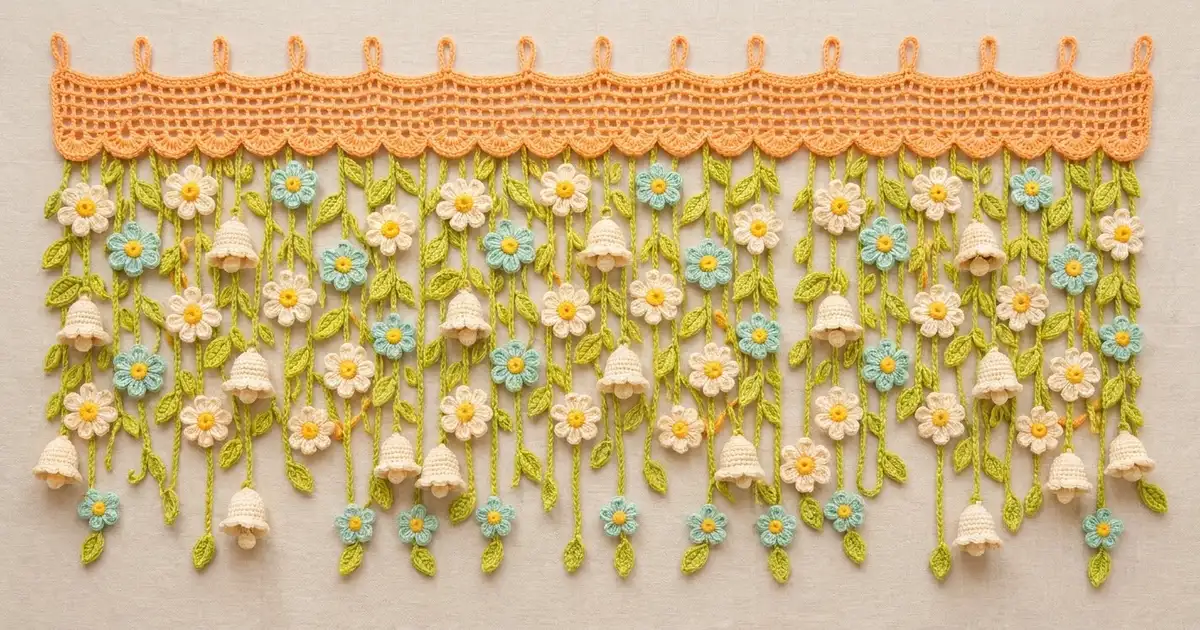
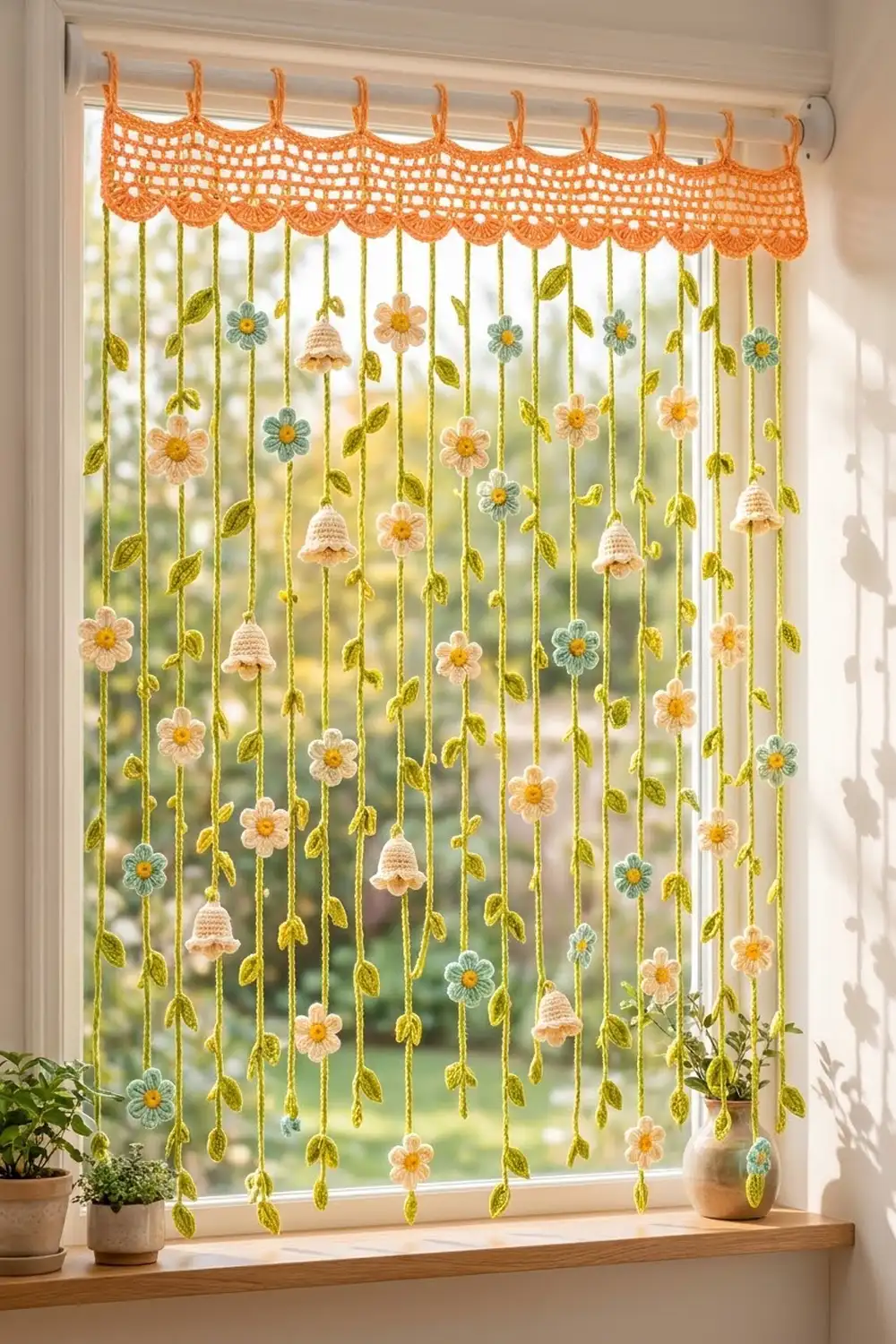
The Apricot Meadow Window Curtain puts a garden in your window. A warm apricot filet header hangs from a rod on small chain loops. Below it, lime-green vines fall in even lines, set with cream daisies, aqua blossoms, pointed leaves and little cream bells.
The colors are soft: apricot orange, lime green, cream, aqua and golden yellow. The open mesh and spaced vines let light through, so the curtain decorates the window without darkening the room.
This pattern uses US crochet terms. The finished curtain is 38 in (96.5 cm) wide and about 45 in (114.3 cm) long from the top edge of the header to the ends of the vines, not counting the hanging loops.
Here is how it’s built. You crochet the header flat in rows. Next you make the flowers, leaves, bells and vines and sew the motifs onto the vines. Then you add the scalloped edge and the hanging loops to the header, and finally you attach one vine at each dip between scallops.
Finished Size and Construction
- Finished size: 38 in (96.5 cm) wide × 45 in (114.3 cm) long
- Skill level: Intermediate (simple stitches, lots of repetition and assembly)
- Terminology: US
- Yarn weight: Worsted (#4)
- Hooks: 5.0 mm (H-8) for header and vines; 4.0 mm (G-6) for motifs
- Number of pieces: 1 header, 23 vines, 35 cream flowers, 23 aqua flowers, 11 bells, 11 clappers, 115 leaves
- Layout: 23 vines in a single row, alternating Vine A and Vine B
- Header size before border: 38 in × 4 in (96.5 cm × 10.2 cm)
- Border depth: scallops add 1 in (2.5 cm); hanging loops stand 1.25 in (3.2 cm) above the top edge
- Vine length: 40 in (101.6 cm)
Materials
Choose a smooth cotton or cotton-blend worsted yarn of about 200 yd (183 m) per 100 g. Cotton holds the mesh square and keeps the flowers flat, which helps in a sunny window.
- Apricot orange: 150 g, 275 m (header, scallops, loops)
- Lime green: 200 g, 366 m (vines and leaves)
- Cream: 125 g, 229 m (cream flowers, bells, clappers)
- Aqua: 50 g, 92 m (aqua flowers)
- Golden yellow: 50 g, 92 m (flower centers)
These quantities already include a safety margin of roughly 15–20%.
Tools:
– 5.0 mm (H-8) and 4.0 mm (G-6) hooks
– Tapestry needle
– Scissors
– Stitch markers
– Small amount of fiberfill or yarn scraps (clappers)
– Measuring tape
– Blocking mat and rust-proof pins
– Spray bottle
Abbreviations (US Terms)
- ch – chain
- sl st – slip stitch
- sc – single crochet
- hdc – half double crochet
- dc – double crochet
- BLO – back loop only
- MR – magic ring
- sp – space
- st(s) – stitch(es)
- sk – skip
Special stitches:
– Shell: 7 dc worked into the same stitch.
– Petal: (hdc, 3 dc, hdc) worked into the same stitch.
Gauge and Checkpoints
Header gauge (5.0 mm hook): 14 dc and 6 rows = 4 in (10.2 cm).
Vine gauge (5.0 mm hook): 4 sl sts = 1 in (2.5 cm) along the finished vine.
Before starting the full header, make one of each motif and one test vine. These are the checkpoints:
- Cream flower: 2.5 in (6.4 cm) across
- Aqua flower: 2.25 in (5.7 cm) across
- Leaf: 1.75 in (4.4 cm) long
- Bell: 1.75 in (4.4 cm) tall, rim 2 in (5.1 cm) wide
- Header Row 1: 38 in (96.5 cm) wide
- Header after Row 6: 4 in (10.2 cm) deep
- Header after scallops: 5 in (12.7 cm) deep
If your work comes out too big, go down half a hook size. If it’s too small, go up half a size. If a vine comes out at 38 in (96.5 cm) or 42 in (106.7 cm) instead of 40 in (101.6 cm), change the starting chain rather than the hook. Add or remove 4 ch for each inch, and move the motif positions to match.
Header
The header is worked from the top down using the 5.0 mm hook and apricot yarn. It uses 133 stitches across: the mesh needs an odd number of stitches, and the scallop edge needs a multiple of 6 plus 1, so 133 = (6 × 22) + 1 satisfies both.
Foundation: Ch 135.
Row 1 (solid top band): Dc in 4th ch from hook (skipped 3 ch count as first dc), dc in each ch across. Turn. (133 sts)
Checkpoint: 38 in (96.5 cm) wide.
Row 2 (first mesh row): Ch 4 (counts as dc + ch 1), sk next dc, dc in next dc; ch 1, sk next dc, dc in next dc; repeat from * across, working last dc in top of beginning ch-3. Turn. (67 dc + 66 ch-1 sps = 133 sts; 66 mesh squares)
Rows 3–5 (mesh): Ch 4 (counts as dc + ch 1), sk ch-1 sp, dc in next dc; ch 1, sk ch-1 sp, dc in next dc; repeat from * across, working last dc in 3rd ch of turning ch-4. Turn. (133 sts; 66 mesh squares in each row)
Row 6 (solid lower band): Ch 3 (counts as dc), dc in next ch-1 sp, dc in next dc; repeat from * 66 times, working last dc in 3rd ch of turning ch-4. (1 + 132 = 133 sts) Do not fasten off. Set the header aside with the loop on a stitch marker.
Checkpoint: 38 in × 4 in (96.5 cm × 10.2 cm). The mesh squares should look square, not stretched tall.
Flowers (4.0 mm Hook)
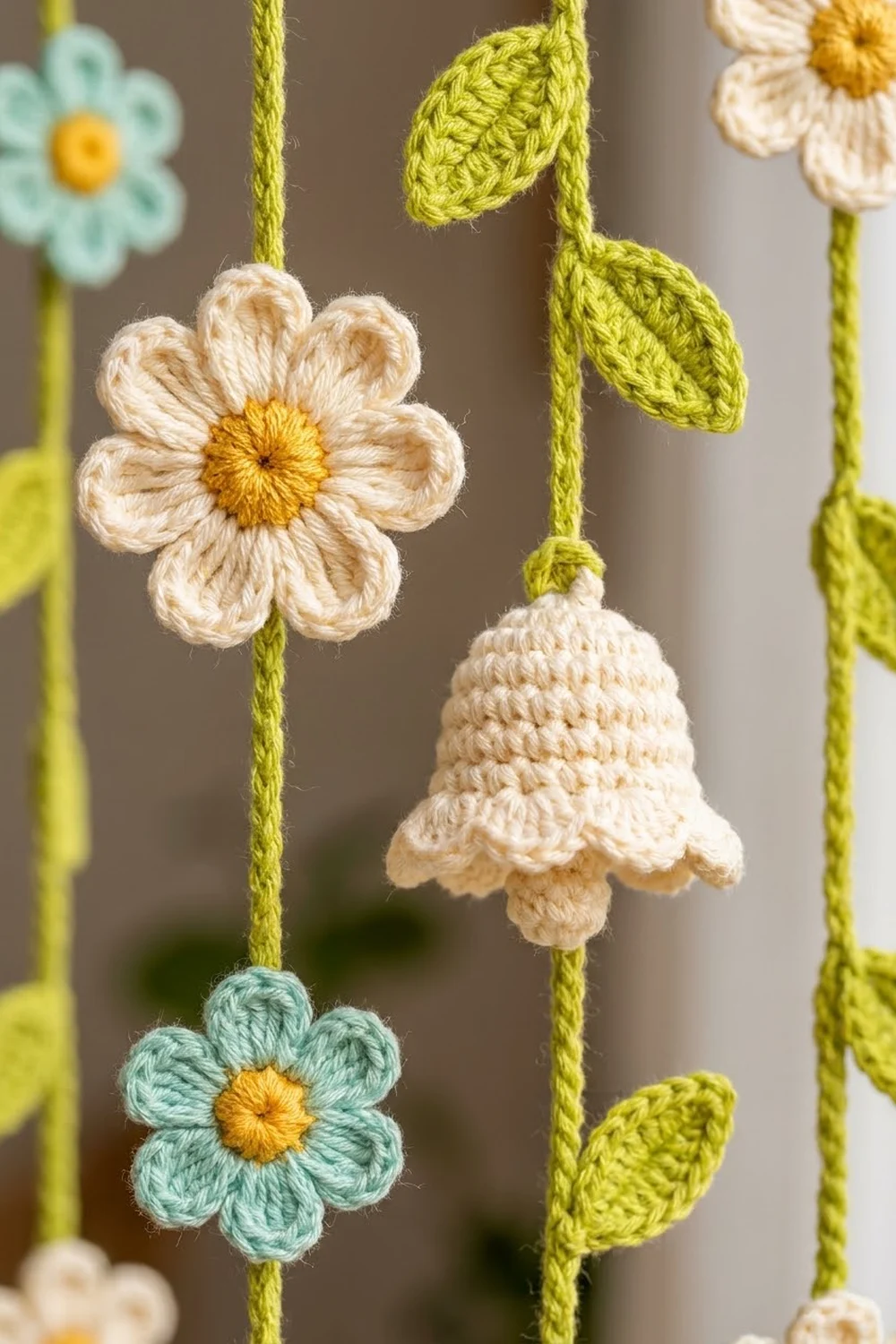
Cream Daisy (make 35)
– Rnd 1 (yellow): MR, ch 1, 8 sc in ring, sl st to first sc. (8 sts)
– Rnd 2 (yellow): Ch 1, 2 sc in each st around, sl st to first sc. Fasten off. (16 sts)
– Rnd 3 (cream): Join in any sc. Sl st in next sc, petal in next sc; repeat from * 8 times. Sl st to the base of the first sl st. Fasten off, leaving a 10 in (25.4 cm) tail. (8 petals; 8 sl sts + 40 petal sts = 48 sts)
Aqua Flower (make 23)
– Rnd 1 (yellow): MR, ch 1, 6 sc in ring, sl st to first sc. (6 sts)
– Rnd 2 (yellow): Ch 1, 2 sc in each st around, sl st to first sc. Fasten off. (12 sts)
– Rnd 3 (aqua): Join in any sc. Sl st in next sc, petal in next sc; repeat from * 6 times. Sl st to join. Fasten off, leaving a 10 in (25.4 cm) tail. (6 petals; 6 + 30 = 36 sts)
Leaves (4.0 mm Hook, Lime; Make 115)
Ch 8. Sc in 2nd ch from hook, hdc in next ch, dc in next 2 ch, hdc in next ch, sc in next ch, 3 sc in last ch (tip). Rotate and work along the other side of the foundation chain: sc in next ch, hdc in next ch, dc in next 2 ch, hdc in next ch, sc in next ch. Sl st in first sc. Fasten off, leaving an 8 in (20.3 cm) tail. (6 + 3 + 6 = 15 sts)
The foundation chain becomes a raised center vein.
Bells (4.0 mm Hook, Cream; Make 11)
- Rnd 1: MR, 6 sc in ring. Work in continuous spirals and mark the first stitch of each round. (6)
- Rnd 2: 2 sc in each st. (12)
- Rnd 3: Sc in next st, 2 sc in next st; repeat from * around. (18)
- Rnds 4–8: Sc in BLO of each st around. (18 in each round) These rounds form the horizontal ridges.
- Rnd 9: Sc in next 2 sts, 2 sc in next st; repeat from * around. (24)
- Rnd 10 (flared rim): Sl st in next st, sk next st, 5 dc in next st, sk next st; repeat from * 6 times. Sl st to the first sl st. Fasten off. (6 scallops; 6 sl sts + 30 dc = 36 sts)
Hanging loop: Join cream at the center top of the bell, ch 6, sl st back into the same spot. Fasten off, leaving a 10 in (25.4 cm) tail.
Clapper (make 11): MR, 6 sc in ring. In the next round, sc in each st (6). Stuff with a small pinch of fiberfill or scraps. Fasten off, leaving an 8 in (20.3 cm) tail, and run the tail through the front loops to close. Thread the tail up through the center of Rnd 1 of the bell so the clapper hangs 0.25 in (0.6 cm) below the rim. Secure inside the bell.
Vines (5.0 mm Hook, Lime; Make 23)
Leave a 12 in (30.5 cm) starting tail. This end is the top of the vine.
Ch 161. Sl st in the back bump of the 2nd ch from hook and in each ch across. (160 sl sts) Fasten off and weave in the bottom tail.
Checkpoint: 40 in (101.6 cm). Counting from the top, every 4 sl sts is 1 in (2.5 cm), so a motif at “7 in” sits at sl st 28 from the top.
Make All Pieces
| Piece | Color | Quantity |
|---|---|---|
| Header | Apricot | 1 |
| Vines | Lime | 23 (12 Vine A, 11 Vine B) |
| Leaves | Lime | 115 (5 per vine) |
| Cream flowers | Yellow + cream | 35 (2 per Vine A, 1 per Vine B) |
| Aqua flowers | Yellow + aqua | 23 (1 per vine) |
| Bells + clappers | Cream | 11 each (1 per Vine B) |
Vine order across the header (left to right):
A B A B A B A B A B A B A B A B A B A B A B A
1 2 3 4 5 6 7 8 9 ...                      23
Vine A (positions measured from top):
– Leaf at 3 in (7.6 cm), sl st 12
– Cream flower at 7 in (17.8 cm), sl st 28
– Leaf at 11 in (27.9 cm), sl st 44
– Aqua flower at 16 in (40.6 cm), sl st 64
– Leaf at 21 in (53.3 cm), sl st 84
– Cream flower at 28 in (71.1 cm), sl st 112
– Leaf at 32 in (81.3 cm), sl st 128
– Leaf at 37 in (94.0 cm), sl st 148
Vine B (positions measured from top):
– Leaf at 5 in (12.7 cm), sl st 20
– Aqua flower at 10 in (25.4 cm), sl st 40
– Leaf at 15 in (38.1 cm), sl st 60
– Bell at 21 in (53.3 cm), sl st 84
– Leaf at 25 in (63.5 cm), sl st 100
– Leaf at 29 in (73.7 cm), sl st 116
– Cream flower at 33 in (83.8 cm), sl st 132
– Leaf at 38 in (96.5 cm), sl st 152
Because the positions on A and B vines are staggered, flowers on neighboring vines never sit side by side, which gives the scattered look you see in the window.
Joining
Method: Sew the motifs to the vines with their own tails, using small whipstitches through both strands of the vine’s slip stitches.
Stitch-to-stitch logic:
– Flowers: Center the flower over the listed sl st. Take 3 stitches through the yellow center and the vine, then 1 stitch at the back of the top petal and 1 at the bottom petal so the flower can’t spin.
– Leaves: Sew the base of the leaf (the sl st end) to the listed sl st, angled downward at about 45 degrees. Alternate sides: the first leaf on each vine points left, the next points right, and so on.
– Bells: Wrap the ch-6 hanging loop around the vine at sl st 84 and stitch it closed. The bell then hangs free beside the vine.
Tension: Pull each stitch just snug. Tight stitches pucker and shorten the vine. Lay the vine flat while you sew, never stretched.
Size checkpoint: Each finished vine should still measure 40 in (101.6 cm). If it’s shorter, your sewing is gathering it, so loosen up and re-sew.
Border
The border has two parts, both worked on the header: a scalloped edge along the bottom, and hanging loops along the top.
Border gauge: each scallop spans 6 header stitches, about 1.7 in (4.3 cm).
Border Row 1 (bottom scallops): Pick up the apricot loop left after Row 6. Ch 1, sc in first dc. Sk 2 dc, shell in next dc, sk 2 dc, sc in next dc; repeat from * 22 times. Fasten off.
This is a conversion row. It turns the 133 stitches of Row 6 into 23 sc plus 22 shells of 7 dc, so 23 + 154 = 177 sts. It produces 22 scallops with 23 sc valleys.
Why the math works: 1 starting sc + (22 repeats × 6 sts) = 133, so the last sc lands exactly on the last dc. The edge stays the full 38 in (96.5 cm), and the scallops add 1 in (2.5 cm) of depth.
Border Row 2 (top edge with hanging loops): Turn the header so the foundation chain is on top. Join apricot in the free loop at the base of the first Row 1 stitch. Ch 1, then work 1 sc in each free loop of the foundation chain, under each of the 133 Row 1 stitches. On stitches 1, 13, 25, 37, 49, 61, 73, 85, 97, 109, 121 and 133, work the sc, then ch 14 and sl st into that same sc to make a loop. Fasten off.
The count is 133 sc + 12 loops. That gives 11 gaps of 12 sts each (11 × 12 = 132, plus 1 = 133), so the loops are spaced about 3.4 in (8.6 cm) apart. Each loop stands 1.25 in (3.2 cm) tall and fits a rod up to 1 in (2.5 cm) in diameter.
Hanging the vines: Thread each vine’s 12 in (30.5 cm) top tail through one sc valley of the scallop row, from front to back. Put Vine 1 in the first sc and Vine 23 in the last. Bring the top of the vine right up against the valley and tie a square knot with the tail. Then weave the tail up into the solid Row 6 band and back down. Valleys are 6 sts apart, so the vines hang 1.7 in (4.3 cm) apart across the full 38 in (96.5 cm).
Final Blocking
- Weave in all remaining ends before blocking.
- Pin the header face up to 38 in × 5 in (96.5 cm × 12.7 cm), including the scallops.
- Pin each scallop into a rounded fan. Line up the mesh squares with a straight edge.
- Mist the header until it’s damp and let it dry completely.
- Mist the flowers and leaves while they lie flat. Press the petals open with your fingers.
- Hang the curtain on its rod. Mist the vines lightly and let them hang overnight so they straighten under their own weight.
Final Quality-Control Checklist
- Header is 38 in (96.5 cm) wide and 5 in (12.7 cm) deep with scallops
- 66 mesh squares in every mesh row
- 22 even scallops and 23 vines, one in each valley
- 12 hanging loops spaced evenly
- Every vine is 40 in (101.6 cm), with all ends level
- Vines alternate A and B, starting and ending with A
- Leaves alternate sides, flowers sit flat, and every bell has its clapper
- No loose tails on the front of the curtain
Troubleshooting
- Mesh squares look tall: Your dc is loose. Go down a hook size for the mesh rows only, or use ch 1 with tighter tension.
- Scallops don’t end evenly: Row 6 is not 133 sts. Count again and fix Row 6 before working the border.
- Header ripples: Your foundation chain was tight. Redo it with a hook one size larger, then work Row 1 with the 5.0 mm hook.
- Vines curl: Sl st into the back bumps as written, and block the vines while they hang.
- Flowers cup: Rnd 2 is too tight. Work it with a 4.5 mm hook.
- Bells flare too little: Make sure each shell in Rnd 10 has 5 full dc.
Care
Hand wash in cool water with mild soap and roll in a towel to remove the water. Re-block the header flat, and hang the vines to dry.
Final Notes
The measurements build on each other:
– 14 dc to 4 in (10.2 cm) gives a 133-stitch header 38 in (96.5 cm) wide.
– Six rows give 4 in (10.2 cm) of depth, and the scallops bring it to 5 in (12.7 cm).
– The 133 stitches divide into 22 scallops and 23 valleys, one for each vine.
– At 4 sl sts per inch, 160 sl sts make each vine 40 in (101.6 cm), for a curtain about 45 in (114.3 cm) long.
Check each stage against its measurement and the curtain will hang straight.
Happy crocheting!