
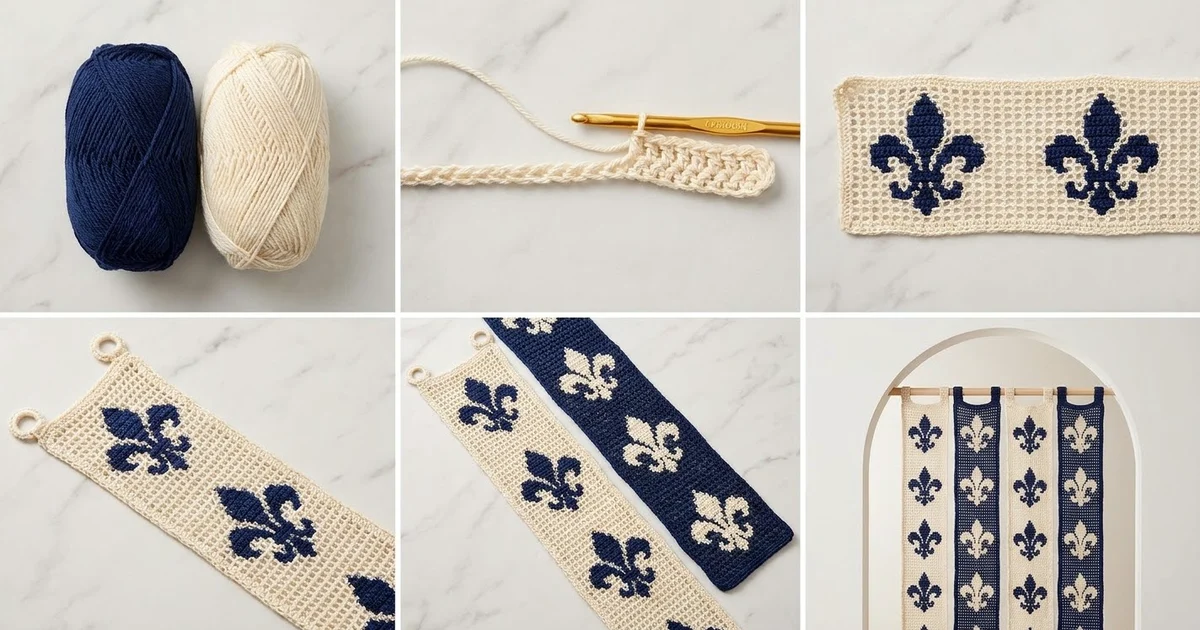
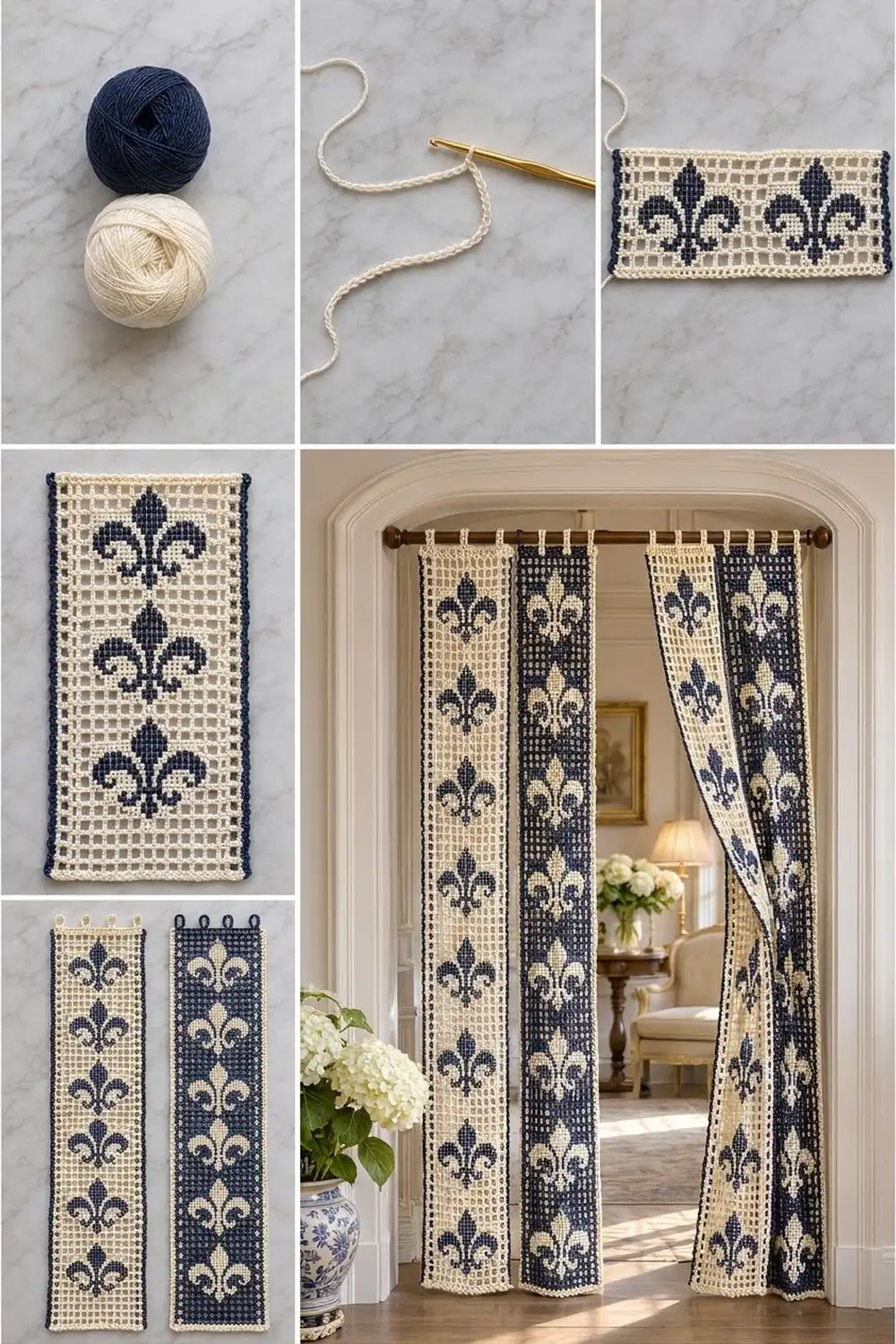
These hanging strips combine the open lace of filet crochet with bold fleur-de-lis motifs. Each strip has a single column of eight fleurs-de-lis on a square mesh grid. A corded crab-stitch edge runs all the way around, and four ring tabs at the top slide onto a curtain rod.
The curtain uses two colorways. Strip A has a cream mesh with navy motifs. Strip B reverses this, with a navy mesh and cream motifs. Hang them in the order A, B, A, B for a crisp, classic doorway curtain.
The pattern uses US crochet terms. Each finished strip measures 11 in (27.9 cm) wide by 78.5 in (199.4 cm) long. The tabs add about 1.25 in (3.2 cm) above the top edge.
Each strip is worked flat in rows from the bottom up in tapestry filet, with mesh squares in the main color and solid blocks in the contrast color. To finish, you add one round of single crochet, one round of crab stitch, and four tabs. The four strips are not sewn together. They hang side by side from the rod.
Finished Size and Construction
- Finished strip size: 11 in x 78.5 in (27.9 cm x 199.4 cm), not counting tabs
- Skill level: Intermediate (filet with color changes)
- Terminology: US
- Yarn weight: Sport (#2 fine), 100% cotton
- Hook: 3.5 mm (E-4)
- Number of pieces: 4 separate strips (2 Strip A, 2 Strip B)
- Layout: strips hang side by side on one rod in the order A-B-A-B, not joined
- Strip body: 21 squares wide x 156 rows tall
- Size before border: 10.5 in x 78 in (26.7 cm x 198.1 cm)
- Border depth: 0.25 in (0.6 cm) per side
Materials
Choose a smooth, mercerized sport-weight cotton with about 155 m per 50 g. Cotton keeps the filet squares crisp, hangs straight, and washes well. Avoid stretchy fibers, because long strips can grow under their own weight.
Yarn (for all 4 strips):
- Cream: 250 g, about 775 m (5 balls of 50 g / 155 m)
- Navy: 250 g, about 775 m (5 balls of 50 g / 155 m)
Per strip: about 65 g (201 m) of the main (mesh) color and 55 g (170 m) of the contrast (motif) color.
These quantities include a margin of about 10 to 15 percent for the gauge swatch, carried strands, and weaving in ends.
Tools:
- 3.5 mm (E-4) crochet hook
- Tapestry needle
- Locking stitch markers
- Tape measure
- Blocking mats, rust-proof pins, and blocking wires (optional)
- Spray bottle
- Curtain rod up to 0.75 in (1.9 cm) in diameter
Abbreviations (US Terms)
- ch – chain
- sl st – slip stitch
- sc – single crochet
- dc – double crochet
- rev sc – reverse single crochet (crab stitch)
- st(s) – stitch(es)
- sp – space
- MC – main color (mesh color)
- CC – contrast color (motif color)
- RS – right side
Special stitches and terms:
- Square: one filet unit, 3 sts wide. A row of 21 squares has 64 sts: 22 dc “posts” plus 21 two-stitch fillings (22 + 42 = 64).
- Mesh (open square, MC): ch 2, skip 2 sts, dc in the next dc.
- Block (filled square, CC): dc in each of the next 3 sts if working over a block, or 2 dc in the ch-2 sp and dc in the next dc if working over a mesh.
- Color change: use the new color for the last yarn over of the stitch before the change.
- Rev sc (crab stitch): with RS facing, work from left to right. Insert hook in the next st to the right, yarn over, pull up a loop, yarn over, pull through both loops.
Gauge and Checkpoints
Gauge: 8 squares and 8 rows = 4 in (10.2 cm) in filet mesh, before blocking. Each square is 0.5 in (1.3 cm) wide and tall.
Make a swatch first. Ch 33. Dc in the 4th ch from the hook and in each ch across (31 sts, or 10 squares). Work 9 mesh rows. The swatch should measure 5 in (12.7 cm) square. If it is off by more than 0.25 in (0.6 cm), change your hook before starting a strip. Each strip is 156 rows long, so even a small difference adds up.
- Too big: go down to a 3.25 mm hook, or make your chains tighter.
- Too small: go up to a 3.75 mm hook, and check that your ch-2 spaces aren’t pulling the dc posts together.
Checkpoints for each strip (measure flat, without stretching):
- After Row 1: 10.5 in (26.7 cm) wide.
- After Row 20 (first motif done): 10 in (25.4 cm) tall.
- After Row 77 (fourth motif done): 38.5 in (97.8 cm) tall.
- After Row 156: 78 in (198.1 cm) tall and still 10.5 in (26.7 cm) wide.
Fleur-de-Lis Motif Chart
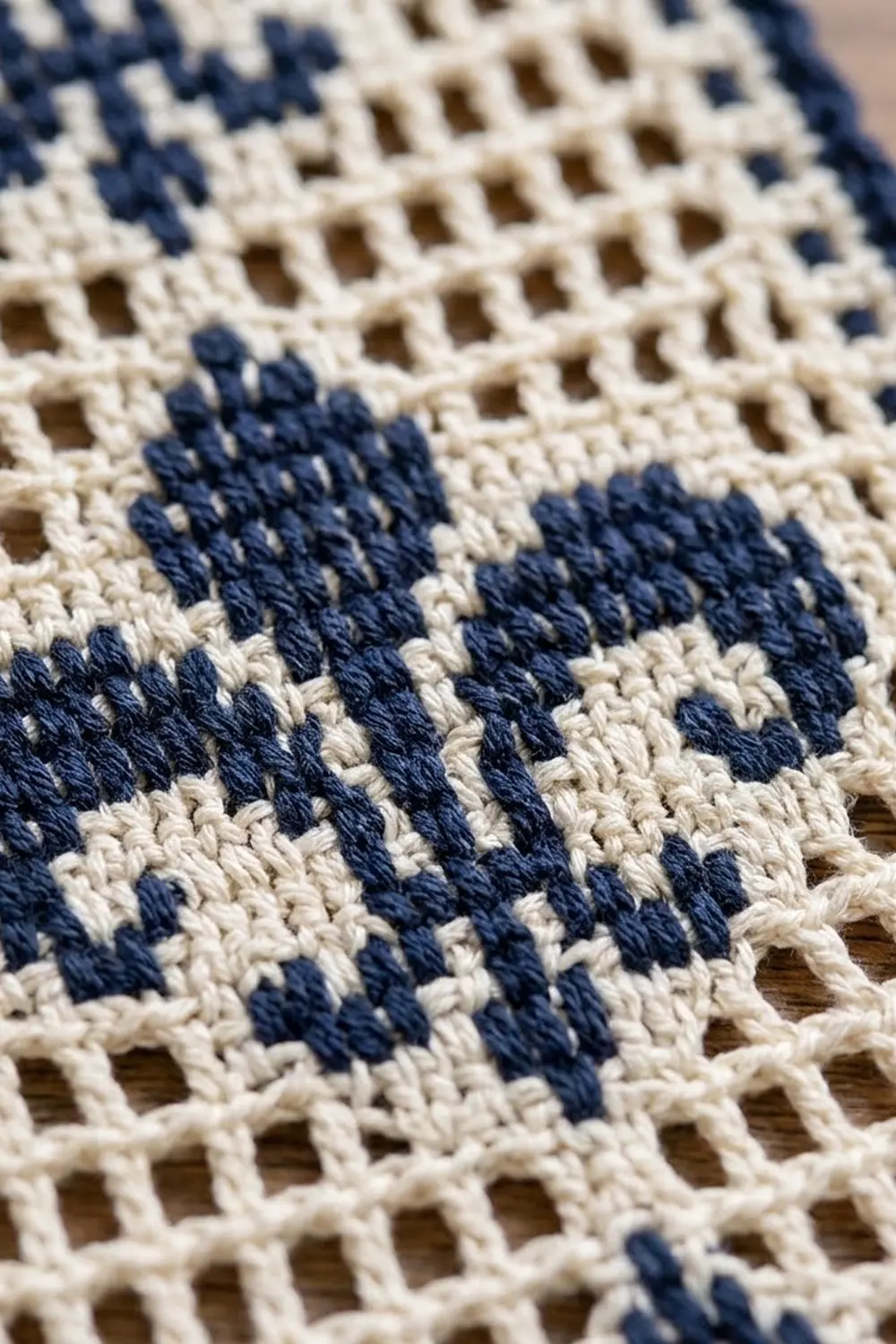
The motif is 15 squares wide and 17 rows tall. In the chart, X = block (CC) and . = mesh (MC). Read it from Row 1 at the bottom up to Row 17. The chart is symmetrical, so it reads the same in both directions.
17  .......X.......
16  ......XXX......
15  .....XXXXX.....
14  ....XXXXXXX....
13  .XX.XXXXXXX.XX.
12  XXXX.XXXXX.XXXX
11  XX.X..XXX..X.XX
10  X..XX.XXX.XX..X
 9  ...XXXXXXXXX...
 8  ....XXXXXXX....
 7  ..XXXXXXXXXXX..
 6  ..XXXXXXXXXXX..
 5  ....XX.X.XX....
 4  ...XX..X..XX...
 3  ..XX..XXX..XX..
 2  ......XXX......
 1  .......X.......
Rows 1–5 make the pointed foot, and Rows 6–7 make the solid crossband. In Rows 8–13 the side petals curl outward and droop at the tips. Rows 13–17 form the pointed center petal. Each motif has 117 blocks.
Strip Pattern
For Strip A, use MC = cream and CC = navy. For Strip B, use MC = navy and CC = cream. The instructions are the same for both.
Foundation: With MC, ch 66.
Row 1 (solid): Dc in the 4th ch from the hook (the skipped 3 ch count as the first dc) and in each ch across. Turn. (64 sts)
Rows 2–3 (spacer): Ch 3 (counts as dc). Ch 2, skip 2 sts, dc in next st; repeat from * across, working the last dc in the top of the turning ch. Turn. (64 sts: 21 mesh squares)*
Rows 4–20 (Motif 1): Work each row as follows:
- Ch 3 (counts as dc), then work 3 mesh squares in MC.
- Work squares 1–15 of the matching chart row. Row 4 is chart Row 1, and Row 20 is chart Row 17.
- Work 3 mesh squares in MC, ending with a dc in the top of the turning ch. Turn.
Every row has 64 sts (21 squares), and the 3 outer squares on each side always stay open mesh.
Carrying the yarn: Join CC at the first block of chart Row 1. Within the motif span, lay the unused color along the tops of the stitches and work your dc over it. Wrap your chains around it as well so it stays hidden in the ch-2 spaces. Outside the motif span, leave CC resting at the edge of the motif until the next row reaches it. Never carry it into the 3 outer squares. After chart Row 17, fasten off CC and leave a 6 in (15.2 cm) tail.
Rows 21–39: Rows 21–22 are spacer rows, worked like Rows 2–3. Rows 23–39 are Motif 2 (chart Rows 1–17).
Keep repeating 2 spacer rows and 17 motif rows until you have 8 motifs. Motif k takes up Rows (19k − 15) through (19k + 1), so Motif 8 ends on Row 153.
Rows 154–155: Spacer rows, worked like Rows 2–3. (64 sts)
Row 156 (solid): Ch 3 (counts as dc). 2 dc in next ch-2 sp, dc in next dc; repeat from * across. (64 sts)* Don’t fasten off MC.
Row math check: 1 solid + 8 x (2 spacer + 17 motif) + 2 spacer + 1 solid = 1 + 152 + 2 + 1 = 156 rows. At 8 rows per 4 in (10.2 cm), that’s 78 in (198.1 cm).
Make All Pieces
- Strip A (cream mesh, navy fleurs-de-lis): make 2, using about 65 g cream and 55 g navy each.
- Strip B (navy mesh, cream fleurs-de-lis): make 2, using about 65 g navy and 55 g cream each.
Layout (seen from the room, left to right):
[ A ] [ B ]   [ A ] [ B ]
 left pair     right pair
Joining: Hanging Tabs Instead of Seams
The strips aren’t sewn together. They share the rod, so each strip moves on its own and you can part the two pairs by hand.
Stitch logic: Every strip has the same 64-stitch top edge, and the tabs sit at the same stitch positions on each one. When the strips hang side by side, the tabs line up and the motifs sit at matching heights.
Tension advice: Chain the ch-12 tab loops loosely and evenly so all 16 tabs come out the same size. A tight tab will make its strip hang higher than the others.
Size checkpoint: Four strips placed edge to edge measure 44 in (111.8 cm) across. In a 36 in (91.4 cm) doorway, this gives a little soft fullness, and the two pairs meet in the center.
Border
Border gauge: Work 1 sc per stitch along the short edges and 2 sc in each dc row-end along the long edges. Each dc row is 0.5 in (1.3 cm) tall, so 2 sc per row-end gives 4 sc per inch. At that rate the edge lies flat without ruffling or pulling in.
Round 1 (MC, conversion round): Ch 1, turn, and hold the strip so this side faces you as the RS. Work 3 sc in the first st (corner) and sc in each of the next 62 sts. Work 3 sc in the top of the turning ch (corner). Rotate the strip. Work 2 sc in each row-end of Rows 155 down to 2 (154 row-ends = 308 sc). Work 3 sc in the first foundation ch (corner), sc in each of the next 62 foundation ch, and 3 sc in the last foundation ch (corner). Work 2 sc in each row-end of Rows 2 to 155 (308 sc). Join with a sl st to the first sc.
Count: (64 sts worked 1 per existing stitch on each short side, 128 total) + (308 row-end sc on each long side, 616 total) + (2 extra sc at each of 4 corners, 8 total) = 752 sts.
Per side, counting both corner sts: each short side has 66 sts and each long side has 312 sts. Check: 2 x 66 + 2 x 312 − 4 shared corners = 752.
Tab anchors (part of Round 1, along the top edge): Number the 64 non-corner sts of the top edge from right to left. At sts 2, 22, 43, and 63, work the sc, then ch 12 and sl st into the left vertical leg of that same sc. This keeps the top two loops of that sc free for Round 2. The tabs don’t change the stitch count. There are 19, 20, and 19 sts between the tabs, so the spacing is symmetrical. Fasten off MC.
Round 2 (CC, crab stitch): With RS facing, join CC in any corner sc. Rev sc in each st around, including the corner sc. At each tab, skip the ch-12 loop and work into the sc below it. Join and fasten off. (752 sts: 66 per short side and 312 per long side, including corners)
Tab covers (MC): Join MC in a ch-12 loop. Work 18 sc into the loop and sl st to the first sc. Fasten off. Repeat for all 4 tabs.
Why the math works: The body measures 10.5 in x 78 in (26.7 cm x 198.1 cm). The two border rounds add 0.25 in (0.6 cm) to every side, so the strip becomes 11 in x 78.5 in (27.9 cm x 199.4 cm). All the corner increases happen in Round 1, so Round 2 is worked 1 per st and keeps the count the same.
Final Blocking
- Weave in ends along dc posts of the same color, never across open mesh.
- Soak each strip in cool water for 15 minutes, then roll it in a towel and press out the water. Don’t wring it.
- Lay the strip flat on mats. Block it in sections if your mats aren’t long enough.
- Thread blocking wires through the long edges, or pin every 2 in (5.1 cm).
- Pin to 11 in (27.9 cm) wide by 78.5 in (199.4 cm) long.
- Straighten the mesh so the dc posts form straight vertical lines.
- Let the strip dry completely before unpinning, and block all four strips to the same length.
Final Quality-Control Checklist
- Every row has 64 sts (21 squares).
- All 8 motifs are centered, with 3 open squares on each side.
- There are exactly 2 spacer rows between motifs.
- No carried strands show in the outer squares.
- Round 1 has 752 sts, with 3 sc in each corner.
- The crab stitch is smooth and evenly corded.
- There are 4 tabs at sts 2, 22, 43, and 63, all the same size.
- All four strips measure 11 in x 78.5 in (27.9 cm x 199.4 cm).
Troubleshooting
- Squares slant: you’re skipping the wrong number of sts. Skip exactly 2 sts for each mesh.
- Motif looks squashed: your chains are too tight. Loosen your ch-2s, or use one hook size larger for the chains only.
- Carried color shows in the mesh: wrap the chains snugly around the strand, or leave it at the edge of the motif.
- Long edges ruffle: work 2 sc per row-end, not 3.
- Strips hang at different lengths: block them again, or redo the tabs on the shorter strip more loosely.
- Crab stitch twists: keep the hook tip angled slightly down and work only from left to right.
Care
Hand wash in cool water with a mild detergent, roll in a towel, and dry flat. Block lightly to bring back the crisp square grid.
Final Notes
Here is the full measurement chain. Each square is 0.5 in (1.3 cm), so 21 squares make a strip 10.5 in (26.7 cm) wide, and 156 rows make it 78 in (198.1 cm) long. The border adds 0.25 in (0.6 cm) per side, for a finished strip of 11 in x 78.5 in (27.9 cm x 199.4 cm). Four strips together span 44 in (111.8 cm). If you check your gauge first and measure at each checkpoint, your fleur-de-lis curtain will hang straight and even.
Happy crocheting!