
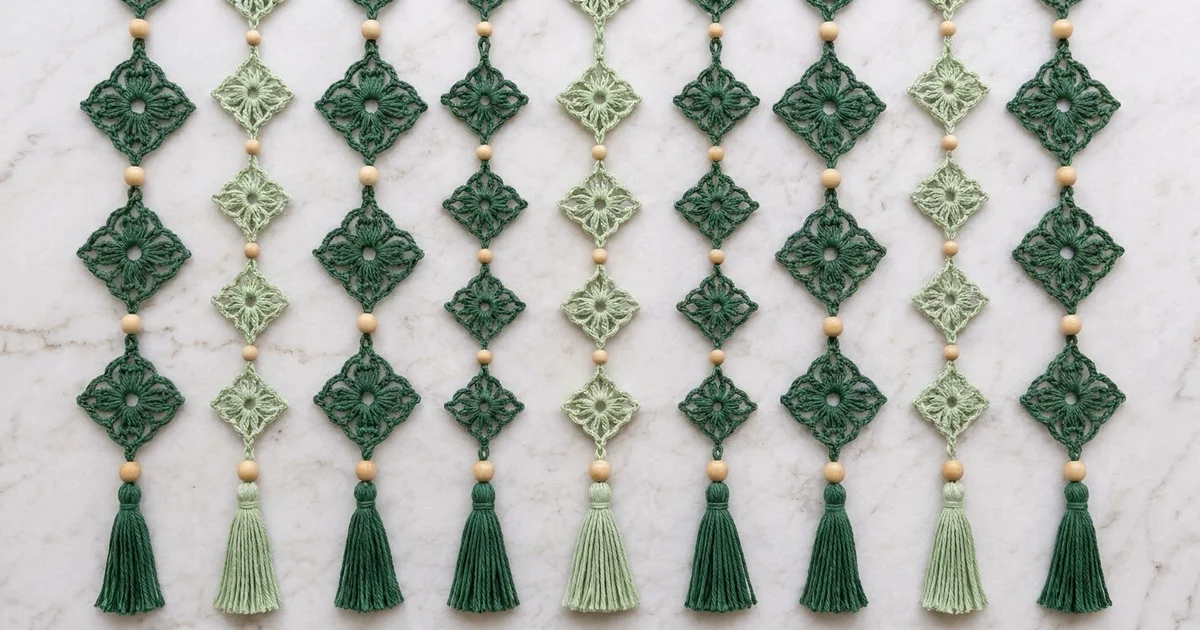
This curtain is made of hanging strands of lacy diamond motifs. Each motif has an open center ring, four fat petals that point to the corners, and an airy chain frame. A rope-like single crochet border holds the frame in shape. Natural wooden beads separate the motifs, and every strand ends in a full tassel.
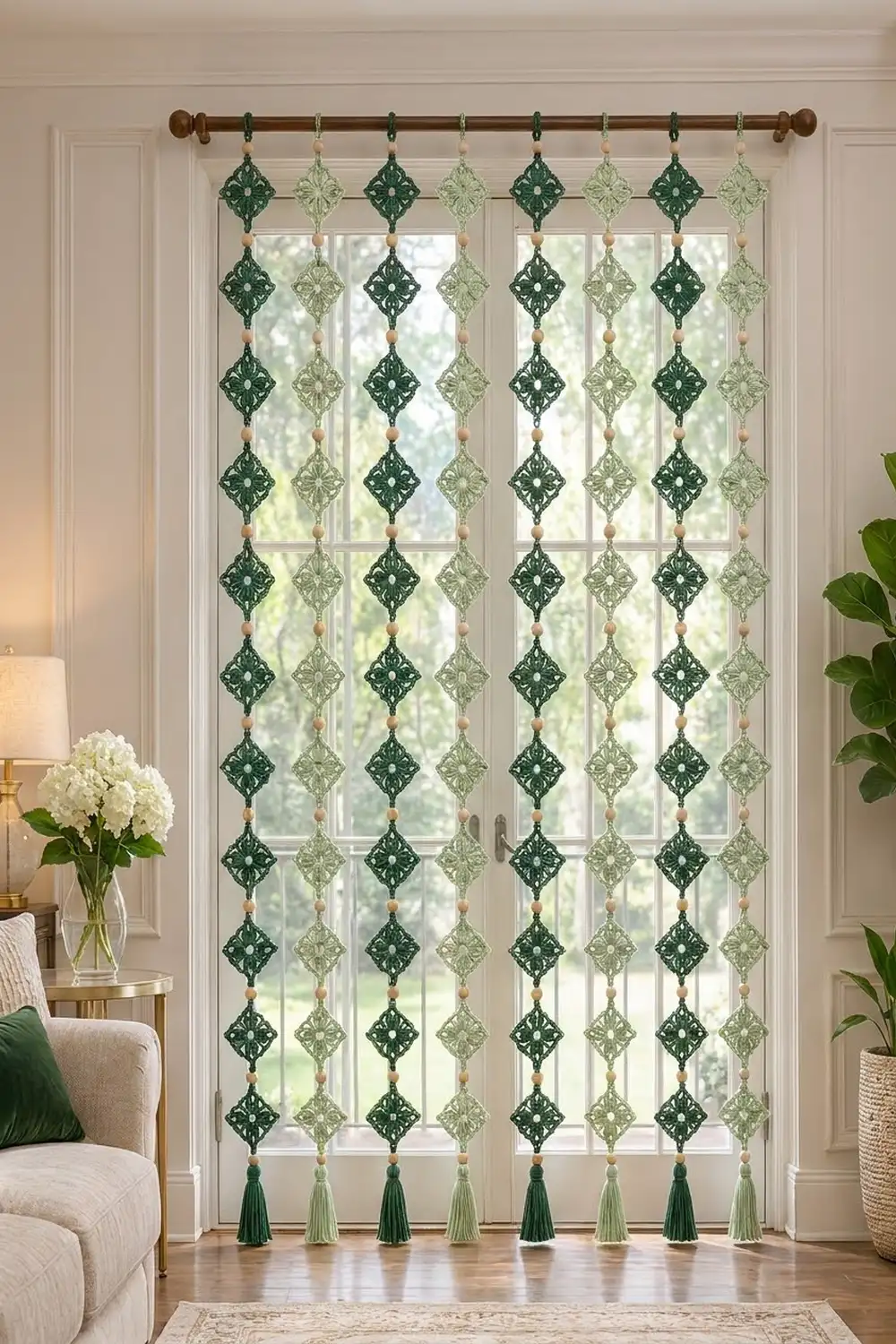
The design alternates dark forest green and soft sage green strands. Light comes through the open centers and frames, so the curtain works well on a window, a doorway, or a room divider. The style is boho, with clean geometry and a little texture.
The pattern uses US crochet terms. The finished curtain is 8 strands wide, about 43 in (109.2 cm) across when hung, and each strand is about 55 in (139.7 cm) long including the hanging loop and tassel.
You work each motif in the round from a chain ring. You make all 64 motifs, give each one a border round with corner loops, and then link them into strands with beaded chain connectors. Finally, you add a hanging loop to the top of each strand and a tassel to the bottom.
Finished Size and Construction
- Finished curtain: 43 in (109.2 cm) wide × 55 in (139.7 cm) long
- Skill level: Easy-intermediate
- Terminology: US crochet terms
- Yarn weight: Worsted (#4) cotton
- Hook: 5.0 mm (H-8)
- Number of pieces: 64 motifs (32 per color), 8 tassels
- Layout: 8 strands × 8 motifs, alternating colors
- Motif size: 4.5 in (11.4 cm) point to point, not counting the corner loops
- Size before border: 4 in (10.2 cm) point to point after Round 3
- Border depth: 0.25 in (0.6 cm) added on each side
- Strand spacing on rod: 5.5 in (14.0 cm) center to center
Materials
Use a smooth, mercerized or combed worsted cotton. Cotton holds the diamond points crisply and does not stretch much while hanging. Avoid fuzzy or very stretchy acrylics, because long strands can grow over time.
- Color A, dark forest green: 250 g, about 400 m (437 yd)
- Color B, sage green: 250 g, about 400 m (437 yd)
Each motif uses about 5 g (about 9 m). Each tassel uses about 5 g. These quantities include a margin of roughly 25% for swatching, connectors, and weaving in ends.
Tools and notions:
- 5.0 mm (H-8) crochet hook
- 70 natural wooden beads, 16 mm, with a hole of at least 4 mm (64 needed, plus spares)
- Tapestry needle
- Stitch markers
- Scissors
- A piece of cardboard 5 in (12.7 cm) tall, for tassels
- Blocking mat and rustproof pins
- Spray bottle
- Curtain rod
Abbreviations (US Terms)
- ch – chain
- sl st – slip stitch
- sc – single crochet
- dc – double crochet
- tr – treble crochet
- sp – space
- st(s) – stitch(es)
- sk – skip
Special stitch: Bead chain (bead ch). Slide one pre-strung bead up against the hook. Yarn over beyond the bead and pull through the loop on the hook. The bead is now locked into the back of that chain.
Gauge and Checkpoints
Make one complete motif first, including the border. Measure it before you commit to all 64.
- After Round 1: the ring measures 1.25 in (3.2 cm) across.
- After Round 2: the flower measures 3 in (7.6 cm) from petal tip to opposite petal tip.
- After Round 3: the frame measures 4 in (10.2 cm) from point to point.
- After Round 4 (border): the motif measures 4.5 in (11.4 cm) from point to point, not counting the loops. Each side measures about 3.2 in (8.1 cm).
If your motif is too big: go down to a 4.5 mm hook, or tighten your tr stitches.
If your motif is too small: go up to a 5.5 mm hook.
A difference of 0.25 in (0.6 cm) per motif adds 2 in (5.1 cm) to each strand, so check carefully.
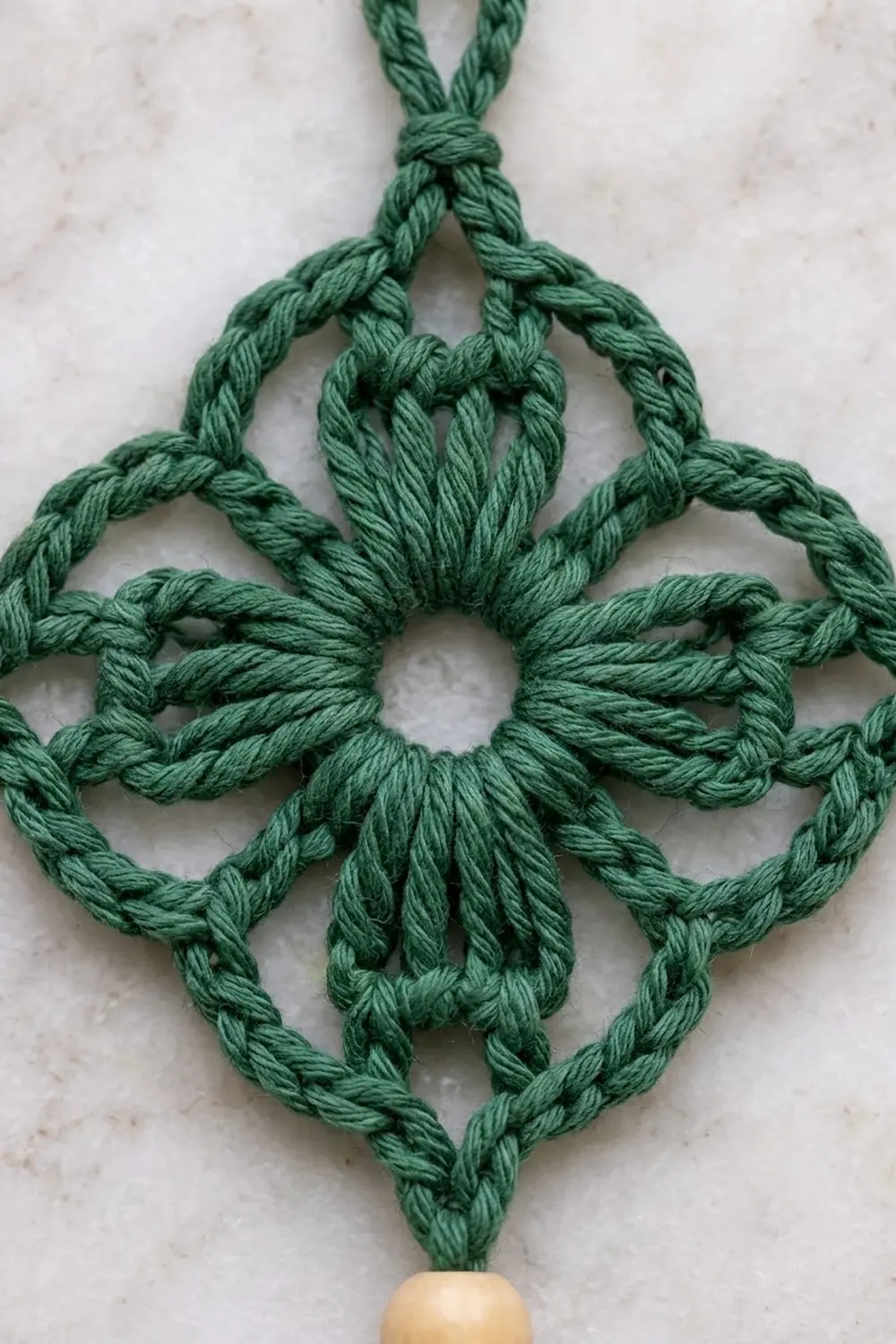
Motif Pattern (Make 64: 32 in Color A, 32 in Color B)
Foundation: Ch 6, sl st in the first ch to form a ring.
Round 1: Ch 1, work 16 sc into the ring. Sl st in the first sc to join. (16 sc)
Round 2 (petals): Ch 1. Sc in the next st, 2 dc in the next st, 3 tr in the next st, 2 dc in the next st. Repeat from * to * 3 more times. Sl st in the first sc to join.
Each repeat is 8 sts: 1 sc, 4 dc, and 3 tr. (32 sts: 4 sc, 16 dc, 12 tr)
Each petal fans out from 3 sc of Round 1. The single sc between petals gives the dip that separates them. The center tr of each 3-tr group is the petal tip, and those four tips become the diamond’s corners.
Round 3 (frame): Sl st in each of the next 4 sts so you land in the center tr of the first petal. Ch 1.
(Sc, ch 3, sc) in the center tr, ch 4, sk the next 3 sts, tr in the sc between petals, ch 4, sk the next 3 sts. Repeat from * to * 3 more times. Sl st in the first sc to join.
(12 sts: 8 sc and 4 tr, plus 4 ch-3 corner sps and 8 ch-4 sps)
The ch-3 spaces sharpen the four points. Each tr pushes the middle of a side outward, so the sides stay straight instead of curving in. The open spaces between the chains and the petals make the airy window effect.
Do not fasten off. Go straight on to the Border round in the Border section below, and then join. The working order for every motif is: Rounds 1–3, then the Border, then joining.
Make All Pieces
Make 32 motifs in Color A and 32 in Color B. Work Rounds 1–3 and the Border on each one. Before you start any joining, check every motif against your 4.5 in (11.4 cm) test motif.
Make 4 tassels in Color A and 4 in Color B.
Strand layout as seen from the room. A = dark green and B = sage. Each column is one strand, and each letter is one motif.
Strand:  1  2  3  4  5  6  7  8
Row 1:   A  B  A  B  A  B  A  B
Row 2:   A  B  A  B  A  B  A  B
Row 3:   A  B  A  B  A  B  A  B
Row 4:   A  B  A  B  A  B  A  B
Row 5:   A  B  A  B  A  B  A  B
Row 6:   A  B  A  B  A  B  A  B
Row 7:   A  B  A  B  A  B  A  B
Row 8:   A  B  A  B  A  B  A  B
         T  T  T  T  T  T  T  T   (bead + tassel)
That gives 4 strands of each color, 8 motifs per strand, and 64 motifs in total.
Joining
The motifs join point to point with a beaded chain connector. Each connector goes from the bottom ch-4 loop of one motif to the top ch-4 loop of the next one. Those loops are made in the Border round.
Connector (make 7 per strand):
- Thread 1 bead onto the yarn in the strand’s color.
- Make a slip knot, then sl st into the bottom ch-4 loop of the upper motif.
- Ch 5, bead ch, ch 5.
- Sl st into the top ch-4 loop of the next motif. Fasten off.
Stitch logic: Each connector is 11 chains with one bead locked in the center chain. Both ends attach to a loop, not to a border stitch, so the motifs hang straight and the side points stay level.
Tension: Keep the connector chains a little firmer than your motif chains. Loose connector chains stretch under the weight of the strand and the bead slides off center. Make sure the bead is snug against the 6th chain before you continue.
Checkpoint: Lay a finished strand flat. Measure from the bottom point of one motif to the top point of the next one, counting only the border edges. That gap should be 1.5 in (3.8 cm). Each motif plus one gap is 6 in (15.2 cm).
A strand of 8 motifs measures 36 in (91.4 cm) of motifs plus 10.5 in (26.7 cm) of gaps, for 46.5 in (118.1 cm).
Top hanging loop: Join the yarn with a sl st in the top ch-4 loop of motif 1. Ch 18, then sl st into the same ch-4 loop. Fasten off. The loop hangs 2 in (5.1 cm).
Bottom connector:
- Thread 1 bead onto the yarn.
- Sl st into the bottom ch-4 loop of motif 8.
- Ch 5, bead ch, ch 5.
- Ch 4, then sl st in the 4th ch from the hook to make a small ring. Fasten off.
This connector measures 1.5 in (3.8 cm).
Tassel:
- Wrap the yarn 30 times around the 5 in (12.7 cm) cardboard.
- Slide a 10 in (25.4 cm) tie strand under the wraps at the top and thread it through the bottom ring of the strand. Knot it tightly.
- Cut the wraps along the bottom edge.
- Wrap another strand of yarn 8 times around the tassel, 0.5 in (1.3 cm) below the top, and tie it off.
- Trim the tassel to 5 in (12.7 cm).
Each strand is 2 + 46.5 + 1.5 + 5 = 55 in (139.7 cm) long.
Border (Round 4, Worked on Every Motif Before Joining)
Border gauge: 15 sc per side = about 3.2 in (8.1 cm), or about 4.7 sc per inch along the edge.
Round 4: Continue in the same color. Sl st into the first ch-3 corner sp; this is the top corner. Ch 1.
- Top corner: (sc, ch 4, sc) in the ch-3 sp.
- Side: sc in the next sc, 5 sc in the ch-4 sp, sc in the tr, 5 sc in the next ch-4 sp, sc in the next sc. (13 sc)
- Right corner: (sc, ch 2, sc) in the ch-3 sp.
- Side: repeat step 2. (13 sc)
- Bottom corner: (sc, ch 4, sc) in the ch-3 sp.
- Side: repeat step 2. (13 sc)
- Left corner: (sc, ch 2, sc) in the ch-3 sp.
- Side: repeat step 2. (13 sc)
- Sl st in the first sc to join. Fasten off and weave in the ends.
Per side: 1 corner sc + 13 sc + 1 corner sc = 15 sc, including both corner sc.
Total: (4 sides × 13 sc) + (4 corners × 2 sc) = 52 + 8 = 60 sc. You will also have 2 ch-2 points and 2 ch-4 loops.
Why the math works: Each 5 sc fills one ch-4 space without ruffling. One sc sits on each base stitch, so the sides stay flat. Each corner gets 2 sc with a chain between them, which turns the corner sharply. On each corner, one sc belongs to each of the two sides that meet there.
The border adds 0.25 in (0.6 cm) on every side. That takes the motif from 4 in (10.2 cm) to 4.5 in (11.4 cm). The ch-4 loops become the attachment points for the connectors, and the ch-2 points give the side corners a crisp tip.
Final Blocking
- Mist or lightly soak each strand, then press out the extra water in a towel.
- Lay the strand flat on the blocking mat.
- Pin each motif at all four points so it measures 4.5 in (11.4 cm) in both directions.
- Pin the centers of the open rings so they stay round.
- Straighten the connectors so each gap is 1.5 in (3.8 cm) and the beads sit centered.
- Smooth the tassel strands straight down and mist them.
- Let everything dry completely before you unpin.
- Hang the strands on the rod 5.5 in (14.0 cm) apart, center to center. Total width: 7 × 5.5 in + 4.5 in = 43 in (109.2 cm).
Final Quality-Control Checklist
- Every motif has 32 sts in Round 2 and 60 sc in Round 4.
- Every motif measures 4.5 in (11.4 cm) point to point.
- Every motif has ch-4 loops at the top and bottom and ch-2 points at the sides.
- Every strand has 8 motifs, 8 beads, 1 hanging loop, and 1 tassel.
- All strands measure 55 in (139.7 cm) from the top of the loop to the tassel tip.
- The colors alternate A, B, A, B across the rod.
- All ends are woven into the border sc, and none show on the front.
- The tassels are trimmed to the same length.
Troubleshooting
The petals cup or ruffle. Your tr stitches are too loose for the ring. Tighten them, or check that Round 1 has exactly 16 sc.
The diamond sides curve inward. You probably worked sc instead of tr between the petals in Round 3. Rework that round with tr.
The points are rounded. Check the corners. Round 3 needs (sc, ch 3, sc) at each corner, and Round 4 needs a chain between the corner sc.
The strands are different lengths. Re-block them, then compare the connector gaps. Remake any connector that is longer than 1.5 in (3.8 cm).
A bead slides along the chain. The bead ch was skipped or worked loosely. Remake that connector and lock the bead firmly.
The strands twist on the rod. Block them flat again, and hang each loop squarely over the rod.
Care
Hand wash in cool water, press dry in a towel, and lay flat to dry, reshaping the points. Do not tumble dry, because the wooden beads can crack.
Final Notes
The measurements build on each other:
- The 1.25 in (3.2 cm) ring grows into a 3 in (7.6 cm) flower.
- The flower grows into a 4 in (10.2 cm) frame.
- The border brings the frame to a 4.5 in (11.4 cm) diamond with 15 sc per side.
- Each motif plus one 1.5 in (3.8 cm) connector is 6 in (15.2 cm).
- Eight motifs, a hanging loop, a bottom connector, and a tassel make a 55 in (139.7 cm) strand.
- Eight strands spaced 5.5 in (14.0 cm) apart make a 43 in (109.2 cm) curtain.
If you check each stage against these numbers, the whole curtain will hang evenly.
Happy crocheting!