
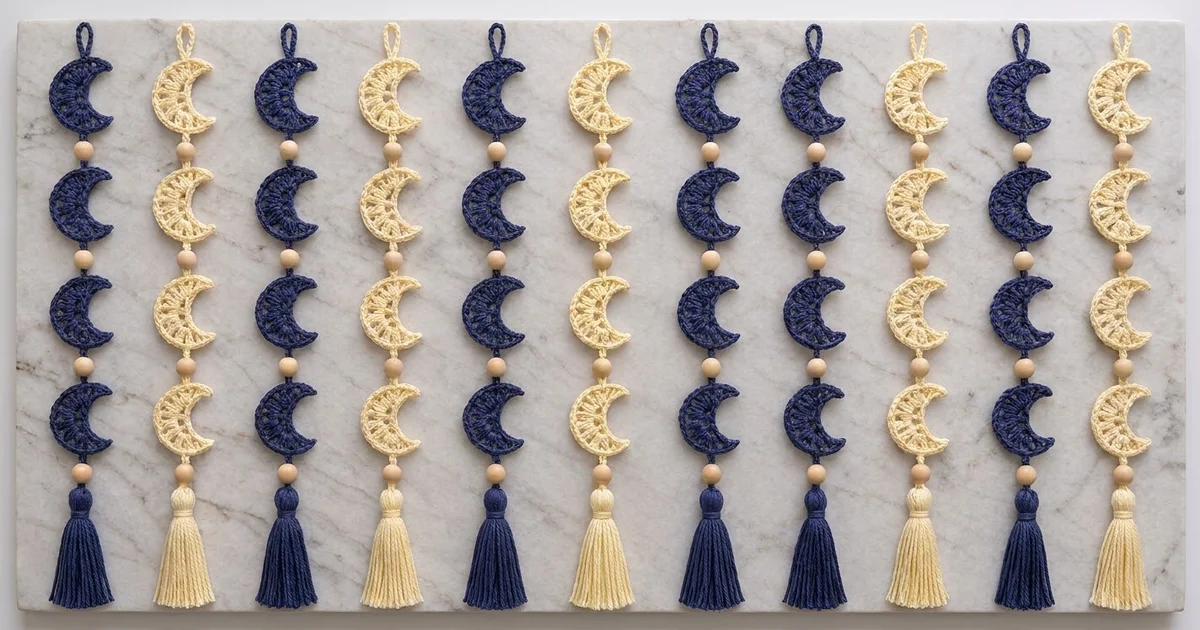
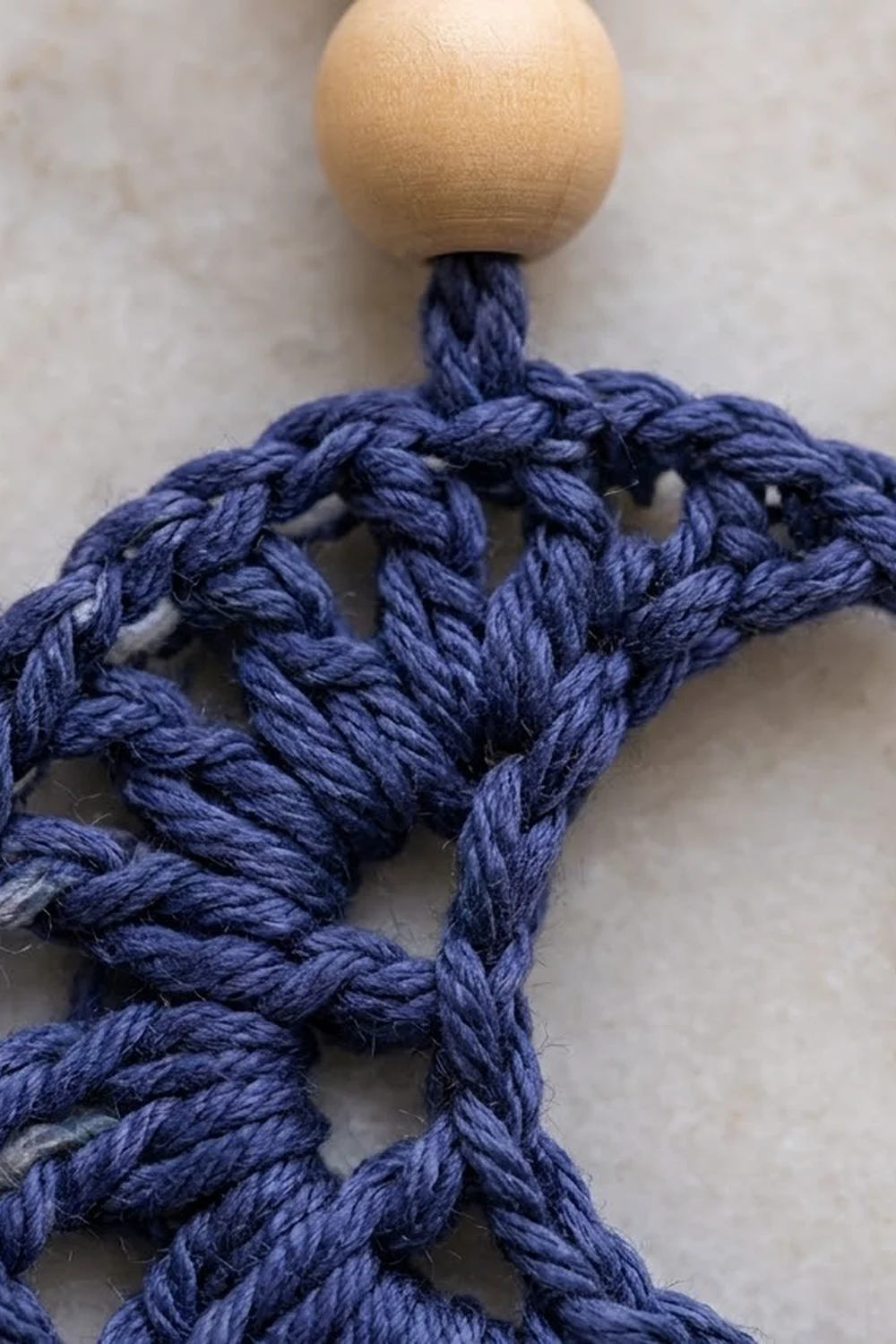
This curtain is made of hanging strands of small crescent moons. Each moon has a fan of tall stitches, a row of open double crochet groups, and a twisted crab-stitch edge that looks like rope. Natural wooden beads sit between the moons, and a full tassel finishes each strand.
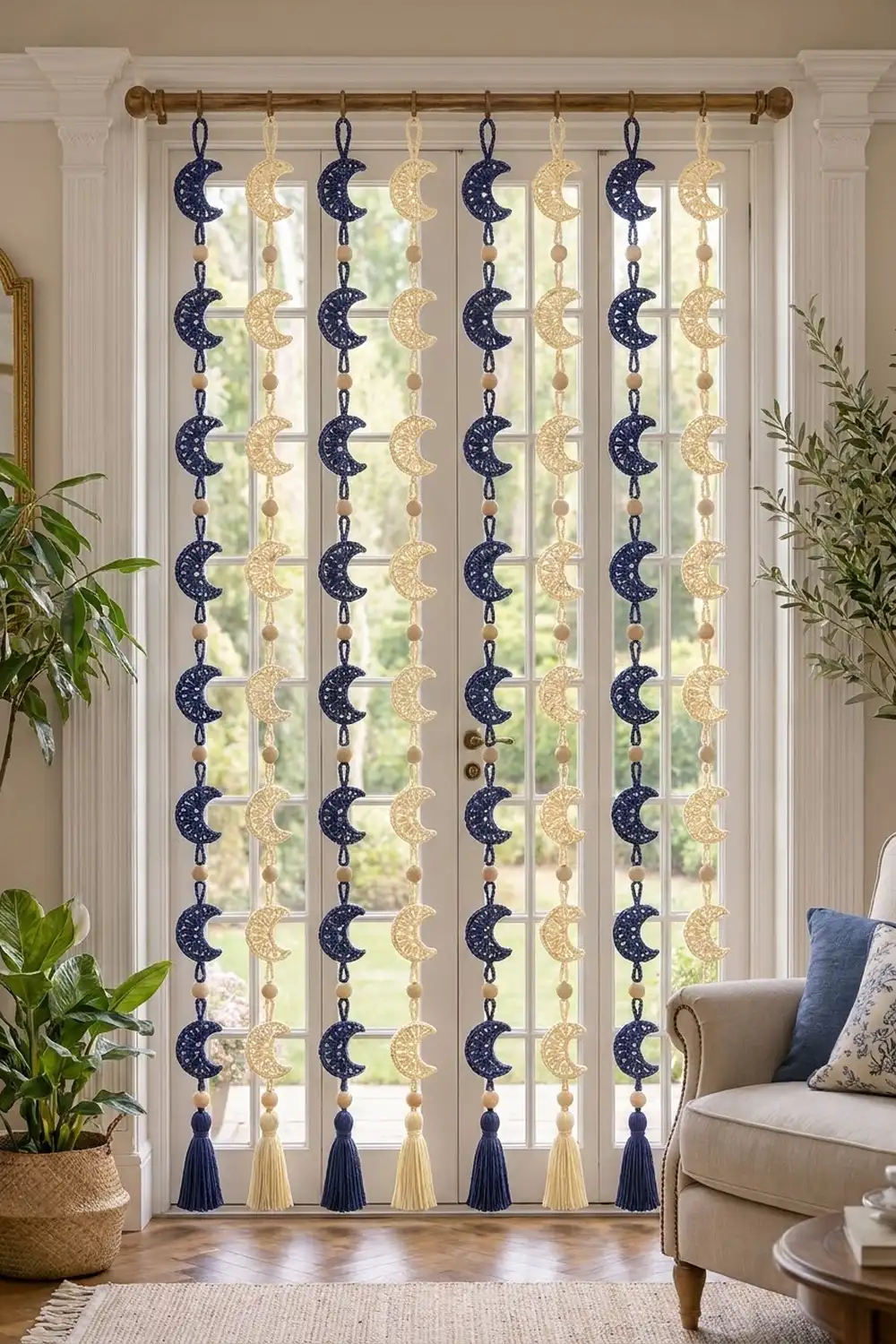
The curtain alternates deep navy and soft cream strands, so night and moonlight repeat across the doorway. The style is calm, a little boho, and suits a doorway, a window, or a reading nook. When light comes through, the open spaces in each moon show clearly.
This pattern uses US crochet terms. Each finished moon measures 3.5 in (8.9 cm) from horn to horn and 2 in (5.1 cm) wide. Each finished strand hangs about 38.5 in (97.8 cm) long, including the rod loop and tassel.
Construction is simple. You crochet each moon flat in 2 rows, then work a 2-round border that adds the crab-stitch edge and the 2 linking loops. Then you link the moons into strands with beads, add tassels, and hang the strands on a rod.
Finished Size and Construction
- Finished moon size: 3.5 in (8.9 cm) tall x 2 in (5.1 cm) wide, not counting the loops
- Moon size before border: 3 in (7.6 cm) tall x 1.75 in (4.4 cm) wide
- Border depth: 0.25 in (0.6 cm)
- Finished strand length: about 38.5 in (97.8 cm)
- Skill level: Easy-Intermediate
- Terminology: US
- Yarn weight: DK (#3) cotton
- Hook: 4.0 mm (G-6)
- Number of pieces: 48 moons (24 navy, 24 cream), 8 tassels
- Layout: 8 strands, 6 moons per strand, colors alternating
Materials
Use a smooth, tightly plied DK cotton or cotton blend. Cotton keeps a crisp shape, shows the crab-stitch twist clearly, and does not stretch much while hanging.
- Navy: 150 g, about 360 m (3 balls of 50 g / 120 m)
- Cream: 150 g, about 360 m (3 balls of 50 g / 120 m)
Each color makes 4 strands. One strand uses about 23 g: about 18 g for 6 moons, 3.5 g for the tassel, and 1.5 g for links and the hanger. The quantities above include a margin for your gauge swatch and tassel trimming.
Tools:
– 4.0 mm (G-6) crochet hook
– 60 natural wooden beads, 16 mm, with a hole of at least 4 mm (56 needed)
– Tapestry needle
– 2 stitch markers
– A piece of cardboard 4 in (10.2 cm) wide, for wrapping tassels
– Scissors
– Blocking mat, rustproof pins, and a spray bottle
– A curtain rod or tension rod
Abbreviations (US Terms)
- ch: chain
- sl st: slip stitch
- sc: single crochet
- hdc: half double crochet
- dc: double crochet
- tr: treble crochet
- sp: space
- st(s): stitch(es)
- RS / WS: right side / wrong side
Special stitch – reverse sc (crab stitch): Keep the RS facing you. Insert the hook into the next stitch to the right, yarn over, and pull up a loop. Yarn over and pull through both loops on the hook. This makes a twisted, rope-like edge.
Gauge and Checkpoints
Gauge: 20 sc and 22 rows = 4 in (10.2 cm) in DK cotton with a 4.0 mm hook. Border gauge is 5 sc per 1 in (2.5 cm) along the outer edge.
Make and measure one complete moon before you make the rest. Moons that are even slightly off become obvious once they hang in a column.
Checkpoints:
1. After Row 1, the strip curves gently. The inner chain edge is about 2.6 in (6.6 cm) long.
2. After Row 2, horn to horn measures 3 in (7.6 cm) and the width is 1.75 in (4.4 cm).
3. After Round 4, horn to horn measures 3.5 in (8.9 cm) and the width is 2 in (5.1 cm).
If the moon is too big: go down to a 3.5 mm hook. If it is too small: go up to a 4.5 mm hook. If the moon cups instead of lying flat, your Row 2 is too tight, so loosen your tension on the dc groups.
Crescent Moon Motif
Make 24 in navy and 24 in cream.
Foundation: Ch 14.
Row 1 (RS): Sc in the 2nd ch from the hook, hdc in the next ch, dc in the next ch, 2 dc in the next ch, [2 tr in the next ch] 5 times, 2 dc in the next ch, dc in the next ch, hdc in the next ch, sc in the last ch. Turn. (20 sts)
Check: the stitches use 1+1+1+1+5+1+1+1+1 = 13 chains. That is 13 working chains plus the skipped chain. The tall trebles fan out over the center, which makes the inner curve.
Row 2: Ch 1 (does not count as a stitch). Sc in each of the first 2 sts, hdc in the next st. 2 dc in the next st, dc in the next st (one 3-dc group made), ch 1. Repeat from * 6 more times, but leave out the final ch 1. You now have 7 groups with 6 ch-1 spaces between them. Hdc in the next st, sc in each of the last 2 sts. Do not turn yet. (27 sts: 4 sc, 2 hdc, 21 dc, plus 6 ch-1 sps)
Check: 2 + 1 + 14 + 1 + 2 = 20 stitches worked into. The ch-1 spaces between the dc groups make the small open gaps that radiate around the moon.
Border
The border is worked on each moon separately, before any linking. It has 2 rounds: a round of sc that frames the shape, then a crab-stitch round that adds the twist and the loops.
Round 3 (sc frame): Ch 1 and turn so the RS faces you.
- Outer edge: Sc in each st and in each ch-1 sp across Row 2. That gives 27 + 6 = 33 sc.
- Horn 2 tip: Ch 2.
- Horn 2 side: Work 1 sc into the side of each row, Row 2 then Row 1. (2 sc)
- Inner edge: Sl st into the free loop of each of the 13 foundation chains. (13 sl sts)
- Horn 1 side: Work 1 sc into the side of each row, Row 1 then Row 2. (2 sc)
- Horn 1 tip: Ch 2, then sl st to the first sc of the round.
Round 3 total: 50 sts (33 + 2 + 13 + 2) plus 2 ch-2 tip spaces.
Using slip stitches on the inner edge keeps that edge short and firm, so the crescent keeps its curve.
Before you go on, number the 33 outer sc in your head from 1 to 33. Place a marker in st 7 and in st 27. These stitches are 6 in from each end, so the loops sit symmetrically.
Round 4 (crab-stitch trim): Ch 1 and do not turn. Work in reverse sc, moving to the right.
- Horn 1 tip: Work (reverse sc, ch 1, reverse sc) in the ch-2 sp.
- Horn 1 side: Reverse sc in each of the 2 sc.
- Inner edge: Sl st loosely in each of the 13 sl sts.
- Horn 2 side: Reverse sc in each of the 2 sc.
- Horn 2 tip: Work (reverse sc, ch 1, reverse sc) in the ch-2 sp.
- Outer edge: Reverse sc in each of the 33 sc, working from st 33 back to st 1. At marked st 27 and marked st 7, work the reverse sc, then ch 6 and sl st into the top of that same reverse sc. This makes a linking loop.
- Sl st to the first st and fasten off. Weave in the ends.
Round 4 total: 50 sts worked one into each existing stitch (33 + 2 + 13 + 2), plus 4 extra sts worked into the tip spaces, = 54 sts. You also have 2 ch-1 tip points and 2 ch-6 loops.
Why the math works: The outer edge has 33 sc at 5 sc per inch, which is about 6.6 in (16.8 cm) of arc. The inner edge has 13 sl sts, which is about 2.6 in (6.6 cm). With the outer edge about 2.5 times as long as the inner edge, the piece curves into a crescent with horns 3.5 in (8.9 cm) apart. The extra stitches at the 2 tips sharpen the points without adding length along the curves.
Make All Pieces
- Navy: 24 moons and 4 tassels
- Cream: 24 moons and 4 tassels
Make the tassels the same way for both colors. Wrap yarn 40 times around the 4 in (10.2 cm) card. Slide a 12 in (30.5 cm) strand under the wraps at the top and tie it tightly. Cut the bottom loops. Wrap another strand around the bundle 0.5 in (1.3 cm) below the top, tie it, and hide the ends inside. Trim the tassel to 3.5 in (8.9 cm). Keep the long tie ends for attaching.
Layout grid (N = navy, C = cream; columns are strands, read from left to right):
Strand:  1  2  3  4  5  6  7  8
Moon 1:  N  C  N  C  N  C  N  C
Moon 2:  N  C  N  C  N  C  N  C
Moon 3:  N  C  N  C  N  C  N  C
Moon 4:  N  C  N  C  N  C  N  C
Moon 5:  N  C  N  C  N  C  N  C
Moon 6:  N  C  N  C  N  C  N  C
Base:    2 beads + tassel on each strand
Joining
Each strand is joined from the top down, with one bead link between each pair of moons. Use the strand’s own color for all links.
Hanger: Join yarn with a sl st into the top loop of Moon 1 (the loop at outer st 27). Ch 20, then sl st into the same loop. This makes a rod loop about 2 in (5.1 cm) deep. Fasten off.
Bead link (5 per strand):
1. Thread 1 bead onto the working yarn.
2. Sl st into the bottom loop of the upper moon (the loop at st 7).
3. Ch 1, slide the bead up against the hook, and ch 1 around the bead. This last chain closes behind the bead and locks it in place.
4. Sl st into the top loop of the next moon. Fasten off and weave in the ends.
Every moon hangs from the same 2 loops, at outer st 27 and st 7, so all horns point in the same direction. Keep each link snug. If a link is loose, the moons swing and twist on the strand.
Base: Thread 2 beads onto the yarn. Sl st into the bottom loop of Moon 6. Ch 1, slide up a bead, ch 1. Slide up the second bead, ch 1. Ch 2 more and fasten off, leaving an 8 in (20.3 cm) tail. Tie the tassel ends to this tail and hide all ends inside the tassel.
Strand length checkpoint:
– Rod loop: 2 in (5.1 cm)
– 6 moons x 3.5 in = 21 in (53.3 cm)
– 5 links x 2 in = 10 in (25.4 cm)
– Base and beads: 2 in (5.1 cm)
– Tassel: 3.5 in (8.9 cm)
Total: 38.5 in (97.8 cm). Each extra moon you add lengthens the strand by 5.5 in (14.0 cm), which is one moon plus one link.
Hang the strands 4.5 in (11.4 cm) apart. With 8 strands, that spans 31.5 in (80.0 cm) from the first strand to the last.
Final Blocking
- Pin each moon RS up on the blocking mat before you link it. Put pins at both horn tips and along the outer curve.
- Check each moon against the 3.5 in (8.9 cm) by 2 in (5.1 cm) size.
- Mist the moons with water until they are damp, not soaked.
- Gently open the dc groups so every ch-1 space shows as a clear gap.
- Let the moons dry completely, about 6 to 8 hours.
- After linking, hang each strand and lightly steam the tassels from a distance so they fall straight.
Final Quality-Control Checklist
- Every moon measures 3.5 in (8.9 cm) horn to horn.
- Row 1 has 20 sts and Row 2 has 27 sts plus 6 sps.
- Round 3 has 50 sts and Round 4 has 54 sts.
- The loops sit at outer sts 7 and 27 on every moon.
- All horns on a strand point the same way.
- Each strand has 6 moons, 7 beads, and 1 tassel.
- Strands alternate N, C, N, C across the rod.
- Every strand measures 38.5 in (97.8 cm).
- All ends are woven in or hidden inside the tassels.
Troubleshooting
Moon cups or ruffles: Recount Row 2. If you have more than 21 dc, you have too many stitches, which makes the piece ruffle. If the edge is tight, the piece cups instead, so work the dc groups more loosely.
Horns are blunt: Make sure the ch-2 tips in Round 3 and the (reverse sc, ch 1, reverse sc) points in Round 4 are both present.
Crab-stitch edge flares: Go down one hook size for Round 4 only.
Moons hang crooked: A loop is in the wrong place. Recount the outer edge and move the loop to st 7 or st 27.
Bead slides along the link: The locking chain is missing. Redo step 3 of the bead link.
Strands are different lengths: Compare moon sizes and redo any moon that is off by more than 0.25 in (0.6 cm).
Care
Dust the curtain by shaking it gently. If needed, hand wash the strands in cool water, then lay them flat to dry. Keep the wooden beads out of soaking water.
Final Notes
The measurements build on each other. Gauge is 20 sc per 4 in (10.2 cm). Rows 1 and 2 give a 3 in (7.6 cm) crescent, and the 0.25 in (0.6 cm) border brings each moon to 3.5 in (8.9 cm). Six moons, five 2 in (5.1 cm) links, the rod loop, the base, and the tassel make a 38.5 in (97.8 cm) strand. Eight strands spaced 4.5 in (11.4 cm) apart fill 31.5 in (80.0 cm) of rod. Check each stage as you go and the finished curtain will hang evenly.
Happy crocheting!