

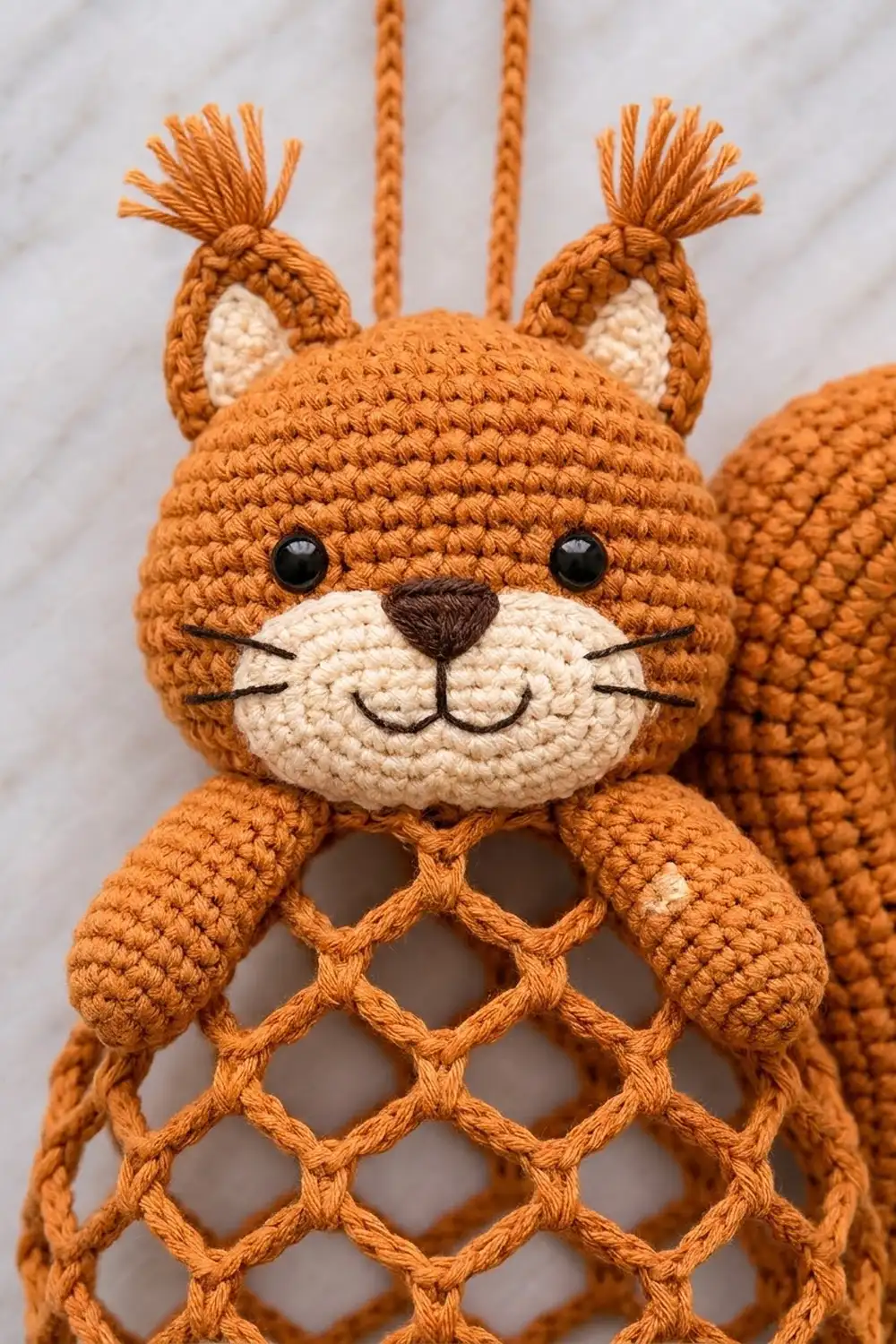
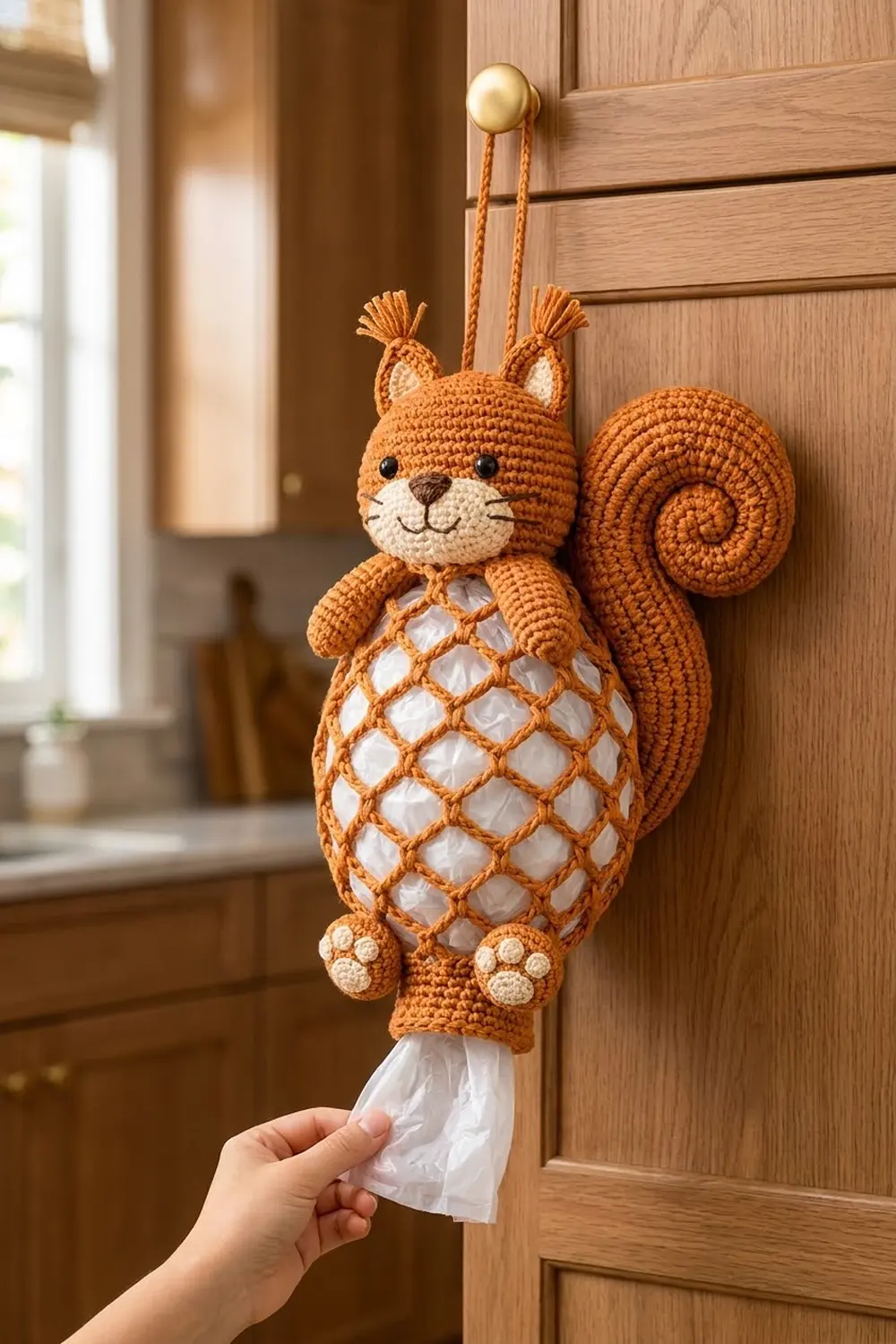
This squirrel grocery-bag holder turns a pile of plastic bags into a cheerful kitchen helper. A rust-orange squirrel hugs an open diamond-mesh belly. It has a big curled tail at one side, round feet at the bottom and tufted ears on top. You push bags in at the top and pull them out one at a time through the solid cuff at the base.
The main color is a warm rust orange. Cream is used for the inner ears, cheeks, paw pads and toes, dark brown for the nose and black for the whiskers. The eyes are black safety eyes. A soft taupe works just as well for a more neutral version.
The pattern uses US crochet terms. The finished holder is 8 in (20.3 cm) wide across the belly and 18 in (45.7 cm) long from the cuff edge to the top of the head. That is about 19.5 in (49.5 cm) to the tips of the ear tufts, and about 11 in (27.9 cm) wide including the tail.
The body is one piece worked from the bottom up: a solid cuff, then a chain-loop mesh, then a solid top band. The hollow head and the small parts are made separately and sewn on.
Finished Size and Construction
- Finished size: 8 in (20.3 cm) x 18 in (45.7 cm), plus ears and cords
- Skill level: Intermediate
- Terminology: US crochet terms
- Yarn weight: Worsted (#4) cotton
- Hooks: US G-6 (4.0 mm) for the solid parts, US H-8 (5.0 mm) for the mesh
- Number of pieces: 1 assembled holder made of a body, head, 2 ears, 2 inner ears, 2 cheeks, nose, 2 arms, 2 feet, 2 paw pads, 6 toes, tail and 2 cords
- Layout: One upright squirrel, with the tail sewn to its right side
- Body size (flat): 8 in (20.3 cm) wide at the widest point
- Size before border: Cuff plus mesh is 14.4 in (36.6 cm) long
- Border depth: The top band is 0.4 in (1.0 cm); the cuff edge is a single round of slip stitches
Materials
Choose a smooth, firm worsted-weight cotton or cotton blend. Cotton keeps the mesh open and won’t stretch out under the weight of the bags. These amounts assume about 85 m per 50 g.
- Rust orange (main color): 200 g, about 340 m
- Cream: 20 g, about 34 m
- Dark brown: 5 g, about 9 m
- Black: 2 m, for embroidery
All quantities include a margin of about 15 percent for gauge differences.
Tools: US G-6 (4.0 mm) and US H-8 (5.0 mm) hooks, two 10 mm black safety eyes, a small amount of fiberfill, stitch markers, a tapestry needle, scissors, pins and a tape measure.
Abbreviations (US Terms)
- ch – chain
- sl st – slip stitch
- sc – single crochet
- inc – 2 sc in the same stitch
- sc2tog / sc3tog – single crochet 2 / 3 together
- MR – magic ring
- sk – skip
- sp – space
- st(s) – stitch(es)
- rnd(s) – round(s)
Special stitch – mesh loop: “Ch X, sc in next sp” makes one loop of X chains anchored by one sc. Each loop counts as 1 in the round’s total.
Gauge and Checkpoints
Solid gauge (G hook): 18 sc and 20 rnds = 4 in (10.2 cm). One rnd is 0.2 in (0.5 cm) tall.
Mesh gauge (H hook): One rnd of ch-6 loops is about 0.8 in (2.0 cm) tall when lightly stretched lengthwise.
Use the cuff as your test piece. If it comes out wider than stated, go down a hook size. If it’s narrower, go up a size. For the mesh, change the hook size rather than the chain counts.
Checkpoints:
- After cuff Rnd 8: 3.6 in (9.1 cm) wide flat and 1.6 in (4.1 cm) tall.
- After Mesh Rnd 4: about 6 in (15.2 cm) wide flat; total length 3.8 in (9.7 cm).
- After Mesh Rnd 14: 8 in (20.3 cm) wide flat; total length 11.8 in (30.0 cm).
- After Mesh Rnd 18: total length 14.4 in (36.6 cm).
- Head: 6.7 in (17.0 cm) wide flat and 3.6 in (9.1 cm) tall.
If the mesh is too long, work one fewer ch-6 rnd in Rnds 5–14. If it’s too short, add one. Every ch-6 rnd has 32 loops, so this doesn’t change any later counts.
Body: Cuff
With rust and the G hook, ch 32. Join with a sl st to the first ch, taking care not to twist the chain.
Rnd 1: Sc in each ch around. (32)
Rnds 2–8: Sc in each st around. (32)
Don’t fasten off. The cuff is 3.6 in (9.1 cm) wide flat and 1.6 in (4.1 cm) tall.
Body: Mesh
Switch to the H hook. Work in a continuous spiral and move your marker to the first loop of each rnd.
Rnd 1: Sl st in the next st (call it st 1). Ch 3, sk 1 st, sc in next st 16 times. The last sc lands in st 1. (16 ch-3 loops)
Rnd 2 (growth): Ch 4, sc in next sp, ch 4, sc in next sp, ch 4, sc in same sp 8 times. (24 ch-4 loops) Every 2 old spaces become 3 new loops.
Rnd 3: Ch 5, sc in next sp 24 times. (24 ch-5 loops)
Rnd 4 (growth): (Ch 5, sc in next sp) 3 times, ch 5, sc in same sp 8 times. (32 ch-5 loops) Every 3 old spaces become 4 new loops.
Rnds 5–14: Ch 6, sc in next sp 32 times. (32 ch-6 loops in each rnd) This is the widest part of the belly, 8 in (20.3 cm) flat.
Rnds 15–16: Ch 5, sc in next sp 32 times. (32 ch-5 loops in each rnd)
Rnd 17 (decrease): (Ch 5, sc in next sp) twice, ch 5, sk next sp, sc in following sp 8 times. (24 ch-5 loops) Every 4 old spaces become 3 new loops.
Rnd 18: Ch 5, sc in next sp 24 times. (24 ch-5 loops)
Don’t fasten off; the top band is worked in the Border section. The body should now be 14.4 in (36.6 cm) long.
Head
With rust and the G hook. The head is a hollow dome with an open bottom.
Rnd 1: 6 sc in MR. (6)
Rnd 2: Inc in each st. (12)
Rnd 3: Sc, inc 6 times. (18)
Rnd 4: 2 sc, inc 6 times. (24)
Rnd 5: 3 sc, inc 6 times. (30)
Rnd 6: 4 sc, inc 6 times. (36)
Rnd 7: 5 sc, inc 6 times. (42)
Rnd 8: 6 sc, inc 6 times. (48)
Rnd 9: 7 sc, inc 6 times. (54)
Rnd 10: 8 sc, inc 6 times. (60)
Rnds 11–18: Sc in each st. (60)
Sl st to join, then fasten off, leaving a long tail. Insert the safety eyes between Rnds 12 and 13, 9 sts apart and centered on the front.
Face
Cheeks (make 2, cream, G hook):
Rnd 1: 6 sc in MR. (6)
Rnd 2: Inc in each st. (12)
Rnd 3: Sc, inc 6 times. (18)
Fasten off. Each cheek is 1.2 in (3.0 cm) across.
Nose (dark brown, G hook):
Row 1: Ch 4, sc in 2nd ch from hook and next 2 ch. (3)
Row 2: Ch 1, turn, sc3tog. (1)
Fasten off. This makes a triangle 0.7 in (1.8 cm) wide.
Sew the cheeks side by side, just touching, with their top edges at Rnd 14. Sew the nose point-down where the cheeks meet. With black, embroider a small “w” mouth and 3 whiskers per cheek, each 1 in (2.5 cm) long.
Ears
Ear (make 2, rust, G hook):
Rnd 1: 4 sc in MR. (4)
Rnd 2: Sc, inc twice. (6)
Rnd 3: 2 sc, inc twice. (8)
Rnd 4: 3 sc, inc twice. (10)
Rnd 5: 4 sc, inc twice. (12)
Rnd 6: 5 sc, inc twice. (14)
Rnds 7–8: Sc in each st. (14)
Flatten and close with 7 sc through both layers. Each ear is 1.6 in (4.1 cm) tall and 1.6 in (4.1 cm) wide.
Inner ear (make 2, cream, G hook):
Row 1: Ch 5, sc in 2nd ch from hook and next 3 ch. (4)
Row 2: Ch 1, turn, sc2tog twice. (2)
Row 3: Ch 1, turn, sc2tog. (1)
Fasten off. Each inner ear is 0.9 in (2.3 cm) wide and 0.6 in (1.5 cm) tall. Sew one to the front of each ear, point up.
Tufts: Cut 4 rust strands, each 3 in (7.6 cm) long. Fold them in half and attach them as fringe through the ear tip. Separate the plies and trim the tuft to 1 in (2.5 cm).
Arms, Feet and Tail
Arms (make 2, rust, G hook):
Rnd 1: 6 sc in MR. (6)
Rnd 2: Inc in each st. (12)
Rnds 3–12: Sc in each st. (12)
Stuff lightly, flatten, and close with 6 sc through both layers. Each arm is 1.3 in (3.3 cm) wide and 2.4 in (6.1 cm) long.
Feet (make 2, rust, G hook):
Rnds 1–4: Work as Head Rnds 1–4. (24)
Rnds 5–6: Sc in each st. (24)
Rnd 7: 2 sc, sc2tog 6 times. (18)
Rnd 8: Sc, sc2tog 6 times. (12) Stuff lightly.
Rnd 9: Sc2tog 6 times. (6)
Close the hole. Each foot is about 1.8 in (4.6 cm) across.
Paw pads (make 2, cream): Work Cheek Rnds 1–2. (12) Each pad is 0.8 in (2.0 cm) across.
Toes (make 6, cream): Work 5 sc in MR, pull the ring closed and fasten off. Each toe is 0.4 in (1.0 cm) across. Sew one pad to each foot with 3 toes in an arc above it.
Tail (rust, G hook):
Rnd 1: 6 sc in MR. (6)
Rnd 2: Sc, inc 3 times. (9)
Rnds 3–5: Sc in each st. (9)
Rnd 6: 2 sc, inc 3 times. (12)
Rnds 7–11: Sc in each st. (12)
Rnd 12: 3 sc, inc 3 times. (15)
Rnds 13–17: Sc in each st. (15)
Rnd 18: 4 sc, inc 3 times. (18)
Rnds 19–44: Sc in each st. (18)
Stuff lightly, flatten, and close with 9 sc through both layers. The tail is 8.8 in (22.4 cm) long and 2 in (5.1 cm) wide. Coil the narrow first 17 rnds, about 3.4 in (8.6 cm), inward into a spiral and tack it in place.
Hanging cords (make 2, rust, G hook): Ch 45. Sl st in the back bump of the 2nd ch from hook and in each ch across. (44) Each cord is 10 in (25.4 cm) long.
Border: Top Band and Cuff Edge
Border gauge: 18 sc = 4 in (10.2 cm) on the G hook. With the body flattened, each rnd has two sides: front and back.
Rnd 19 (conversion, G hook): 2 sc in next sp, 3 sc in next sp 12 times. (24 sps x 2 sc = 48) + (12 extra sc) = 60, which is 30 front and 30 back.
Rnd 20: Sc in each st around. (60: 30 front, 30 back) Sl st to join and fasten off.
Cuff edge: Join rust in the foundation ch of the cuff. Sl st loosely in each ch around. (32: 16 front, 16 back) Fasten off.
Why the math works: The band and the head’s open edge both have 60 sts, so they match stitch for stitch. At 4.5 sts per inch, 60 sts is 13.3 in (33.8 cm) around, or 6.7 in (17.0 cm) flat, which is exactly the width of the head. The cuff edge stays at 32 sts, 7.1 in (18.0 cm) around. That’s loose enough to pull out one bag but firm enough to hold the rest.
Assembly:
- Slip the head over the band so its edge lines up with the bottom of Rnd 19.
- Whipstitch the head to the band through 36 matching sts: the 30 back sts plus 3 on each side. Leave the front 24 sts open. This is where you push bags in, and the chin lifts like a flap.
- Sew the ears to the top of the head between Rnds 5 and 8, 12 sts apart.
- Sew the arms angled downward onto the mesh just below the band.
- Sew the feet to Mesh Rnd 1, one on each side of the cuff.
- Sew the tail to the right side of the body from Mesh Rnd 6 to Mesh Rnd 16.
- Sew one end of each cord to the back of the head behind an ear, then join the free ends to make a hanging loop.
Final Blocking
- Lightly mist the holder with water.
- Fill the body with bags or a rolled towel until it’s 8 in (20.3 cm) wide.
- Gently stretch the body to 14.4 in (36.6 cm), measured from the cuff edge to the bottom of the head.
- Straighten the diamonds with your fingers.
- Shape the head into a smooth dome and stand the ear tufts upright.
- Let it dry completely, then take out the filling.
Final Quality-Control Checklist
- The cuff is 3.6 in (9.1 cm) wide flat, and its edge has 32 sl sts.
- The mesh loop counts are 16, 24, 24, 32, then 32 through Rnd 16, then 24, 24.
- The top band has 60 sts and is fully hidden inside the head.
- The front 24 sts of the head lift freely.
- The eyes are level and the nose is centered.
- The tail coil is tacked down.
- All yarn ends are woven in at least 2 in (5.1 cm).
- The total length is 18 in (45.7 cm).
Troubleshooting
The mesh twists: Make sure each sc goes into a chain space, not into a chain.
The loop count is wrong: Recount Rnds 2, 4 and 17, which should have 24, 32 and 24 loops.
The head is wider than the band: Rework Rnds 11–18 more tightly, or use a hook one size smaller.
Bags fall out of the cuff: Add a second round of sl sts on the cuff edge.
The tail flops over: Tack it to the body again at Mesh Rnds 10 and 14.
Care
Hand wash in cool water and lay flat to dry, reshaping the mesh while it’s damp. Don’t tumble dry.
Final Notes
Here is the measurement chain. The cuff has 32 sts and is 3.6 in (9.1 cm) wide. The mesh grows from 16 to 24 to 32 loops and reaches 8 in (20.3 cm) wide, then narrows to 24 loops. At that point the body is 14.4 in (36.6 cm) long. The 60-st band matches the 60-st head, and the 3.6 in (9.1 cm) head brings the holder to 18 in (45.7 cm). If each checkpoint matches, your squirrel will too.
Happy crocheting!