
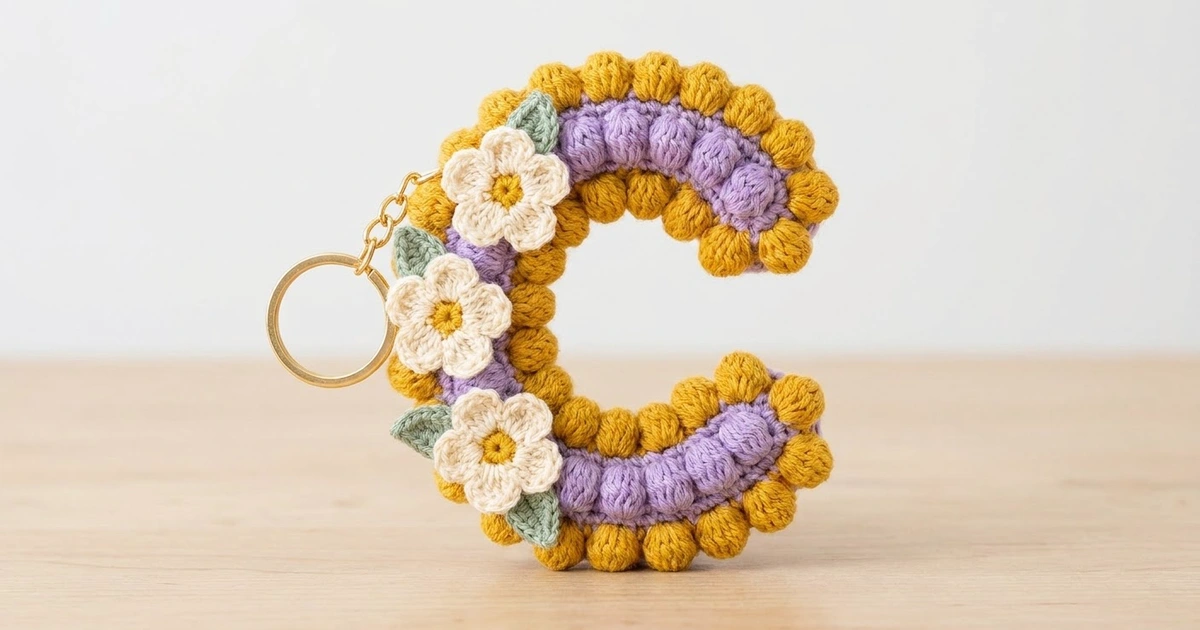
This little letter C is a chunky, squishy keychain covered in round bobbles. A single line of soft lavender bobbles runs down the middle of the letter. Sunny mustard-yellow bobbles frame it on both sides and wrap around the rounded ends.
Three cream daisies with yellow centers and sage-green leaves run down the outer curve, giving it a cottage-garden look. A gold key ring finishes it, so it can hang from a bag, a set of keys or a zipper pull.
The pattern uses US crochet terms. The finished letter measures about 3.5 in (8.9 cm) tall, 3 in (7.6 cm) wide and 1 in (2.5 cm) across the band, not counting the hardware.
Construction is simple. You first work a short, straight lavender strip of two rows. Then you work one yellow bobble round all the way around it. That round has more stitches on the outer edge than on the inner edge, which bends the strip into a C. Finally you make the flowers and leaves separately and sew them on after blocking.
Finished Size and Construction
- Finished size: 3.5 in (8.9 cm) tall x 3 in (7.6 cm) wide
- Skill level: Advanced beginner
- Terminology: US terms
- Yarn weight: DK (light worsted, #3)
- Hook: 3.5 mm (E-4)
- Number of pieces: 1 letter body, plus 3 flower appliqués and 6 leaf appliqués
- Layout: One curved C body; flowers along the outer left curve
- Lavender strip size (before border): 5 in (12.7 cm) long x 0.5 in (1.3 cm) wide
- Border depth: 0.25 in (0.6 cm) on each long edge
- Band width after border: 1 in (2.5 cm)
- Flower size: 0.9 in (2.3 cm) across
- Leaf size: 0.75 in (1.9 cm) long x 0.4 in (1.0 cm) wide
Materials
Use a smooth, mercerized or soft cotton DK yarn. Cotton gives the bobbles crisp, round shapes, and it holds the C shape well after blocking. Avoid fuzzy or very splitty yarns, because they blur the bobbles.
- Mustard yellow: 6 g, about 15 m (border round and flower centers)
- Lavender: 4 g, about 10 m (center strip)
- Cream or off-white: 3 g, about 8 m (flower petals)
- Sage green: 2 g, about 5 m (leaves)
Tools:
- 3.5 mm (E-4) crochet hook
- Tapestry needle
- Scissors
- Gold split key ring, 1 in (2.5 cm), with a short chain
- One 6 mm gold jump ring
- Two pairs of flat-nose pliers
- Rust-proof pins and a foam blocking board
- Spray starch (optional, recommended)
All yarn quantities include a margin of about 20% for swatching and tails.
Abbreviations (US Terms)
- ch = chain
- sl st = slip stitch
- sc = single crochet
- hdc = half double crochet
- dc = double crochet
- sc2tog = single crochet 2 together
- st(s) = stitch(es)
- RS / WS = right side / wrong side
- B = bobble (see below)
Bobble (B): Yarn over (yo), insert the hook in the indicated st and pull up a loop, then yo and draw through 2 loops. You now have 2 loops on the hook. Repeat this 3 more times in the same st, for 5 loops on the hook. Yo and draw through all 5 loops. Each bobble counts as 1 st.
Bobbles pop out on the side facing away from you. That is why every bobble row and round in this pattern is worked with the WS facing.
Gauge and Checkpoints
Gauge: 5 sc = 1 in (2.5 cm) with DK cotton and a 3.5 mm hook.
Make the lavender strip first and measure it before you add the border. Use these checkpoints:
- After Row 1: 25 sc measure 5 in (12.7 cm).
- After Row 2: The strip measures 5 in (12.7 cm) x 0.5 in (1.3 cm).
- After the border: The band is 1 in (2.5 cm) wide. The piece already curls into a loose C.
- After blocking: The C is 3.5 in (8.9 cm) tall x 3 in (7.6 cm) wide, with a gap of about 1 in (2.5 cm) between the tips.
If your strip is too long (over 5.25 in / 13.3 cm), go down to a 3.25 mm hook. If it is too short (under 4.75 in / 12.1 cm), go up to a 3.75 mm hook.
If your bobbles look flat, tighten the final yo-through-5. If they look stiff and pointed, relax your tension slightly.
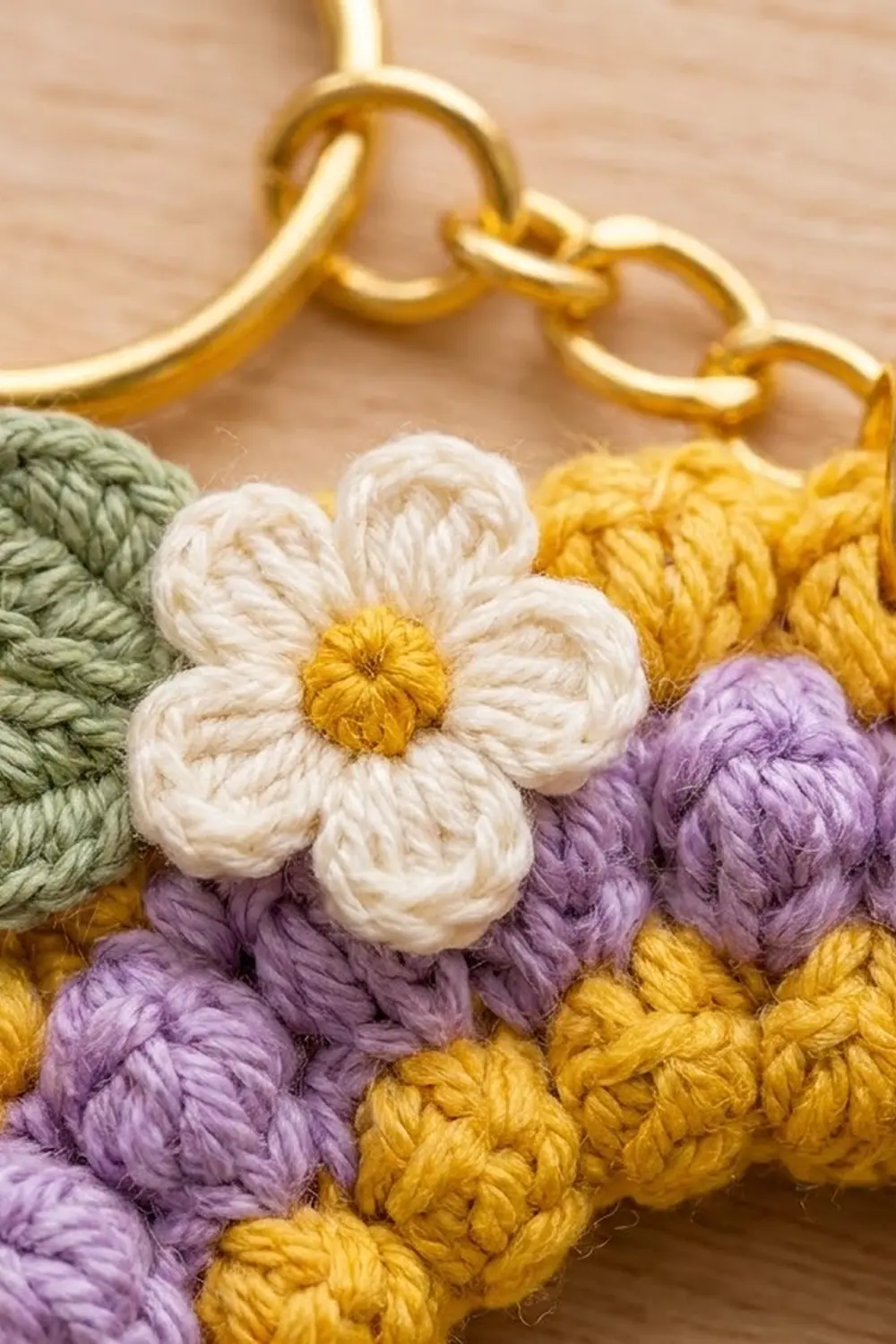
Lavender Center Strip
Foundation: With lavender, ch 26.
Row 1 (RS): Sc in 2nd ch from hook and in each ch across. Turn. (25 sts)
Row 2 (WS): Ch 1 (does not count as a st). Sc in first st, B in next st, sc in next st; repeat from * to * 11 more times. (25 sts: 12 B, 13 sc)
Fasten off, leaving a 6 in (15.2 cm) tail. Look at the RS: the 12 lavender bobbles form a straight line down the middle of the strip.
Checkpoint: the strip measures 5 in (12.7 cm) x 0.5 in (1.3 cm).
Border: Yellow Bobble Round
This round makes both yellow bobble lines and the two yellow end caps in one pass. It also shapes the curve of the C.
Border gauge: One bobble plus one sc measures about 0.4 in (1.0 cm) along the outer edge. The border adds 0.25 in (0.6 cm) of depth to each long edge.
Setup: Hold the strip with the WS facing you and Row 2 along the top. Join yellow with a standing sc in the first st of Row 2, at the right-hand end.
Round 1 (WS):
- Outer edge (along the tops of Row 2): The standing sc counts as the first st. Then work B in next st, sc in next st, (B, sc) in next st; repeat from * to * 7 more times. (33 sts: 16 B, 17 sc)
- First end (along the row-ends): B in the side of Row 2, sc in the gap between the rows, B in the side of Row 1. (3 sts: 2 B, 1 sc)
- Inner edge (along the underside of the foundation chain, 25 loops): Sc in the first ch loop, then work B in next loop, sc2tog over next 2 loops; repeat from * to * 7 more times. (17 sts: 8 B, 1 sc, 8 sc2tog)
- Second end (along the row-ends): B in the side of Row 1, sc in the gap between the rows, B in the side of Row 2. (3 sts: 2 B, 1 sc)
Join with a sl st to the first sc. Fasten off, leaving an 8 in (20.3 cm) tail.
Round 1 total: 33 + 3 + 17 + 3 = 56 sts (28 B and 28 sc-type sts).
Why the math works:
- Outer edge: Each repeat works 4 sts into 3 strip sts. That gives 1 + (8 x 4) = 33 sts from 25.
- Inner edge: Each repeat works 2 sts over 3 loops. That gives 1 + (8 x 2) = 17 sts from 25.
- Curve: The outer edge has almost twice as many stitches as the inner edge, so the strip bends into an arc.
- Alternating pattern: Every segment starts and ends so that bobbles and sc alternate the whole way around. That is why the count is exactly 28 of each, with no two bobbles side by side.
Checkpoint: the band measures 1 in (2.5 cm) wide and curls into a loose C on its own.
Flowers (Make 3)
Round 1: With yellow, make a magic ring. Ch 1, then work 5 sc in the ring. Pull the ring closed and sl st to the first sc. Fasten off yellow. (5 sts)
Round 2: Join cream with a sl st in any sc. (Ch 2, 3 dc, ch 2, sl st) in the same st, then sl st in the next st; repeat from * to * 4 more times. Work the final sl st into the joining st. (5 petals)
Fasten off, leaving a 10 in (25.4 cm) tail for sewing. Each flower measures 0.9 in (2.3 cm) across.
Leaves (Make 6)
With sage green, ch 6.
Round 1:
- First side: Sc in the 2nd ch from the hook, hdc in the next ch, dc in the next ch, hdc in the next ch, then 3 sc in the last ch.
- Second side (working along the opposite side of the chain): Hdc in the next ch, dc in the next ch, hdc in the next ch, sc in the next ch.
- Sl st in the skipped ch at the tip. (11 sts plus the tip sl st)
Fasten off, leaving an 8 in (20.3 cm) tail. Each leaf measures 0.75 in (1.9 cm) x 0.4 in (1.0 cm).
Final Blocking
- Weave in all the tails on the letter body, but keep the 8 in (20.3 cm) yellow tail for now.
- Dampen the C with cool water and press it gently in a towel.
- With the RS up, pin the C onto foam. Shape it into three-quarters of a circle, 3.5 in (8.9 cm) tall and 3 in (7.6 cm) wide, with a 1 in (2.5 cm) gap between the tips. Pin between bobbles, never through them.
- Mist with spray starch if you are using it. Let the piece dry completely, which takes 6–12 hours.
- Lightly block the flowers and leaves flat, and pin each petal tip open.
- When everything is dry, plan the appliqué layout. Place one flower at the upper-left curve, one at the left midpoint and one at the lower-left curve. Each should overlap the outer yellow bobbles and part of the lavender line. Tuck two leaves behind each flower so their tips point outward past the edge.
- Sew the leaves first, using their own tails and small stitches through their bases. Then sew each flower through its yellow center and petal bases. Weave all the tails in on the WS.
- Open the jump ring with two pliers. Pass it between two yellow bobbles on the outer edge of the upper arm, about 1.25 in (3.2 cm) from the upper tip. Hook on the key ring chain and close the jump ring fully.
Final Quality-Control Checklist
- The lavender strip has 25 sts and 12 bobbles.
- The border round has 56 sts: 33 outer, 3 per end, 17 inner.
- Bobbles alternate with sc all the way around, with no doubled bobbles.
- All bobbles pop to the RS.
- The C measures 3.5 in (8.9 cm) x 3 in (7.6 cm).
- The band is a steady 1 in (2.5 cm) wide.
- All three flowers have 5 even petals, and each has two leaves.
- The jump ring is fully closed and passes between stitches, not through split yarn.
- No tails are visible on the RS.
Troubleshooting
The bobbles pop to the wrong side. You worked that row or round with the RS facing. Rip it back and redo it with the WS facing you.
The C won’t curve enough. Check the inner edge: it must have 17 sts, not 25. If it does, pin the piece more firmly and starch it while blocking.
The outer edge ruffles. Your bobbles are too loose. Go down half a hook size for the border round only.
The end caps look gappy. Work the end sc into the gap between the rows, not into a row-end stitch.
The petals curl. Block them flat and pin each tip, or work the petal dc with slightly looser tension.
The key ring pulls the piece out of shape. Move the jump ring so it sits between bobbles, catching both the sc and the strip stitch below it.
Care
Spot clean with mild soap and cool water, then reshape and dry the keychain flat. Remove the key ring before any thorough washing.
Final Notes
The measurement chain is short and reliable:
- Gauge: 5 sc = 1 in (2.5 cm).
- Lavender strip: 25 sts = 5 in (12.7 cm) long and 0.5 in (1.3 cm) wide.
- Border: 56 sts, with 33 outer and 17 inner, adds 0.25 in (0.6 cm) to each edge for a 1 in (2.5 cm) band.
- Finished letter: Blocking sets the C at 3.5 in (8.9 cm) x 3 in (7.6 cm).
If you hit every checkpoint, your letter will match. Once you have made one C, try other colors, flowers or ribbon trims.
Happy crocheting!