

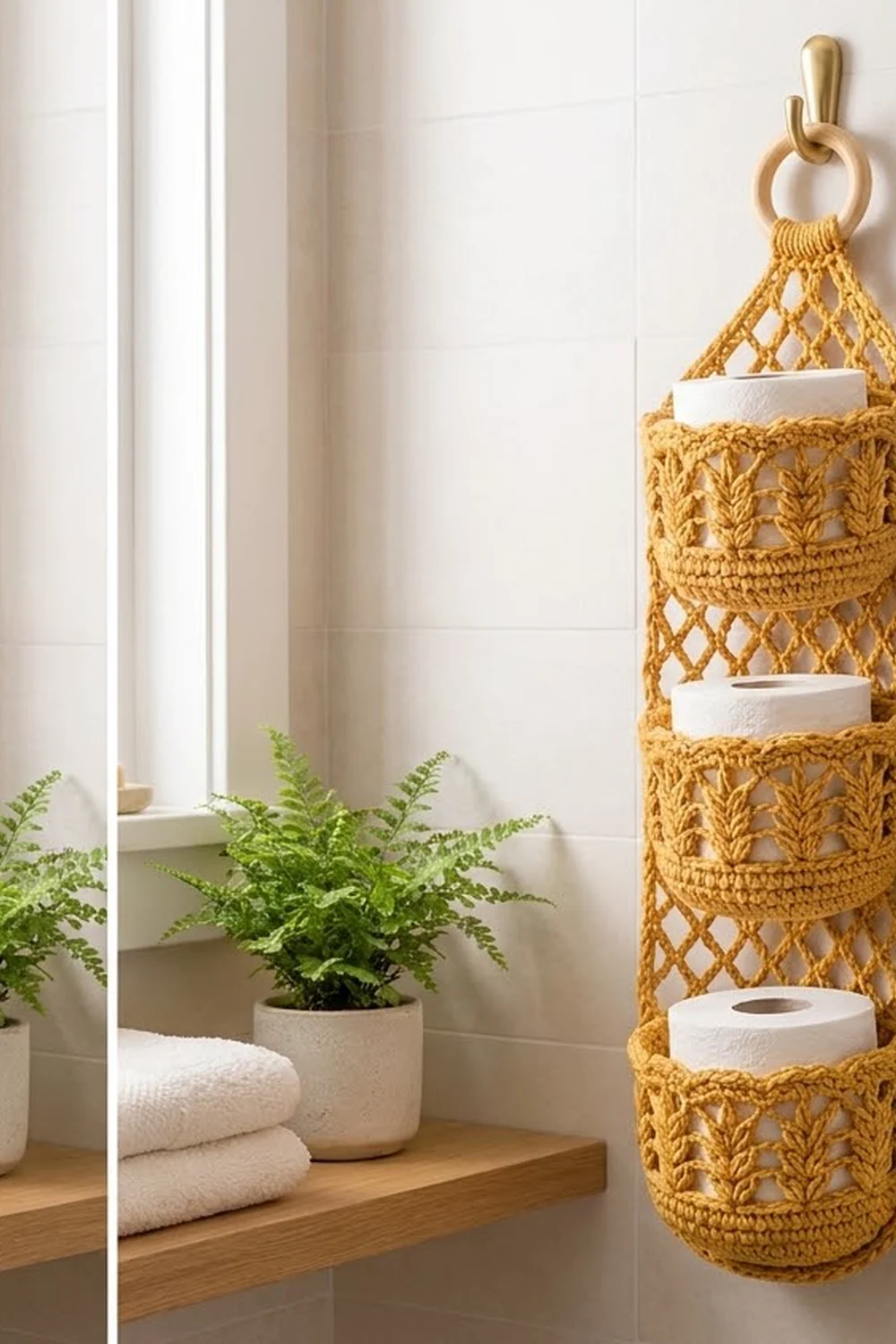
This hanging organizer stacks three round baskets on a long diamond-mesh panel that hangs from a 2 in (5.1 cm) wooden ring. Each basket holds one standard toilet paper roll. The roll sits deep inside, and its top shows a little above the scalloped rim.
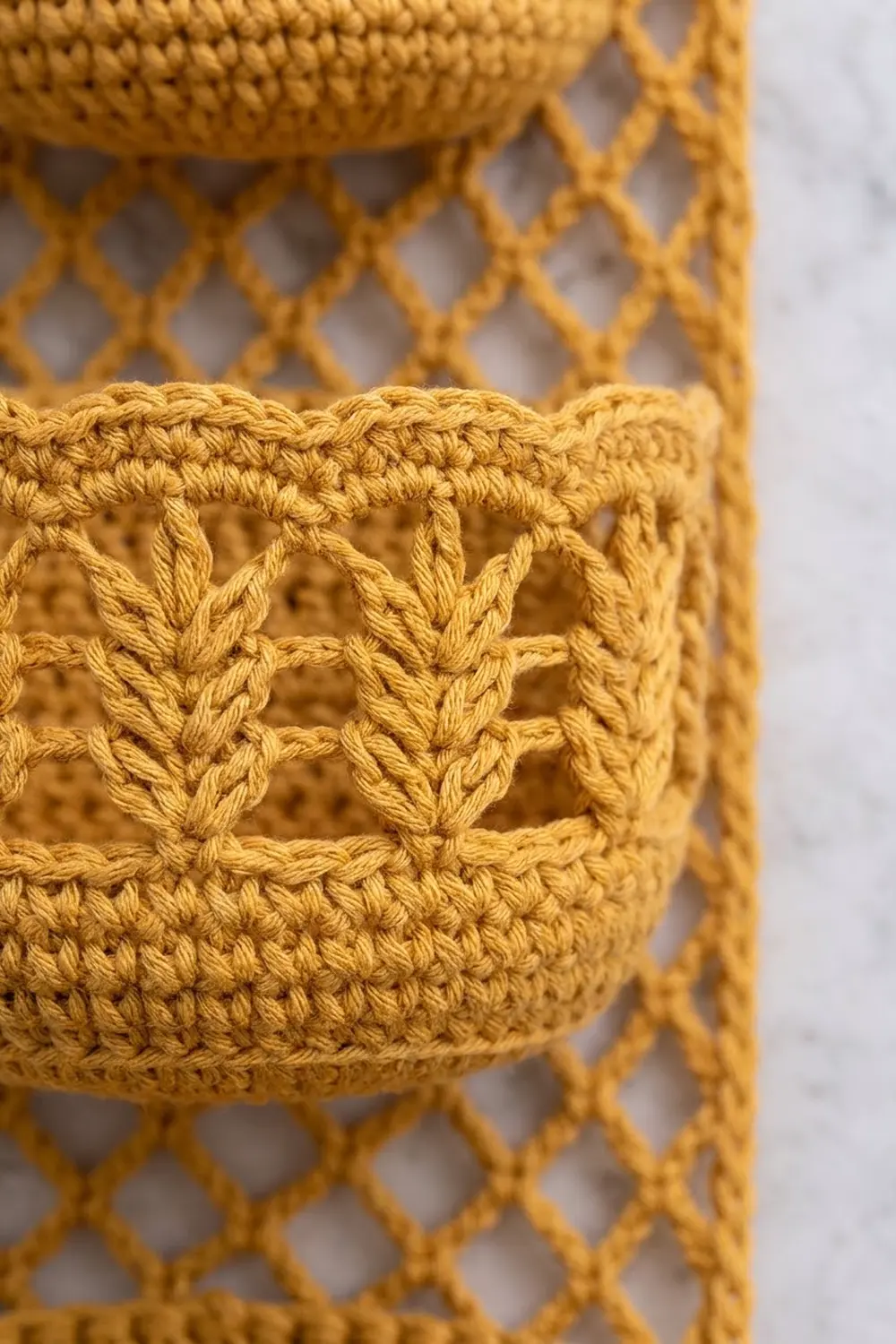
The look comes from a band of openwork “wheat ears” around the middle of each basket. Each ear is a stack of shells, with open windows between the ears. The holder uses one solid color. The photographed versions are golden mustard and soft cream, and both suit a warm, natural bathroom.
The pattern uses US crochet terms. With the border on, the panel is 8 in x 24 1/8 in (20.3 cm x 61.3 cm). Each basket is 5 1/4 in (13.3 cm) across and 3 3/4 in (9.5 cm) tall. Including the ring, the holder hangs about 27 in (68.6 cm) long.
First, crochet three identical baskets in the round, starting at the base. Then work one mesh panel in rows from the bottom up, tapering it at the top. Sew the baskets onto the panel and add a two-round border. To finish, fold a short strap over the wooden ring.
Finished Size and Construction
- Finished size: panel 8 in x 24 1/8 in (20.3 cm x 61.3 cm); about 27 in (68.6 cm) long including strap and ring
- Skill level: Intermediate
- Terminology: US
- Yarn weight: worsted (#4) cotton
- Hook: 4.5 mm (US 7)
- Number of pieces: 4 (3 baskets + 1 mesh panel), plus a strap worked onto the panel
- Layout: 3 baskets stacked in 1 vertical column
- Basket size: 5 1/4 in (13.3 cm) diameter x 3 3/4 in (9.5 cm) tall
- Panel size before border: 7 in x 23 1/8 in (17.8 cm x 58.7 cm)
- Border depth: 2 rounds of sc, 1/2 in (1.3 cm)
Materials
Choose a firm worsted-weight yarn that is 100% cotton or a cotton blend. Cotton keeps the baskets in shape and won’t stretch under the weight of a roll. Very soft or mostly acrylic yarns make floppy walls.
- Colorway A (Mustard): 175 g / 273 m (298 yd) golden mustard
- Colorway B (Cream): 175 g / 273 m (298 yd) cream or ecru
The holder uses one color, so buy the full amount in your chosen shade. These amounts assume 50 g = 78 m (85 yd). Each basket takes about 35 g (55 m). The panel and border together take about 35 g (55 m), and the strap about 3 g (5 m). The totals include a margin of about 20%.
Tools:
– 4.5 mm (US 7) crochet hook
– 2 in (5.1 cm) wooden ring
– Tapestry needle
– 4-6 stitch markers
– Rust-proof pins and measuring tape
– Scissors
– Blocking mat and spray bottle
Abbreviations (US Terms)
- ch – chain
- sl st – slip stitch
- sc – single crochet
- hdc – half double crochet
- dc – double crochet
- BLO – back loop only
- sc2tog – single crochet 2 together
- st(s) – stitch(es)
- sp – space
- rep – repeat
- PM – place marker
Special stitches:
– V-st: (dc, ch 2, dc) in the same st.
– Shell: (2 dc, ch 2, 2 dc) in the same sp.
– Scallop: 5 hdc in the same st.
Gauge and Checkpoints
Solid gauge: 16 sc x 16 rounds = 4 in (10.2 cm).
Mesh gauge: 7 ch-5 loops wide = 7 in (17.8 cm); 8 mesh rows = 5 in (12.7 cm).
Make one basket first and measure it, because every other piece depends on it.
Basket checkpoints:
– After Round 5 (30 sts): the base is 2.4 in (6.1 cm) across.
– After Round 11 (66 sts): the base is 5 1/4 in (13.3 cm) across.
– After Round 15: the wall is 1 in (2.5 cm) tall.
– After Round 19: the wall is 3 in (7.6 cm) tall.
– After Round 22: the wall is 3 3/4 in (9.5 cm) tall.
Too big? Switch to a 4.0 mm (US G-6) hook. Too small? Switch to a 5.0 mm (US H-8) hook. If a roll won’t slide in, change the hook size before you change any stitch counts.
Basket (make 3)
Start each round with ch 1, which doesn’t count as a stitch. Join each round with a sl st to the first st. When you fasten off, leave a 30 in (76.2 cm) tail for sewing.
Base
Round 1: Magic ring, 6 sc in ring. (6 sts)
Round 2: 2 sc in each st. (12 sts)
Round 3: Sc in next st, 2 sc in next st; rep 6 times. (18 sts)
Round 4: Sc in next 2 sts, 2 sc in next st; rep 6 times. (24 sts)
Round 5: Sc in next 3 sts, 2 sc in next st; rep 6 times. (30 sts)
Round 6: Sc in next 4 sts, 2 sc in next st; rep 6 times. (36 sts)
Round 7: Sc in next 5 sts, 2 sc in next st; rep 6 times. (42 sts)
Round 8: Sc in next 6 sts, 2 sc in next st; rep 6 times. (48 sts)
Round 9: Sc in next 7 sts, 2 sc in next st; rep 6 times. (54 sts)
Round 10: Sc in next 8 sts, 2 sc in next st; rep 6 times. (60 sts)
Round 11: Sc in next 9 sts, 2 sc in next st; rep 6 times. (66 sts)
The base should lie flat. If it ruffles, your tension is loose. If it cups, your tension is tight.
Solid Wall
Round 12: Sc in BLO of each st. (66 sts) This turns the wall upward and leaves a crisp ridge of front loops around the base edge.
Rounds 13-15: Sc in each st. (66 sts)
Wheat Band
The 66 sts divide into 11 repeats of 6 sts, which makes 11 wheat ears.
Round 16: Sc in next st, ch 2, skip 2 sts, V-st in next st, ch 2, skip 2 sts; rep 11 times. (11 sc, 11 V-sts, 22 ch-2 sps)
Round 17: Sc in next sc, ch 2, shell in ch-2 sp of next V-st, ch 2; rep 11 times. (11 sc, 11 shells)
Round 18: Sc in next sc, ch 2, shell in ch-2 sp of next shell, ch 2; rep 11 times. (11 sc, 11 shells)
Round 19: Sc in next sc, ch 3, shell in ch-2 sp of next shell, ch 3; rep 11 times. (11 sc, 11 shells)
Each ear is a stack of shells. The sc columns and chain spans between them form the open windows. In Round 19, the longer ch-3 spans let the top of the band open out a little.
Rim
Round 20 (conversion round): Sc in next sc, sc in ch-3 sp, sc2tog over next 2 dc, sc in shell ch-2 sp, sc2tog over next 2 dc, sc in ch-3 sp; rep 11 times. Count: 11 sc in sc + 22 sc in ch-3 sps + 22 sc2tog + 11 sc in shell sps = 66 sts.
Round 21: Sc in each st. (66 sts)
Round 22: Sl st in first st, skip 2 sts, scallop in next st, skip 2 sts, sl st in next st; rep 11 times. Work the last sl st into the first sl st. (11 scallops: 55 hdc + 11 sl sts)
Fasten off, leaving the 30 in (76.2 cm) tail. Weave in only the starting tail.
Mesh Panel
Work the panel in rows, starting at the bottom edge.
Foundation: Ch 30.
Row 1: Sc in 6th ch from hook (the skipped chs form the first loop), ch 5, skip 3 ch, sc in next ch; rep 6 times. (7 loops)
Row 2: Ch 5, turn, sc in first ch-5 loop, ch 5, sc in next loop; rep across, ending with sc in last loop. (7 loops: turning ch-5 + 6 ch-5)
Rows 3-32: Rep Row 2. (7 loops per row)
Checkpoint: After Row 8, the panel is 7 in x 5 in (17.8 cm x 12.7 cm). After Row 32, it is 7 in x 20 in (17.8 cm x 50.8 cm).
Taper
Row 33: Ch 5, turn, skip first loop, sc in next loop, ch 5, sc in next loop; rep across. (6 loops)
Row 34: Rep Row 33. (5 loops)
Row 35: Rep Row 33. (4 loops)
Row 36: Rep Row 33. (3 loops)
Row 37: Rep Row 33. (2 loops)
Fasten off. The taper adds 3 1/8 in (7.9 cm), so the panel measures 7 in x 23 1/8 in (17.8 cm x 58.7 cm) before the border. Pin it to size and mist it lightly so the diamonds are even before you sew.
Make All Pieces
For one holder, make:
- 3 baskets
- 1 mesh panel
All pieces are the same color. A Mustard holder needs 3 mustard baskets and 1 mustard panel. A Cream holder needs the same pieces in cream.
Layout (top to bottom):
      [ ring ]
      [ strap ]
     /  taper  \
   | [Basket 3] |
   |    mesh    |
   | [Basket 2] |
   |    mesh    |
   | [Basket 1] |
   |____________|
Joining
Sew on the baskets with whipstitch, using each basket’s long tail. Lay the panel flat, right side up, with the taper at the top. Measure from the bottom edge of the mesh, before the border:
- Basket 1: base at 1 in (2.5 cm), rim at 4 3/4 in (12.1 cm)
- Basket 2: base at 7 3/4 in (19.7 cm), rim at 11 1/2 in (29.2 cm)
- Basket 3: base at 14 1/2 in (36.8 cm), rim at 18 1/4 in (46.4 cm)
This leaves 3 in (7.6 cm) between baskets, enough room to tilt a roll in. Above Basket 3, 1 3/4 in (4.4 cm) of straight mesh remains.
Stitch-to-stitch logic: Center the basket’s round join at the back. Count 11 sts to each side of it and PM. The marked section is the back 22 of the 66 sts, a 5 1/2 in (14.0 cm) arc. Sew two lines:
- Base line: Whipstitch through each of the 22 unused front loops of Round 11, catching the nearest mesh chain each time. (22 stitches)
- Rim line: Whipstitch through the top of each of the back 22 sts of Round 21, just below the scallops, catching the nearest mesh chain each time. (22 stitches)
At Round 18, tack the wall to the mesh at both markers so the basket doesn’t peel forward.
Tension: Pull each whipstitch snug, but not so tight that the mesh gathers. The panel must stay 7 in (17.8 cm) wide behind every basket. Measure after sewing each basket.
Checkpoint: All three baskets are centered, level, and on their lines. The panel still measures 7 in x 23 1/8 in (17.8 cm x 58.7 cm).
Border
Border gauge: 4 sc = 1 in (2.5 cm), the same as the solid gauge.
With the right side facing, join yarn at the bottom right corner.
Round 1:
– Bottom: 4 sc across each of the 7 foundation sections (the chain stretch under each loop). (28 sc)
– Bottom left corner: 3 sc in the corner. (3 sc)
– Left side, straight: 5 sc in each of the 16 edge loops. (80 sc)
– Left side, taper: 16 sc spaced evenly along the slanted edge. (16 sc)
– Top: 3 sc in each of the 2 loops of Row 37. (6 sc)
– Right side, taper: 16 sc spaced evenly. (16 sc)
– Right side, straight: 5 sc in each of the 16 edge loops. (80 sc)
– Bottom right corner: 3 sc in the corner. (3 sc)
– Join. Total: 28 + 3 + 96 + 6 + 96 + 3 = 232 sts.
The 96 sts on each side don’t include the corner sts. The corners are counted separately, once.
Round 2: Sc in each st, and work 3 sc in the center st of each bottom corner group. Count: 232 sts worked 1 per st + 4 added at corners = 236 sts. Don’t fasten off.
Why the math works: At 4 sc per in (2.5 cm), the 28 sc along the bottom equal exactly 7 in (17.8 cm), the mesh width. Each of the 16 side edge loops spans 2 rows, or 1 1/4 in (3.2 cm). Five sc per loop is exactly 4 per inch, so 80 sc cover the 20 in (50.8 cm) straight edge. The taper edge is about 4 in (10.2 cm) long, so it takes 16 sc. The edges neither stretch nor ruffle. The two rounds add 1/2 in (1.3 cm) all around, for a finished size of 8 in x 24 1/8 in (20.3 cm x 61.3 cm).
Strap
Sl st along Round 2 to the first of the 6 top sts.
Rows 1-12: Ch 1, turn, sc in each of the 6 sts. (6 sts) The strap is 1 1/2 in (3.8 cm) wide and 3 in (7.6 cm) long.
Fasten off, leaving a 12 in (30.5 cm) tail. Fold the strap front to back over the wooden ring. Whipstitch the last row to the base of the strap through all 6 sts.
Final Blocking
- Weave in all remaining ends through solid sc, not through the mesh.
- Mist the holder until it is damp but not wet.
- Pin the panel to 8 in x 24 1/8 in (20.3 cm x 61.3 cm), opening each diamond evenly.
- Fill each basket with a roll wrapped in a plastic bag to set the 5 1/4 in (13.3 cm) diameter.
- Shape each scallop and wheat ear with your fingers.
- Let it dry completely, at least 24 hours, before you unpin it.
Final Quality-Control Checklist
- Each basket has 66 sts in Rounds 11-15, 20, and 21, with 11 ears and 11 scallops.
- Every basket measures 5 1/4 in (13.3 cm) across and 3 3/4 in (9.5 cm) tall.
- The panel has 7 loops in every straight row and tapers to 2 loops.
- The baskets are level, centered, and 3 in (7.6 cm) apart.
- Border Round 2 has 236 sts, and the edges lie flat.
- The strap is sewn securely around the ring.
- The panel measures 8 in x 24 1/8 in (20.3 cm x 61.3 cm).
Troubleshooting
- Base cups or ruffles: Change the hook size and redo the base. Keep the same increases.
- Wheat ears lean: Work every shell into a ch-2 sp, never into a dc.
- Rim flares: You probably missed an sc2tog in Round 20. Recount to 66.
- Baskets droop forward: Add more tacks at Round 18, going through the mesh crossings.
- Panel narrows behind baskets: The whipstitches are too tight. Resew them more loosely.
- Border ripples: Use 4 sc per edge loop. If the edge pulls in instead, use 6 sc per loop.
Care
Hand wash in cold water, then dry flat with a roll in each basket so it keeps its shape. Don’t tumble dry, because heat can shrink cotton unevenly.
Final Notes
Each measurement in this pattern builds on the one before it. The solid gauge of 16 sc = 4 in (10.2 cm) gives a 66-st basket that is 5 1/4 in (13.3 cm) wide and 3 3/4 in (9.5 cm) tall. The mesh gauge gives a 7 in x 23 1/8 in (17.8 cm x 58.7 cm) panel. Sewing on the baskets doesn’t change that size, and the two-round border brings it to 8 in x 24 1/8 in (20.3 cm x 61.3 cm). If you check each measurement as you go, the holder will hang straight and hold three rolls neatly.
Happy crocheting!