

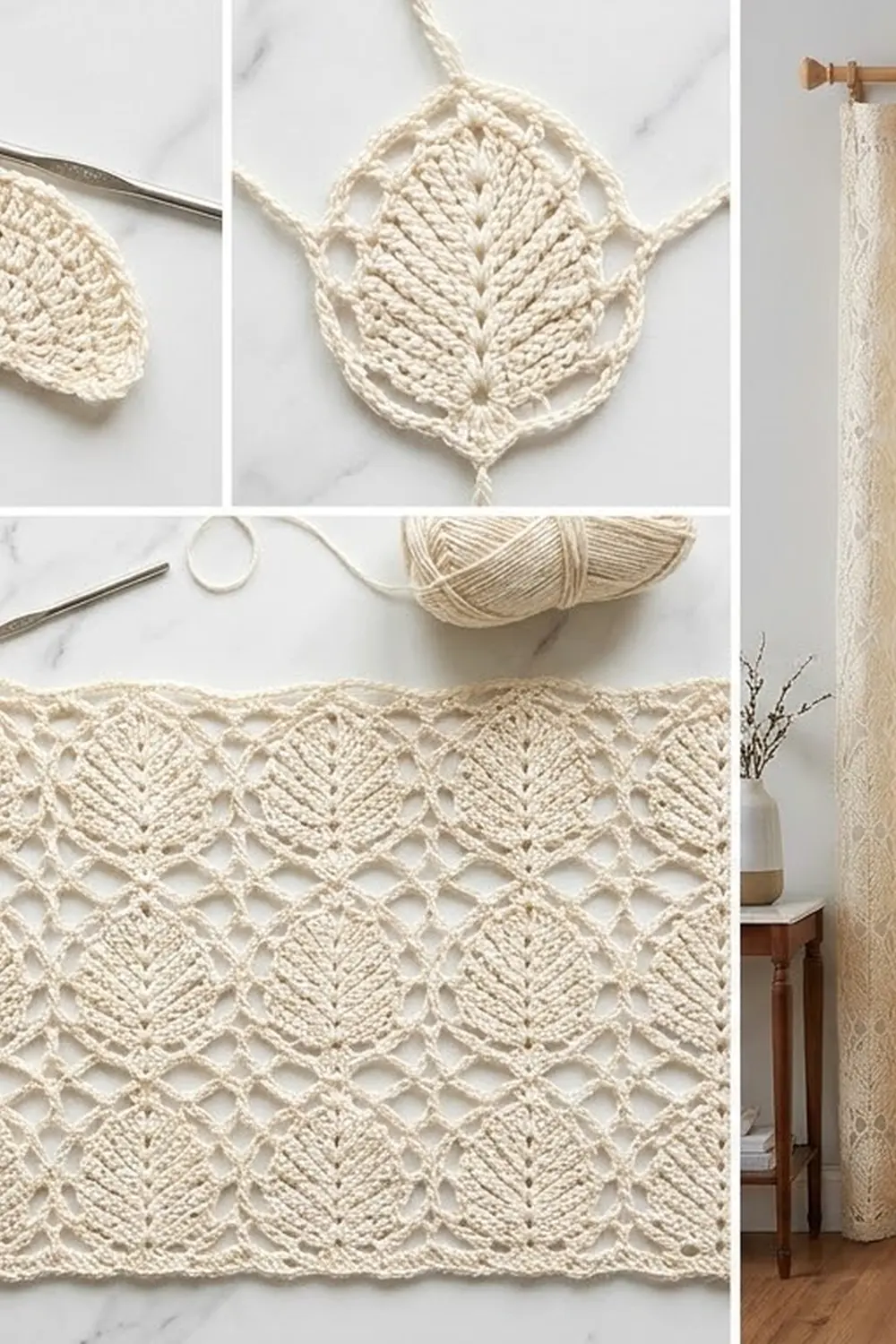
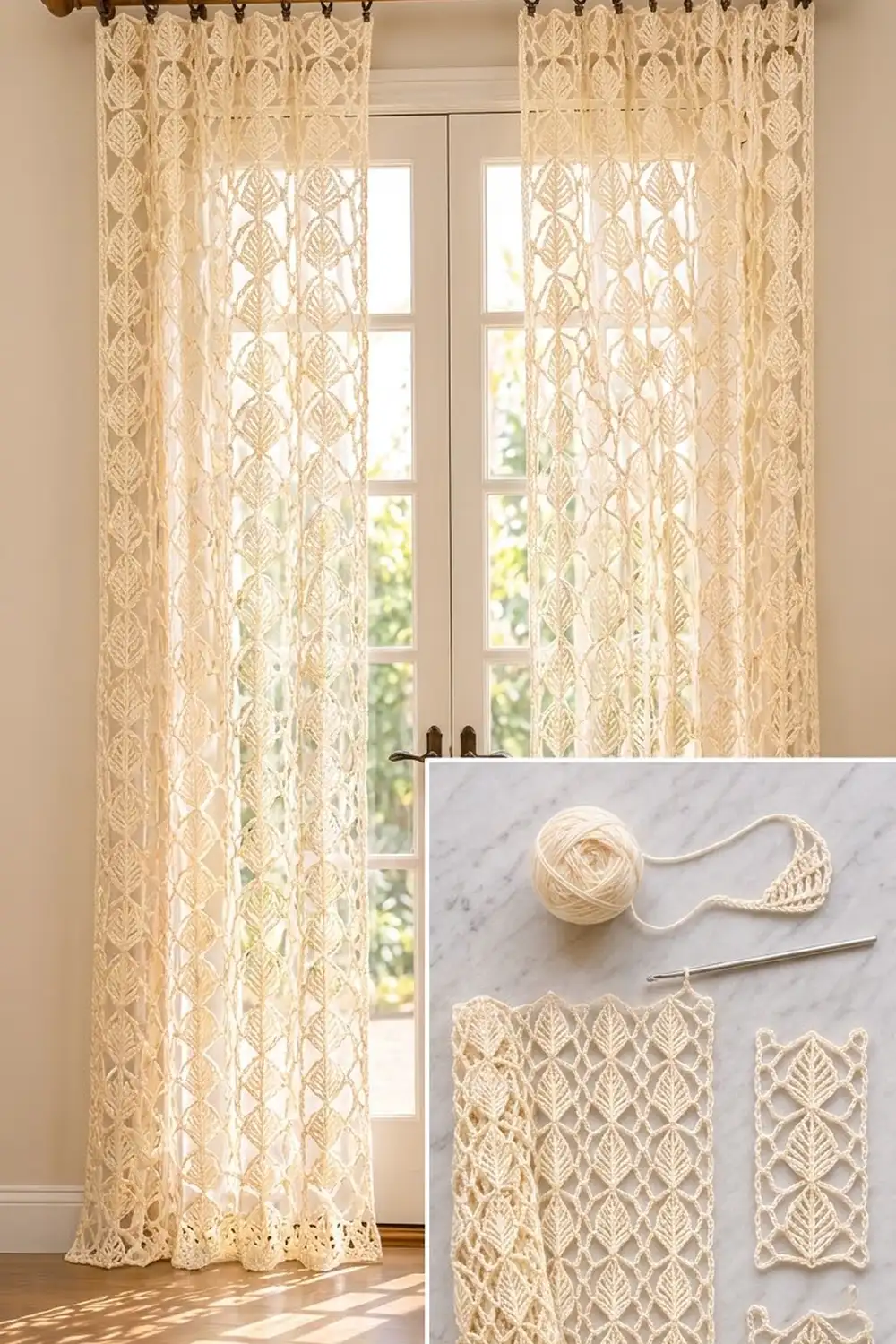
This curtain panel is made from columns of tall, pointed leaves set inside an open chain lattice. Each leaf starts as a small V-stitch tip, fans out into seven trebles with a straight center spine, and closes into a neat cluster at the top. Where one leaf ends, the next one begins, so the columns run unbroken from hem to rod.
The design uses one soft ivory yarn. Light comes through the lattice and falls on the floor as a pattern of diamonds, which is what makes a lace curtain worth the time. It suits a farmhouse, cottage, or minimal room equally well.
The pattern is written in US crochet terms. One finished panel measures 41.25 x 81.5 in (104.8 x 207.0 cm) after blocking. The photo shows a matching pair hanging from clip rings, so make two identical panels if you want the same look.
Each panel is one continuous piece worked in rows from the bottom hem up. You work a single crochet foundation row, repeat a 6-row leaf band 16 times, and finish with a flat single crochet top row. Then you add a two-round border with picots. There is no joining and no sewing.
Finished Size and Construction
- Finished size: 41.25 x 81.5 in (104.8 x 207.0 cm) per panel
- Skill level: Intermediate
- Terminology: US crochet terms
- Yarn weight: DK (#3), cotton or cotton blend
- Hook: 4.0 mm (G-6)
- Number of pieces: 1 per panel (make 2 for a pair)
- Layout: 10 leaf columns wide x 16 leaves tall
- Stitch repeat: 16 sts = 4 in (10.2 cm) wide; one leaf band (6 rows) = 5 in (12.7 cm) tall
- Size before border: 40.25 x 80.5 in (102.2 x 204.5 cm)
- Border depth: 0.5 in (1.3 cm) on every side
Materials
Choose a smooth, mercerized or combed cotton DK. Cotton holds the leaf shapes after blocking, resists stretching while it hangs, and washes well. Avoid fuzzy or very splitty yarn, because the tr7tog clusters need clean loops.
- Ivory/cream: 800 g, about 1,920 m (2,100 yd) per panel, based on a yarn of roughly 240 m per 100 g
- For a pair, buy 1,600 g, about 3,840 m (4,200 yd), all from one dye lot
These amounts include about 10 percent extra for the swatch and the border.
Tools:
- 4.0 mm (G-6) crochet hook
- Tapestry needle
- Stitch markers
- Measuring tape
- Rust-proof pins and blocking mats (or a clean carpet covered with towels)
- Spray bottle
- Curtain clip rings for hanging
Abbreviations (US Terms)
- ch – chain
- sl st – slip stitch
- sc – single crochet
- tr – treble crochet
- sk – skip
- sp – space
- lp – loop
- st(s) – stitch(es)
- rep – repeat
- RS / WS – right side / wrong side
Special stitches:
- V-st (V-stitch): (tr, ch 2, tr) in the same st. This is the bottom tip of each leaf.
- tr7tog (treble 7 together): *Yo twice, insert hook in next tr, yo and pull up a loop, (yo, pull through 2 loops) twice; rep from * 6 more times (8 loops on hook), yo and pull through all 8 loops. This is the top point of each leaf.
- Picot: Ch 3, sl st in 3rd ch from hook.
Gauge and Checkpoints
Gauge matters here because small differences add up across 161 stitches and 98 rows. Make one test swatch before you start the panel.
Gauge swatch: Ch 34. Work Row 1 (33 sc), then Rows 2–7 once, then the Top Row (Row 98 instructions). You will have 2 leaves side by side.
- Width: 33 sc = 8.25 in (21.0 cm), so 4 sc = 1 in (2.5 cm)
- Height: 5.5 in (14.0 cm) total; the leaf band alone is 5 in (12.7 cm)
Measure the swatch after wetting and pinning it flat, because cotton lace opens up when blocked.
If the swatch is too big, go down to a 3.75 mm hook. If it is too small, go up to a 4.5 mm hook. If the width is right but the band is too tall, wrap your trebles a little more snugly. If the band is too short, lift each loop slightly before you yarn over.
Checkpoints on the panel (lightly stretched flat):
- After Row 1: 40.25 in (102.2 cm) wide
- After the first leaf band: 5.25 in (13.3 cm) tall
- After 8 leaf bands: 40.25 in (102.2 cm) tall
- After 16 leaf bands: 80.25 in (203.8 cm) tall
- After the Top Row: 80.5 in (204.5 cm) tall
- After the border: 41.25 x 81.5 in (104.8 x 207.0 cm)
Curtain Panel Pattern
Ch 162.
Row 1 (RS): Sc in 2nd ch from hook and in each ch across, turn. (161 sc)
Row 2 (WS) – leaf tips: Ch 1, sc in first sc, ch 5, sk 7 sc, V-st in next sc, ch 5, sk 7 sc, sc in next sc; rep from * across, turn. (11 sc, 10 V-sts, 20 ch-5 lps)*
Each repeat uses 16 sts (7 + 1 + 7 + 1), plus the first sc: 16 x 10 + 1 = 161.
Row 3 (RS) – leaf fans: Ch 4 (counts as tr), ch 3, sc in next ch-5 lp, ch 3, 7 tr in ch-2 sp of next V-st, ch 3, sc in next ch-5 lp, ch 3, tr in next sc; rep from * across, turn. (81 tr: 70 in fans + 11 between fans; 20 sc; 40 ch-3 sps)*
Row 4 (WS) – leaf opening: Ch 1, sc in first tr, ch 4, tr in first tr of next fan, (ch 1, tr in next tr) 6 times, ch 4, sc in next tr; rep from * across, working the last sc in the top of the turning ch, turn. (11 sc, 70 tr, 60 ch-1 sps, 20 ch-4 lps)*
The 4th tr of each fan sits straight above the V-st. Keep it vertical, because it becomes the leaf’s center spine.
Row 5 (RS) – widest row: Ch 4 (counts as tr), ch 3, tr in first tr of next leaf, (ch 2, tr in next tr) 6 times, ch 3, tr in next sc; rep from * across, turn. (81 tr: 70 in leaves + 11 between leaves; 60 ch-2 sps; 20 ch-3 sps)*
Row 6 (WS) – leaf point: Ch 1, sc in first tr, ch 5, tr7tog over the 7 tr of the next leaf, ch 5, sc in next tr; rep from * across, working the last sc in the top of the turning ch, turn. (11 sc, 10 clusters, 20 ch-5 lps)*
The cluster pulls the seven trebles together. The outer trebles slant inward like veins, and the top of the leaf comes to a point.
Row 7 (RS) – lattice row: Ch 1, sc in first sc, ch 5, sc in top of next cluster, ch 5, sc in next sc; rep from * across, turn. (21 sc, 20 ch-5 lps)*
That completes one leaf band.
Repeat Row 2 on the lattice row (WS): Ch 1, sc in first sc, ch 5, V-st in next sc (the sc above a cluster), ch 5, sc in next sc; rep from * across, turn. (11 sc, 10 V-sts, 20 ch-5 lps)*
This row has the same count as the first Row 2. The new V-st sits directly on the previous leaf’s point, so the leaves stack into one continuous column with a small knot where they meet.
Keep working Rows 3–7, then the repeated Row 2, until you have 16 leaf bands. End after a Row 7 (RS). That is Row 1 plus 16 x 6 rows = 97 rows.
Row 98 (WS) – top row: Ch 1, sc in first sc, 7 sc in next ch-5 lp, sc in next sc; rep from * across, turn. (161 sc)*
Each leaf column gives 2 x (7 + 1) = 16 sc, plus the first sc: 16 x 10 + 1 = 161. This matches Row 1, so the top and bottom edges are the same width. Do not fasten off.
Border
Border gauge: 4 sc = 1 in (2.5 cm), the same as Row 1 and Row 98. Along the sides, each leaf band gets 20 sc, which is also 4 sc per inch over 5 in (12.7 cm).
Round 1 (RS): Ch 1. From here on, work in rounds.
- Top edge: Sc in each of the 161 sc of Row 98, ch 2 (corner).
- First side: Working in row ends, sc in end of Row 98, 20 sc across each of the 16 leaf bands, sc in end of Row 1. (322 sc) Ch 2 (corner).
- Bottom edge: Working in the free loops of the foundation ch, sc in each of the 161 ch. (161 sc) Ch 2 (corner).
- Second side: Work as the first side. (322 sc) Ch 2 (corner).
- Join with sl st to first sc. (966 sc, 4 ch-2 corner sps)
The corners are the ch-2 spaces only. They are not part of any side count.
To place 20 sc in one band, work 4 sc in each of the Row 3, 4, and 5 ends, 3 sc in each of the Row 2 and 6 ends, and 2 sc in the Row 7 end (12 + 6 + 2 = 20). Place a marker at each band and count to 20 before moving on.
Round 2 (RS): Ch 1.
- Top edge: Sc in first sc, sc in next sc, picot, sc in next sc; rep from * 79 more times. (161 sc, 80 picots)*
- Corner: (Sc, picot, sc) in the ch-2 sp.
- Each side: Sc in next sc, picot, sc in next sc; rep from * 160 more times. (322 sc, 161 picots)*
- Bottom edge: Work as the top edge. (161 sc, 80 picots)
- Work each corner as above, then join with sl st to first sc and fasten off.
Why the math works: The body is 161 sts wide at 4 sts per inch, or 40.25 in (102.2 cm). Each side holds 322 sc at the same gauge, or 80.5 in (204.5 cm), which is exactly the body height. Because the border matches the body gauge, the edges won’t ruffle or pull in. The odd count of 161 lets the top and bottom edges start with one sc and then work 80 pairs. The even count of 322 divides into 161 pairs. Each round adds 0.25 in (0.6 cm), so the border adds 0.5 in (1.3 cm) per side, for a finished size of 41.25 x 81.5 in (104.8 x 207.0 cm).
Final Blocking
- Weave in all ends along the sc rows or inside the trebles, never across an open chain lp.
- Soak the panel in cool water with a little wool wash for 20 minutes.
- Press out the water gently and roll the panel in towels. Do not wring it.
- Lay it flat on mats or towels on the floor.
- Pin the four corners to 41.25 x 81.5 in (104.8 x 207.0 cm).
- Pin along each edge every 4 in (10.2 cm), lining up the leaf columns so they run straight.
- Pin open a few leaves in the middle so the fans spread evenly and each spine is vertical.
- Let it dry completely, at least 24 hours, before you unpin it.
Final Quality-Control Checklist
- 10 leaf columns across and 16 leaves in each column
- Every leaf has a V-st tip, 7 trebles, and a tr7tog point
- Each leaf’s center tr lines up with the spine below it
- Row 1 and Row 98 both have 161 sc
- In Round 1, each side has 322 sc and the top and bottom have 161 sc each
- Corners are square and lie flat
- The panel measures 41.25 x 81.5 in (104.8 x 207.0 cm) after blocking
- For a pair, the two panels match in length within 0.5 in (1.3 cm)
Troubleshooting
Leaves lean to one side. You probably worked the 7 tr into a ch-5 lp instead of the ch-2 sp of the V-st. Check where you placed them in Row 3.
Leaf tops look flat, not pointed. The tr7tog is too loose. Pull the final loop snug before you chain.
The panel narrows toward the top. Your ch-5 lps are getting tighter as you go. Chain a little looser.
The panel is too long after hanging. Cotton lace stretches under its own weight. Block it to the stated size and let it hang for two days before you decide to remove a band.
The side edges are wavy. There are too many sc in the row ends. Recount to 20 per band.
Row 98 count is off. Make sure you worked exactly 7 sc in every ch-5 lp.
Care
Hand wash in cool water, or machine wash on a gentle cycle in a mesh bag. Reshape and dry flat; don’t hang the panel while it’s wet, because the weight will stretch it.
Final Notes
The whole panel follows one measurement chain. Your swatch sets 4 sc per inch and 5 in (12.7 cm) per leaf band. Row 1 gives 161 sc, or 40.25 in (102.2 cm). Sixteen bands plus the two sc rows give 80.5 in (204.5 cm). The border keeps the same gauge, with 161 sc on the top and bottom and 322 sc on each side, and adds 0.5 in (1.3 cm) all around. The finished panel measures 41.25 x 81.5 in (104.8 x 207.0 cm). Check each step as you go and the panel will hang straight and even.
Happy crocheting!