
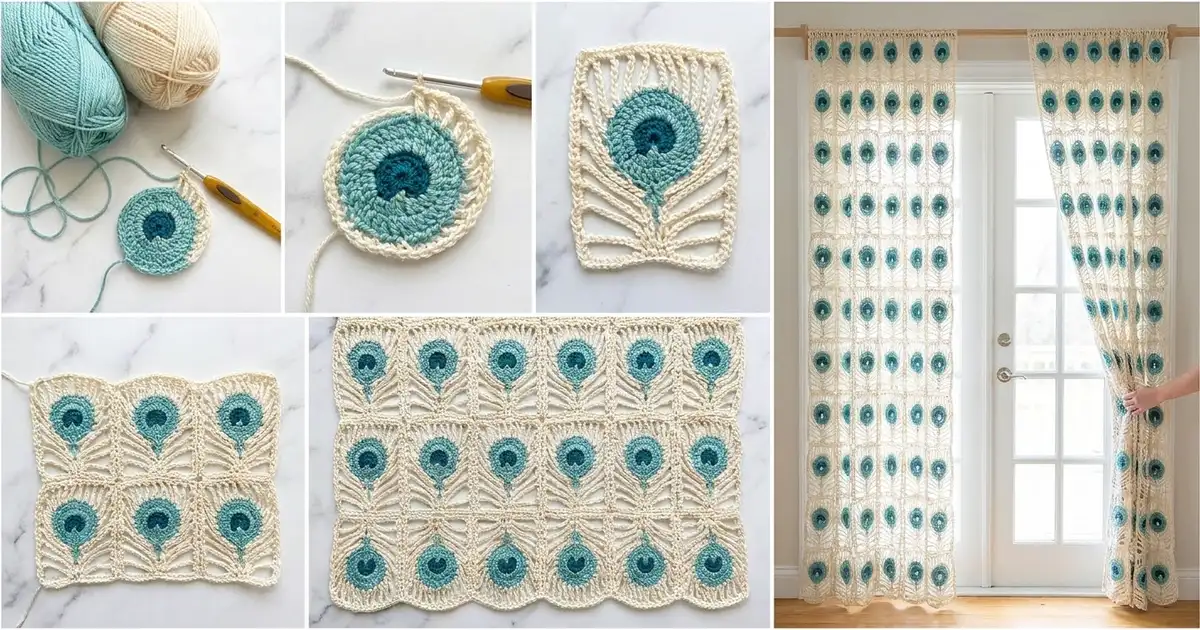
These curtains bring a quiet peacock feather into the room. Each panel is a grid of airy lace rectangles, and every rectangle holds one soft-teal feather eye inside cream chain loops. When the light comes through, the open chain arcs and the teal eyes read clearly, even from across the room.
Only two colors are used: warm ivory cream for the lace and a dusty teal for the eyes. The style is vintage lace in a calm, modern palette. All instructions use US crochet terms.
One finished panel measures 46 x 84.5 in (116.8 x 214.6 cm) after blocking. The curtains in the photo are a pair, so make two panels.
To build a panel, you crochet 165 identical motifs in the round, starting each one with the teal eye. You then join them with slip stitches into a grid 11 motifs wide and 15 motifs tall and finish with a two-round single crochet base and a scalloped border.
Finished Size and Construction
- Finished size (one panel): 46 x 84.5 in (116.8 x 214.6 cm)
- Skill level: Intermediate
- Terminology: US terms
- Yarn weight: DK (#3), mercerized or matte cotton
- Hook: 4.0 mm for the motifs and border; 4.5 mm for joining
- Number of pieces: 165 motifs per panel (330 for a pair)
- Layout: 11 motifs across x 15 motifs down
- Motif size: 4 x 5.5 in (10.2 x 14.0 cm)
- Size before border: 44 x 82.5 in (111.8 x 209.6 cm)
- Border depth: 1 in (2.5 cm) on all sides
Materials
Use a smooth DK cotton or cotton blend at about 2.3 m per gram (roughly 115 m per 50 g ball). Cotton gives crisp chain loops and holds its shape on a window. Avoid fuzzy yarns, because they blur the lace.
Yarn for one panel:
– Teal (eyes): 400 g, about 920 m
– Cream (lace and border): 1,150 g, about 2,645 m
Yarn for a pair of panels:
– Teal: 800 g, about 1,840 m
– Cream: 2,300 g, about 5,290 m
Each motif uses about 2.2 g (5 m) of teal and 6 g (14 m) of cream. These quantities include a margin of about 10% for gauge swatches and tails. Buy all cream from a single dye lot.
Tools:
– 4.0 mm and 4.5 mm crochet hooks
– Tapestry needle
– Stitch markers
– Tape measure
– Blocking pins, spray bottle, and a large flat surface or blocking mats
– 14 to 16 curtain clip rings per panel
Abbreviations (US Terms)
- ch – chain
- sl st – slip stitch
- sc – single crochet
- hdc – half double crochet
- dc – double crochet
- tr – treble crochet
- sk – skip
- sp – space
- st(s) – stitch(es)
- rnd – round
- BLO – back loop only
Special stitch – Corner group: (dc, ch 2, dc) worked into one stitch. In Rnd 6, count both dc as stitches but not the corner ch-2 sp.
Counting note: In Rnd 6, every chain along the sides counts as a stitch, because Rnd 7 places one sc in each of those chains.
Gauge and Checkpoints
Make one complete motif before you start production, and block it. Gauge across Rnd 7 is 23 sts = 4 in (10.2 cm).
Checkpoints:
– After Rnd 2: the teal eye is about 1.5 in (3.8 cm) tall.
– After Rnd 4: the outline measures about 2.5 in (6.4 cm) from spine point to tip.
– After Rnd 5: the arcs measure about 4.5 in (11.4 cm) from top to bottom.
– After Rnd 7: the motif is 4 x 5.5 in (10.2 x 14.0 cm), with 23 sts on the top and bottom edges and 31 sts on each long side.
If the motif is more than 0.25 in (0.6 cm) too large, go down half a hook size. If it is too small, go up half a size. Do not change any stitch counts, because the border math depends on them.
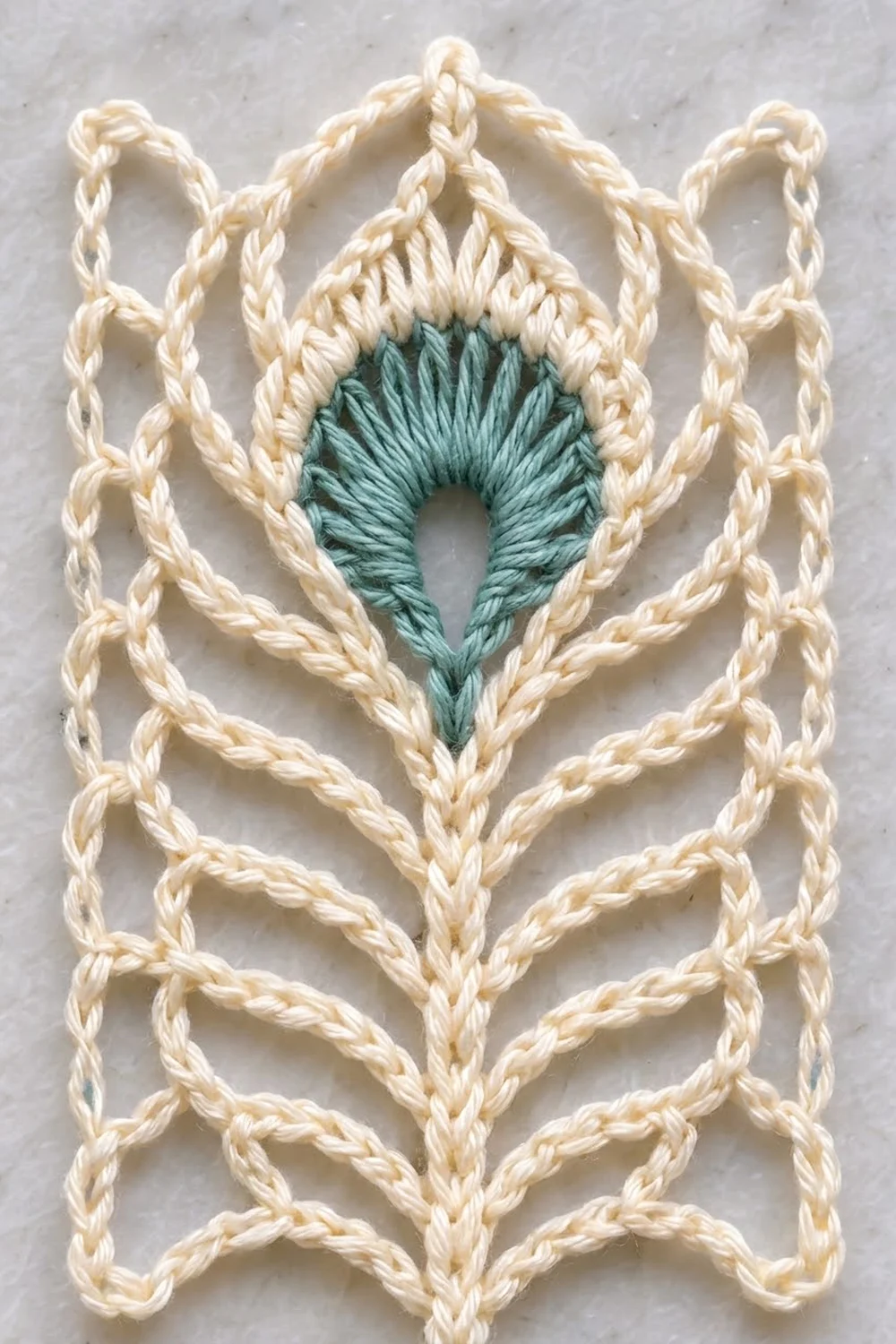
Motif (Make 165 per Panel)
Rnd 1 – Eye (teal)
With teal, ch 8 and sl st to the first ch to form a ring. Ch 1 (does not count). Into the ring, work: sc, 2 hdc, 3 dc, 4 tr, 3 dc, 2 hdc, sc. Sl st to the first sc. (16 sts)
The short stitches sit at the bottom and the tall ones at the top, so the opening becomes a teardrop that points down.
Rnd 2 – Fan (teal)
Ch 1. Sc in the first 2 sts, 2 dc in each of the next 12 sts, and sc in the last 2 sts. Sl st to the first sc. (28 sts)
The dc pairs form the ribbed fan. Fasten off teal and weave in the end.
Rnd 3 – Outline base (cream)
Join cream with a sl st in the first sc of Rnd 2, which is the bottom point. Ch 1. Sc in the first 14 sts, ch 3 for the tip, sc in the last 14 sts, and ch 6 for the spine. Sl st to the first sc. (28 sc, one ch-3 tip, one ch-6 spine)
Rnd 4 – Pointed outline
Sl st back into the ch-6 spine sp. Ch 1, then work (sc, ch 5, sc) in the spine sp. Work (ch 3, sk 1 sc, sc in next sc) 6 times. Ch 3, sk 2 sc, and work (sc, ch 5, sc) in the tip sp. Ch 3, sk 2 sc, and sc in the next sc. Work (ch 3, sk 1 sc, sc in next sc) 5 times. Ch 3, sk the last sc, and sl st to the first sc. (16 loops: 14 ch-3 loops, one ch-5 tip, one ch-5 spine)
That gives 7 ch-3 loops on each side, mirrored exactly.
Rnd 5 – Barb arcs
Sl st into the spine ch-5 sp. Ch 1, then sc in the same sp. Work (ch 7, sc in next loop) 15 times, then ch 7 and sl st to the first sc. (16 sc, 16 ch-7 arcs)
Number the sc 0 to 15, starting at the spine. Sc 0 is the spine, and sc 8 is in the tip loop. Sc 2, 6, 10, and 14 will be corners, and sc 0, 4, 8, and 12 will be centers. Mark the four corner sc.
Rnd 6 – Squaring
Ch 1, then sc in sc 0 (bottom center). Skip every Rnd 5 sc except the corners and centers.
– Bottom, first half: (sc, ch 2, sc) in each of the next 2 arcs.
– Corner: Corner group in sc 2.
– Long side: (sc, ch 4, sc) in each of the next 2 arcs, sc in sc 4, then (sc, ch 4, sc) in each of the next 2 arcs.
– Corner: Corner group in sc 6.
– Top: (sc, ch 2, sc) in each of the next 2 arcs, sc in sc 8, then (sc, ch 2, sc) in each of the next 2 arcs.
– Corner: Corner group in sc 10.
– Long side: Work as before, with the center sc in sc 12.
– Corner: Corner group in sc 14.
– Bottom, second half: (sc, ch 2, sc) in each of the last 2 arcs. Sl st to the first sc.
Count: Top and bottom have 4 groups x 4 sts + 1 center = 17 sts each. Each long side has 4 groups x 6 sts + 1 center = 25 sts. Add 8 corner dc for a total of 92 sts.
The ch-4 groups on the long sides form the open lattice.
Rnd 7 – Frame
Ch 1. Sc in each st around, working one sc into each chain. Work 3 sc in each corner ch-2 sp. Sl st to the first sc. (92 + 12 = 104 sts)
Per side, including both corner sc:
– Top and bottom: 1 corner + 1 + 1 dc + 17 + 1 dc + 1 + 1 corner = 23 sts
– Long sides: 1 + 1 + 1 + 25 + 1 + 1 + 1 = 31 sts
Check: 2 x 23 + 2 x 31 − 4 shared corners = 104. Fasten off and leave a 6 in (15.2 cm) tail.
Make All Pieces
For one panel, make 165 motifs. That takes 165 teal eyes and 165 cream rounds, or about 363 g of teal and 990 g of cream before the margin. For a pair, make 330 motifs.
Block motifs in batches of 20 so you can catch size drift early.
Layout (one panel, feather tips pointing up):
Columns:  1  2  3  4  5  6  7  8  9 10 11
Row 1:    M  M  M  M  M  M  M  M  M  M  M   (top / rod edge)
Row 2:    M  M  M  M  M  M  M  M  M  M  M
...       (rows 3 to 14 identical)
Row 15:   M  M  M  M  M  M  M  M  M  M  M   (hem edge)
That is 11 x 15 = 165 motifs, and every M is the same motif, oriented the same way.
Joining
Method: Slip-stitch join through the BLO with the 4.5 mm hook. Hold two motifs wrong sides together, and work with the right side facing you.
Stitch-to-stitch logic:
– Top edge to bottom edge: 23 sts to 23 sts, corner to corner, one sl st per stitch pair.
– Long side to long side: 31 sts to 31 sts, corner to corner.
The join adds no stitches. Every motif keeps its own 23 or 31 edge stitches.
Order: Join 15 motifs top to bottom to make each of the 11 columns. Then join the columns side by side along their 15 x 31 = 465-stitch edges. Where four corners meet, work across the junction without extra chains.
Tension: Keep the slip stitches as loose as the frame sc. If a seam puckers or pulls shorter than the motif edge, rip it out and rework it more loosely.
Size checkpoint: Lay the joined panel flat. It should measure 44 x 82.5 in (111.8 x 209.6 cm). Each column is 4 in (10.2 cm) wide, and each row is 5.5 in (14.0 cm) tall.
Border
Border gauge: 23 sc = 4 in (10.2 cm), which matches the frame. Two sc rounds add about 0.4 in (1.0 cm), and the scallop round adds about 0.6 in (1.5 cm), for a total depth of 1 in (2.5 cm).
Starting counts:
– Top and bottom: 11 x 23 = 253 sts each
– Sides: 15 x 31 = 465 sts each
Each motif’s per-side count already includes its own corner stitches, so nothing is added at the seams.
Border Rnd 1
Join cream in any stitch. Sc in each stitch, and work 3 sc in each of the 4 panel corner stitches. Sl st to the first sc.
– Top and bottom: 253 worked 1 per stitch + 2 extra = 255 sts
– Sides: 465 + 2 = 467 sts
Border Rnd 2
Ch 1. Sc in each sc, and work 3 sc in each corner (middle) sc. Sl st to the first sc.
– Top and bottom: 255 + 2 = 257 sts
– Sides: 467 + 2 = 469 sts
Border Rnd 3 – Scallops
Ch 1. In each corner sc, work 7 dc for the corner shell. Along each side, after the corner shell: sk 1, sc in next st, then sk 1, 5 dc in next st, sk 1, sc in next st. Repeat from * to the last st before the next corner, then sk 1. Sl st to the first st at the end. Fasten off.
The stitches between the corners number 257 − 2 = 255 on the top and bottom and 469 − 2 = 467 on the sides. This repeat uses 4m − 1 stitches between corners, where m is the number of sc.
– Top and bottom: 255 = 4 x 64 − 1, so there are 64 sc and 63 shells.
– Sides: 467 = 4 x 117 − 1, so there are 117 sc and 116 shells.
Why the math works: Both the motif edges (23 and 31) and the motif counts (11 and 15) are odd, so every panel edge is odd. Adding 2 per round keeps each edge odd, and both between-corner totals land on 3 more than a multiple of 4. The scallops therefore close perfectly at every corner.
Final Blocking
- Weave in all ends along the frame sc, never through the open chains.
- Lay the panel on mats or a clean sheet over carpet.
- Pin the four corners to 46 x 84.5 in (116.8 x 214.6 cm).
- Pin every motif seam line so that the rows run straight and the columns stay at 4 in (10.2 cm).
- Pin out each scallop along the border.
- Mist the panel until it is evenly damp, but not dripping.
- Open each teal eye and each arc with your fingertips.
- Let it dry completely, which usually takes 24 to 48 hours, before unpinning.
Final Quality-Control Checklist
- All 165 motifs have 23 / 31 / 23 / 31 edge stitches.
- Every feather tip points up.
- Each teal eye shows a clear teardrop hole.
- The seams are flat, with no puckers.
- The panel measures 44 x 82.5 in (111.8 x 209.6 cm) before the border.
- Border Rnd 2 counts are 257 and 469 per side.
- There are 63 shells on the top and bottom and 116 on each side.
- The blocked size is 46 x 84.5 in (116.8 x 214.6 cm).
- No tails show on the right side.
Troubleshooting
- Eye looks round, not teardrop: The tr are probably too short. Pull up a taller loop, and keep the bottom sc tight.
- Motif cups: The ch-7 arcs are too short. Loosen the chains or go up half a hook size for Rnd 5 only.
- Motif ruffles: The arcs are too loose, so tighten your chains.
- Long sides shorter than 5.5 in (14.0 cm): Make the ch-4 lattice chains a little looser.
- Scallops don’t fit at a corner: Recount Border Rnd 2. The edges must be 257 and 469.
- Panel leans: Re-block, pinning the seams to a straight line every 4 in (10.2 cm).
Care
Hand wash cool with mild detergent and roll the panel in towels to remove water. Dry flat and re-pin if needed, and never hang the panel wet, because the weight will stretch it.
Final Notes
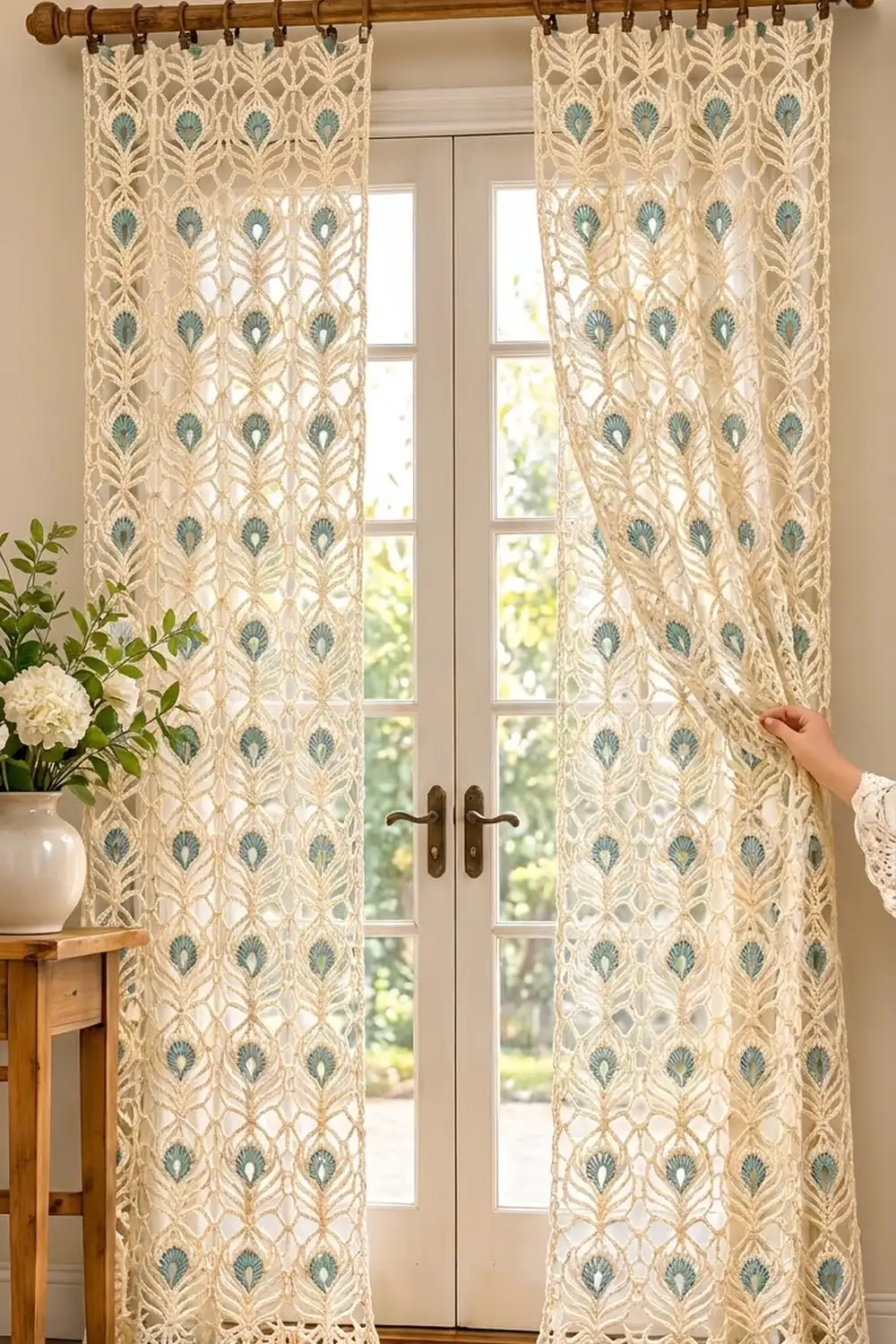
The measurement chain is simple. A 23 x 31-stitch motif blocks to 4 x 5.5 in (10.2 x 14.0 cm). An 11 x 15 grid joined stitch to stitch gives 44 x 82.5 in (111.8 x 209.6 cm). Three border rounds take the edges from 253 / 465 to 257 / 469 sts and finish them with even scallops, for a final panel of 46 x 84.5 in (116.8 x 214.6 cm). Check each link in that chain, and the second panel will match the first.
Happy crocheting!