
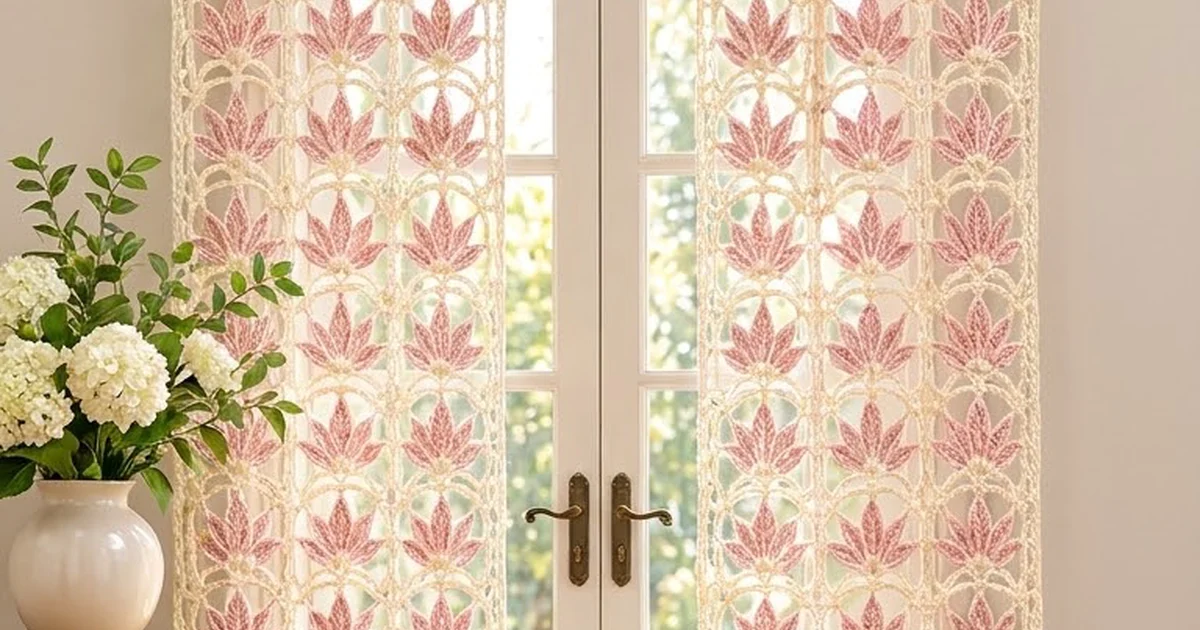
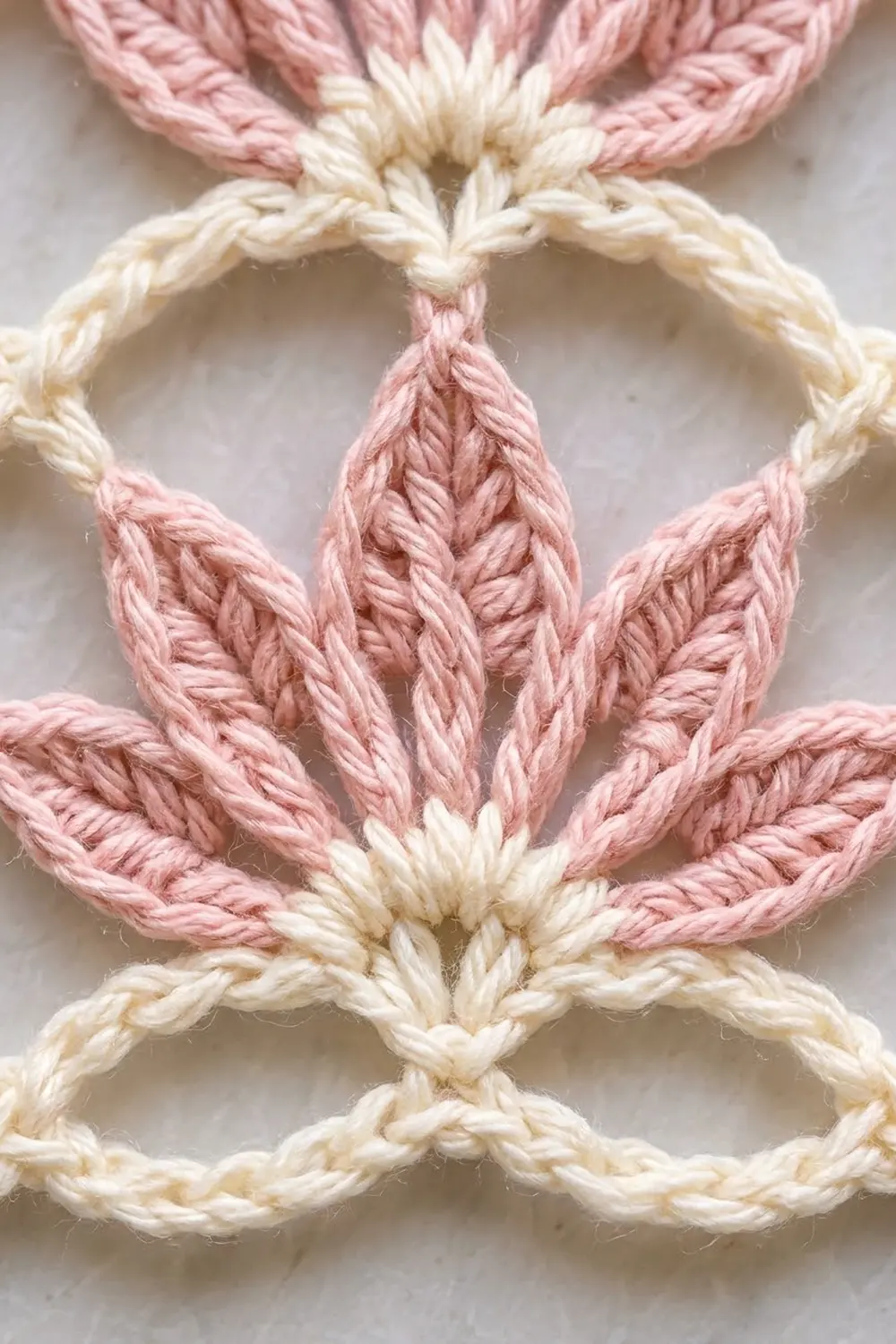
These curtain panels pair airy cream lace with rows of blush-pink lotus fans. Each lotus has five pointed petals with a raised center vein, rising from a small cream shell and held in place by chain arches. The look is soft, romantic and a little vintage, and the light shining through the mesh makes the petals glow.
The palette is just two colors: cream for the lace framework and blush pink for the petals. The pattern uses US crochet terms throughout.
Each finished panel measures 33 1/4 in wide x 81 3/4 in long (84.5 x 207.6 cm). The pattern makes a matching pair of two separate panels.
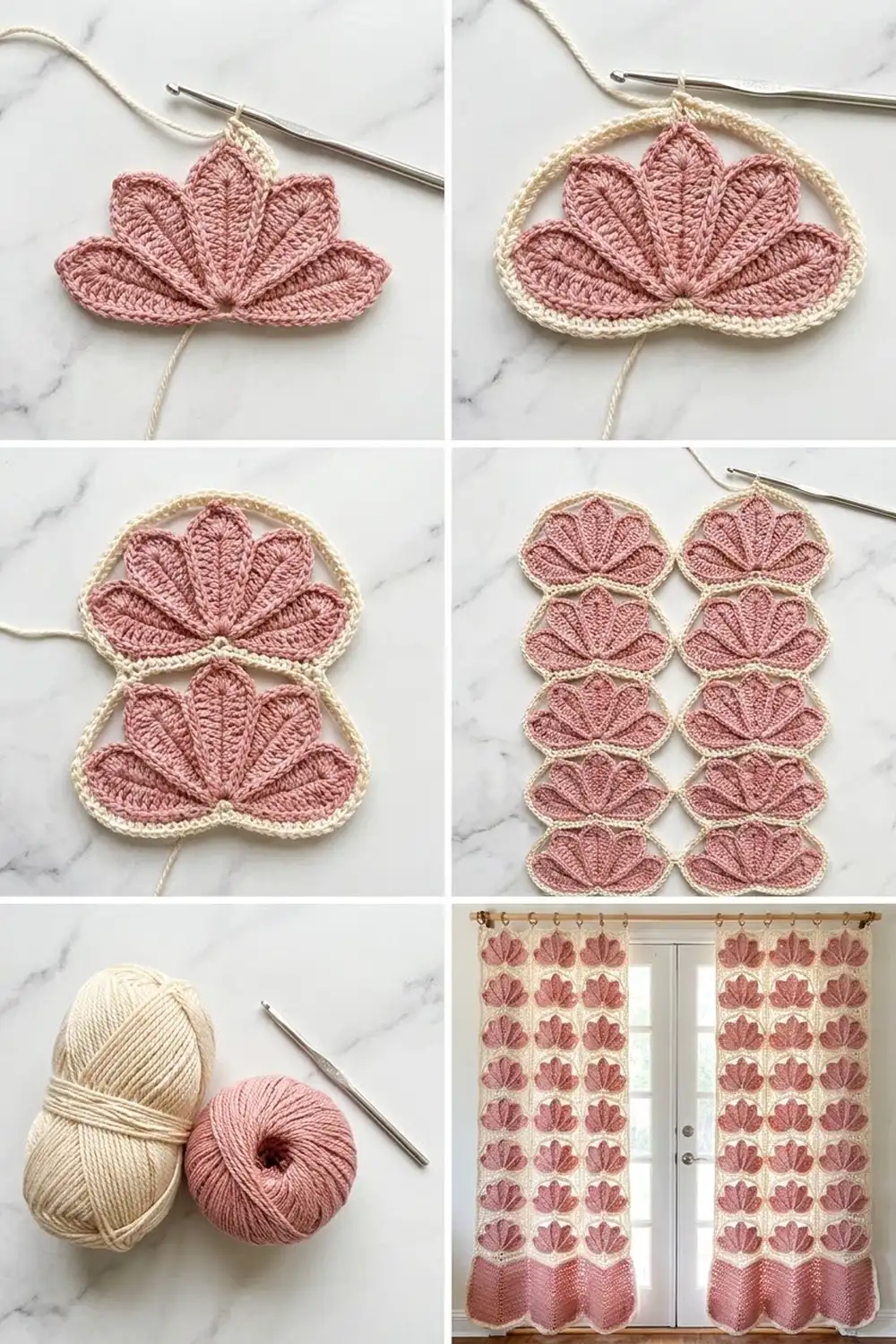
Each panel is one continuous piece, worked flat from the bottom up in rows. A 6-row band builds one tier of 4 lotuses, and you repeat that band 16 times. The pink petals are added to each shell after the shell row, and the next cream row catches every petal tip. A two-round border finishes the edges, with scallops along the bottom.
Finished Size and Construction
- Finished size (each panel): 33 1/4 x 81 3/4 in (84.5 x 207.6 cm)
- Skill level: Intermediate
- Terminology: US crochet terms
- Yarn weight: Worsted (#4), cotton or cotton blend
- Hook: 5.0 mm (H-8)
- Number of pieces: 2 panels, each one continuous piece
- Layout: each panel is 4 lotus columns x 16 lotus tiers (64 lotuses)
- Piece size before border: 32 1/4 x 80 1/4 in (81.9 x 203.8 cm)
- One lotus repeat: 8 in wide x 5 in tall (20.3 x 12.7 cm)
- Border depth: 1/2 in (1.3 cm) at the top and sides, 1 in (2.5 cm) at the bottom
Materials
Choose a smooth, mercerized worsted cotton or cotton blend. Cotton keeps the petals crisp and the lace hangs straight. The amounts below assume a yarn with about 200 m (218.7 yd) per 100 g.
- Cream: 900 g, about 1,800 m (1,968.5 yd) for the pair (450 g / 900 m / 984.3 yd per panel)
- Blush pink: 1,000 g, about 2,000 m (2,187.2 yd) for the pair (500 g / 1,000 m / 1,093.6 yd per panel)
The quantities include a safety margin of roughly 15–25% for your gauge swatch and weaving in ends.
Tools:
- 5.0 mm (H-8) crochet hook
- Tapestry needle
- Scissors
- Locking stitch markers
- Measuring tape
- Rustproof pins, and blocking wires if you have them
- Curtain clip rings for hanging (about 12 per panel)
Abbreviations (US Terms)
- ch – chain
- sl st – slip stitch
- sc – single crochet
- hdc – half double crochet
- dc – double crochet
- tr – treble crochet (yo twice)
- trtr – triple treble crochet (yo 4 times, then [yo, pull through 2 loops] 5 times)
- sk – skip
- sp(s) – space(s)
- st(s) – stitch(es)
- yo – yarn over
Special Stitch: Petal
Each petal is worked from one shell dc. Ch the number given. Side 1: working in the back bumps and starting in the 2nd ch from the hook, work the side sequence toward the shell, then sl st in the same shell dc. Side 2: rotate and work into the free loops of the same chains. Work the same sequence in reverse, from the base out to the tip. Tip: ch 2, then sl st in the skipped tip ch (this ch-2 is the anchor point for later). Vein: work surface sl sts down the center line between the two halves, 1 per chain, then sl st in the same shell dc.
- Short Petal (SP): ch 8. Sequence: sc, hdc, dc, tr, tr, dc, hdc (7 sts per side, 14 total).
- Medium Petal (MP): ch 10. Sequence: sc, hdc, dc, tr, tr, tr, dc, dc, hdc (9 sts per side, 18 total).
- Tall Petal (TP): ch 12. Sequence: sc, hdc, 2 dc, 4 tr, 2 dc, hdc (11 sts per side, 22 total).
Gauge and Checkpoints
Gauge: 14 sc = 4 in (10.2 cm). One band (Rows 2–7) = 5 in (12.7 cm) tall.
Test piece first. Ch 30. Work Row 1 (29 sc), then work Rows 2–7 once, using a single repeat. Your swatch should measure 8 1/4 in wide x 5 1/4 in tall (21.0 x 13.3 cm).
Checkpoints:
- After Row 1: 32 1/4 in (81.9 cm) wide
- After 4 bands: 20 1/4 in (51.4 cm) tall
- After 8 bands: 40 1/4 in (102.2 cm) tall
- After 12 bands: 60 1/4 in (153.0 cm) tall
- After 16 bands: 80 1/4 in (203.8 cm) tall
If the swatch is too big, go down 0.5 mm. If it is too small, go up 0.5 mm. If the width is right but the band is too short, gently tug each petal chain to full length before you work its sides.
Panel Pattern
Use cream unless stated otherwise. The stitch repeat is a multiple of 28 + 1.
Foundation: With cream, ch 114.
Row 1: Sc in 2nd ch from hook and in each ch across. (113 sc)
The Lotus Band (Rows 2–7)
Row 2 (shell row): Ch 1, turn. Sc in first sc, ch 6, sk 6 sts, sc in next st, ch 3, sk 6 sts, 7 dc in next st, ch 3, sk 6 sts, sc in next st, ch 6, sk 6 sts, sc in next st; rep from * 3 more times.
(13 sc, 4 shells of 7 dc, 8 ch-6 sps, 8 ch-3 sps)*
Each repeat uses exactly 28 sts: 4 groups of 6 skipped sts, plus 2 sc, 1 shell st and the closing sc. The shells sit in sts 15, 43, 71 and 99.
Row 3 (petals, pink): Do not turn. Work each lotus separately. Join pink with a sl st in the 1st dc of a shell. SP, sl st in 2nd dc, MP, sl st in 3rd dc, sl st in 4th dc, TP, sl st in 5th dc, sl st in 6th dc, MP, sl st in 7th dc, SP. Fasten off. Repeat for all 4 shells.
(4 lotuses, 20 petals, 86 petal sts per lotus)
Before going on, arrange each lotus by hand. The short petals should spread almost sideways, the medium petals sit on the diagonal and the tall petal points straight up. The lotus should measure about 4 1/2 in (11.4 cm) across, and the tall petal about 3 1/2 in (8.9 cm) long.
Row 4 (anchor row): Turn. Ch 6 (counts as trtr) to stand on the last sc of Row 2. Ch 5, sc in ch-2 tip of SP, ch 4, sc in tip of MP, ch 4, sc in tip of TP, ch 4, sc in tip of MP, ch 4, sc in tip of SP, ch 5, trtr in the next boundary sc of Row 2 (the sc between two ch-6 sps or at the row end); rep from * 3 more times. Skip the other Row 2 sts.
(5 trtr, 20 sc, 8 ch-5 sps, 16 ch-4 sps)*
These trtr form the vertical cream bars between columns. The chains form the arches over each lotus.
Row 5 (leveling row): Ch 3 (counts as dc), turn. 4 tr in ch-5 sp, tr in sc, 4 dc in ch-4 sp, hdc in sc, 3 hdc in ch-4 sp, sc in sc, 3 hdc in ch-4 sp, hdc in sc, 4 dc in ch-4 sp, tr in sc, 4 tr in ch-5 sp, dc in trtr; rep from * 3 more times, working the last dc in the top of the beginning ch-6.
(113 sts = 25 sts worked 1 per existing st + 88 sts worked into the chain sps)*
Taller stitches over the low side arches and shorter ones over the tall petal tip bring the top edge level.
Row 6 (arch mesh): Ch 1, turn. Sc in first st, ch 5, sk 3 sts, sc in next st; rep from * 27 more times.
(29 sc, 28 ch-5 sps)*
Row 7: Ch 1, turn. Sc in first sc, 3 sc in ch-5 sp, sc in next sc; rep from * 27 more times.
(113 sc = 29 sc worked 1 per sc + 84 sc worked into the sps)*
Row 7 works as Row 1 of the next band. Repeat Rows 2–7 for 16 bands in total. Fasten off cream after the last Row 7.
The lace is reversible. On every band, work the petals with the same side facing you as when you worked Row 2.
Changing the length: add or remove whole bands. Each band changes the length by 5 in (12.7 cm).
Make All Pieces
Make 2 identical panels. Per panel: 64 lotuses, 450 g cream, 500 g blush pink.
Panel A (4 columns x 16 tiers)     Panel B (4 columns x 16 tiers)
[L][L][L][L]                       [L][L][L][L]
[L][L][L][L]   ... 16 tiers ...    [L][L][L][L]
[L][L][L][L]                       [L][L][L][L]
The panels hang side by side on the rod and are not joined, so there is no joining step.
Border
Border gauge: 14 sc = 4 in (10.2 cm) along the top and bottom. Along the sides, work 18 sc per 5 in (12.7 cm) band.
Round 1: With RS facing, join cream in the last sc of the top row. Work 3 sc in that corner st.
– Top edge: 1 sc in each of the next 111 sts, then 3 sc in the last corner st.
– Side: 288 sc down the row ends. Per band, work 1 sc in the Row 7 end, 3 in Row 6, 4 in Row 5, 8 in Row 4 and 2 in Row 2.
– Bottom corner: 3 sc in the first free loop of the foundation chain.
– Bottom edge: 1 sc in each of the next 111 free loops, then 3 sc in the last loop.
– Second side: 288 sc up the row ends.
Join with a sl st to the first sc.
(111 + 288 + 111 + 288 = 798 sc between corners, + 4 corner groups of 3 = 810 sc)
Round 2: Ch 1. Work 3 sc in the center sc of the first corner.
– Top edge: 113 sc up to the next corner center, then 3 sc in the corner center.
– Side: 290 sc.
– Bottom corner: 2 sc in the corner center.
– Bottom edge: sc in the next sc, sk 3, 7 dc in next sc, sk 3, sc in next sc; rep from * 13 more times. Then 2 sc in the corner center.
– Second side:* 290 sc.
Join and fasten off.
(Top 113 sc, sides 290 sc each, bottom 14 scallops = 98 dc + 15 sc, corners 3 + 3 + 2 + 2)
Why the math works: On the top and bottom, the 111 sts plus 2 corner centers equal the original 113 sts, so the border adds nothing extra across the width. On the sides, 18 sc per 5 in matches the 3.5 sc per inch gauge closely, so the edges neither ruffle nor pull. The bottom span is 113 = 8 x 14 + 1, so the 14 scallops fit exactly, 3 1/2 scallops per lotus column.
Final Blocking
- Weave in all ends. Run each pink tail back through its own petal.
- Soak the panel in cool water for 15 minutes, then gently squeeze it out. Do not wring.
- Roll the panel in towels to remove excess water.
- Lay it flat on blocking mats or a clean sheet on the floor.
- Pin it to 33 1/4 x 81 3/4 in (84.5 x 207.6 cm). Use wires along the long sides if you have them.
- Open each lotus, pinning the petal tips into the arches. Ease the chain mesh into round arches.
- Pin out each bottom scallop.
- Let it dry completely, then repeat for the second panel.
Final Quality-Control Checklist
- Both panels measure 33 1/4 x 81 3/4 in (84.5 x 207.6 cm)
- Every panel has 16 tiers of 4 lotuses
- Every petal tip is caught by a Row 4 sc
- Row 5 and Row 7 count 113 sts in every band
- Side edges lie flat and straight
- 14 scallops along each bottom edge
- All ends are woven in securely
Troubleshooting
- Petals droop or twist: an anchor sc missed the ch-2 tip. Undo Row 4 back to that point and re-anchor.
- Panel narrows as you go: Row 5 or Row 7 is short of 113 sts. Count each band.
- Lotus columns lean sideways: a shell is off center. Check that it sits in sts 15, 43, 71 and 99.
- Side edges ruffle: use 16 sc per band instead of 18 and note the change for both sides.
- Top edge of a band is wavy: check the stitch heights in Row 5 and block firmly.
- Panels are different lengths: count the bands, then re-block the shorter panel.
Care
Hand wash cool or machine wash on a delicate cycle inside a mesh bag. Reshape and dry flat, and avoid hanging the panels wet, because the weight will stretch them.
Final Notes
The measurement chain is simple. Gauge is 14 sc = 4 in (10.2 cm), so 113 sts give 32 1/4 in (81.9 cm) across. Sixteen 5 in (12.7 cm) bands give 80 1/4 in (203.8 cm). The border adds 1 in (2.5 cm) to the width and 1 1/2 in (3.8 cm) to the length, for a finished 33 1/4 x 81 3/4 in (84.5 x 207.6 cm) panel. Check your swatch, count every Row 5 and Row 7, and both panels will hang evenly. Hang them with clip rings spaced about every 3 in (7.6 cm).
Happy crocheting!