
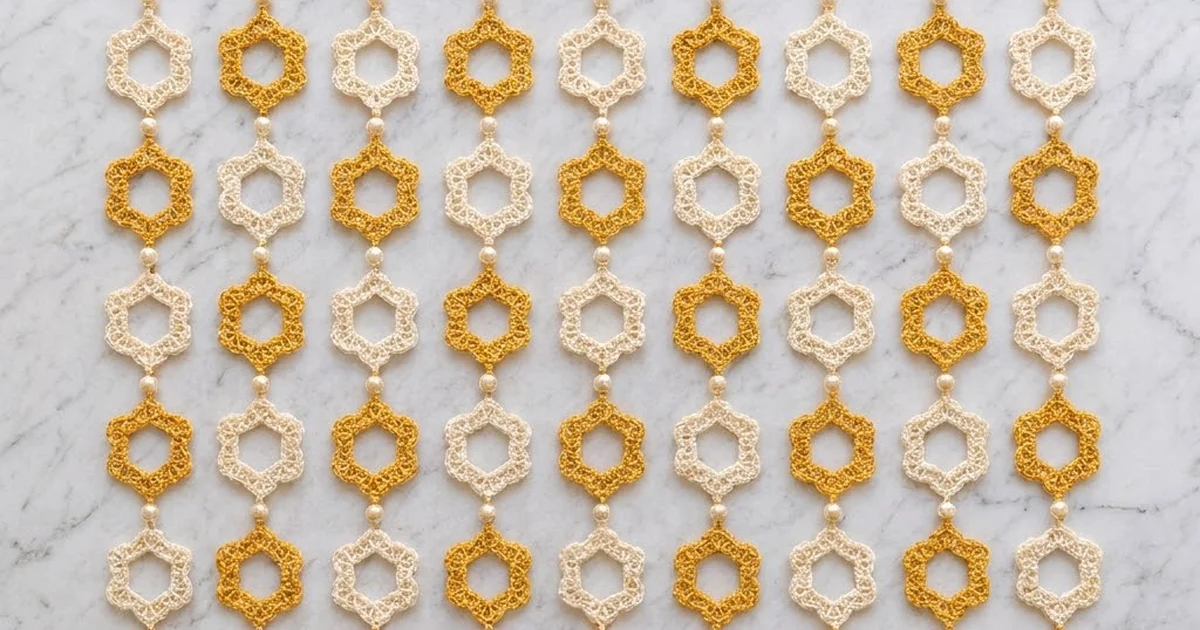
This curtain is built from lacy hexagon flowers. Each one has an open center, six fanned lobes, and a pearl bead linking it to the next motif. Hung in a window, the strands catch the light, sway gently, and cast honeycomb shadows across the room.
The palette is just mustard gold and cream. Colors alternate down each strand, and neighboring strands start with opposite colors, so the curtain reads as a soft checkerboard. Pearl beads and full tassels give it a warm boho look.
The pattern uses US crochet terms. The finished curtain is 33.5 in (85.1 cm) wide and 37.5 in (95.3 cm) long, measured from the top of the hanging loop to the tip of the tassel.
You make each motif in three rounds: a solid hexagon of double crochet, treble-crochet fans at the corners, and a single crochet rim. Each new motif joins the one above it as you finish its last round, so every strand is assembled while you work. Tassels go on last.
Finished Size and Construction
- Finished curtain: 33.5 in (85.1 cm) wide × 37.5 in (95.3 cm) long
- Skill level: Intermediate
- Terminology: US crochet terms
- Yarn weight: DK (#3) cotton
- Hook: 3.5 mm (E-4)
- Number of pieces: 63 hexagon motifs (32 gold, 31 cream) and 9 tassels
- Layout: 9 strands × 7 motifs, hung about 3.75 in (9.5 cm) apart (center to center)
- Motif size: 3.5 in (8.9 cm) point to point
- Size before border (after Round 2): 3.25 in (8.3 cm) point to point
- Border depth (Round 3 rim): 0.125 in (0.3 cm) on each side
- Link between motifs: 1 in (2.5 cm), including the bead
Materials
Use a smooth, mercerized DK cotton. It shows the stitch definition clearly, holds the hexagon shape, and doesn’t stretch much when hung. The amounts below assume about 2.3 m per gram (115 m per 50 g ball).
- Mustard gold: 160 g (368 m). Used for 32 motifs, 5 hanging loops and 5 tassels.
- Cream: 150 g (345 m). Used for 31 motifs, 4 hanging loops and 4 tassels.
Both amounts include a margin of roughly 12% for gauge differences and tassel trimming.
Tools:
– 3.5 mm (E-4) crochet hook
– 0.75 mm steel hook or a dental-floss threader, for placing beads
– 80 ivory pearl beads, 8 mm, with holes at least 2 mm wide (72 needed, plus spares)
– A piece of stiff card 3.75 in (9.5 cm) wide, for wrapping tassels
– Tapestry needle, scissors, stitch markers
– Blocking mat, rustproof pins and a spray bottle
– A curtain rod up to 1 in (2.5 cm) in diameter
Abbreviations (US Terms)
- ch – chain
- sl st – slip stitch
- sc – single crochet
- dc – double crochet
- tr – treble crochet
- sp – space
- st(s) – stitch(es)
Special technique – place bead (PB): Take the hook out of the working loop. Insert the steel hook (or floss threader) through a bead, catch the working loop and pull it through the bead. Put the 3.5 mm hook back into the loop. The next chain locks the bead in place.
Gauge and Checkpoints
Gauge: 20 sc × 22 rows = 4 in (10.2 cm) square. The motif itself is the real gauge, so make one complete motif before you start a strand.
Checkpoints (measure point to point, laid flat, without stretching):
– Foundation ring: center opening about 1.5 in (3.8 cm) across
– After Round 1: 2.25 in (5.7 cm)
– After Round 2: 3.25 in (8.3 cm)
– After Round 3: 3.5 in (8.9 cm)
Too big? Go down 0.5 mm in hook size. Too small? Go up 0.5 mm. If the opening is the right size but the fans ruffle, your trebles are too tall. Pull each loop snug before you yarn over again.
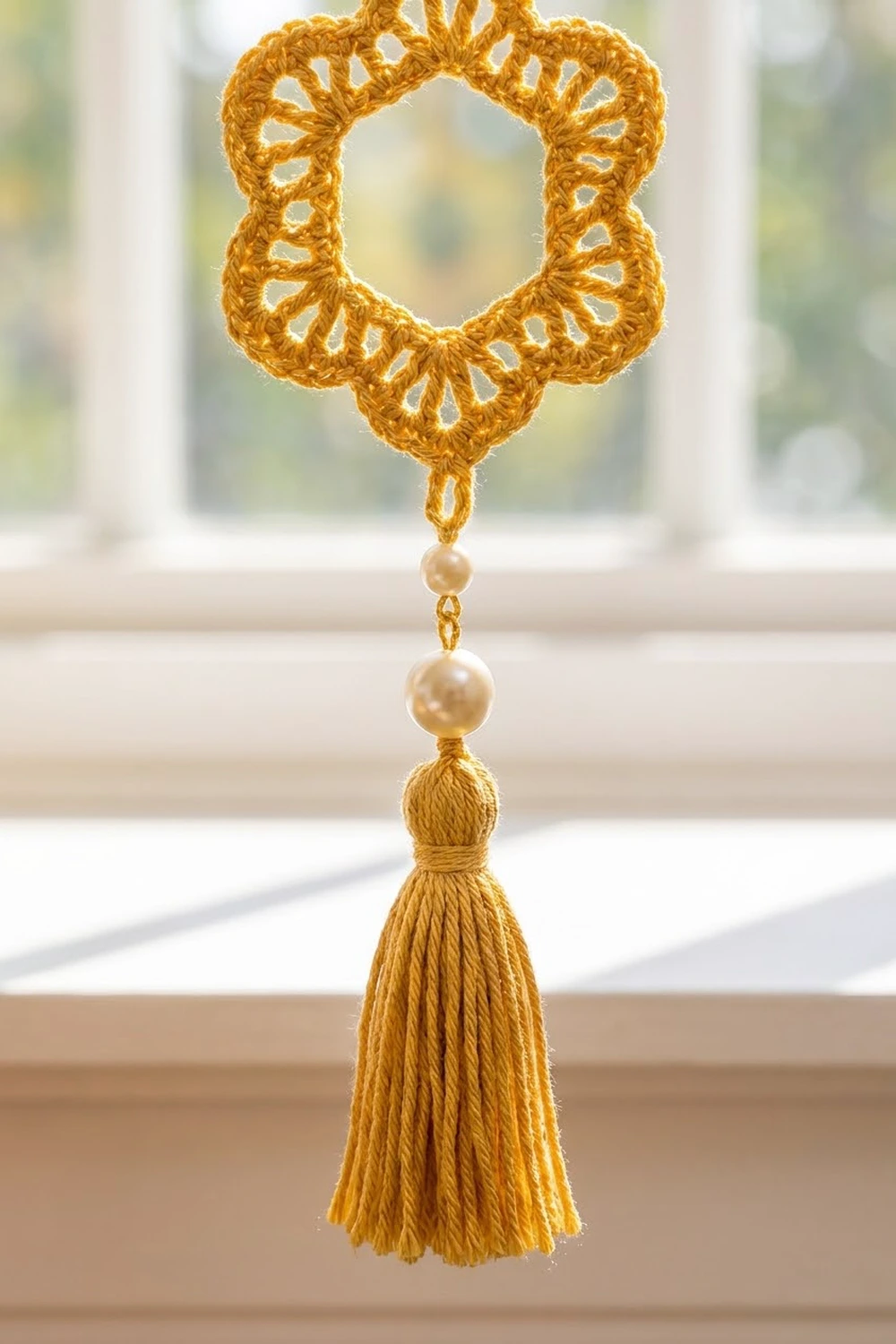
Hexagon Motif (make 63)
Every motif is worked the same way. The joining step at the end of Round 3 is the only difference, and that is covered in the Joining section.
Foundation: Ch 24 and join with a sl st to the first ch to form a ring. Be careful not to twist the chain. You now have 6 sides of 4 ch each.
Round 1 (solid hexagon): Ch 5 (counts as dc + ch 2), dc in the same ch. Dc in each of the next 3 ch, then (dc, ch 2, dc) in the next ch. Repeat from * to * 4 more times. Dc in each of the last 3 ch, then sl st to the 3rd ch of the beginning ch-5.
Count: 30 dc and 6 ch-2 corner sps. Each side has 5 dc between corner spaces (1 corner dc + 3 dc + 1 corner dc). The ch-2 corners give the opening its sharp hexagon points.
Round 2 (corner fans): Sl st into the first ch-2 sp. Ch 4 (counts as tr), then (ch 1, tr) 4 times in the same sp. Skip 2 dc, sc in the next dc (the center dc of the side), skip 2 dc, then work (tr, ch 1) 4 times and 1 more tr, all in the next ch-2 sp. Repeat from * to * 4 more times. Skip 2 dc, sc in the next dc, skip 2 dc, then sl st to the 4th ch of the beginning ch-4.
Count: 6 fans of 5 tr and 4 ch-1 sps each (30 tr and 24 ch-1 sps in total), plus 6 sc. Each side uses its 5 dc as 2 skipped + 1 sc + 2 skipped, so the fans sit exactly on the corners.
Round 3 (scalloped rim): Ch 1, sc in the same st as the join. (Sc in the next ch-1 sp, sc in the next tr) 4 times, then sl st in the next sc. Sc in the next tr. Repeat from * to * 4 more times, ending with a sl st in the last sc of Round 2. Sl st to the first sc of the round.
Count: 6 lobes of 9 sc each (54 sc) plus 6 sl st dips, for 60 sts.
The first lobe is the top lobe. Its 5th sc (the center one) is the top point. The 5th sc of the 4th lobe is the bottom point.
To finish: Sl st in each of the next 4 sc to reach the top point. Then go to the Joining instructions. Weave the beginning tail into the Round 1 stitches.
Make All Pieces
Make two kinds of strand:
– Strand A (5 strands): gold, cream, gold, cream, gold, cream, gold. Gold loop and gold tassel.
– Strand B (4 strands): cream, gold, cream, gold, cream, gold, cream. Cream loop and cream tassel.
Totals: Gold: 5 × 4 + 4 × 3 = 32 motifs. Cream: 5 × 3 + 4 × 4 = 31 motifs. Tassels: 5 gold and 4 cream.
Layout (G = gold, C = cream; columns are strands 1–9 from left to right, rows are motif positions 1–7 from top to bottom):
     1  2  3  4  5  6  7  8  9
1    G  C  G  C  G  C  G  C  G
2    C  G  C  G  C  G  C  G  C
3    G  C  G  C  G  C  G  C  G
4    C  G  C  G  C  G  C  G  C
5    G  C  G  C  G  C  G  C  G
6    C  G  C  G  C  G  C  G  C
7    G  C  G  C  G  C  G  C  G
Joining
Method: Each strand is built from the top down, using a bead-chain join that you work as you go.
Motif 1 (top of strand): After reaching the top point, ch 2, PB, then ch 21. Sl st into the 21st ch from the hook (the first ch after the bead) to close the hanging loop. Fasten off and weave in the end. The loop holds 20 chains, which is enough for a rod up to 1 in (2.5 cm) thick. For a thicker rod, add 4 ch for each extra 0.25 in (0.6 cm) of diameter.
Motifs 2–7: Work the motif through Round 3 and sl st to its top point. Then ch 2, PB, ch 2, and sl st into the bottom point (the 5th sc of lobe 4) of the motif above it. Fasten off and weave the tail back along the link chains.
Stitch-to-stitch logic: The link always runs from the center sc of a top lobe to the center sc of the bottom lobe above it. Joining center to center keeps every motif hanging point-up and straight, with no twist down the strand.
Tension: Make the link chains the same size as your rim stitches. If a link is loose, the bead slips and the strand looks uneven. If it’s too tight, the lobes pucker. Before fastening off, hold the strand up and check that the motif hangs flat.
Bottom bead: Join yarn in the strand color with a sl st in the bottom point of motif 7. Ch 2, PB, ch 1, then fasten off, leaving an 8 in (20.3 cm) tail for attaching the tassel.
Size checkpoint: Two linked motifs should measure 8 in (20.3 cm) from point to point (3.5 + 1 + 3.5 in). All 7 motifs should measure 30.5 in (77.5 cm): 7 × 3.5 in plus 6 × 1 in.
Border
The curtain has no outer border around the strands. Each motif’s Round 3 rim acts as its own border, so this section covers the gauge and math for that rim.
Rim gauge: 9 sc fit across one Round 2 fan, which measures about 1.4 in (3.6 cm) along its curve. That is a little below the general gauge of 20 sc per 4 in (10.2 cm). The fan’s curve takes up the small difference, so the edge stays flat instead of cupping.
Counts per side: Each of the 6 sides has 1 lobe of 9 sc and 1 sl st dip, for 10 sts per side and 60 sts in total.
Why the math works: Each Round 2 fan offers 9 places to work: 5 tr and 4 ch-1 sps. Working 1 sc into each place uses every stitch exactly once, so no increases are needed. The sl st over each Round 2 sc ties the rim down at the middle of every side, which keeps the dips crisp. The 5th sc lands at the exact center of each lobe, so the top and bottom joins sit directly opposite each other. Round 3 adds 0.125 in (0.3 cm) on each side, taking the motif from 3.25 in (8.3 cm) to 3.5 in (8.9 cm).
Tassels (make 9): Wrap yarn 30 times around the 3.75 in (9.5 cm) card. Slide a 12 in (30.5 cm) strand under the wraps at the top and tie it tightly. Cut the loops at the bottom. Wrap another strand around the bundle 0.5 in (1.3 cm) below the top, 6 times, and knot it. Trim the tassel to 3.5 in (8.9 cm). Tie the top strand to the bottom-bead tail, then hide the ends inside the tassel.
Final Blocking
- Lay each strand flat on the blocking mat.
- Spray it until damp, but not soaked.
- Pin every motif to 3.5 in (8.9 cm) point to point, with 1 pin in each of the 6 dips.
- Shape each center opening into a hexagon with sides of about 0.75 in (1.9 cm).
- Steam or spray the tassels, then comb them straight.
- Leave everything to dry completely before unpinning.
- Hang the strands on the rod, spacing the loops 3.75 in (9.5 cm) apart (center to center).
Final Quality-Control Checklist
- 63 motifs, each 3.5 in (8.9 cm) point to point
- Every Round 3 has 54 sc and 6 sl st
- Colors match the layout grid, with strands 1 and 9 both starting in gold
- 8 beads per strand (72 in total), all locked by a chain
- Every strand is 37.5 in (95.3 cm) long, within 0.5 in (1.3 cm)
- Tassels are trimmed evenly to 3.5 in (8.9 cm)
- All ends are woven in at least 1 in (2.5 cm)
Troubleshooting
- Center opening looks round, not hexagonal: Make sure each corner has a full ch-2, and pull the foundation ring snug.
- Fans ruffle: Your trebles are too tall. Go down a hook size for Round 2 only.
- Rim cups: Work Round 3 a little more loosely, or use a hook 0.5 mm larger for that round.
- Strand twists: One of the joins is off center. Redo it into the 5th sc.
- Bead won’t go over the loop: Use the floss threader, or beads with 2.5 mm holes.
- Strands are different lengths: Adjust only the link chains, by 1 ch at a time.
Care
Hand wash in cool water with mild soap, roll the strands in a towel, and dry them flat. Comb the tassels while they’re damp and re-pin any motif that has lost its shape.
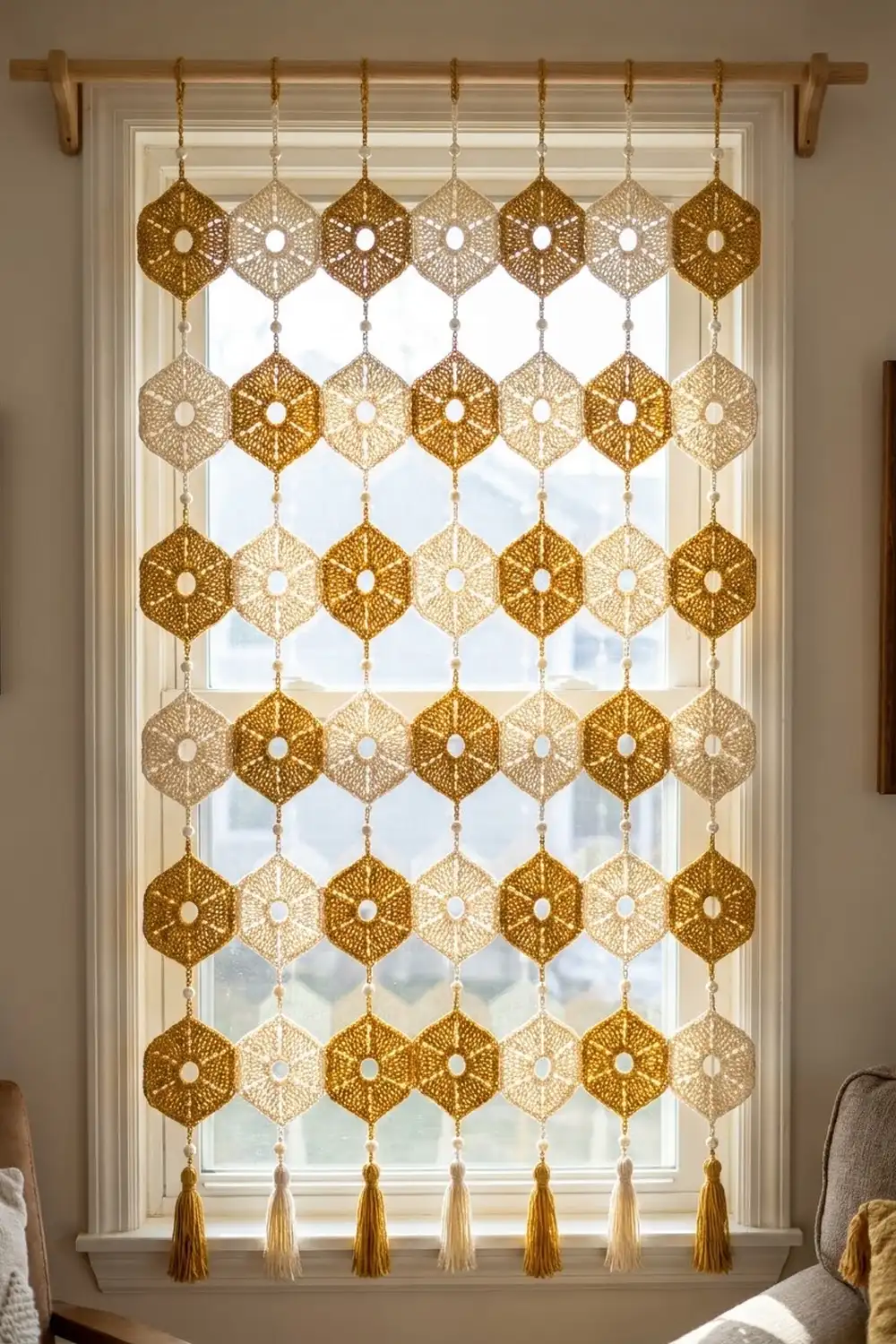
Final Notes
The measurements build on each other. A 1.5 in (3.8 cm) opening grows to 2.25 in (5.7 cm) after Round 1, then to 3.25 in (8.3 cm) after Round 2, and to 3.5 in (8.9 cm) after the rim. Seven motifs and six 1 in (2.5 cm) links make 30.5 in (77.5 cm). Adding the 2.75 in (7.0 cm) top loop section, the 0.75 in (1.9 cm) bottom bead and the 3.5 in (8.9 cm) tassel gives a strand of 37.5 in (95.3 cm). Nine strands spaced 3.75 in (9.5 cm) apart make a curtain 33.5 in (85.1 cm) wide. If you check your measurements at each stage, the finished curtain will hang evenly. Happy crocheting!