
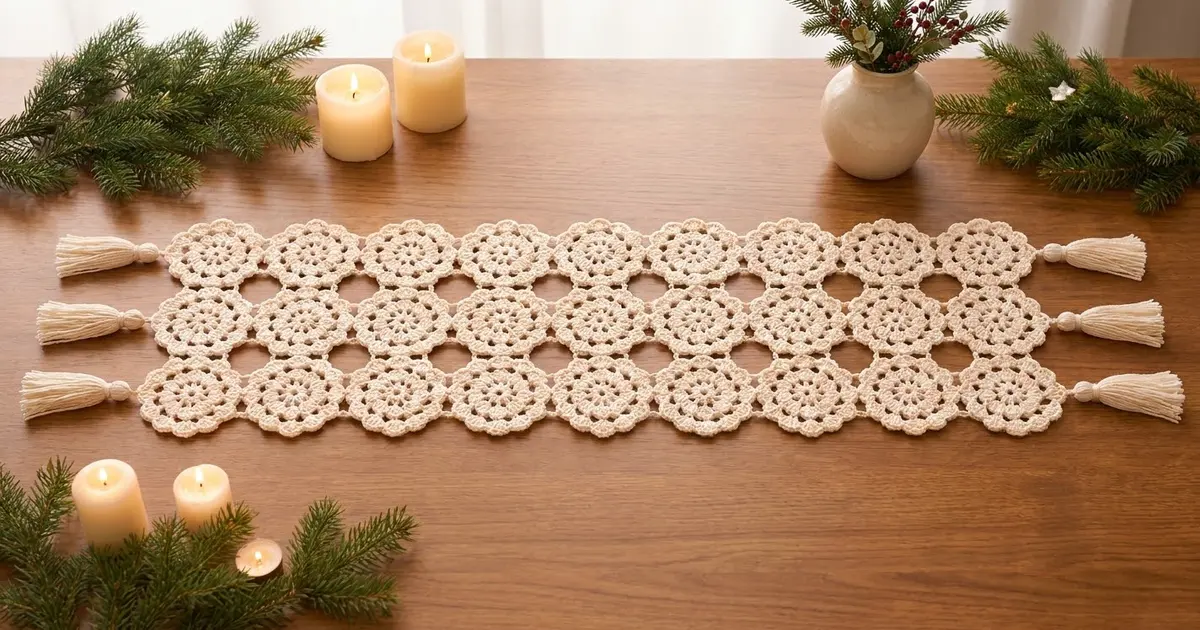
The Hearthside Fan Flower Table Runner is a cozy, airy lace runner built from small round flower motifs. Each motif has a tiny open center, a ring of petite fan petals and an outer circle of generous scalloped fans. When the motifs are joined point to point, open diamond windows form between them and let the wood grain of your table show through.
This sample is worked in a single ivory cotton. That keeps the look soft and timeless and works for winter holidays and every other season. Three tassels finish each short end and add a little weight and swing where the runner drapes over the table edge.
The pattern uses US crochet terms. The finished runner measures 13.5 in (34.3 cm) wide by 54 in (137.2 cm) long, not counting the tassels. With a 4 in (10.2 cm) tassel at each end, the total length is 62 in (157.5 cm).
Construction is simple. You work 36 identical 5-round motifs, joining each one to its neighbors as you go in the last round, at one fan tip per shared side. Then you add hanging loops and tassels to the end motifs. No separate border is worked.
Finished Size and Construction
- Finished size: 13.5 in x 54 in (34.3 cm x 137.2 cm), tassels excluded
- Skill level: Easy-intermediate
- Terminology: US crochet terms
- Yarn weight: Worsted (#4) cotton
- Hook: US H-8 (5.0 mm)
- Number of pieces: 36 motifs
- Layout: 3 motifs wide x 12 motifs long
- Piece size: 4.5 in (11.4 cm) across, measured fan tip to opposite fan tip
- Size before border: 13.5 in x 54 in (34.3 cm x 137.2 cm)
- Border depth: 0 in (0 cm). The motif scallops are the finished edge.
Materials
Yarn: Use a smooth, mercerized or combed worsted-weight cotton. Cotton gives the fans crisp stitch definition, blocks flat and stands up to washing. Avoid fuzzy or very loosely plied yarns, which blur the fan shapes.
- Ivory/cream: 250 g, about 425 m (465 yd). Each motif uses about 4.5 g (7.5 m). The six tassels and their loops use about 30 g (50 m).
Quantities include a margin of roughly 15–20% for gauge differences, swatching and weaving in ends.
Tools:
- US H-8 (5.0 mm) crochet hook
- Tapestry needle
- Scissors
- Stitch markers (2–3)
- Stiff card, 4 in (10.2 cm) tall, for the tassels
- Blocking mats and rustproof pins
- Spray bottle
- Tape measure
Abbreviations (US Terms)
- ch: chain
- sl st: slip stitch
- sc: single crochet
- dc: double crochet
- sk: skip
- sp: space
- st(s): stitch(es)
- rep: repeat
- MR: magic ring
Special technique: Drop-loop join (DLJ). Work the dc that will be the join point as normal. Remove the hook from the loop and insert the hook from front to back through the top of the matching dc on the neighboring motif. Pick up the dropped loop and pull it through. Then continue with the next stitch. The DLJ adds no stitches.
Gauge and Checkpoints
Make one complete motif before starting the runner. Block it and measure it.
- After Rnd 1: 1.5 in (3.8 cm) across
- After Rnd 3: 3 in (7.6 cm) across, measured tip to tip of opposite petals
- After Rnd 5 (blocked): 4.5 in (11.4 cm) across, measured fan tip to opposite fan tip
If the motif is too big (over 4.75 in / 12.1 cm), go down half a hook size to 4.5 mm. If it is too small (under 4.25 in / 10.8 cm), go up to 5.5 mm. A difference of 0.25 in (0.6 cm) per motif adds up to 3 in (7.6 cm) over the 12-motif length, so check your gauge before going further.
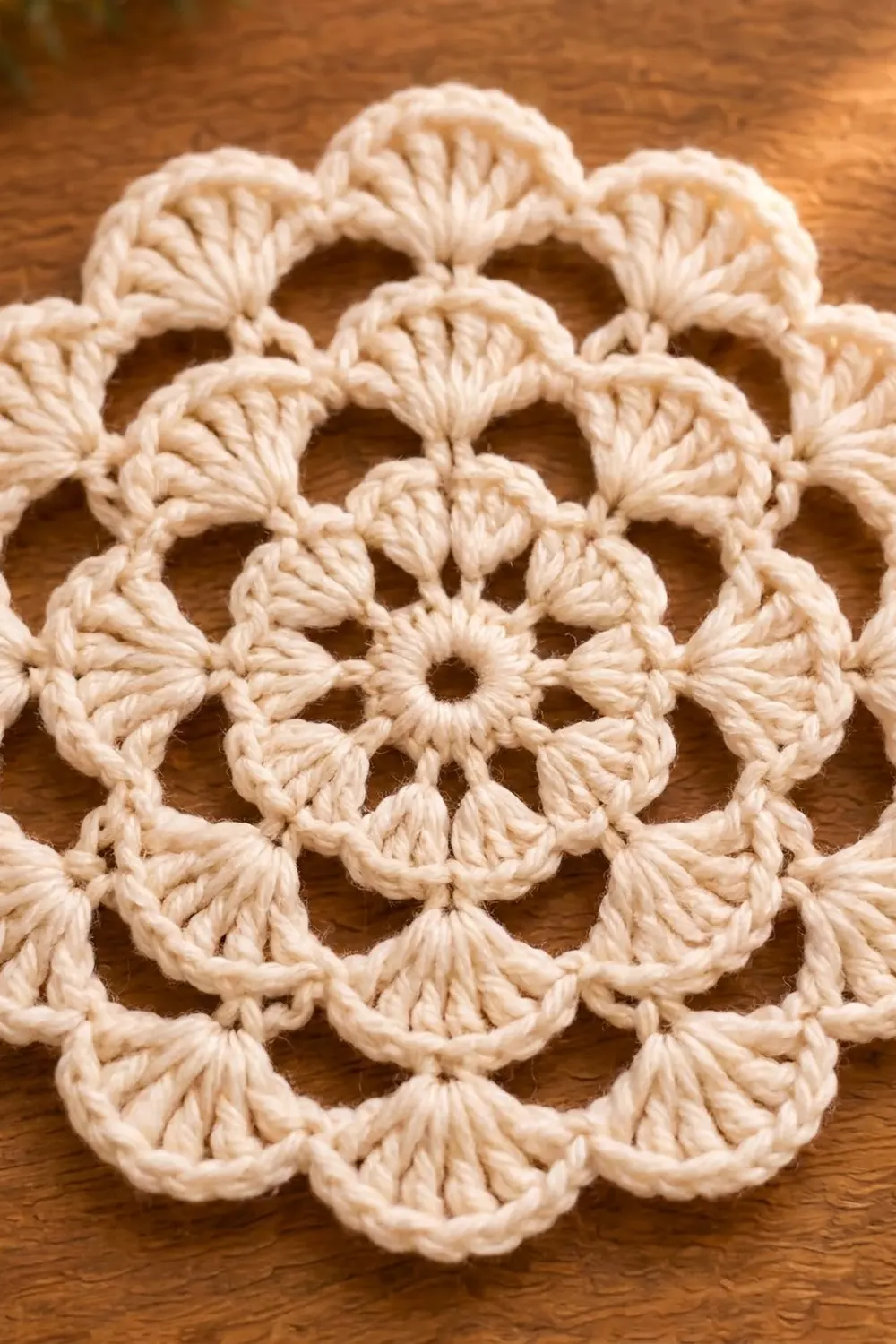
Motif Pattern
Every motif is worked the same way. The first motif is worked in full. All other motifs join to their neighbors during Rnd 5 (see Joining).
Rnd 1: Make a MR. Ch 3 (counts as dc), work 15 dc in the ring, then sl st to the top of the beginning ch-3. Pull the ring snug but leave a small open center, about 0.25 in (0.6 cm). (16 dc)
Rnd 2: Ch 1, sc in the same st, ch 3, sk 1 st. Sc in the next st, ch 3, sk 1 st. Rep from * to * 6 more times. Sl st to the first sc. (8 sc, 8 ch-3 sps)
Rnd 3 (petal round): Sl st into the first ch-3 sp. Ch 3 (counts as dc) and work 4 dc in the same sp, then ch 1. Work 5 dc in the next ch-3 sp, ch 1. Rep from * to * 6 more times. Sl st to the top of the beginning ch-3. (8 petals of 5 dc = 40 dc, plus 8 ch-1 sps)
Each 5-dc group fans out into a small petal. Together they form the inner flower.
Rnd 4 (arch round): Sl st in the next 2 dc so you are at the center (3rd) dc of the first petal. Ch 1, sc in the same st, ch 5. Sc in the center dc of the next petal, ch 5. Rep from * to * 6 more times. Sl st to the first sc. (8 sc, 8 ch-5 arches)
The arches pass behind the ch-1 gaps between petals and anchor at the petal tips. This creates the open ring of windows around the flower.
Rnd 5 (fan round): Ch 1, sc in the same st as the join. Work 9 dc in the next ch-5 arch. Sc in the next sc, 9 dc in the next ch-5 arch. Rep from * to * 6 more times. Sl st to the first sc and fasten off. (8 fans of 9 dc = 72 dc, plus 8 sc = 80 sts)
The 5th dc of each fan is the fan tip. Number the fans 1 to 8 in the order you work them. Fans 1, 3, 5 and 7 are the point fans. They face straight up, left, down and right, and they are the only fans used for joining and tassels. Fans 2, 4, 6 and 8 are diagonal fans and always stay free. That is what opens the diamond windows.
Weave in the ends as you finish each motif. Hide the tails inside the dc posts of Rnd 1 or Rnd 5.
Make All Pieces
- Ivory: 36 motifs in total
Lay out the motifs in 12 rows of 3. In the grid below, the letter is the column and the number is the row:
Row 1:  A1  B1  C1   <- tassel end (3 tassels)
Row 2:  A2  B2  C2
Row 3:  A3  B3  C3
 ...    ...  ...  ...
Row 11: A11 B11 C11
Row 12: A12 B12 C12  <- tassel end (3 tassels)
Work A1 completely. Join every motif after that as you go, row by row from left to right.
Joining
Method: Join-as-you-go during Rnd 5, using the DLJ at the fan tips.
Stitch-to-stitch logic: Each shared side has exactly one join, made from the 5th dc of a point fan to the 5th dc of the facing point fan on the neighbor. Every fan still has 9 dc and every motif still has 80 sts, so the joins add no stitches.
How to orient each new motif:
- Work Rnds 1–4 of the new motif.
- Begin Rnd 5. Work the fans so that, when you reach a point fan facing an already-finished neighbor, you do the DLJ on its 5th dc into that neighbor’s facing fan tip.
- A motif in Row 1 (except A1) joins only on its left side, so it has 1 join.
- A motif in Column A (except A1) joins only on its top side, so it has 1 join.
- Every other motif joins on its left and top sides, so it has 2 joins.
- Finish the round normally and fasten off.
Total joins: 24 side-to-side joins (12 rows x 2) plus 33 top-to-bottom joins (11 gaps x 3 columns), for 57 joins in total.
Tension advice: Keep the DLJ loop the same height as a normal dc. If you pull it tight, the fan tip puckers and the two motifs overlap. If you leave it loose, the motifs drift apart and the runner grows longer. Before each join, lay the two motifs flat to make sure the fan tips meet without stretching.
Size checkpoint: After 4 rows (12 motifs), the joined piece should measure 13.5 in x 18 in (34.3 cm x 45.7 cm), relaxed and unblocked to within about 0.5 in (1.3 cm). If not, adjust the hook size for the rest of the motifs, because the remaining 8 rows will magnify any error.
Border (Edge Finish and Tassels)
This design has no continuous border, so the border gauge is simply the motif gauge of 4.5 in (11.4 cm) per motif. A straight border would fill the scallops and diamond gaps and lose the motif silhouette, so the fans themselves form the finished edge.
Outer edge counts:
- Each long side: 12 free point fans (one per motif in Column A or C), with the diagonal fans between them. Each point fan has 9 dc.
- Each short end: 3 free point fans (one per motif in Row 1 or Row 12). These are the tassel fans.
Tassel loops (6 in total):
- Join yarn with a sl st in the 5th dc (fan tip) of an outward-facing point fan of a Row 1 motif.
- Ch 6, then sl st into the same 5th dc.
- Fasten off and weave in the ends.
You now have 1 ch-6 loop, about 0.75 in (1.9 cm) long. Repeat on all 3 motifs of Row 1 and all 3 motifs of Row 12.
Tassels (make 6):
- Wrap yarn 30 times around a 4 in (10.2 cm) card.
- Slide a 9 in (22.9 cm) strand under the wraps at the top and thread it through a tassel loop. Tie it tightly.
- Slide the wraps off the card. Wrap a separate 12 in (30.5 cm) strand around the bundle about 0.75 in (1.9 cm) below the top. Wind it 6 times and knot it.
- Bury the tails inside the tassel.
- Cut the bottom loops open and trim them even at 4 in (10.2 cm).
Why the math works: The edge adds no stitches. Every fan keeps its 9 dc, so every scallop is identical and lies flat. Each motif spans exactly 4.5 in (11.4 cm), and motifs touch at single points, so the size is a straight multiplication: 3 x 4.5 in = 13.5 in (34.3 cm) wide and 12 x 4.5 in = 54 in (137.2 cm) long.
Final Blocking
- Weave in any remaining ends before blocking.
- Lay the runner face up on the blocking mats. Use two rows of mats if needed. Align the columns with a straight edge.
- Pin the 3 tassel-end fan tips at each short end first so the width is 13.5 in (34.3 cm).
- Pin down the long sides at every outer point-fan tip. Check that the runner is 54 in (137.2 cm) long.
- Pin the tips of the diagonal fans on the outer edges so the scallops open evenly.
- Mist the runner until it is evenly damp but not dripping. Gently pat the fans and petals into shape with your fingers.
- Let it dry completely, usually for 12–24 hours.
- Unpin the runner. Steam the tassels lightly, comb them straight and trim them again if needed.
Final Quality-Control Checklist
- 36 motifs, each with 8 petals, 8 arches and 8 fans of 9 dc
- Each motif measures 4.5 in (11.4 cm) tip to tip
- 57 joins, all at fan tips, with no twisted motifs
- Diagonal fans are all free and the diamond windows are open and even
- Runner measures 13.5 in x 54 in (34.3 cm x 137.2 cm)
- 6 tassel loops, each centered on a fan tip
- 6 tassels, each 4 in (10.2 cm) long and evenly trimmed
- All ends woven in securely, with none showing through the open center or the windows
Troubleshooting
The center hole is too big: Pull the magic ring tighter and weave the tail back through Rnd 1 once more.
The petals cup or ruffle in Rnd 3: Your ch-3 spaces in Rnd 2 are too tight. Work the chains slightly looser, or go up half a hook size for Rnd 2 only.
The outer fans curl up: Make the ch-5 arches in Rnd 4 a little looser. Blocking will also flatten mild curl.
The motifs overlap at the joins: The DLJ was pulled too tight. Remove it and redo it at normal dc height.
The runner is crooked: A motif was probably joined at a diagonal fan instead of a point fan. Count the fans from fan 1 and redo that join.
The runner is too long or short: Check the size of a single blocked motif. Adding or removing one row changes the length by 4.5 in (11.4 cm).
The tassels are uneven: Trim them while damp, after steaming, holding each tassel flat against a ruler.
Care
Hand wash in cool water with a mild detergent, gently press out the water, and dry the runner flat in its blocked shape. Iron lightly on a cotton setting under a pressing cloth if needed. Avoid ironing the tassels.

Final Notes
The whole runner depends on one measurement. Rnd 1 should be 1.5 in (3.8 cm), Rnd 3 should be 3 in (7.6 cm) and the finished motif should be 4.5 in (11.4 cm). Three motifs across give 13.5 in (34.3 cm), and twelve rows give 54 in (137.2 cm). Get that first motif right and the rest follows. Take your time with the joins, enjoy watching the diamond windows appear, and finish with soft swinging tassels.
Happy crocheting!