
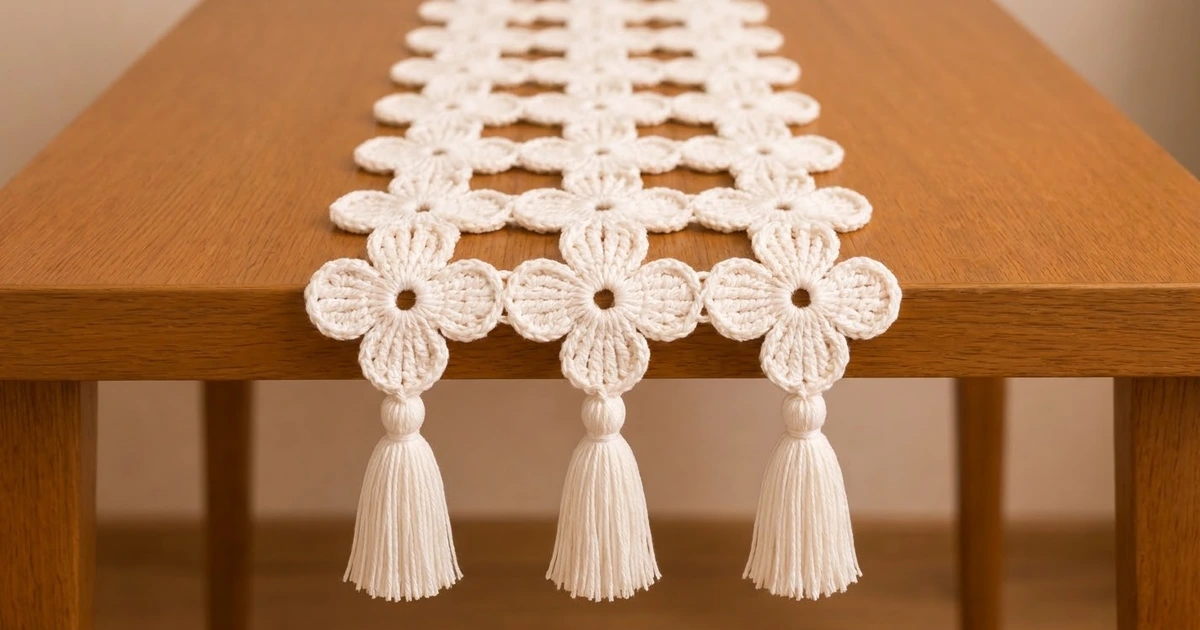
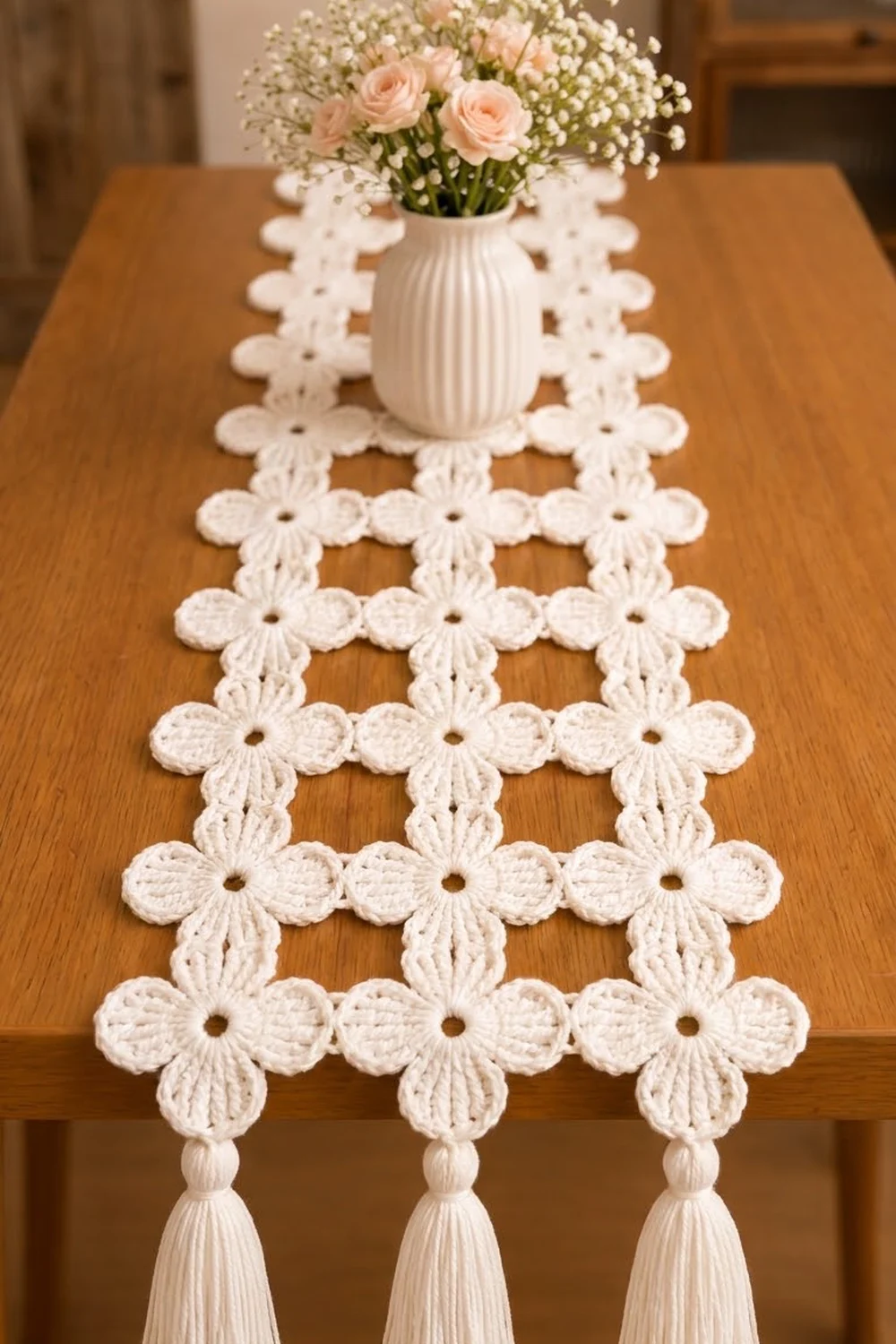
The Quatrefoil Lace Table Runner uses one simple idea, repeated many times: a four-petal flower motif with a small open center, long ribbed petals, and a neat chain-like outline. You join thirty of these motifs tip to tip in a grid three motifs wide. This leaves square windows between the flowers, so the table shows through.
The runner uses a single color, soft white cotton, for a clean, airy look that suits both farmhouse and heirloom styles. Each short end has three full tassels, one hanging from the outer petal tip of each end motif.
This pattern uses US crochet terms. The finished runner is 10.5 in (26.7 cm) wide by 35 in (88.9 cm) long, or about 41 in (104.1 cm) with the tassels.
The construction is simple. You crochet a center ring, fan tall stitches into four petals, then outline each petal with single crochet. From the second motif on, you join as you go on the last round, so there is no sewing. You add the tassels at the end.
Finished Size and Construction
- Finished size: 10.5 in (26.7 cm) x 35 in (88.9 cm), plus 3 in (7.6 cm) tassels at each end
- Skill level: Easy-intermediate (tall stitches, join-as-you-go)
- Terminology: US crochet terms
- Yarn weight: DK (light worsted, weight 3) cotton
- Hook: 3.5 mm (E-4)
- Number of pieces: 30 identical motifs, joined; plus 6 tassels
- Layout: 3 motifs wide x 10 motifs long
- Piece size: 3.5 in (8.9 cm) from petal tip to opposite petal tip
- Size before border: 10.5 in (26.7 cm) x 35 in (88.9 cm)
- Border depth: None. The motif outline is the finished edge, so the size does not change.
Materials
Choose a smooth mercerized or combed DK cotton. Cotton holds the petal shape, shows the stitch ribs clearly, and blocks flat. Avoid fuzzy or very stretchy yarns, because the petals will lose definition.
- White / ivory DK cotton: 150 g, about 330 m (361 yd)
- Motifs: about 3 g and 7 m (7.7 yd) each; 90 g and 210 m (229.7 yd) for all 30
- Tassels: about 2.5 g and 5.5 m (6 yd) each; 15 g and 33 m (36.1 yd) for all 6
The 150 g total includes a margin of about 45 g for gauge differences, swatching, and weaving in. Buy all the yarn from the same dye lot. Even white can vary between lots, and the difference shows on a large lace piece.
Tools:
- 3.5 mm (E-4) crochet hook
- Tapestry needle
- Scissors
- 1 stitch marker
- Stiff card cut to 3.25 in (8.3 cm) tall, for the tassels
- Blocking mats and rust-proof pins
- Spray bottle
- Ruler or tape measure
Abbreviations (US Terms)
- ch: chain
- sl st: slip stitch
- sc: single crochet
- dtr: double treble crochet
- trtr: triple treble crochet
- st(s): stitch(es)
- sp: space
- Rnd: round
Special stitches:
- Double treble (dtr): Yarn over 3 times, insert hook in st, pull up a loop (5 loops on hook), [yarn over, pull through 2 loops] 4 times.
- Triple treble (trtr): Yarn over 4 times, insert hook in st, pull up a loop (6 loops on hook), [yarn over, pull through 2 loops] 5 times.
- Tip ch-2 sp: The 2 chains at the very point of each petal on Rnd 3. These are the only stitches used for joining and for attaching tassels.
- Tip join: Instead of ch 2 at a petal tip, work ch 1, sl st in the tip ch-2 sp of the neighboring motif, ch 1.
Gauge and Checkpoints
Make one complete motif before anything else. The whole runner is made of identical units, so one accurate motif sets the final size.
- After Rnd 1: The sc ring is 0.9 in (2.3 cm) across, with an open center hole about 0.3 in (0.8 cm) wide.
- After Rnd 2: 3 in (7.6 cm) from petal tip to opposite petal tip.
- After Rnd 3: 3.5 in (8.9 cm) from tip to tip, measured after light blocking. Each petal is about 1.3 in (3.3 cm) long, measured from the ring.
If your motif is too big: Go down to a 3.25 mm hook, or wrap the tall stitches more snugly. Every extra 0.125 in (0.3 cm) per motif adds 1.25 in (3.2 cm) to the runner’s length.
If your motif is too small: Go up to a 3.75 mm hook. Pull up the first loop of each tall stitch to full height before you work it off.
Write down which hook you used and keep it for all 30 motifs. If you crochet over several sessions, measure a motif from each session against your test motif.
Motif Pattern
First Motif
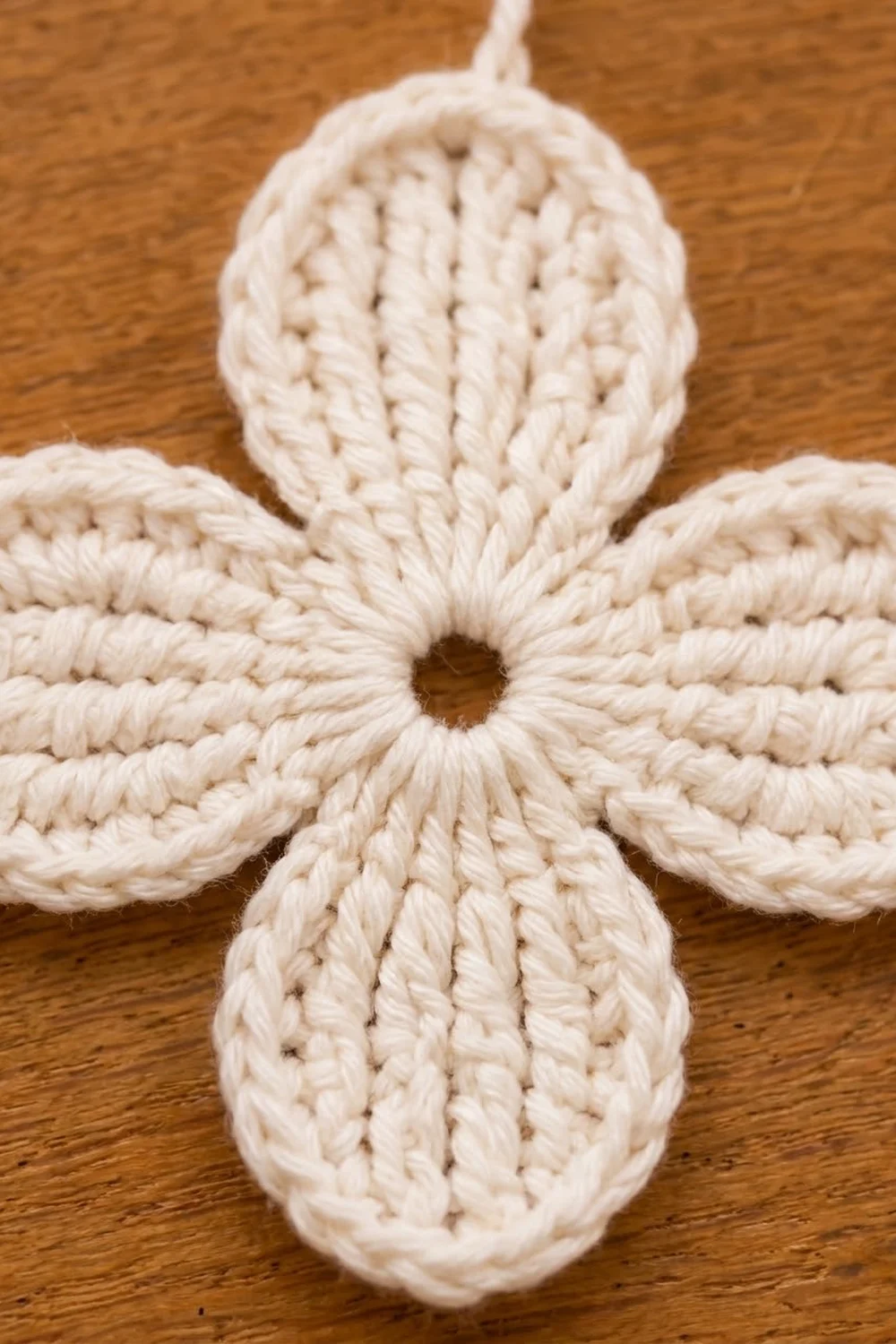
Rnd 1: Ch 6, sl st in first ch to form a ring. Ch 1, work 16 sc in ring, sl st in first sc to join. (16 sc)
Pack the sc evenly around the ring so the center hole stays round and open. Place a marker in the joining sc.
Rnd 2 (petals): Sl st in next sc, (dtr, trtr, trtr) in next sc, (trtr, trtr, dtr) in next sc, sl st in next sc; repeat from * 3 more times. The final sl st lands in the marked joining sc of Rnd 1. (4 petals; 24 tall sts: 8 dtr and 16 trtr; plus 8 sl sts)*
Each petal is a fan of 6 tall stitches rising from just 2 sc. The base is narrow and the tops spread, so the petal is slim near the center and rounded at the outer end. The long posts of the trtr make the ribs that run along each petal.
Check: You used all 16 sc (4 per petal x 4 petals).
Rnd 3 (outline): Do not turn. Work each petal as follows:
- Up the side: Work 5 sc evenly around the post of the first dtr and up the edge of the first trtr.
- Across the top: Sc in top of dtr, 2 sc in each of next 2 trtr, ch 2 (tip ch-2 sp), 2 sc in each of next 2 trtr, sc in top of dtr. (10 sc + 1 tip ch-2 sp)
- Down the side: Work 5 sc evenly down the edge of the last trtr and around the post of the last dtr.
- Between petals: Sl st in each of the next 2 sl sts.
Repeat for all 4 petals. The last sl st goes in the first sl st of Rnd 2. Fasten off, leaving a 6 in (15.2 cm) tail. (80 sc, 20 per petal; 4 tip ch-2 sps; 8 sl sts)
The doubled sc across the top keep the rounded end flat. The unbroken line of sc makes the braided outline around every petal. Spread the 5 side sc evenly along the post: if they bunch near the base, the petal waists in and the tip pulls sideways.
Joined Motifs (Join-As-You-Go)
Work Rnds 1 and 2 exactly as for the first motif. Work Rnd 3 as written, except at any petal tip that meets an existing motif: there, replace the ch 2 with a tip join. All other tips get a normal ch 2.
Each petal tip joins to at most one neighbor, and each join uses one tip on each motif. A tip join adds nothing to the Rnd 3 stitch count, because it still has 2 chains, one on each side of the sl st.
Make All Pieces
- Motifs: 30 in white
- Tassels: 6 in white (3 per short end)
Layout grid (M = motif, T = tassel hanging from the outer tip):
        T     T     T
Row 1   M  -  M  -  M
        |     |     |
Row 2   M  -  M  -  M
        |     |     |
  ...  (rows 3–9 the same)
        |     |     |
Row 10  M  -  M  -  M
        T     T     T
“-” is a side-to-side tip join; “|” is a top-to-bottom tip join.
Joining
You join each new motif while working its Rnd 3. Work row by row, left to right.
- Row 1, motif 1: No joins.
- Row 1, motifs 2 and 3: Join the left petal tip to the right petal tip of the motif before it (1 join each).
- Rows 2–10, first motif: Join the top petal tip to the bottom petal tip of the motif above (1 join).
- Rows 2–10, motifs 2 and 3: Join the top tip to the motif above, then the left tip to the motif before it (2 joins each).
To keep the layout clear, start Rnd 3 on the petal that will become the top petal. You then reach the joining tips in the same order on every motif.
Stitch-to-stitch logic: Every connection links one tip ch-2 sp to one tip ch-2 sp, so neighboring motifs sit exactly one motif width apart. The center-to-center spacing is 3.5 in (8.9 cm). Because only the tips touch, every group of 4 motifs frames an open square window.
Join count: 2 side joins per row x 10 rows = 20, plus 3 vertical joins x 9 gaps = 27, for 47 joins in total.
Tension: Keep the sl st in each tip join relaxed. If you pull it tight, the tips pucker and the runner gets shorter. Two joined motifs should lie flat side by side, with their tips just meeting.
Size checkpoint: After Row 3, the piece should be 10.5 in (26.7 cm) wide and 10.5 in (26.7 cm) long. Fix any difference now, before you continue.
Border
This runner has no crocheted border. The outline round (Rnd 3) is the finished edge. A border would fill in the scalloped flower outline that defines the design.
Border gauge: Not applicable. The size is the same before and after finishing: 10.5 in (26.7 cm) x 35 in (88.9 cm).
Edge counts per side, for reference:
- Short ends: 3 motifs x 1 free outer tip ch-2 sp = 3 tip sps per end. Each of these tips gets one tassel.
- Long sides: 10 motifs x 1 free outer tip ch-2 sp = 10 tip sps per side. These stay open as small points along the edge.
Why the math works: Every motif has exactly 4 tips, so 30 motifs x 4 = 120 tips. The 47 joins use 94 tips. The free outer tips are 3 + 3 + 10 + 10 = 26. Since 94 + 26 = 120, every tip is accounted for, and the edge has no gaps or extra stitches.
Tassels (make 6)
- Wrap yarn 30 times around the 3.25 in (8.3 cm) card.
- Slide a 10 in (25.4 cm) strand under the wraps at the top and tie it tightly. Leave the tails long.
- Cut through the wraps along the bottom edge.
- Wrap a separate strand 6 times around the bundle, 0.5 in (1.3 cm) below the top. Tie it and hide the ends inside the tassel.
- Trim the bottom evenly to 3 in (7.6 cm).
- Thread the top tails through the outer tip ch-2 sp of an end motif, knot securely on the wrong side, and weave in.
For matching tassels, count the wraps aloud and keep the same gentle tension on the card each time.
Final Blocking
- Weave in all tails before blocking. Run them along the sc outline so they disappear.
- Lay the runner on the blocking mats, right side up.
- Spray evenly with water until damp but not dripping.
- Pin the outer petal tips first, along straight lines: 10.5 in (26.7 cm) for the width and 35 in (88.9 cm) for the length.
- Pin each joined tip so the windows form true squares.
- Gently round each petal with your fingers so the ribs run straight out from the center.
- Comb the tassels straight and let them hang off the edge of the mat.
- Let the runner dry completely, then unpin.
Final Quality-Control Checklist
- All 30 motifs have 16 sc in Rnd 1 and 80 sc in Rnd 3.
- Every motif is 3.5 in (8.9 cm) from tip to tip.
- There are 47 joins, and no tip is joined twice.
- Every window between motifs is an open square.
- The width is 10.5 in (26.7 cm) and the length is 35 in (88.9 cm).
- Each end has 3 tassels, all 3 in (7.6 cm) long.
- All tails are woven in and invisible from both sides.
Troubleshooting
- Petals curl forward: Your tall stitches are too short. Pull up each yarn-over loop fully, or go up a hook size.
- Petals ruffle at the top: On each side of the tip, work 2 sc in only one trtr instead of two (8 sc across the top), then block firmly.
- Center hole has closed up: Start with ch 7 instead of ch 6, and keep 16 sc.
- Runner is too long for your table: Leave out a row of motifs. Each row is 3.5 in (8.9 cm).
- Windows are diamond-shaped: You joined to the wrong tip. Top tips must meet bottom tips, and side tips must meet side tips.
- Tassels look thin: Add 5 to 10 more wraps.
Care
Hand wash in cool water with mild soap, press the water out in a towel, and dry flat, reshaping the petals. Comb the tassels while they are still damp.
Final Notes
The measurement chain is simple. Rnd 1 is 0.9 in (2.3 cm) and the finished motif is 3.5 in (8.9 cm). Three motifs make 10.5 in (26.7 cm) of width, and 10 rows make 35 in (88.9 cm) of length. Add two sets of 3 in (7.6 cm) tassels and the runner reaches about 41 in (104.1 cm). Once the first motif is the right size, the rest will be too.
Happy crocheting!