
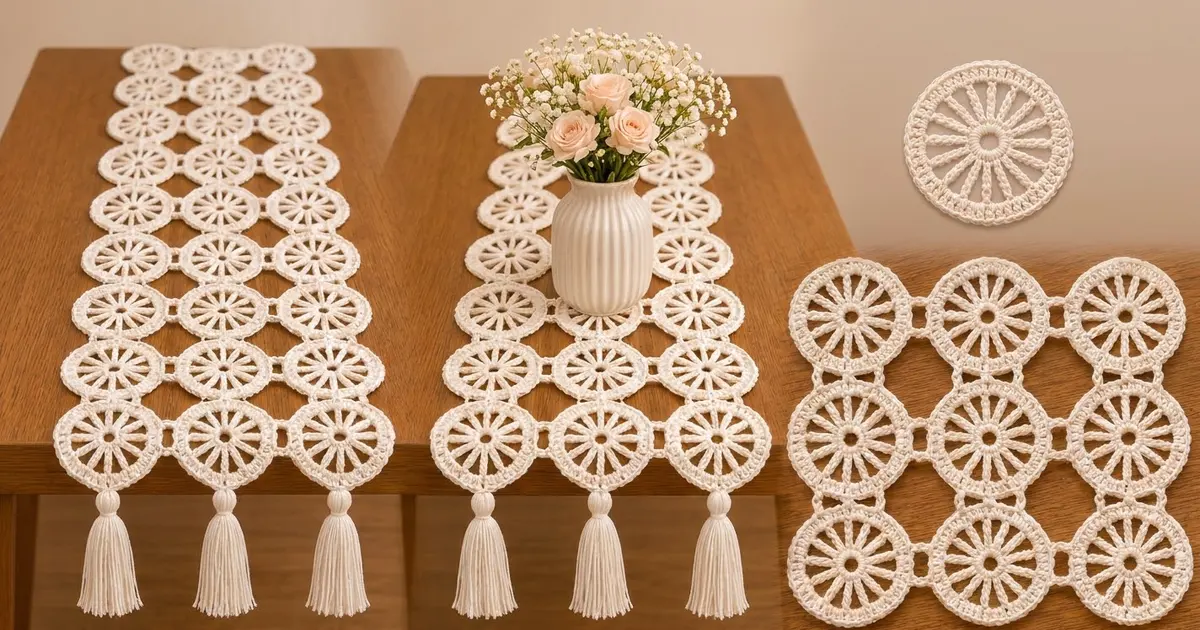
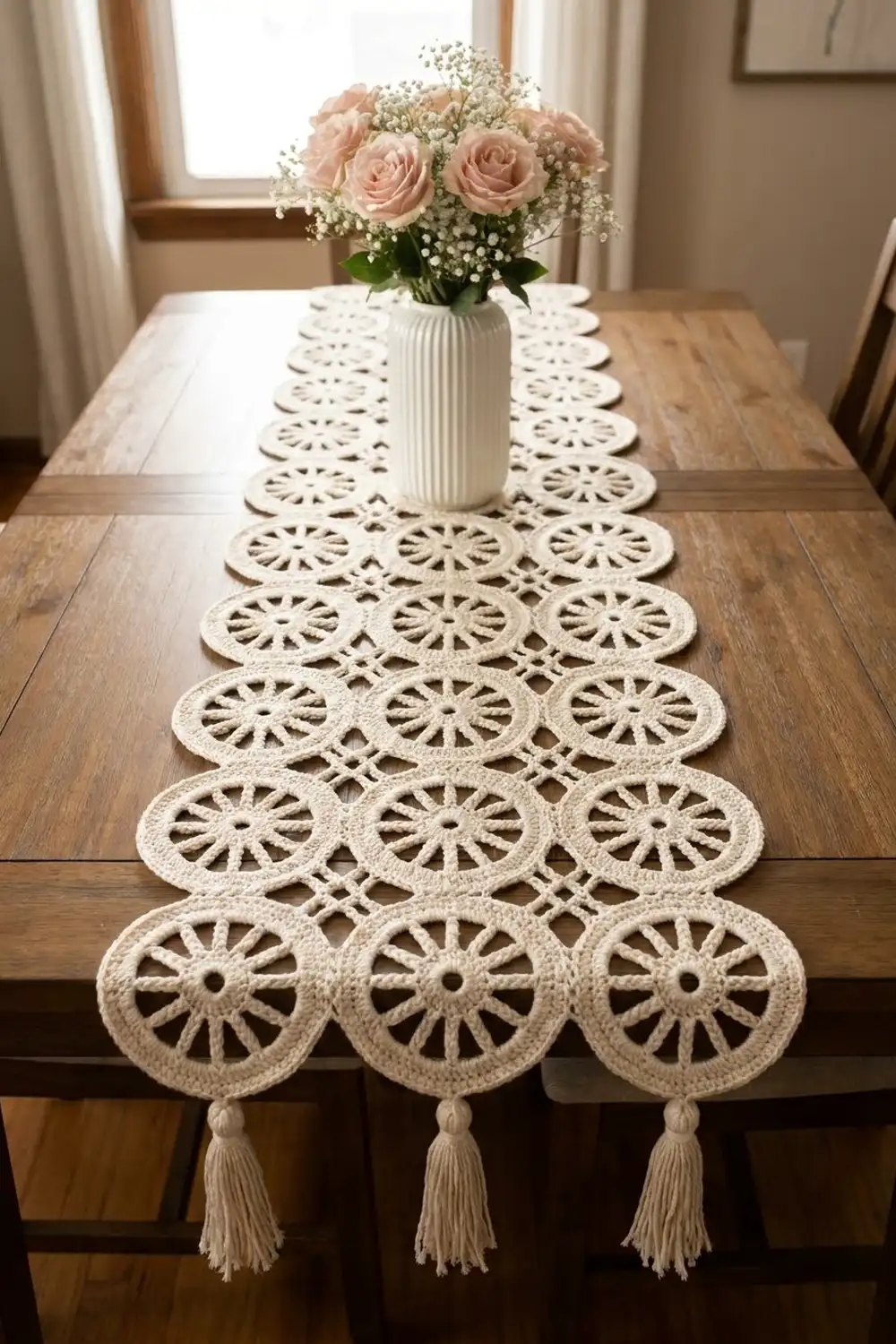
The Cartwheel Lace Table Runner is made of 27 openwork wheel motifs joined into a long, airy strip. Each circle has a small open centre, sixteen slim spokes and a solid frame. Short double bars hold the circles together and leave tiny square windows at each joint.
The sample uses one colour, a soft ivory cotton. That keeps the style classic and calm, so it works with wood, linen and fresh flowers. Three simple tassels finish the near end.
This pattern uses US crochet terms. The finished runner measures 14.5 in (36.8 cm) wide and 44.5 in (113.0 cm) long, not counting tassels. With the 4 in (10.2 cm) tassels, the overall length is 48.5 in (123.2 cm).
Construction is straightforward. You crochet the first motif completely. Every later motif is joined to its neighbours as you go, during its last round. When all 27 are linked, you add the tassels and block.
Finished Size and Construction
- Finished size: 14.5 in × 44.5 in (36.8 cm × 113.0 cm), plus 4 in (10.2 cm) tassels
- Skill level: Easy+ / confident beginner
- Terminology: US crochet terms
- Yarn weight: DK / light worsted (#3) cotton
- Hook: 4.0 mm (US G-6)
- Number of pieces: 27 identical wheel motifs
- Layout: 3 motifs wide × 9 motifs long
- Piece size: each motif is 4.5 in (11.4 cm) across
- Joint size: each bridge gap is 0.5 in (1.3 cm)
- Size before border: 14.5 in × 44.5 in (36.8 cm × 113.0 cm)
- Border depth: 0 in (0 cm). There is no separate border, because Round 5 of each motif forms the edge.
Materials
Yarn: Use a smooth mercerised or combed cotton in DK weight, about 110 m per 50 g. Cotton gives crisp spokes and blocks flat. Avoid fuzzy or very stretchy blends, because the openwork will lose its shape.
- Ivory / natural white: 250 g (about 550 m)
That covers about 162 g for the motifs, about 24 g for the tassels and a small amount for joining. The quantities include a safety margin, so you won’t run short if your tension is slightly loose.
Tools:
- 4.0 mm (US G-6) crochet hook
- Tapestry needle
- 4 to 6 locking stitch markers
- A piece of stiff card 4.5 in (11.4 cm) tall, for the tassels
- Sharp scissors
- Blocking mats and rustproof pins
- Spray bottle
- Tape measure
Abbreviations (US Terms)
- ch – chain
- sl st – slip stitch
- sc – single crochet
- hdc – half double crochet
- dtr – double treble crochet (yarn over 3 times, insert hook, pull up a loop, then [yarn over, pull through 2] 4 times)
- sp – space
- st(s) – stitch(es)
- rep – repeat
Special stitch – Join sc (bridge): Sc in the next stitch, then ch 2. Sl st into the matching stitch on the neighbouring motif, then ch 2. Sl st into the top of the sc you just made, under its front loop and the strand below. The bridge counts as one stitch of Round 5. Its chains are not counted.
Gauge and Checkpoints
Gauge: 5 sc = 1 in (2.5 cm) in the round.
Make one full motif first and block it lightly before you start any joins. Measure across the centre at each checkpoint:
- After Round 1: 1 in (2.5 cm)
- After Round 2: 3 in (7.6 cm), measured from spoke tip to spoke tip
- After Round 3: 3.5 in (8.9 cm)
- After Round 4: 4 in (10.2 cm)
- After Round 5: 4.5 in (11.4 cm)
Too big? Switch to a 3.75 mm (US F-5) hook. If only the spokes are too long, pull each dtr loop snug before you finish it.
Too small? Switch to a 4.5 mm (US 7) hook.
Edge waving? Your Round 5 is too loose. Go down a hook size for that round only.
Edge cupping? Round 5 is too tight. Go up a hook size for that round only.
A difference of just 0.125 in (0.3 cm) per motif adds up to more than 1.125 in (2.9 cm) over nine motifs. Check carefully.
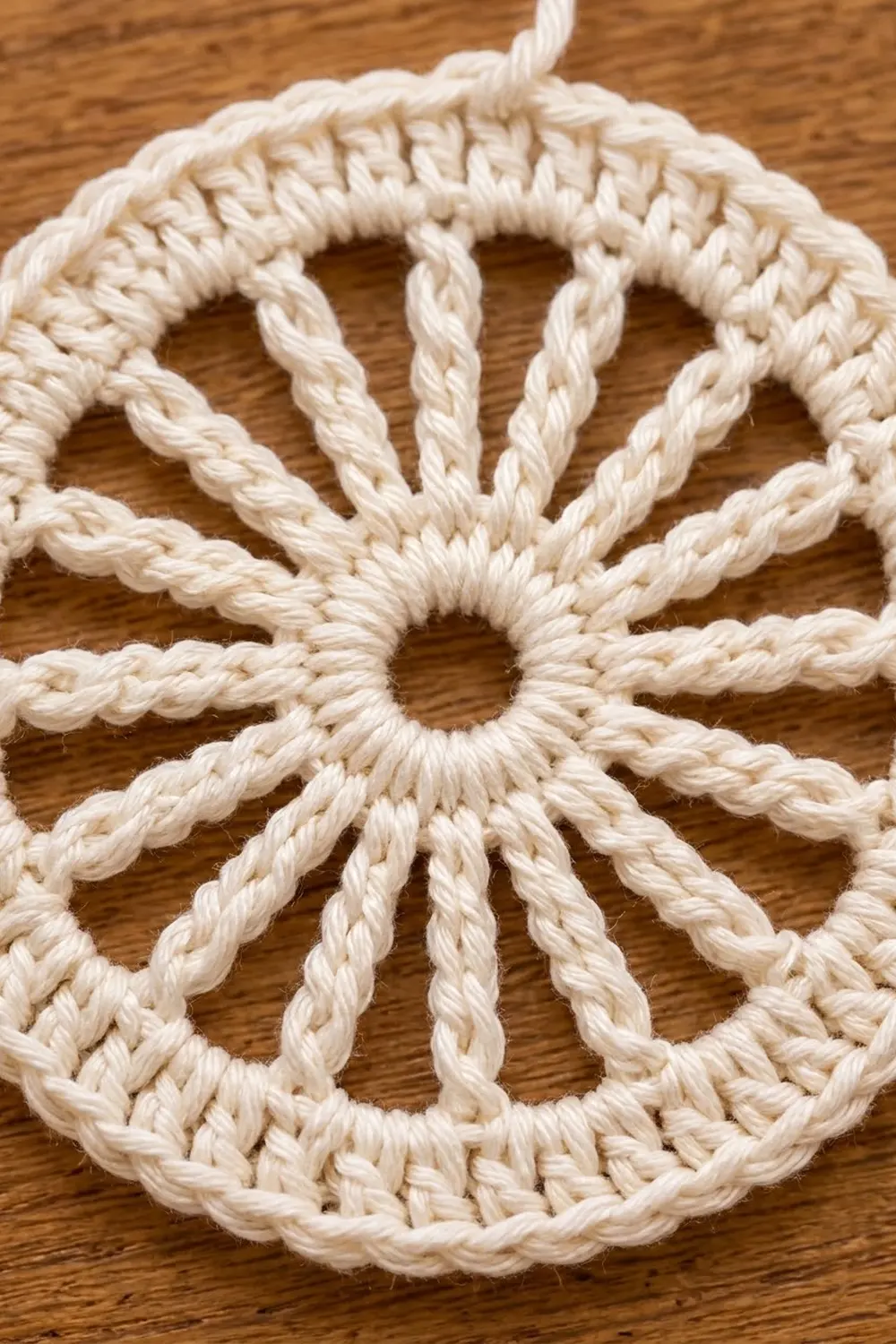
Wheel Motif
Work in joined rounds with the right side facing. Don’t turn.
Ring: Ch 6 and sl st to the first ch to form a ring.
Round 1 (centre ring): Ch 1, then work 16 sc into the ring. Sl st to the first sc. (16 sc)
This makes the small open hole with a solid band of sc around it.
Round 2 (spokes): Ch 5 (counts as the first dtr), ch 2. Dtr in the next sc, ch 2. Rep from * 14 more times. Sl st to the top of the beginning ch-5. (16 dtr, 16 ch-2 sps)
Each dtr stands up as a long, twisted spoke, and the ch-2 spaces become the open gaps between spokes.
Round 3 (spoke ring): Ch 1. Sc in the same st as the join, then 2 sc in the next ch-2 sp. Sc in the next dtr, 2 sc in the next ch-2 sp. Rep from * 14 more times. Sl st to the first sc. (48 sc)
Check the math: 16 sc worked 1-per-dtr + 32 sc worked into the spaces = 48 sc.
Round 4 (frame): Ch 2 (does not count as a st). Hdc in the next 2 sts, 2 hdc in the next st. Rep from * 15 more times. Sl st to the first hdc. (64 hdc)
This is a growth round, with 16 increases. The total for the round is 64 hdc.
Round 5 (edge), first motif only: Ch 1. Sc in the next 7 sts, 2 sc in the next st. Rep from * 7 more times. Sl st to the first sc. (72 sc)
Fasten off and weave in the ends. This motif is A1.
Numbering Round 5
The joins are placed by stitch number. Put a marker in sc #1 and turn the motif so that sc #1 sits at the top, 12 o’clock. Keep every motif turned the same way.
For right-handed crocheters working counter-clockwise, the key positions are:
- Top: bridges at sc #71 (upper right) and sc #3 (upper left)
- Left: bridges at sc #17 (upper left) and sc #21 (lower left)
- Bottom: bridges at sc #35 (lower left) and sc #39 (lower right)
- Right: bridges at sc #53 (lower right) and sc #57 (upper right)
Each pair of bridges has 3 plain sc between them. That makes the small square window you see at every joint. The pair centres are 18 stitches apart (72 ÷ 4), so the four joint points sit exactly at the quarters of the circle.
If you crochet left-handed, swap the words “left” and “right” throughout. The stitch numbers stay the same.
Make All Pieces
You need 27 motifs, all in ivory. One motif uses about 6 g, so all 27 use about 162 g.
Layout grid (columns A–C, rows 1–9):
A1 – B1 – C1
 |    |    |
A2 – B2 – C2
 |    |    |
A3 – B3 – C3
 ...  ...  ...
A9 – B9 – C9
 T    T    T   (tassels)
Work Rounds 1–4 of each new motif as written. Then join it to its neighbours during Round 5, as explained below.
Joining (Join-As-You-Go)
Method: Work Round 5 exactly as written above, but replace the plain sc at the bridge positions with a Join sc. The increase pattern does not change, and the round still ends at 72 stitches.
Which stitch joins to which:
- Joining to the motif on the left: your sc #17 joins to its sc #57, and your sc #21 joins to its sc #53.
- Joining to the motif above: your sc #3 joins to its sc #35, and your sc #71 joins to its sc #39.
Because you work counter-clockwise from the top, the order in one round is: #3 (above), then #17 and #21 (left), then #71 (above). You never need to skip ahead or go back.
Order of work:
- Row 1: make A1 complete. Join B1 to A1 on its left side. Join C1 to B1 on its left side.
- Row 2 onward: join A to the motif above it only. Join B and C to both the motif above and the motif on the left.
Joint count: There are 2 joints in each row × 9 rows = 18 side-to-side joints, and 3 joints per row boundary × 8 boundaries = 24 top-to-bottom joints. That’s 42 joints, or 84 bridges in total.
Tension: Keep the ch-2 sections relaxed but even. All bridges should be the same length so the gaps stay at 0.5 in (1.3 cm). Tight bridges will pucker the circles, and loose ones will let the runner sag.
Size checkpoint: After Row 1, the strip should measure 14.5 in (36.8 cm) wide. That is 3 × 4.5 in (11.4 cm) + 2 × 0.5 in (1.3 cm).
After Rows 1–2, the length should be 9.5 in (24.1 cm). That is 2 × 4.5 in + 0.5 in.
If either measurement is off by more than 0.25 in (0.6 cm), check your gauge before going on.
Border (Edge Finish) and Tassels
This runner has no added border rounds. Round 5 of each outer motif is the finished edge.
Border gauge: It’s the same as the motif edge, 5 sc = 1 in (2.5 cm).
Exposed edge counts per side:
- Long sides: each of the 9 outer motifs shows its free outer arc. The left side uses the sc between #3 and #35 on column A, and the right side uses the sc between #39 and #71 on column C.
- Short ends: the top edge uses the arcs between #71 and #3 on A1, B1 and C1. The tassel end uses the arcs between #35 and #39 on A9, B9 and C9.
Why the math works: Every motif keeps exactly 72 sc, whether it is joined or not, because a Join sc replaces one plain sc. The edge therefore has the same density as a single motif, and it blocks flat without extra rounds. A continuous border would fill in the scalloped outline that gives this runner its character.
Tassels (make 3):
- Wrap yarn 40 times around the 4.5 in (11.4 cm) card.
- Slip a 12 in (30.5 cm) length of yarn under the top of the loops and tie it tightly.
- Cut through the loops at the bottom.
- Wrap a separate strand 6 times around the bundle, 0.75 in (1.9 cm) below the top, to form the neck. Knot it and bury the tails inside the tassel.
- Steam the tassel, then trim it to 4 in (10.2 cm).
Attach: Thread both top ties through sc #37 of A9, B9 and C9, the bottom centre of each motif. Knot them on the wrong side and weave them in. The head of each tassel should sit right against the motif.
To add tassels to the far end as well, attach three more at sc #1 of A1, B1 and C1. This adds about 24 g, which the 250 g already covers.
Final Blocking
- Weave in any remaining ends along solid sc rounds, never through the spokes.
- Lay the runner on the mats with the wrong side up.
- Pin it out to 14.5 in × 44.5 in (36.8 cm × 113.0 cm).
- Pin each motif round at 4.5 in (11.4 cm), with one pin at every joint.
- Ease the spokes straight so that they line up with the centre hole.
- Mist with water until damp, but not soaked.
- Leave it to dry completely before you unpin.
- Fluff the tassels and trim them evenly to 4 in (10.2 cm).
Final Quality-Control Checklist
- [ ] All 27 motifs measure 4.5 in (11.4 cm)
- [ ] Every motif has 16 spokes and 72 sc in Round 5
- [ ] All 84 bridges are present and the same length
- [ ] Every joint shows a square window with 3 sc between the bridges
- [ ] Width is 14.5 in (36.8 cm) and length is 44.5 in (113.0 cm)
- [ ] There are no twisted joints, and all motifs are oriented the same way
- [ ] The 3 tassels are even at 4 in (10.2 cm)
- [ ] All ends are secured and invisible
Troubleshooting
Spokes lean or curve: Your dtr stitches are uneven. Pull each loop to the same height, and block with pins at the spoke tips.
Centre hole closes up: Make the starting chain looser, or begin with ch 7 instead of ch 6.
Motifs cup: Rounds 3–5 are too tight. Go up a hook size for Rounds 4–5.
Edge ruffles: Rounds 4–5 are too loose. Go down a hook size.
Runner drifts sideways: Some motifs were turned the wrong way. Undo the joins on those motifs and reposition sc #1 at the top.
Joints are different sizes: Rework the bridges, keeping the ch-2 sections the same each time.
Tassels splay: Tighten the neck wrap and steam the tassels again.
Care
Hand wash in cool water with mild soap and press out the water in a towel. Dry flat, pinned to 14.5 in × 44.5 in (36.8 cm × 113.0 cm), and steam lightly if needed.
Final Notes
The measurements build on each other. A gauge of 5 sc = 1 in (2.5 cm) gives a 4.5 in (11.4 cm) motif with 72 edge stitches. Bridges of 0.5 in (1.3 cm) joined at the quarter points give rows of 14.5 in (36.8 cm). Nine rows give 44.5 in (113.0 cm), and the 4 in (10.2 cm) tassels bring the overall length to 48.5 in (123.2 cm). If you check the first motif and the first row, the rest of the runner will fall into place.
Happy crocheting!