
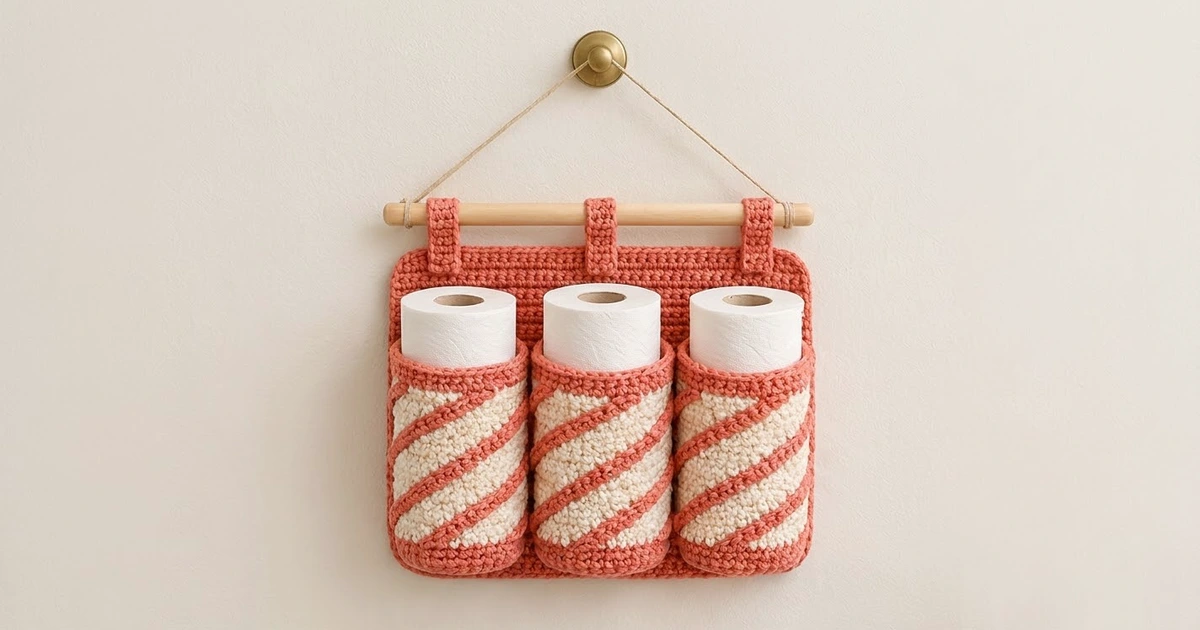
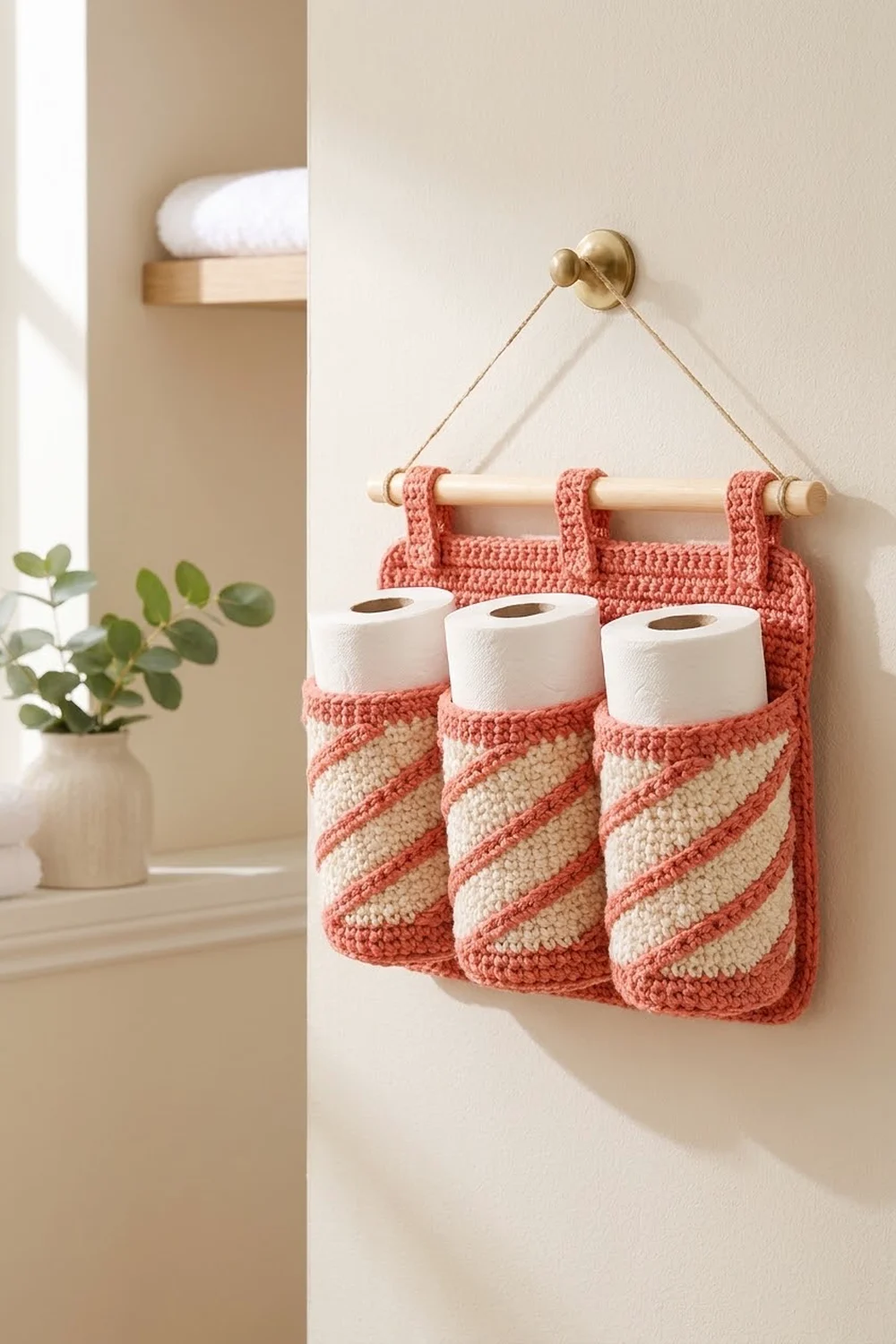
The Coral Twist holder keeps three spare rolls tidy and on display. Three cream cylinders with coral candy-cane stripes sit side by side on a solid coral back panel. The whole organizer hangs from a wooden dowel on three crocheted tabs.
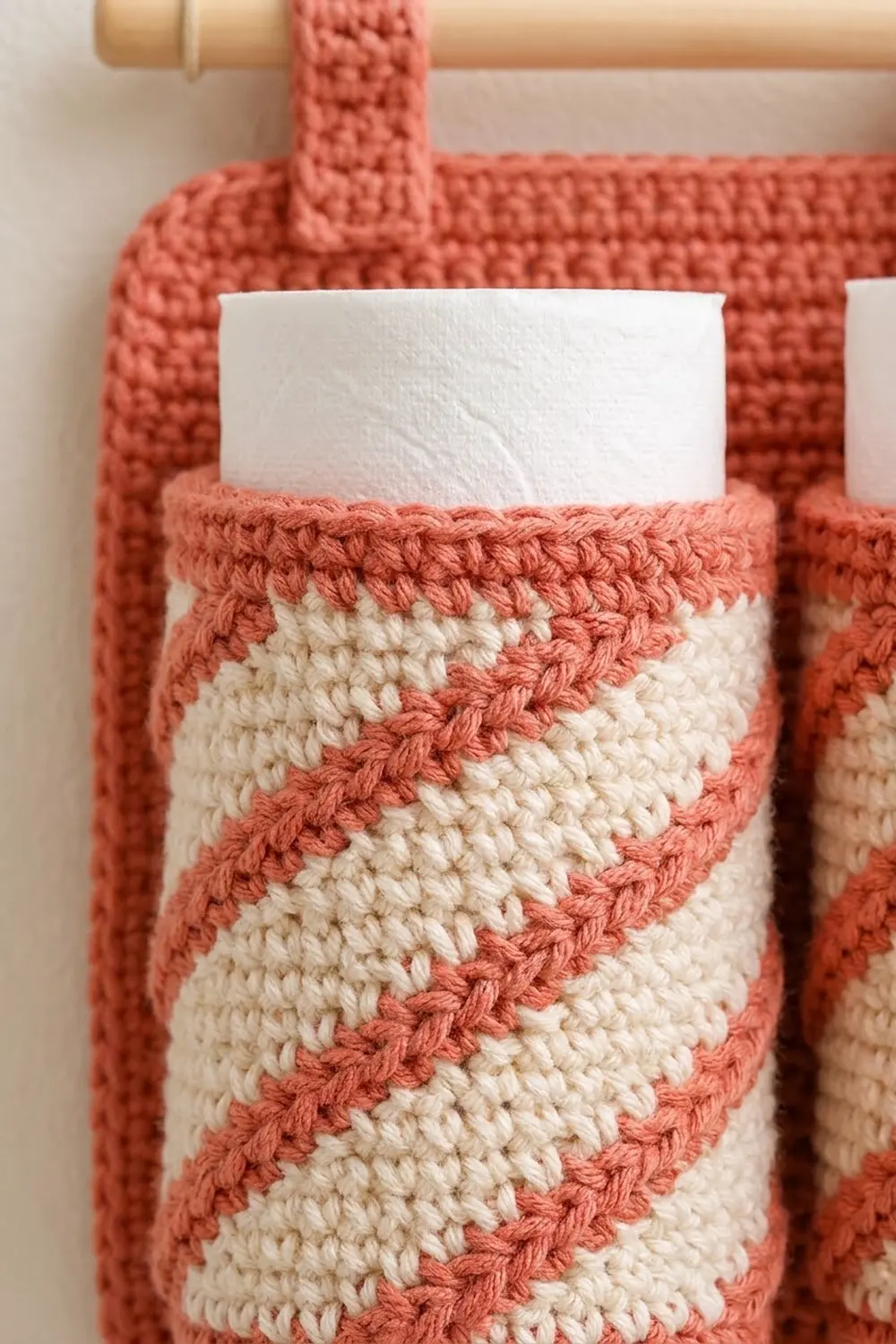
The palette is simple: warm coral and soft cream. Dense single crochet makes the fabric firm enough to hold its shape when loaded. The diagonal stripes come from tapestry crochet. Each round, the coral block moves one stitch over, so the stripes spiral up the holder.
This pattern uses US crochet terms. The back panel finishes at 16 × 9 in (40.6 × 22.9 cm). Each holder is about 4.75 in (12.1 cm) across and 4 in (10.2 cm) tall.
To build it, you crochet the panel in rows and add a two-round border. Each holder starts as a flat circle, and the wall is worked up from it in joined rounds. Then you make three tabs, sew everything together and hang it from the dowel.
Finished Size and Construction
- Finished panel size: 16 × 9 in (40.6 × 22.9 cm)
- Skill level: Intermediate (tapestry color changes)
- Terminology: US
- Yarn weight: Worsted (#4) cotton
- Hook: 4.0 mm (G-6)
- Number of pieces: 7 crocheted (1 panel, 3 holders, 3 tabs), plus a dowel
- Layout: 3 holders in one row across the panel, 3 tabs along the top
- Holder size: 4.75 in (12.1 cm) diameter × 4 in (10.2 cm) wall height
- Panel size before border: 15 × 8 in (38.1 × 20.3 cm)
- Border depth: 0.5 in (1.3 cm) on every side
Materials
Use a smooth, mercerized or plain worsted cotton of about 170 m per 100 g (85 m per 50 g). Cotton holds its shape and doesn’t stretch much when the holders are full. Avoid acrylic here, because it will sag under the weight of the rolls.
- Coral: 300 g, about 510 m
- Cream: 100 g, about 170 m
Both quantities include a margin of roughly 20% for swatching and tapestry carries.
Tools:
– 4.0 mm (G-6) crochet hook
– Tapestry needle
– 8 stitch markers
– Scissors and a tape measure
– Wooden dowel, 18 in (45.7 cm) long and 0.5 in (1.3 cm) thick
– Jute twine, 24 in (61.0 cm)
– Rust-proof pins and a blocking mat
Abbreviations (US Terms)
- ch – chain
- sc – single crochet
- inc – 2 sc in the same stitch
- sl st – slip stitch
- BLO – back loop only
- MR – magic ring
- st(s) – stitch(es)
Tapestry sc: Work sc with the active color while laying the other color along the tops of the stitches, so the sc encloses it. To change color, start the last sc of the old color, then yarn over with the new color and pull through both loops. Keep the carried strand relaxed.
Gauge and Checkpoints
Gauge: 16 sc and 16 rows = 4 in (10.2 cm) in sc worked firmly. That’s 4 stitches and 4 rows per inch.
Make one holder base (Rnds 1–10) as your test piece before anything else. It should lie flat and measure 4.75 in (12.1 cm) across.
Checkpoints:
– Base, after Rnd 10: 4.75 in (12.1 cm) diameter, 60 sts
– Holder wall, after Rnd 26: 4 in (10.2 cm) tall from the base edge
– Panel, after Row 1: 15 in (38.1 cm) wide
– Panel, after Row 32: 15 × 8 in (38.1 × 20.3 cm)
– Panel after border: 16 × 9 in (40.6 × 22.9 cm)
If your base is bigger than 4.75 in, go down to a 3.75 mm hook. If it is smaller than 4.5 in (11.4 cm), go up to a 4.5 mm hook. Recheck before going on, because every later measurement depends on this gauge.
Holder (Make 3)
Base
Use coral throughout the base.
- Rnd 1: 6 sc in MR, sl st to first sc. (6)
- Rnd 2: Ch 1, inc in each st around, sl st to first sc. (12)
- Rnd 3: Ch 1, sc 1, inc 6 times, join. (18)
- Rnd 4: Ch 1, sc 2, inc 6 times, join. (24)
- Rnd 5: Ch 1, sc 3, inc 6 times, join. (30)
- Rnd 6: Ch 1, sc 4, inc 6 times, join. (36)
- Rnd 7: Ch 1, sc 5, inc 6 times, join. (42)
- Rnd 8: Ch 1, sc 6, inc 6 times, join. (48)
- Rnd 9: Ch 1, sc 7, inc 6 times, join. (54)
- Rnd 10: Ch 1, sc 8, inc 6 times, join. (60)
Checkpoint: 60 sts and 4.75 in (12.1 cm) across, lying flat.
Wall
From here on, the ch 1 at the start of each round does not count as a stitch. Each round ends with a sl st to its first sc.
- Rnd 11: Ch 1, sc in BLO of each st around. (60) This turns the wall up and leaves a neat ridge at the base edge.
- Rnd 12: Ch 1, sc in each st around. (60) On the last sc, change to cream so you can start carrying both colors.
Stripe Rounds
Carry the unused color inside the stitches in every round. Each round is 60 sts. A repeat is 3 coral sts and 9 cream sts, which gives 5 stripes around. The coral block moves one stitch further along in each round, so the stripes lean.
- Rnd 13: 3 coral, 9 cream 5 times. (60)
- Rnds 14–21: Let S = round number minus 13 (so S = 1 on Rnd 14 and S = 8 on Rnd 21). Work S cream, 3 coral, 9 cream 4 times, 3 coral, then (9 − S) cream. (60)
- Rnd 22: 9 cream, 3 coral, 9 cream 4 times, 3 coral. (60)
- Rnd 23: 1 coral, 9 cream, 3 coral, 9 cream 4 times, 2 coral. (60)
- Rnd 24: 2 coral, 9 cream, 3 coral, 9 cream 4 times, 1 coral. (60) Cut cream.
Check Rnd 14: 1 + 48 + 3 + 8 = 60. Every stripe round adds up to 60 the same way.
Top Band and Rim
- Rnds 25–26: With coral, ch 1, sc in each st around. (60)
- Rnd 27: Sl st loosely in each st around. (60) Fasten off and weave in the ends.
Checkpoint: The wall is 4 in (10.2 cm) tall from Rnd 11 to Rnd 26 (16 rounds at 4 rounds per inch). The holder is about 4.25 in (10.8 cm) tall overall, including the base edge.
The joins line up at one spot, which makes a small jog in the stripes. That spot is the back of the holder, and it will be sewn against the panel.
Back Panel (Make 1)
Use coral throughout the panel.
- Foundation: Ch 61.
- Row 1: Sc in 2nd ch from hook and in each ch across. (60)
- Rows 2–32: Ch 1, turn, sc in each st across. (60)
Don’t fasten off.
Checkpoint: 15 × 8 in (38.1 × 20.3 cm). Number the rows 1–32 from the bottom. Number the stitches 1–60 from the left with the right side facing you.
Hanging Tab (Make 3)
- Foundation: With coral, ch 21.
- Row 1: Sc in 2nd ch from hook and in each ch across. (20)
- Rows 2–4: Ch 1, turn, sc in each st across. (20)
Fasten off and leave a 12 in (30.5 cm) tail for sewing. Each tab measures 5 × 1 in (12.7 × 2.5 cm).
Make All Pieces
- Coral only: 1 back panel and 3 tabs
- Coral and cream: 3 holders
Layout, viewed from the front:
      [Tab]          [Tab]          [Tab]
   ======== wooden dowel 18 in ========
 +------------------------------------------+
 |              Back panel                  |
 |     16 x 9 in (40.6 x 22.9 cm)           |
 |  [Holder 1]   [Holder 2]   [Holder 3]    |
 +------------------------------------------+
Border (Back Panel)
Add the border before joining so that the edge is finished all the way around. The border is worked in sc at the same gauge as the panel. Each round adds about 0.25 in (0.6 cm) to every side.
Rnd 1 (trim round): Ch 1. Along the top, work 3 sc in the first st, sc in the next 58 sts, then 3 sc in the last st. Down the left side, sc once in the end of each of rows 31–2 (30 sts). Along the bottom, work 3 sc in the first foundation ch, sc in the next 58 ch, then 3 sc in the last ch. Up the right side, sc once in the end of each of rows 2–31 (30 sts). Sl st to the first sc. Place a marker in the center sc of each 3-sc corner.
That is 180 sts worked one into each existing stitch or row end (60 + 60 + 30 + 30), plus 8 extra stitches (2 per corner), for 188 total. Counted from corner center to corner center, the top and bottom each have 62 sts and each side has 34 sts. Check: 2 × 62 + 2 × 34 − 4 shared corners = 188.
Rnd 2: Ch 1. Sc in each st, and work 3 sc in each marked corner st. Join.
That is 188 sts worked one into each stitch, plus 8 extra stitches, for 196 total. The top and bottom have 64 sts each and the sides have 36 sts each. Check: 2 × 64 + 2 × 36 − 4 = 196.
Why the math works: 64 sts ÷ 4 sts per inch = 16 in (40.6 cm). The side has 36 sts, which matches 32 rows plus 2 border rounds above and 2 below at 4 per inch, so 36 ÷ 4 = 9 in (22.9 cm). Fasten off and weave in the ends.
Joining
Holders to Panel
Each holder is sewn along a back zone 8 sts wide: the last 4 sts and the first 4 sts of its rounds, centered on the join jog. That zone is about 2 in (5.1 cm) wide. The holders are centered on panel stitches 11–12, 30–31 and 49–50, which spaces them 19 sts (4.75 in) apart, so their sides just touch.
| Holder | Panel stitch columns | Panel rows |
|---|---|---|
| 1 | 8–15 | 3–18 |
| 2 | 27–34 | 3–18 |
| 3 | 46–53 | 3–18 |
Stitch-to-stitch logic: Each holder has 16 wall rounds (Rnds 11–26), and panel rows 3–18 are also 16 rows. Because the gauge is square, every holder round lines up with one panel row.
- Pin Holder 1 so that Rnd 11 sits on panel row 3 and Rnd 26 sits on row 18.
- With coral yarn, whipstitch the left edge of the 8-st zone to column 8. Work one stitch per round, so that’s 16 whipstitches.
- Whipstitch the right edge of the zone to column 15 the same way.
- Tack the BLO ridge from Rnd 11 to panel row 3 between the two seams, using 8 stitches.
- Repeat for Holders 2 and 3.
Tension: Pull each whipstitch just snug. If you pull too hard, the panel puckers. If the stitches are too loose, the holders tip forward when they’re loaded.
Tabs
Center the tabs over panel stitch columns 10–13, 29–32 and 48–51. Fold each tab over the dowel. Overlap 1 in (2.5 cm) of one end on the front of the panel’s top border and 1 in (2.5 cm) of the other end on the back. Whipstitch both ends through all layers.
Checkpoint: The dowel sits about 1.25 in (3.2 cm) above the top edge of the panel. Tie the twine to both ends of the dowel.
Final Blocking
- Mist the panel lightly with water, or steam it from 1 in (2.5 cm) away without touching the yarn.
- Pin it out flat to 16 × 9 in (40.6 × 22.9 cm), keeping the corners square.
- Stuff each holder firmly with a towel or a spare roll so it sets as a round cylinder.
- Let everything dry completely, which usually takes 12–24 hours.
- Remove the pins and check that the stripes still lean evenly.
Final Quality-Control Checklist
- Panel measures 16 × 9 in (40.6 × 22.9 cm).
- Border Rnd 2 count is 196, with 3 sc at every corner.
- Each holder is 4.75 in (12.1 cm) across, with 60 sts in every wall round.
- Stripes advance one stitch per round with no skipped shifts.
- No cream shows through the coral bands.
- Join jogs face the panel.
- All seams cover panel rows 3–18.
- Tabs are evenly spaced and sewn through all layers.
- Ends are woven in on the wrong side.
Troubleshooting
Base ruffles or cups: Your tension is changing between rounds. Rework it at the gauge, or change hook size.
Stripes zigzag instead of slanting: You missed a shift on one of the rounds. Frog back to that round and recount the S value.
Cream shows through the coral: Keep the carried strand low and tighten the stitches slightly.
Holders lean forward: Add a third whipstitch line down the center of the back zone.
Panel is narrower than 15 in (38.1 cm): Your stitches are tight. Restart the panel with a hook one size larger.
Border corners curl: Work 3 sc in the corner center only, never in the stitches on either side of it.
Care
Hand wash in cool water, press out the water in a towel and dry flat over a stuffed form. Don’t tumble dry, because heat can distort the cylinders.
Final Notes
Everything rests on one gauge: 4 sts and 4 rows per inch. That gives a 60-stitch base 4.75 in (12.1 cm) across, and 16 wall rounds give a 4 in (10.2 cm) wall. The panel is 60 sts × 32 rows, or 15 × 8 in (38.1 × 20.3 cm). The two border rounds bring it to 64 × 36 sts, which is 16 × 9 in (40.6 × 22.9 cm). The 16 holder rounds sew to 16 panel rows one to one. Check each stage as you go and the pieces will fit together.
Happy crocheting!