
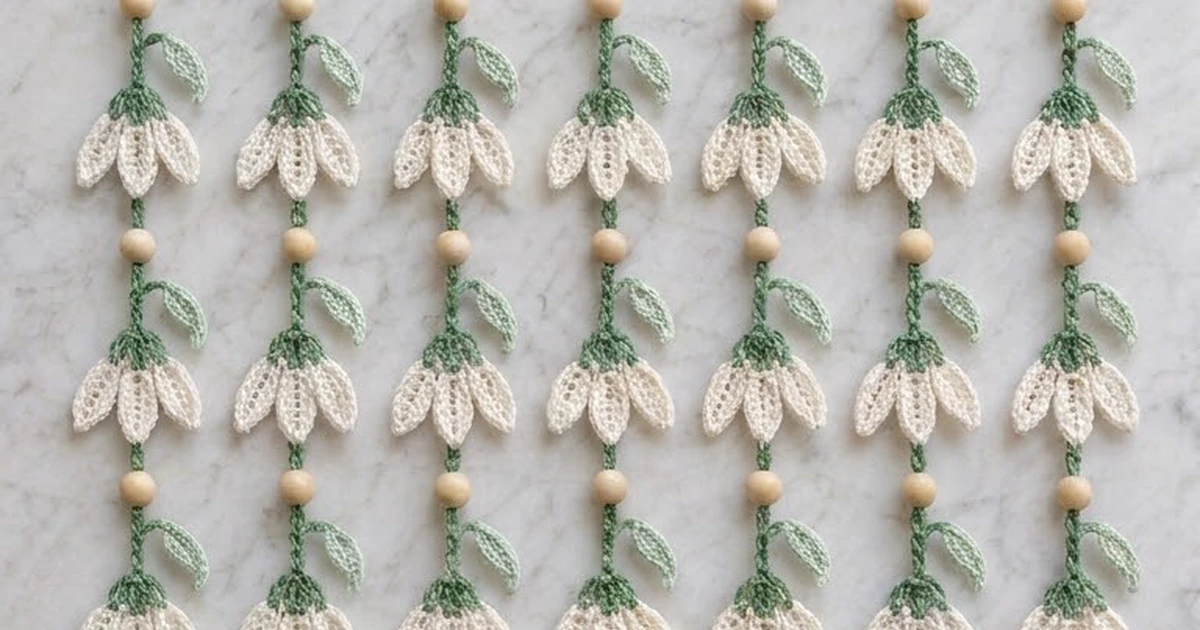
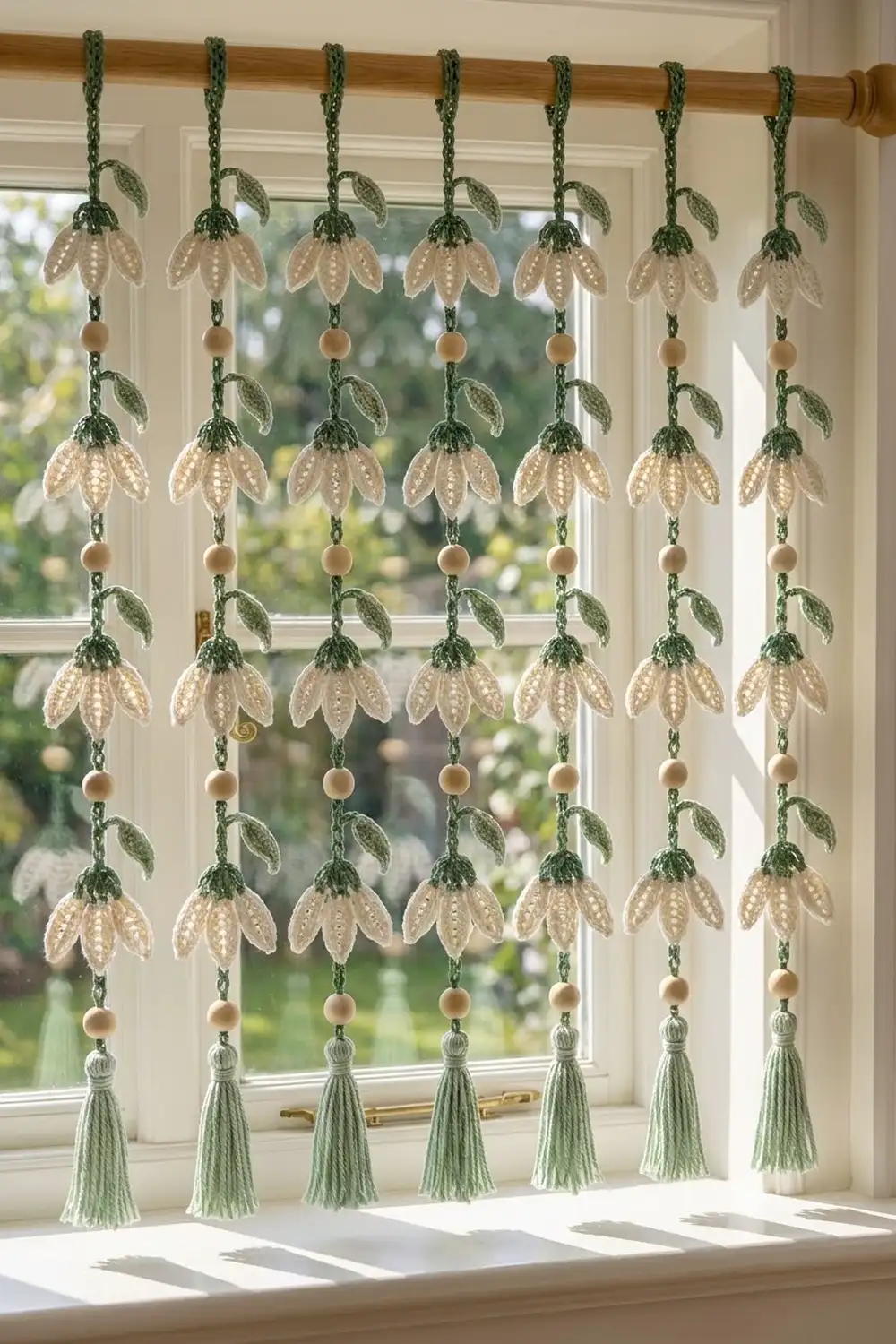
The Snowdrop Rain curtain is a row of seven slim hanging strands, each one a dark green chain stem with nodding snowdrops and small sage leaves along it. Natural wooden beads sit below every flower, and a soft sage tassel weights the bottom of each strand, so the curtain hangs straight and still moves in a breeze.
The palette is quiet and springlike: forest green for the stems and flower caps, white for the petals, light sage for the leaves and tassels, and the warm tone of raw wood. Each snowdrop has a green arched cap over three pointed white petals. Each petal has a line of small eyelets down its center.
This pattern uses US crochet terms. Each finished strand measures 42 in (106.7 cm) from the top of the rod to the tassel tip. With seven strands spaced 3.5 in (8.9 cm) apart, the curtain is about 23.25 in (59.1 cm) wide.
Construction is modular. You crochet small flower caps, petals, and leaves separately. Then you work each strand as one continuous chain cord with the beads pre-threaded, adding a short leaf spur as you go. Finally you sew the flowers and leaves onto the cords, tie on the tassels, and slide the hanging loops onto your rod.
Finished Size and Construction
- Finished size: 23.25 in (59.1 cm) wide x 42 in (106.7 cm) long
- Skill level: Easy to intermediate (small pieces, a lot of repetition)
- Terminology: US crochet terms
- Yarn weight: DK (#3) cotton
- Hooks: 3.5 mm (US E-4) for flowers and leaves; 4.5 mm (US 7) for cords
- Number of pieces: 7 strands, each built from 1 cord, 6 caps, 18 petals, 6 leaves, 6 beads, and 1 tassel
- Layout: 7 strands across x 6 flower units down
- Strand (piece) size: one flower unit is 6 in (15.2 cm) long; one assembled flower is 2.25 in (5.7 cm) wide x 2.5 in (6.4 cm) tall
- Size before border: 38.5 in (97.8 cm) per strand (hanging loop plus 6 units, before the tassel)
- Border depth: a 3.5 in (8.9 cm) tassel at the bottom of each strand
Materials
Use a smooth, mercerized or combed DK cotton. It gives crisp stitch definition, keeps the petal eyelets open, and doesn’t stretch much under the weight of the beads. The amounts below assume about 2.5 m per gram (125 m per 50 g).
- Dark green (stems, caps, spurs): 80 g / 200 m
- White (petals): 90 g / 225 m
- Light sage green (leaves, tassels): 40 g / 100 m
These quantities include a margin of about 25% for gauge differences and sewing tails.
Tools and notions:
- 3.5 mm (US E-4) and 4.5 mm (US 7) crochet hooks
- 42 natural wooden beads, 16 mm, with a hole of at least 4 mm
- Big-eye beading needle or dental floss threader (for threading beads)
- Tapestry needle
- Piece of cardboard, 3.5 in (8.9 cm) tall, for tassels
- Scissors, stitch markers, tape measure
- Curtain rod up to 1.5 in (3.8 cm) in diameter
Abbreviations (US Terms)
- ch – chain
- sl st – slip stitch
- sc – single crochet
- hdc – half double crochet
- dc – double crochet
- sk – skip
- sp – space
- st(s) – stitch(es)
- RS / WS – right side / wrong side
Special technique – bead chain: Slide one pre-threaded bead up against the hook, then yarn over and pull through so the chain closes snugly below the bead. The bead plus this chain counts as 1 ch and measures 0.75 in (1.9 cm).
Special technique – leaf spur: Ch 6, sl st in 2nd ch from hook and in each of next 4 ch (5 sl st). You end back at the main cord. The spur doesn’t count toward the cord length.
Gauge and Checkpoints
Make one complete flower and one 6 in (15.2 cm) cord unit before starting the full set. They show whether your tension is right for both hooks.
- Cord gauge (4.5 mm hook, dark green held double): 4 ch = 1 in (2.5 cm)
- Cap checkpoint: 1.5 in (3.8 cm) wide x 0.75 in (1.9 cm) tall
- Petal checkpoint: 1.75 in (4.4 cm) long x 0.75 in (1.9 cm) wide
- Leaf checkpoint: 1.5 in (3.8 cm) long x 0.6 in (1.5 cm) wide
- Assembled flower: 2.25 in (5.7 cm) wide x 2.5 in (6.4 cm) tall
- One cord unit (22 ch): 6 in (15.2 cm)
If your cord unit is longer than 6 in (15.2 cm), go down to a 4 mm hook. If it’s shorter, go up to a 5 mm hook. If petals come out longer than 1.75 in (4.4 cm), go down a half size. If they’re shorter, go up a half size. A small difference won’t matter for a single flower, but over 6 units it adds up, and strands of different lengths look uneven at the tassel line.
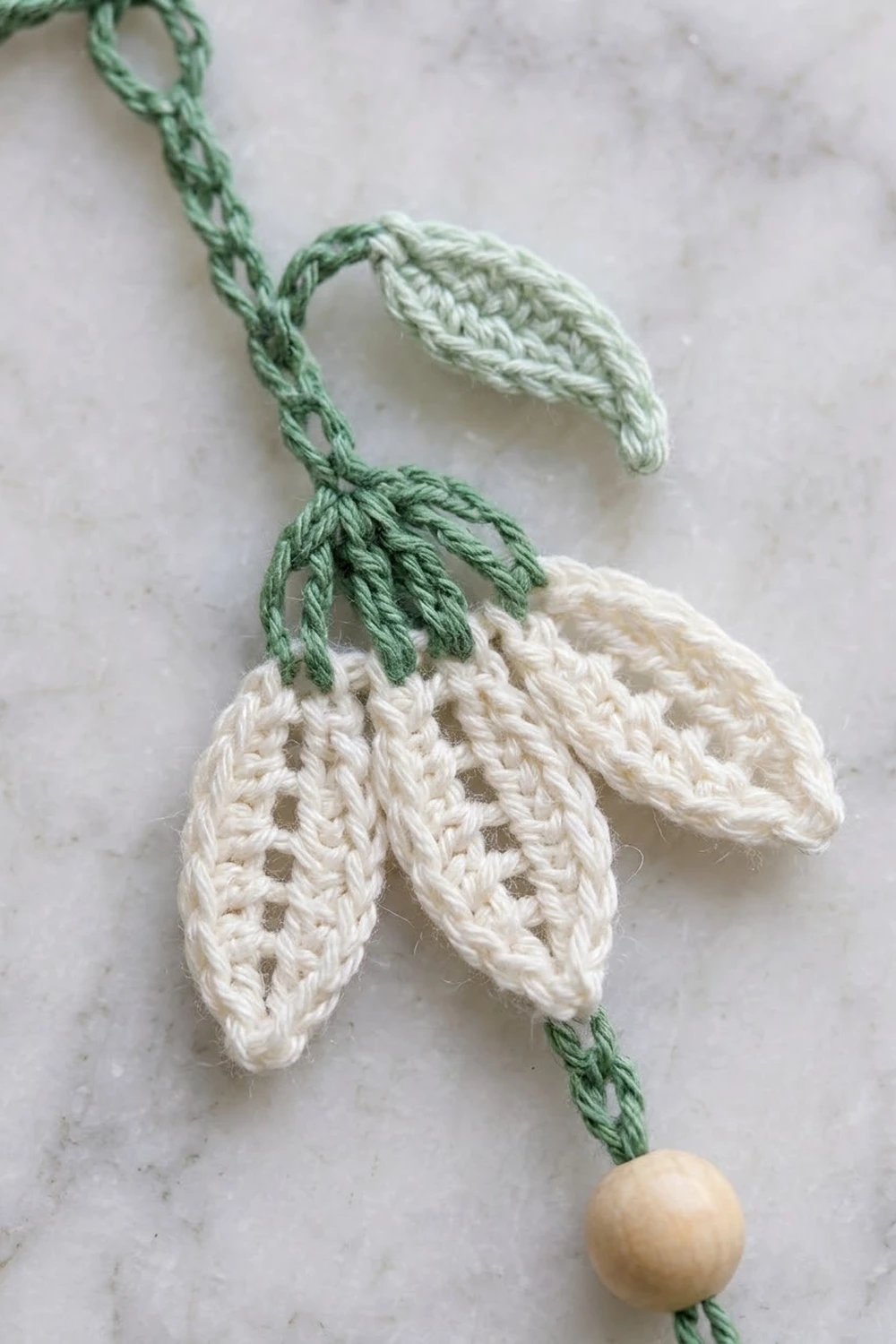
Flower Cap (make 42)
With dark green and 3.5 mm hook, ch 4, sl st in first ch to form a ring.
Row 1: Ch 3 (counts as dc), 6 dc in ring. Turn. (7 dc)
The dc fan opens downward, and the ring sits at the top.
Row 2: Ch 1, sc in first dc, (ch 3, sc in next dc) 6 times. (7 sc, 6 ch-3 arches)
Fasten off and leave a 10 in (25.4 cm) tail for sewing the flower to the cord. These six arches form the green loops that drape over the tops of the petals.
Snowdrop Petal (make 126)
With white and 3.5 mm hook, leave an 8 in (20.3 cm) starting tail. Ch 10. The slip-knot end is the petal base.
Round 1, side 1 (tip to base): Sc in 2nd ch from hook, hdc in next ch, dc in next ch, ch 1, sk next ch, dc in next ch, ch 1, sk next ch, dc in next ch, hdc in next ch, 3 sc in last ch.
Round 1, side 2 (base to tip, along the free loops): Hdc in next ch, dc in next ch, ch 1, sk next ch, dc in next ch, ch 1, sk next ch, dc in next ch, hdc in next ch, sc in next ch.
Tip: Ch 2, sl st in first sc. (15 sts: 6 per side plus 3 at the base, with 4 ch-1 sps and 1 ch-2 tip)
Fasten off at the tip and weave in that end. Keep the 8 in (20.3 cm) starting tail at the base. The skipped chains sit opposite each other on both sides, so they form a short line of eyelets down the center of the petal.
Leaf (make 42)
With light sage and 3.5 mm hook, leave an 8 in (20.3 cm) starting tail. Ch 8.
Round 1: Sc in 2nd ch from hook, hdc in next ch, dc in next 2 ch, hdc in next ch, sc in next ch, 3 sc in last ch. Working along the free loops: sc in next ch, hdc in next ch, dc in next 2 ch, hdc in next ch, sc in next ch. Ch 2, sl st in first sc. (15 sts: 6 per side plus 3 at the base)
Fasten off at the tip. The foundation chain shows as a center vein.
Assemble the Flowers
- Lay a cap RS up with the ring at the top.
- On the WS, sew one petal base to sc 2, one to sc 4, and one to sc 6 of Row 2.
- Angle the outer petals slightly outward and let them overlap the center petal by about 0.25 in (0.6 cm).
- Check that the green arches lie over the RS of the petal tops.
- Tack each outer petal to the center petal with one hidden stitch, about 0.5 in (1.3 cm) below the cap.
Each flower should measure 2.25 in (5.7 cm) wide x 2.5 in (6.4 cm) tall.
Strand Cord (make 7)
Use the 4.5 mm hook with dark green held double. Thread 6 beads onto both strands together, then push them back along the yarn.
Hanging loop: Ch 20, sl st in first ch to form a ring. (20 ch, 5 in / 12.7 cm around)
Flower unit (work 6 times):
- Ch 4. (upper stem, 1 in / 2.5 cm)
- Work 1 leaf spur.
- Ch 4. (1 in / 2.5 cm)
- Ch 8. (flower zone, 2 in / 5.1 cm; place a marker in the first of these ch)
- Ch 3. (0.75 in / 1.9 cm)
- Work 1 bead chain. (0.75 in / 1.9 cm)
- Ch 2. (0.5 in / 1.3 cm)
Unit count: 4 + 4 + 8 + 3 + 1 + 2 = 22 ch on the main cord, plus 1 spur. That gives 1 + 1 + 2 + 0.75 + 0.75 + 0.5 = 6 in (15.2 cm).
Strand count: 20 ch loop + (6 x 22) = 152 main ch, plus 6 spurs and 6 beads. Fasten off and leave a 6 in (15.2 cm) tail for the tassel.
Lay the cord flat. Not counting the loop, it should measure 36 in (91.4 cm). With the loop folded flat at 2.5 in (6.4 cm), the length is 38.5 in (97.8 cm).
Make All Pieces
For the full curtain you need:
- Dark green: 42 caps, 7 cords
- White: 126 petals (18 per strand)
- Light sage: 42 leaves, 7 tassels
- Wood: 42 beads (6 per strand)
Layout grid (S = strand, F = flower unit):
      S1  S2  S3  S4  S5  S6  S7
F1    *   *   *   *   *   *   *
F2    *   *   *   *   *   *   *
F3    *   *   *   *   *   *   *
F4    *   *   *   *   *   *   *
F5    *   *   *   *   *   *   *
F6    *   *   *   *   *   *   *
      T   T   T   T   T   T   T
Each * is a leaf, a flower, and a bead. T is a tassel.
Joining
The strands aren’t joined to each other. Joining here means attaching the flowers and leaves to each cord, then hanging the strands.
Flowers to cord (stitch-to-stitch): Center the cap ring over the marked first ch of the flower zone. Using the 10 in (25.4 cm) cap tail, sew through the ring and around that ch 3 times. Then make 1 tacking stitch from the back of the center petal to the 5th ch of the zone. The flower covers the 8 ch zone, and its 2.5 in (6.4 cm) height reaches 0.5 in (1.3 cm) into the ch-3 below. That’s why the bead sits just under the petal tips.
Leaves to spurs: Sew the leaf base to the tip of its spur with the 8 in (20.3 cm) leaf tail, angling the leaf up and outward. Keep every leaf on the same side of the strand.
Tension: Sew snugly but don’t gather the cord. If the cord puckers, the flower zone shrinks and the strand comes out short.
Size checkpoint: Hang one finished strand. Without the tassel it should measure 38.5 in (97.8 cm) from the top of the loop.
Hanging: Slide the loops onto the rod. Space them 3.5 in (8.9 cm) apart, center to center. Six gaps x 3.5 in = 21 in (53.3 cm), and adding one flower width of 2.25 in (5.7 cm) gives 23.25 in (59.1 cm).
Border
A strand curtain has no crocheted border. The tassel row at the bottom does the job of a border: it defines the lower edge.
Border gauge: a 3.5 in (8.9 cm) card with 20 wraps makes one 3.5 in (8.9 cm) tassel.
Each tassel:
- With light sage, wrap 20 times around the card.
- Slide the cord’s 6 in (15.2 cm) dark green tail under the wraps at the top and tie it tightly.
- Cut the wraps at the bottom. (40 strands)
- Wrap a separate light sage length 6 times around the bundle, 0.5 in (1.3 cm) below the top, to form the head. Knot it and bury the ends inside.
- Trim to 3.5 in (8.9 cm).
Counts across the curtain: 7 tassels x 40 strands = 280 tassel strands.
Why the math works: Every strand has exactly 152 main chains at 4 ch = 1 in (2.5 cm). If gauge is consistent, all cords end at the same height, so trimming all tassels to the same 3.5 in (8.9 cm) gives a level bottom edge at 42 in (106.7 cm).
Final Blocking
- Lightly mist the flowers and leaves with water.
- Lay each strand flat on a towel.
- Shape the petals into points and open the eyelets with a fingertip.
- Curve the leaves slightly toward the stem.
- Comb the tassel strands straight with your fingers and steam them lightly.
- Let everything dry flat completely.
- Hang the strands and retrim any tassel that sits low.
Final Quality-Control Checklist
- 42 flowers, each with 3 petals sewn to sc 2, 4, and 6
- Every arch lies on the RS over the petal tops
- 6 beads per strand, one below each flower
- Every cord is 38.5 in (97.8 cm) before its tassel
- Every tassel is 3.5 in (8.9 cm)
- Leaves all face the same direction
- All ends are woven in at the tips and inside the tassel heads
Troubleshooting
- Strands are different lengths: Recount the chains in each unit (22 per unit). Pull back and rework the long unit.
- Petals curl: Block them wet and pin the tips until dry.
- Eyelets close up: Make the ch-1 a little looser, or use a 3.75 mm hook for the petals.
- Beads slip: Pull the bead chain snug right after you slide the bead up.
- Flowers flip backward: Add the second tacking stitch from the center petal to the cord.
Care
Hand wash in cool water, press out the water in a towel, and dry flat. Re-comb and trim the tassels after washing.
Final Notes
The measurement chain is simple. Check that 4 ch = 1 in (2.5 cm), that each 22-ch unit is 6 in (15.2 cm), and that 6 units plus the loop make a 38.5 in (97.8 cm) cord. A 3.5 in (8.9 cm) tassel brings each strand to 42 in (106.7 cm), and seven strands spaced 3.5 in (8.9 cm) apart give a 23.25 in (59.1 cm) curtain. If the gauge piece matches, the rest of the curtain will too.
Happy crocheting!