

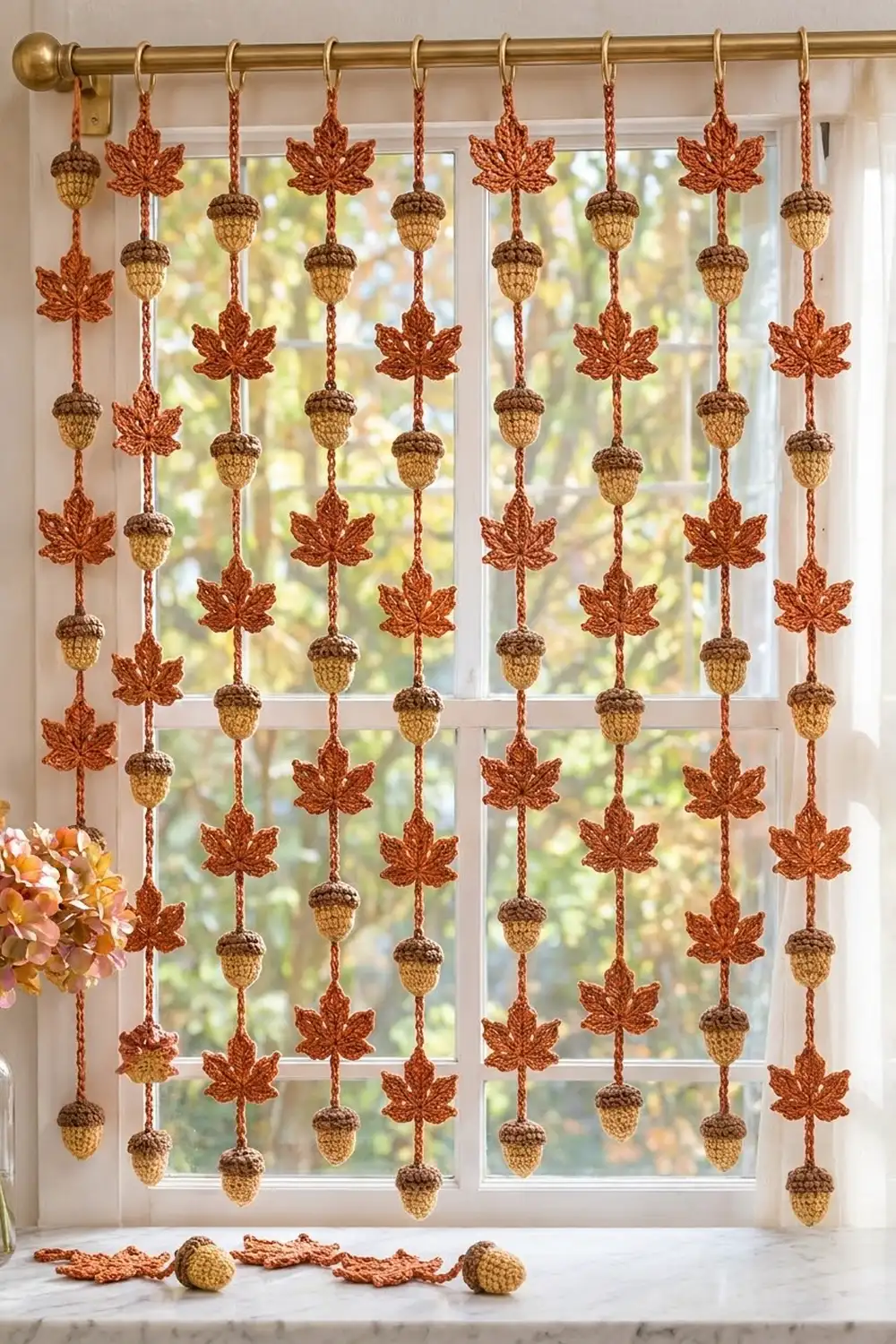
This strand curtain brings autumn to a window without blocking the light. Nine chain cords hang from a curtain rod. Each cord carries rust maple leaves and plump little acorns, alternating all the way down.
The colors are warm and simple: burnt rust for the leaves and cords, golden tan for the acorn nuts, and dark chocolate brown for the textured caps. The leaves are flat and lacy. The acorns are small, stuffed and three-dimensional, so the strands catch the light as they move.
The pattern uses US crochet terms. The finished curtain is about 35.5 in (90.2 cm) wide, with strands spaced 4 in (10.2 cm) apart. Each strand is 48 in (121.9 cm) long from the top of its hanging loop to the tail.
You make the leaves and acorns separately, crochet one firm cord per strand, then tack the motifs to the back of the cord at marked points. There are no seams between motifs and no large fabric to block, just simple pieces you repeat.
Finished Size and Construction
- Finished size: about 35.5 in (90.2 cm) wide x 48 in (121.9 cm) long
- Skill level: Intermediate (double treble, popcorns, small amigurumi)
- Terminology: US terms
- Yarn weight: worsted weight (#4) cotton
- Hooks: 4.0 mm (G-6) for leaves and cords; 3.5 mm (E-4) for acorns
- Number of pieces: 54 leaves, 54 acorns, 9 cords
- Layout: 9 strands, 6 leaves and 6 acorns per strand
- Piece size: leaf 3.5 in (8.9 cm) wide x 3.5 in (8.9 cm) tall, plus stem; acorn 1.5 in (3.8 cm) wide x 2 in (5.1 cm) tall
- Size before border: cord chain of 188 ch = 47 in (119.4 cm)
- Border depth: one slip-stitch return row along each cord, plus an 8-ch hanging loop about 1 in (2.5 cm) long
Materials
Choose a smooth worsted cotton of about 156 m per 100 g (171 yd per 3.5 oz). Cotton holds the pointed leaf tips and stretches very little on the cords.
- Rust: 300 g (about 468 m / 512 yd) for leaves and cords
- Golden tan: 110 g (about 172 m / 188 yd) for acorn nuts
- Dark brown: 180 g (about 281 m / 307 yd) for acorn caps
These amounts include about 15% extra for gauge swatches, tails and tacking.
Tools:
- 4.0 mm (G-6) and 3.5 mm (E-4) hooks
- About 60 g polyester fiberfill
- Tapestry needle
- Locking stitch markers (at least 12)
- 9 curtain rings or clip rings, and a curtain rod
- Measuring tape, scissors, pins, spray bottle
Abbreviations (US Terms)
- ch: chain
- sl st: slip stitch
- sc: single crochet
- hdc: half double crochet
- dc: double crochet
- tr: treble crochet
- dtr: double treble crochet (yo 3 times, insert hook, pull up a loop, [yo, pull through 2] 4 times)
- inc: 2 sc in the same stitch
- sc2tog: single crochet 2 together
- BLO: back loop only
- MR: magic ring
- sp: space
Special stitches:
- Popcorn (pc): Work 3 dc in the same stitch and take the hook out of the loop. Insert the hook from front to back into the top of the first dc, pick up the dropped loop and pull it through. Inserting from the front makes the popcorn pop toward the outside of the acorn.
- Picot: ch 3, sl st in the 3rd ch from the hook.
Gauge and Checkpoints
Make one leaf and one acorn first and measure them.
- Leaf (4.0 mm hook): Rnd 1 measures 1.25 in (3.2 cm) across. After Rnd 2: 2 in (5.1 cm). Finished leaf: 3.5 in (8.9 cm) wide x 3.5 in (8.9 cm) tall, not counting the stem.
- Acorn (3.5 mm hook): 5 sc and 5.5 rounds = 1 in (2.5 cm). After Rnd 8 the nut is about 1.4 in (3.6 cm) tall. Finished acorn: 1.5 in (3.8 cm) wide x 2 in (5.1 cm) tall.
- Cord (4.0 mm hook): 4 ch = 1 in (2.5 cm) after the slip-stitch return row.
If your leaf is larger than 3.5 in (8.9 cm), go down 0.5 mm in hook size. If it is smaller, go up 0.5 mm. If stuffing shows through the acorn, drop to a 3.25 mm hook. If your cord measures differently, keep the chain counts the same and change your hook instead, because every placement mark is based on 4 ch per inch.

Maple Leaf (make 54)
Use rust and the 4.0 mm hook. The leaf has five lobes: two small bottom lobes (A and E), two large side lobes (B and D) and a long top lobe (C).
Rnd 1: MR, ch 3 (counts as dc), 14 dc in ring, sl st to top of ch-3. Pull the ring closed. (15 dc)
Rnd 2: Ch 1, sc in same st, [ch 4, sk 2 sts, sc in next st] 4 times, ch 4, sk 2 sts, sl st to first sc. (5 sc, 5 ch-4 sps)
The first sc of this round sits at the bottom of the leaf, where the stem will go.
Rnd 3 (lobes): Sl st in first ch-4 sp.
- Lobe A (small): in this sp work (hdc, dc, tr, ch 2, tr, dc, hdc). Sl st in next sc.
- Lobe B (large): in next sp work (dc, 2 tr, ch 3, 2 tr, dc). Sl st in next sc.
- Lobe C (top): in next sp work (dc, tr, 2 dtr, ch 3, 2 dtr, tr, dc). Sl st in next sc.
- Lobe D (large): in next sp work (dc, 2 tr, ch 3, 2 tr, dc). Sl st in next sc.
- Lobe E (small): in next sp work (hdc, dc, tr, ch 2, tr, dc, hdc). Sl st in the first sc of Rnd 2.
Stitch count: 6 + 6 + 8 + 6 + 6 = 32 sts, 5 tip sps, 5 sl sts. The sl sts between lobes make the deep notches, and the ch-4 spaces leave small open holes around the center. Checkpoint: the leaf is about 3.25 in (8.3 cm) across.
Rnd 4 (edging): Ch 1.
- Lobe A: sc in each of next 3 sts, (sc, ch 2, sc) in ch-2 sp, sc in each of next 3 sts. Sl st in next sl st.
- Lobe B: sc in next 2 sts, picot, sc in next st, (sc, ch 3, sc) in ch-3 sp, sc in next st, picot, sc in next 2 sts. Sl st in next sl st.
- Lobe C: sc in next 2 sts, picot, sc in next 2 sts, (sc, ch 3, sc) in ch-3 sp, sc in next 2 sts, picot, sc in next 2 sts. Sl st in next sl st.
- Lobe D: work as Lobe B. Sl st in next sl st.
- Lobe E: work as Lobe A. Sl st in the bottom sl st.
Stitch count: 8 + 8 + 10 + 8 + 8 = 42 sc, 5 pointed tips, 6 picot side points, 5 sl sts.
Stem: Ch 7, sl st in 2nd ch from hook and in each of next 5 ch (6 sl sts), sl st in the bottom sl st. Fasten off, leaving an 8 in (20.3 cm) tail for tacking. The stem is about 1 in (2.5 cm) long.
Acorn (make 54)
Use the 3.5 mm hook and work in continuous spiral rounds. Mark the first stitch of each round.
Nut (golden tan):
- Rnd 1: MR, 4 sc in ring. (4)
- Rnd 2: [inc, sc] 2 times. (6)
- Rnd 3: [inc, sc] 3 times. (9)
- Rnd 4: [inc, sc in next 2] 3 times. (12)
- Rnd 5: [inc, sc in next 3] 3 times. (15)
- Rnd 6: [inc, sc in next 4] 3 times. (18)
- Rnd 7: [inc, sc in next 5] 3 times. (21)
- Rnd 8: Sc in each st around, changing to brown in the last st. (21)
Adding only 3 stitches per round gives the nut its rounded point.
Cap (dark brown):
- Rnd 9: Working in BLO, [inc, sc in next 6] 3 times. (24) The unworked front loops form a neat ridge where the cap meets the nut, and the increase makes the cap flare slightly wider than the nut.
- Rnd 10: [sc in next st, pc in next st] 12 times. (24: 12 sc, 12 pc)
- Rnd 11: [sc2tog, sc in next 2] 6 times. (18)
Stuff the nut firmly now, shaping the point with your fingers.
- Rnd 12: [sc2tog, sc in next st] 6 times. (12)
- Rnd 13: Sc2tog 6 times. (6) Add a last bit of stuffing.
Stem nub: Ch 4, sl st in 2nd ch from hook and in each of next 2 ch (3 sl sts), sl st in next st of Rnd 13. Fasten off with an 8 in (20.3 cm) tail. Weave the tail through the front loops of the 6 remaining sts, pull closed, and keep the tail for tacking.
Make All Pieces
- Rust: 54 leaves and 9 cords
- Golden tan + dark brown: 54 acorns
There are two strand types. Strand A starts with a leaf and Strand B starts with an acorn. Make 5 Strand A and 4 Strand B, then hang them alternately so the motifs are staggered across the window.
Strand:  1  2  3  4  5  6  7  8  9
Type:    A  B  A  B  A  B  A  B  A
Pos 1:   L  a  L  a  L  a  L  a  L
Pos 2:   a  L  a  L  a  L  a  L  a
Pos 3:   L  a  L  a  L  a  L  a  L
Pos 4:   a  L  a  L  a  L  a  L  a
...repeat to 12 positions (6 L + 6 a per strand)
L = leaf   a = acorn
Joining
Cord (make 9): With rust and the 4.0 mm hook, ch 8 and sl st in the first ch to form the hanging loop. Ch 188. Work the return row from the Border section before attaching any motifs.
Placement math: Each strand repeat is 30 ch = 7.5 in (19.1 cm): leaf 14 ch, gap 4 ch, acorn 8 ch, gap 4 ch. Count down from the base of the loop and mark these chains:
- Strand A: leaf tops at ch 8, 38, 68, 98, 128, 158; acorn tops at ch 26, 56, 86, 116, 146, 176.
- Strand B: acorn tops at ch 8, 38, 68, 98, 128, 158; leaf tops at ch 20, 50, 80, 110, 140, 170.
Check: the last motif on both strand types ends at ch 184, leaving a 4-ch tail of 1 in (2.5 cm). 8 + (6 x 30) = 188.
Attaching: Lay the cord flat and place the motifs face down on top of it. Tack each motif to the cord at two points on its back.
- Leaf: Use the stem tail to whipstitch the leaf’s Rnd 1 center and stem to the cord, so the stem lies along the cord. Then tack the back of the top lobe tip (the ch-3 sp of Lobe C) to its marked chain with 2 small stitches.
- Acorn: Tack the stem nub to its marked chain, then tack the nut at Rnd 2 to the chain 8 ch below.
Tension: Don’t pull the tacking stitches tight. The cord should stay straight, not puckered. Keep a ruler beside the strand as you work.
Size checkpoint: Each finished strand measures 48 in (121.9 cm) from the top of the loop to the tail, give or take 1 in (2.5 cm).
Border: Cord Finish and Hanging Loops
On this curtain, the border is the cord’s slip-stitch return row. It fixes the cord length so the acorns can’t stretch it.
Border gauge: 4 sl sts = 1 in (2.5 cm).
Return row: Turn after the 188 ch. Sl st in the back bump of the 2nd ch from the hook and in each ch back to the loop (187 sl sts). The skipped ch at the tail end is the 188th position. Sl st in the base of the loop, fasten off and weave in the ends.
Counts per section (Strand A): an 8-st top drop, then six repeats of 14 + 4 + 8 + 4 positions. Strand B has the same totals in the order 8 + 4 + 14 + 4.
Why the math works: 8 + 180 = 188 positions, and 188 / 4 = 47 in (119.4 cm). Add the 1 in (2.5 cm) hanging loop and the strand is 48 in (121.9 cm). The return row works 1 sl st into each ch with nothing added, so the length you marked is the length you hang.
Final Blocking
- Pin each leaf flat on a foam mat so it measures 3.5 in (8.9 cm) across.
- Pin each tip and picot out to a point.
- Mist until damp, not soaked.
- Let dry completely, about 6 hours.
- Hang each finished strand from a hook overnight so the cord settles.
- Don’t block the acorns. Just roll them gently between your palms to shape them.
Final Quality-Control Checklist
- 9 strands: 5 Strand A, 4 Strand B
- 6 leaves and 6 acorns on each strand
- Every leaf: 42 sc, 5 tips, 6 picots, stem attached
- Every acorn: 24 sts at the widest round, firmly stuffed, top closed
- Cords: 188 ch plus the 8-ch loop, return row complete
- Each strand 48 in (121.9 cm) long
- All ends woven in, no stuffing showing
Troubleshooting
- Leaf tips curl: Rnd 4 is too tight. Go up a hook size for Rnd 4 only.
- Leaf cups: The Rnd 3 stitches are too tall for your tension. Replace the dtr with tr.
- Popcorns sink in: Insert the hook from the front when closing each popcorn.
- Acorn looks lumpy: Stuff in small pieces, and add stuffing before Rnd 12.
- Strands twist: Steam the cord lightly and hang it with a small weight overnight.
- Strands are different lengths: Recount the chains. Every cord must have exactly 188 ch.
Care
Hand wash in cool water with mild soap, press out the water in a towel, and dry flat. Re-pin the leaf tips if they soften.
Final Notes
Every measurement here builds on the one before. A 3.5 in (8.9 cm) leaf and a 2 in (5.1 cm) acorn fit a 30-ch repeat of 7.5 in (19.1 cm). Six repeats plus an 8-ch drop make a 188-ch cord of 47 in (119.4 cm), and the loop brings it to 48 in (121.9 cm). Nine strands at 4 in (10.2 cm) spacing fill a 35.5 in (90.2 cm) window. Check your first leaf, first acorn and first cord, and the rest will follow.
Happy crocheting!