
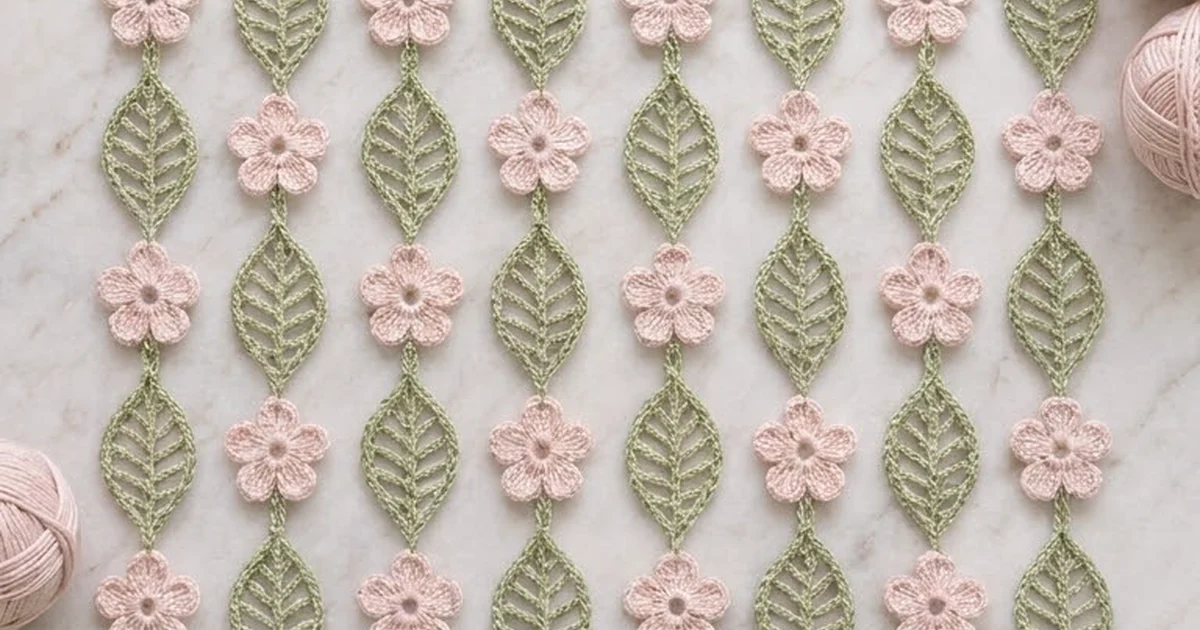
The Blossom Vine Curtain is a light, airy window hanging made from vertical strands of openwork leaves and small five-petal flowers. Each strand alternates sage green leaves with soft pink blossoms. The strands hang from a brass rod on rings, so daylight comes through every gap.
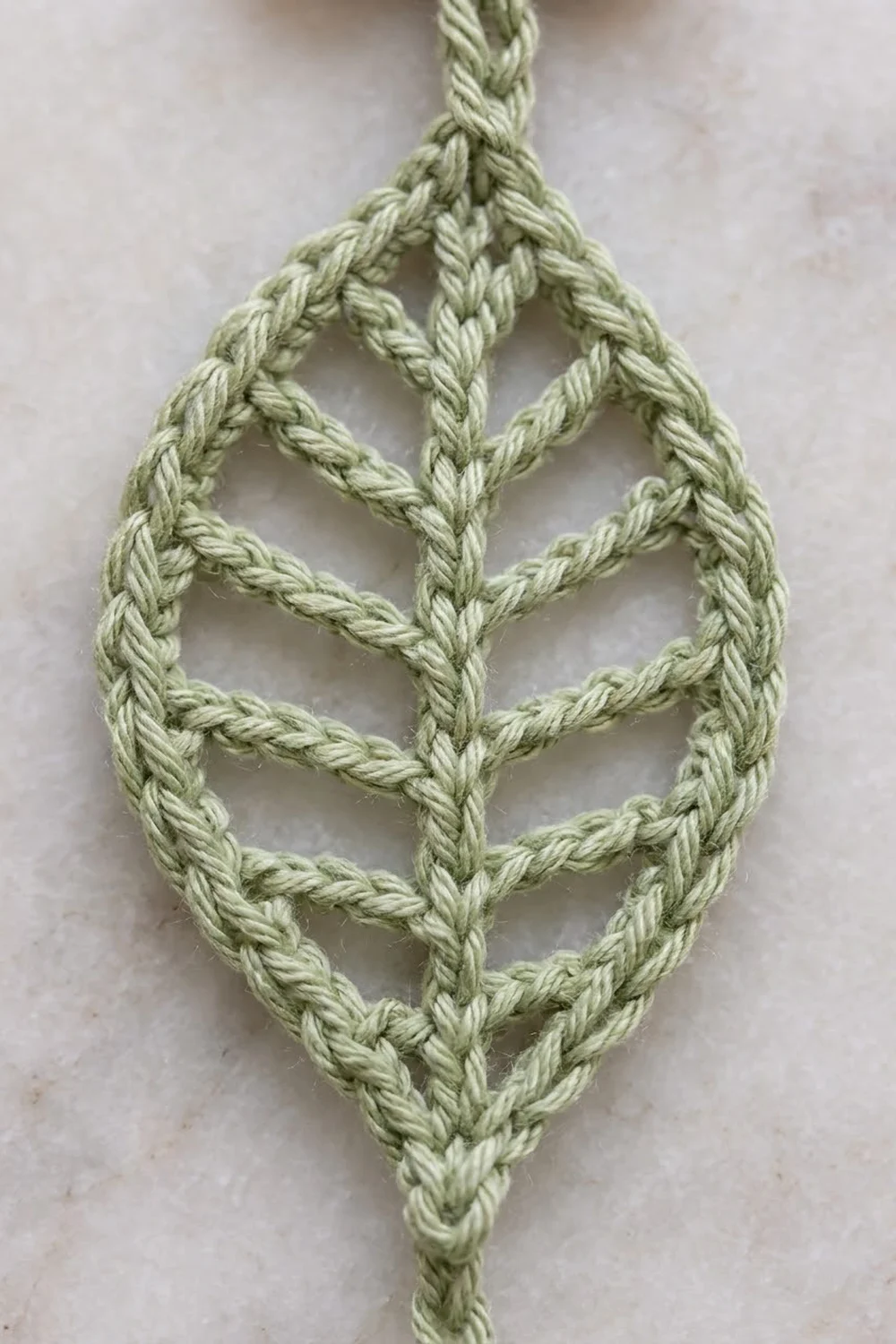
The leaves are lacy, with a central spine, six slanted veins on each side, and a firm outline that comes to a point at both ends. The flowers are solid and rounded, with a small open ring at the center. Together they give a calm cottage-garden look that suits a kitchen window, a doorway, or a reading nook.
This pattern uses US crochet terms. The finished curtain is 8 strands wide. With the strands spaced 4 in (10.2 cm) apart, it measures about 30.25 in (76.8 cm) across. Each strand is 43 in (109.2 cm) long, including its hanging loop.
The construction is simple and modular. You make every leaf and every flower as a separate motif and block them flat. Then you connect them top to bottom with short green chain links. A chain loop at the top of each strand slips onto a curtain ring.
Finished Size and Construction
- Finished curtain: about 30.25 in (76.8 cm) wide x 43 in (109.2 cm) long
- Skill level: Easy-intermediate
- Terminology: US crochet terms
- Yarn weight: DK / light (CYC 3) cotton
- Hook: 3.5 mm (US E-4)
- Number of pieces: 96 motifs (48 leaves, 48 flowers), 88 chain links, 8 hanging loops
- Layout: 8 strands x 12 motifs per strand, leaf and flower alternating
- Piece size: leaf 2.25 in (5.7 cm) wide x 4 in (10.2 cm) tall; flower 2 in (5.1 cm) across
- Strand length before top loops: 41.5 in (105.4 cm)
- Top edge (hanging loop) depth: 1.5 in (3.8 cm)
Materials
Choose a smooth DK cotton, either mercerized or soft-twist. Cotton holds the crisp leaf outline and the rounded petals much better than acrylic, and it stretches very little when the strands hang. The amounts below assume about 115 m per 50 g.
- Sage green (leaves, links, loops): 225 g, about 520 m
- Blush pink (flowers): 125 g, about 290 m
Tools:
- 3.5 mm (US E-4) crochet hook
- Tapestry needle
- Stitch markers
- Scissors
- Rustproof pins and a blocking mat
- Spray bottle
- Tape measure
- Curtain rod with 8 rings or clips
All quantities include a margin of about 15 percent for test motifs and weaving in ends.
Abbreviations (US Terms)
- ch – chain
- sl st – slip stitch
- sc – single crochet
- hdc – half double crochet
- dc – double crochet
- tr – treble crochet
- sp – space
- st(s) – stitch(es)
- sk – skip
Special stitch – Vein (V#): Ch (# + 1), then sl st in 2nd ch from hook and in each remaining ch back to the spine. For example, V5 is ch 6, then 5 sl st back down the chain. Each vein is a short, firm spike that sticks out from the spine until the outline round catches its tip.
Standing sl st: With a slip knot on the hook, insert the hook in the stated stitch, yarn over, and pull through both the stitch and the loop on the hook.
Gauge and Checkpoints
Gauge: 20 sc x 24 rows = 4 in (10.2 cm) with the 3.5 mm hook. Matching the motif sizes matters more than exact gauge, so make one test leaf and one test flower before starting the full set.
Checkpoints:
- Leaf Row 1 (spine): 18 sc = 3.6 in (9.1 cm)
- Finished leaf: 4 in (10.2 cm) tall x 2.25 in (5.7 cm) wide
- Flower Round 1: 1 in (2.5 cm) across
- Finished flower: 2 in (5.1 cm) across, from petal tip to the opposite gap
- Chain link: 0.5 in (1.3 cm) between motifs
If your leaf is more than 0.25 in (0.6 cm) too large, go down half a hook size. If it’s too small, go up half a size. Always change the hook, never the stitch counts, so every motif stays interchangeable.
Leaf (make 48)
Use sage green.
Row 1 (spine): Ch 19. Sc in 2nd ch from hook and in each ch across. (18 sc)
The end where you started is the tip, and the end where you finish is the stem. Next you work all the way around the spine: first along the free loops of the foundation chain, then along the sc tops.
Round 2 (veins): Don’t turn. Rotate the work so you can stitch into the free loops of the foundation chain, moving from stem to tip.
Side A: Sl st in next 2 loops, V3, sl st in next 3 loops, V5, sl st in next 3 loops, V5, sl st in next 3 loops, V5, sl st in next 3 loops, V4, sl st in next 3 loops, V2, sl st in last loop.
Tip: Ch 2.
Side B (along the sc tops, from tip to stem): Sl st in next 2 sts, V2, sl st in next 3 sts, V4, sl st in next 3 sts, V5, sl st in next 3 sts, V5, sl st in next 3 sts, V5, sl st in next 3 sts, V3, sl st in last st.
Stem: Ch 2, sl st in first sl st of the round.
Count: 18 sl st and 6 veins per side (12 veins total), plus a ch-2 sp at each end. Counting from the stem, the veins sit after spine stitches 2, 5, 8, 11, 14, and 17, so the two sides mirror each other.
Round 3 (outline): Sl st in stem ch-2 sp, ch 1, 3 sc in same sp.
Side A: Ch 3, sc in tip of V3, [ch 4, sc in tip of next vein] 5 times, ch 4, 3 sc in tip ch-2 sp.
Side B: [Ch 4, sc in tip of next vein] 6 times, ch 3, sl st in first sc.
Count: 18 sc (12 vein sc + two 3-sc points) and 54 ch (27 per side), for 72 sts total. Each time you sc into a vein tip, angle the vein up toward the stem. This makes the veins form a chevron that points to the tip.
Round 4 (outline trim): Ch 1. Sc in first sc, 3 sc in next sc (stem point), sc in next sc.
Along Side A: 2 sc in ch-3 sp, then [sc in vein sc, 3 sc in next ch-4 sp] 6 times.
At the tip: Sc in next sc, 3 sc in next sc (tip point), sc in next sc.
Along Side B: [3 sc in next ch-4 sp, sc in vein sc] 6 times, 2 sc in last ch-3 sp. Sl st in first sc. Fasten off.
Count: (18 sc worked 1-per-existing sc) + (4 extra sc at the two points) + (40 sc worked into the chain spaces: 12 spaces x 3 sc + 2 spaces x 2 sc) = 62 sc.
Place a marker in the center sc of the stem point as the top anchor. Place another in the center sc of the tip point as the bottom anchor.
Checkpoint: 4 in (10.2 cm) tall and 2.25 in (5.7 cm) wide at the widest vein.
Flower (make 48)
Use blush pink.
Ring: Ch 6, sl st in first ch to form a ring.
Round 1: Ch 1, 15 sc in ring, sl st in first sc. (15 sc)
Checkpoint: 1 in (2.5 cm) across, with an open center.
Round 2: Ch 1, [sc in next sc, ch 3, sk 2 sc] 5 times, sl st in first sc. (5 sc and 5 ch-3 sps)
Round 3 (petals): [(Sc, hdc, 2 dc, tr, 2 dc, hdc, sc) in next ch-3 sp, sl st in next sc] 5 times. The last sl st goes into the first sc of Round 2. Fasten off.
Count: 5 petals x 9 sts + 5 sl st = 50 sts.
Mark the tr at the tip of the first petal as the top anchor. The bottom anchor is the sl st between petals 3 and 4, directly opposite petal 1.
Checkpoint: 2 in (5.1 cm) from petal tip to the opposite gap.
Make All Pieces
- Sage green leaves: 48
- Blush pink flowers: 48
Weave in all motif ends now. Then spray block each motif flat (see Final Blocking) before joining, because blocked motifs are much easier to measure and line up.
Layout grid, top row first (L = leaf, F = flower):
Strand: 1  2  3  4  5  6  7  8
Row 1:  L  F  L  F  L  F  L  F
Row 2:  F  L  F  L  F  L  F  L
Row 3:  L  F  L  F  L  F  L  F
Row 4:  F  L  F  L  F  L  F  L
Row 5:  L  F  L  F  L  F  L  F
Row 6:  F  L  F  L  F  L  F  L
Row 7:  L  F  L  F  L  F  L  F
Row 8:  F  L  F  L  F  L  F  L
Row 9:  L  F  L  F  L  F  L  F
Row 10: F  L  F  L  F  L  F  L
Row 11: L  F  L  F  L  F  L  F
Row 12: F  L  F  L  F  L  F  L
Odd strands start with a leaf, and even strands start with a flower. Every strand holds 6 leaves and 6 flowers, so all strands come out the same length and the motifs form a checkerboard across the curtain.
Joining
Method: Join with separate sage green chain links, one for each gap between motifs.
To make each link, work a standing sl st in the bottom anchor of the upper motif. Ch 4, then sl st in the top anchor of the lower motif. Fasten off and weave both ends into the motifs.
Stitch-to-stitch logic: Each link joins exactly one anchor stitch to one anchor stitch. On a leaf, the anchors are the centers of the two points. On a flower, they are the petal tip and the gap opposite it. Because of this, the motifs hang straight with no twist.
Count: 12 motifs per strand need 11 links. The full curtain needs 8 x 11 = 88 links.
Tension: Keep the 4 chains snug and even. Loose links let the motifs swing and change the strand length, and very tight links pucker the anchor stitch. Check your first few links against a ruler.
Size checkpoint: Lay one finished strand flat. One repeat of leaf, link, flower, link measures 4 + 0.5 + 2 + 0.5 = 7 in (17.8 cm). Six repeats minus the final link give 41.5 in (105.4 cm). If a strand is off by more than 0.5 in (1.3 cm), check the link tension first.
Border: Top-Edge Hanging Loops
This curtain has no stitched border band. Its finished edge is a row of 8 hanging loops, one per strand. That means there are no side counts to balance and no stitches added between strands.
Border gauge: 1 ch is about 0.15 in (0.4 cm) in sage green DK cotton.
Hanging loop (one per strand): Work a standing sl st in the top anchor of the first motif. On a leaf, that’s the center sc of the stem point; on a flower, it’s the tr at the petal tip. Ch 20, then sl st in the same anchor st. Fasten off and weave in ends.
Count: 20 ch per loop x 8 loops = 160 ch total.
Why the math works: The 20 ch fold in half, so each side of the loop is 10 ch, about 1.5 in (3.8 cm) tall. That’s deep enough to slip over a standard curtain ring, and it adds the same length to every strand: 41.5 + 1.5 = 43 in (109.2 cm). Across the rod, 7 gaps of 4 in (10.2 cm) give 28 in (71.1 cm) from the first strand’s center to the last. Adding half a leaf width at each edge, 1.125 in (2.9 cm) per side, brings the total to 30.25 in (76.8 cm).
Final Blocking
- Make sure every motif was spray blocked flat before joining.
- Lay each finished strand flat on a towel or blocking mat.
- Mist lightly until damp, not soaking.
- Pin each leaf to 4 in (10.2 cm) by 2.25 in (5.7 cm), lining up both points with the center of the strand.
- Pin each flower into a 2 in (5.1 cm) circle and open up the center ring.
- Straighten each link so it runs in a clean line.
- Let everything dry completely. Then hang the strands on the rings and check that the bottom motifs sit level.
Final Quality-Control Checklist
- 48 leaves, each with 12 veins and 62 sc in Round 4
- 48 flowers, each with 5 even petals and an open center
- Odd strands start with a leaf; even strands start with a flower
- 11 links per strand, each ch 4, running anchor to anchor
- Every strand measures 41.5 in (105.4 cm) plus a 1.5 in (3.8 cm) loop
- No motif is twisted
- All ends are woven in securely
Troubleshooting
Veins stick straight out instead of slanting. Angle each vein toward the stem before you sc into its tip in Round 3, then pin that angle while blocking.
Leaf outline ruffles. Work 2 sc instead of 3 into the two longest ch-4 spaces on each side, or use a smaller hook for Round 4.
Leaf cups. Your Round 3 chains are too tight. Work them a little looser.
Petals curl. Block the flowers while damp and pin each petal tip.
Petals are uneven. Check that each petal sits in its own ch-3 sp and that you didn’t skip a sl st between petals.
Strands hang at different lengths. Re-check the link tension and remake any loose links.
Motifs twist. A link missed its anchor stitch. Unpick it and rejoin into the marked center stitch.
Care
Hand wash in cool water with mild soap, roll in a towel to remove the water, and dry flat. Re-block if the leaves lose their shape.

Final Notes
The measurements build on each other in a simple chain. An 18-sc spine of 3.6 in (9.1 cm) becomes a 4 in (10.2 cm) leaf, and a 1 in (2.5 cm) ring becomes a 2 in (5.1 cm) flower. Links of 0.5 in (1.3 cm) turn 12 motifs into a 41.5 in (105.4 cm) strand. A 1.5 in (3.8 cm) loop brings each strand to 43 in (109.2 cm), and 8 strands spaced 4 in (10.2 cm) apart fill a 30.25 in (76.8 cm) window.
Happy crocheting!