

The Apricot Tide curtain is a light, airy panel made of rippling lace strips. Each strip curves like a ribbon in water. Open chain arches fan out from clusters of treble stitches, and the clusters change sides every four rows, so the wave comes from the stitches themselves rather than from blocking.
There are two colors. Soft peach makes up the arches and the left-side fans. Terracotta fills the right-side fans, which gives every strip a darker wavy line. Hung at a sunny window, the open lace filters the light and still feels warm.
This pattern uses US crochet terms. The finished curtain measures 40.8 in × 74.2 in (103.6 cm × 188.5 cm) without the tabs. With the tab loops it hangs about 76.2 in (193.5 cm) from the rod.
You make eight identical wave strips and join each one to the previous strip as you go. Then you add a top band with eight tabs, a bottom band, and a narrow edging along both long sides.
Finished Size and Construction
- Finished size: 40.8 in × 74.2 in (103.6 cm × 188.5 cm), plus 2 in (5.1 cm) tab loops
- Skill level: Intermediate
- Terminology: US
- Yarn weight: DK (#3) cotton
- Hook: 4.0 mm (G-6)
- Number of pieces: 8 strips
- Layout: 8 strips side by side, 1 strip deep
- Strip size: 5 in × 72.6 in (12.7 cm × 184.4 cm)
- Size before border: 40 in × 72.6 in (101.6 cm × 184.4 cm)
- Border depth: 0.8 in (2.0 cm) at top and bottom, 0.4 in (1.0 cm) on each long side
Materials
Choose a smooth mercerized or combed cotton in DK weight. Cotton holds the arches open and resists stretching on a hanging piece. Avoid fuzzy yarns because they blur the lace.
- Peach (P): about 350 g / 805 m (880 yd)
- Terracotta (T): about 100 g / 230 m (252 yd)
Both quantities include a margin of about 15% for your gauge swatch and tension differences.
Tools:
– 4.0 mm (G-6) crochet hook
– Tapestry needle
– Stitch markers
– Tape measure
– Rust-proof pins and a blocking surface
– Spray bottle
Abbreviations (US Terms)
- ch – chain
- sl st – slip stitch
- sc – single crochet
- hdc – half double crochet
- dc – double crochet
- tr – treble crochet
- sk – skip
- sp – space
- st(s) – stitch(es)
- P / T – Peach / Terracotta
Special stitch – Fan: 5 tr worked into the same ch-sp. When a fan opens a row, ch 4 (counts as the first tr) and work 4 tr in the ch-sp.
Fan edge / plain edge: In every wave row, the fan sits at one edge (the fan edge) and a single sc anchors the other edge (the plain edge). From fan to plain edge the stitch heights step down (tr, dc, hdc, sc). That wedge shape is what bends the strip.
Gauge and Checkpoints
Gauge: 21 sc = 5 in (12.7 cm); 10 sc rows = 2 in (5.1 cm).
Wave gauge: One 8-row wave repeat = 4.5 in (11.4 cm) of strip length after blocking.
Make one test strip of Rows 1–17 (2 full repeats) before you commit to all eight strips.
- Checkpoint 1 (Row 1): The foundation measures 5 in (12.7 cm) across.
- Checkpoint 2 (Row 9): The strip has curved one way, then back again. Lay it flat. It should look like one S-curve.
- Checkpoint 3 (Row 17): Two repeats measure 9 in (22.9 cm) in length, pinned gently flat.
If your strip is too big, go down a hook size. If it is too small, go up one. If only the length is off, check your trebles: tight trebles shorten the wave and loose ones flatten it.
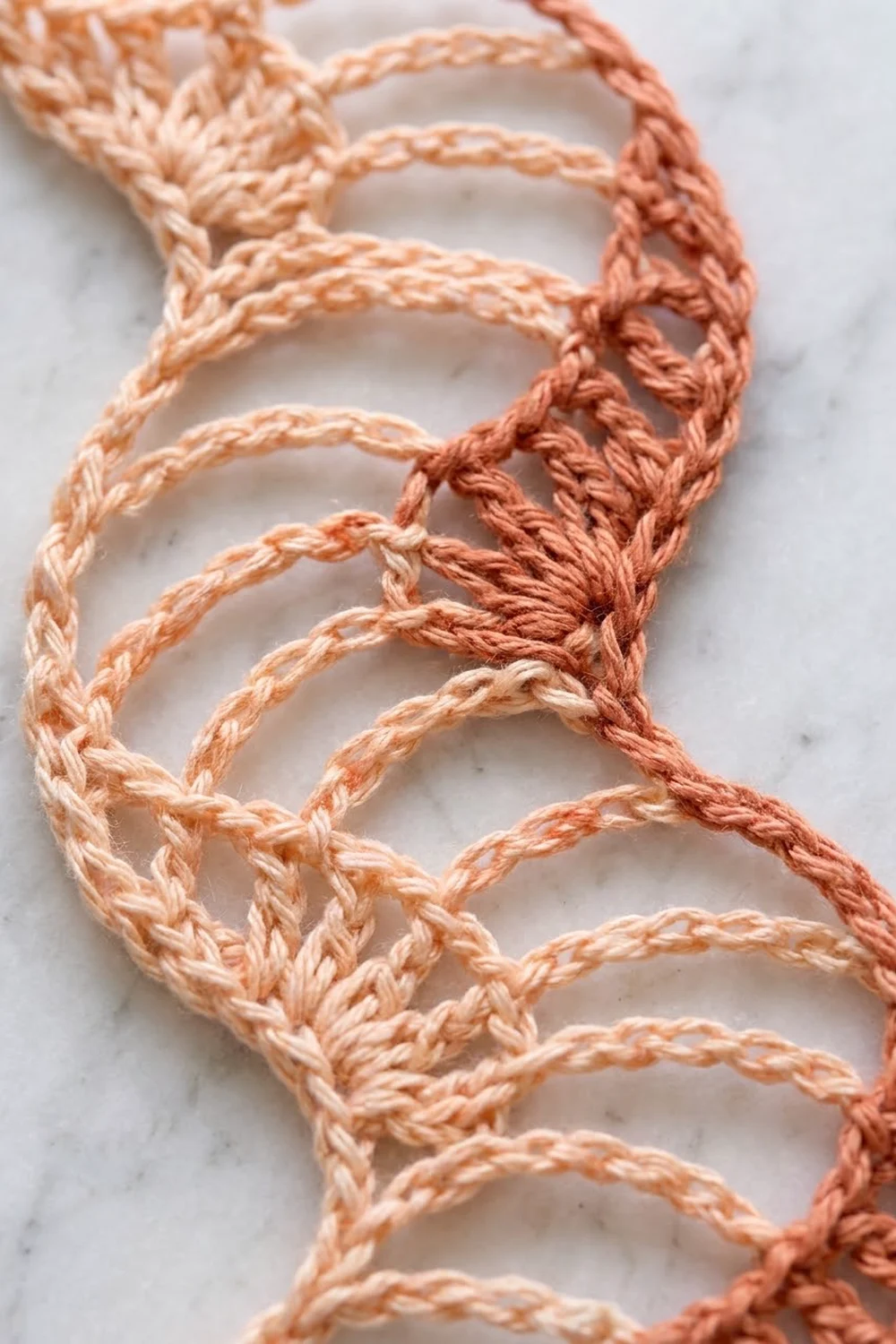
Wave Strip (make 8)
The strip is worked in rows across its width. Odd rows go right to left and end at the left edge. Even rows go left to right and end at the right edge.
Strip count after every wave row: 9 sts (1 edge sc, 1 sc, 1 hdc, 1 dc, 5-tr fan) and 4 ch-sps (one ch-2, three ch-3).
Foundation
With P, ch 22.
Row 1: Sc in 2nd ch from hook, ch 4, sk 4 ch, sc in next ch; rep from * 3 more times. Turn. (5 sc, 4 ch-4 sps = 21 sts across.)*
Wave Repeat (Rows 2–9)
Rows 2–5: fan on the right edge (terracotta fans)
Row 2 (plain→fan, left to right): With P, ch 1, sc in first sc, ch 2, sc in next sp, ch 3, hdc in next sp, ch 3, dc in next sp, ch 3. Drop P and pick up T (on the first repeat, join T here). Work a fan of 5 tr in the last sp. Turn. (9 sts, 4 ch-sps.)
Row 3 (fan→plain, right to left): With T, ch 4, 4 tr in first sp (fan made). Drop T and pick up P. Ch 3, dc in next sp, ch 3, hdc in next sp, ch 3, sc in next sp, ch 2, sc in last sc. Turn. (9 sts, 4 ch-sps.)
Row 4: Rep Row 2, using the T already waiting at the right edge for the fan.
Row 5: Rep Row 3.
After Row 5, the terracotta fans should lie stacked along the right edge, and the strip should curve so that the right edge is the outer curve.
Rows 6–9: fan on the left edge (peach fans)
Work these rows in P only. Leave T at the right edge. Each time you make a sc at the right edge, lay T along the top of the row and work that sc over it so the strand is carried up the edge.
Row 6 (fan→plain, left to right): Ch 4, 4 tr in first sp, ch 3, dc in next sp, ch 3, hdc in next sp, ch 3, sc in next sp, ch 2, sc in last st. Turn. (9 sts, 4 ch-sps.)
Row 7 (plain→fan, right to left): Ch 1, sc in first st, ch 2, sc in next sp, ch 3, hdc in next sp, ch 3, dc in next sp, ch 3, 5 tr in last sp. Turn. (9 sts, 4 ch-sps.)
Row 8: Rep Row 6.
Row 9: Rep Row 7.
Rows 10–129: Rep Rows 2–9 fifteen more times, for 16 wave repeats in total. (Each row still has 9 sts and 4 ch-sps.)
Closing Row
Row 130 (conversion row, left to right, P): Ch 1. Sc in each of the 5 tr, 3 sc in next ch-3 sp, sc in dc, 3 sc in next ch-3 sp, sc in hdc, 3 sc in next ch-3 sp, sc in sc, 3 sc in ch-2 sp, sc in last sc. Fasten off.
Count: 9 sc (1 per existing st) + 12 sc (worked into the ch-sps) = 21 sc.
Strip checkpoint: 16 repeats = 72 in (182.9 cm). Row 1 and Row 130 together add 0.6 in (1.5 cm), so the strip measures 72.6 in (184.4 cm).
Make All Pieces
- Strip 1: made on its own, as above.
- Strips 2–8: made with the join-as-you-go method below.
Each strip uses about 68 m of P and 24 m of T.
Layout (front view, top edge up):
| S1 | S2 | S3 | S4 | S5 | S6 | S7 | S8 |
Every strip faces the same way, with Row 1 at the top and terracotta fans on the right. This keeps all the waves in the same phase so they nest.
Joining
Method: Join as you go along the left edge of each new strip (B) to the right edge of the previous strip (A).
Stitch-to-stitch logic: Odd rows end at the left edge of Strip B. At the end of every odd row (Rows 1, 3, 5 … 129), sl st into the top of the first stitch or turning ch of the same row number on Strip A. Then turn and continue. Because the two strips share the same row numbers, every join lines up with its match.
That gives 65 joins per seam and 7 seams in total. The join sl st is not counted in the row count, so each strip keeps 9 sts per row.
Tension: Make each sl st snug but not tight. Pin the two strips flat first, so that one edge doesn’t pull up the other.
Size checkpoint: After all strips are joined, the panel measures 40 in × 72.6 in (101.6 cm × 184.4 cm).
Border
Border gauge: Same as the main gauge. 21 sc = 5 in (12.7 cm); 5 sc rows = 1 in (2.5 cm).
Top Band (P)
Row 1 (RS): Join P at the top right corner. Working into the bottom loops of the foundation ch, sc in each of the 21 chains of every strip. Don’t add stitches at the seams. (21 × 8 = 168 sc.)
Rows 2–4: Ch 1, sc in each sc across. Turn. (168 sc.)
Tabs: Each tab is 7 sts wide and the gaps between tabs are 16 sts. Count the 168 sc of Row 4 into 8 tabs of 7 sts and 7 gaps of 16 sts, starting and ending with a tab: 7 + 7 × (16 + 7) = 168.
For each tab, join P to the first of its 7 sts. Work Row 1: ch 1, sc in the same st and the next 6 sts (7 sc). Then work 19 more rows of 7 sc each, for 20 rows in total, which is 4 in (10.2 cm). Fasten off and leave a long tail. Fold the tab to the back and sew its last row to the back of Top Band Row 1. This makes a 2 in (5.1 cm) loop.
Each tab is about 1.7 in (4.3 cm) wide, with gaps of about 3.8 in (9.7 cm).
Bottom Band (P)
Row 1: Sc in each of the 21 sc of every strip’s Row 130. (168 sc.)
Rows 2–4: Ch 1, sc in each sc across. (168 sc.)
Side Edging (P)
Work this along the left side of Strip 1, then repeat it along the right side of Strip 8.
Row 1: Work, in order:
– 1 sc in each top band row end (4)
– 1 sc in the Row 1 end (1)
– per wave repeat: 3 sc in each fan row end (4 rows × 3 = 12) and 1 sc in each plain row end (4)
– 1 sc in the Row 130 end (1)
– 1 sc in each bottom band row end (4)
That is 4 + 1 + (16 × 16) + 1 + 4 = 266 sc.
Row 2: Ch 1, sc in each sc. (266 sc.)
These are straight rows, so no corner stitches are added. The 266 already includes both ends.
Why the math works: Each strip gives exactly 21 sts at top and bottom, so 8 strips give 168 sc = 40 in (101.6 cm) at 4.2 sc per inch. The side edging adds 0.4 in (1.0 cm) on each side, for a width of 40.8 in (103.6 cm). The bands add 0.8 in (2.0 cm) at each end, for a length of 72.6 + 1.6 = 74.2 in (188.5 cm).
Final Blocking
- Weave in all ends along the stitches of the same color.
- Lay the curtain flat on a large clean surface or on several blocking mats.
- Pin the top band straight to 40.8 in (103.6 cm).
- Pin the side edges to 74.2 in (188.5 cm), keeping the waves parallel.
- Open each chain arch with a fingertip so the fans spread evenly.
- Mist until damp, but not soaked.
- Let it dry completely, then unpin.
Final Quality-Control Checklist
- [ ] All 8 strips have 130 rows and 16 wave repeats
- [ ] Every terracotta fan is on the right edge of its strip
- [ ] There are 65 joins per seam, with no skipped rows
- [ ] The top and bottom bands each have 168 sc
- [ ] Each side edging has 266 sc
- [ ] There are 8 tabs, evenly spaced and sewn securely
- [ ] The curtain measures 40.8 in × 74.2 in (103.6 cm × 188.5 cm)
Troubleshooting
- The strip doesn’t curve: The trebles are too short. Wrap loosely, or work the fan as 5 dtr.
- The strip curls into a spiral: You’ve worked the fan on the same edge for too long. Recount: 4 rows on the right, then 4 on the left.
- The waves don’t nest: One strip was turned upside down or started on a different row. Check that Row 1 is at the top.
- The carried terracotta shows: Pull the carried strand flat before you work over it.
- The top band ripples: You’ve added stitches at the seams. There should be exactly 21 per strip.
Care
Hand wash cold or machine wash on a gentle cycle in a mesh bag. Reshape and dry flat, and don’t hang it to dry while wet, because the weight will stretch it.
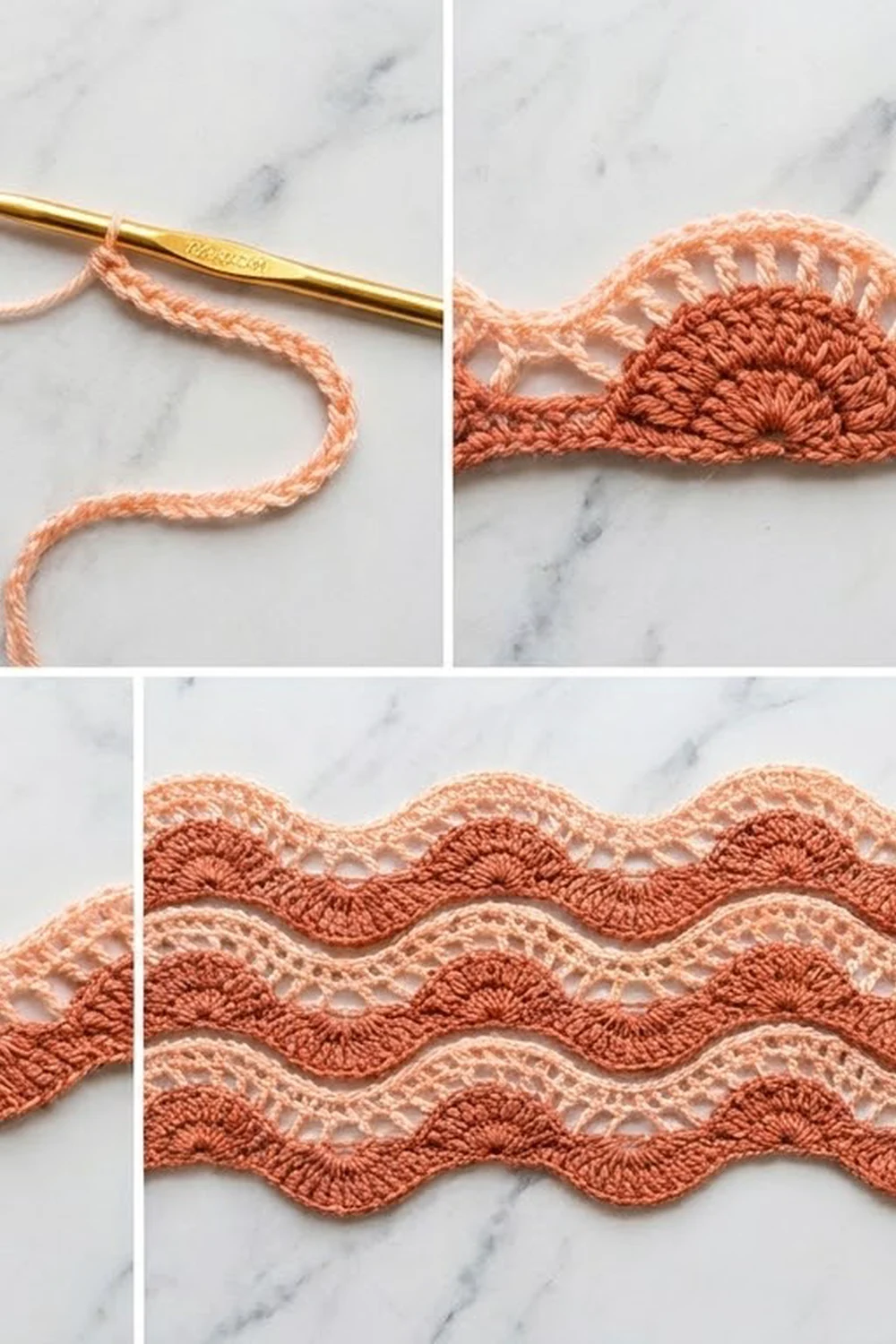
Final Notes
The measurement chain is simple:
– 21 sts = 5 in (12.7 cm) per strip
– 8 strips = 40 in (101.6 cm) across
– 16 repeats of 4.5 in (11.4 cm), plus 0.6 in (1.5 cm) for Row 1 and the closing row, = a 72.6 in (184.4 cm) strip
– the bands and edging bring the curtain to 40.8 in × 74.2 in (103.6 cm × 188.5 cm)
Check your test strip carefully and the rest will follow.
Happy crocheting!