
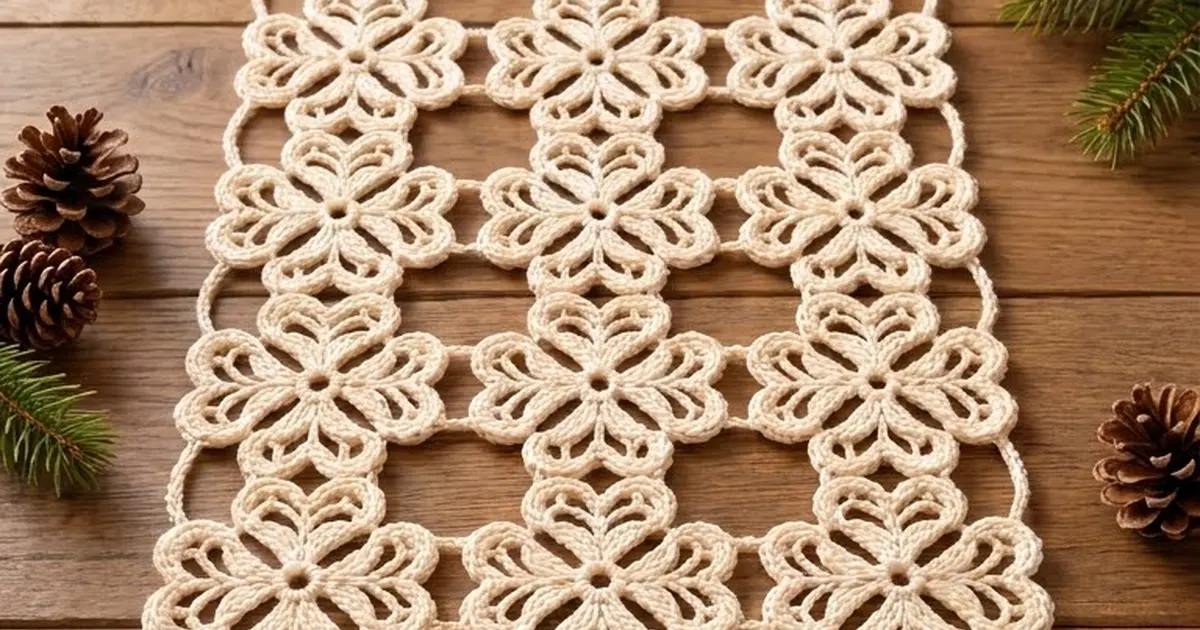
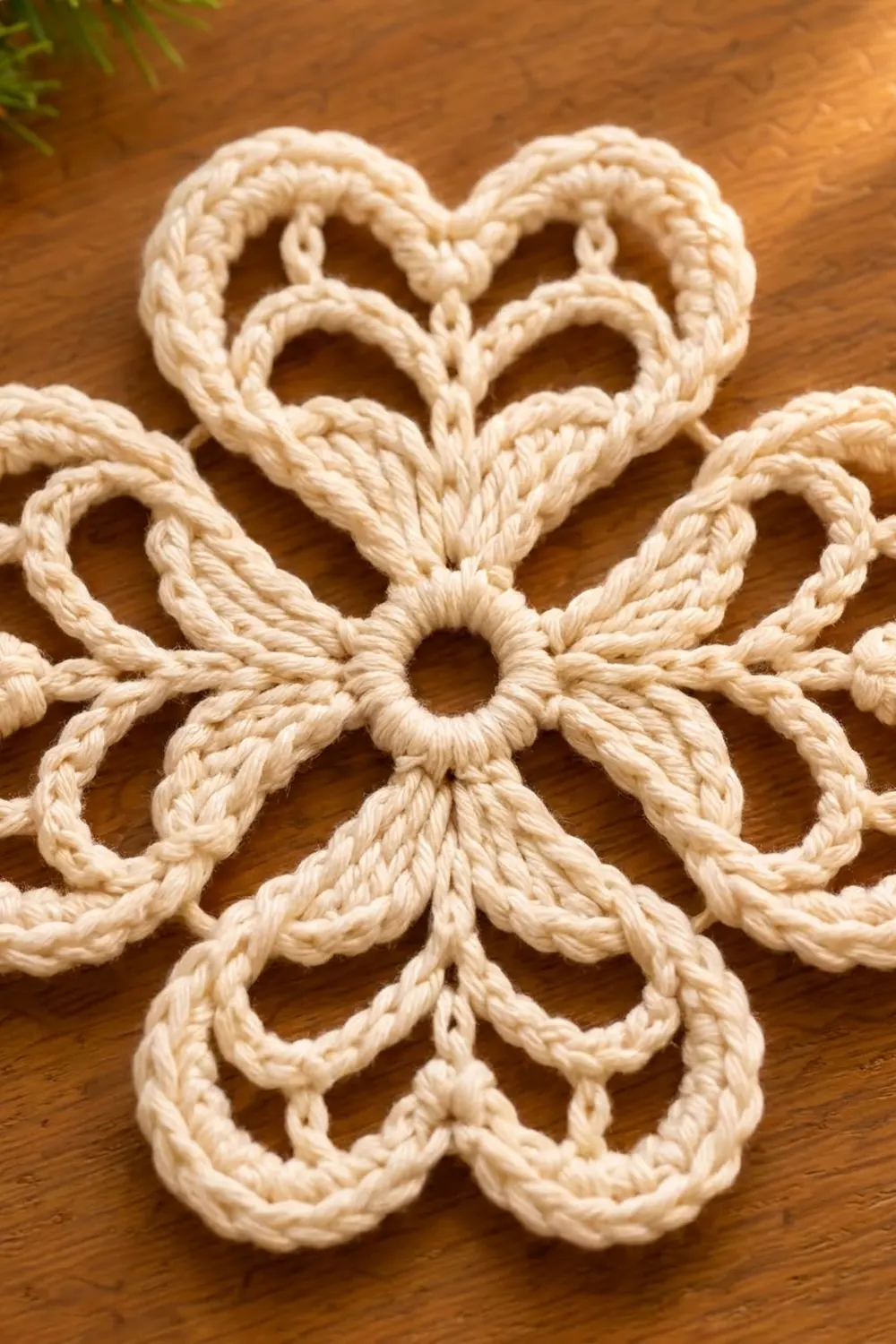
The Hearthside Clover Table Runner is made from lacy four-heart flower motifs. Each motif has a small open center ring and four big hearts pointing out. Each big heart frames a smaller inner heart, and slim leaf points sit between the hearts. Joined together, the motifs leave small open windows in between, so the wood or tablecloth underneath shows through.
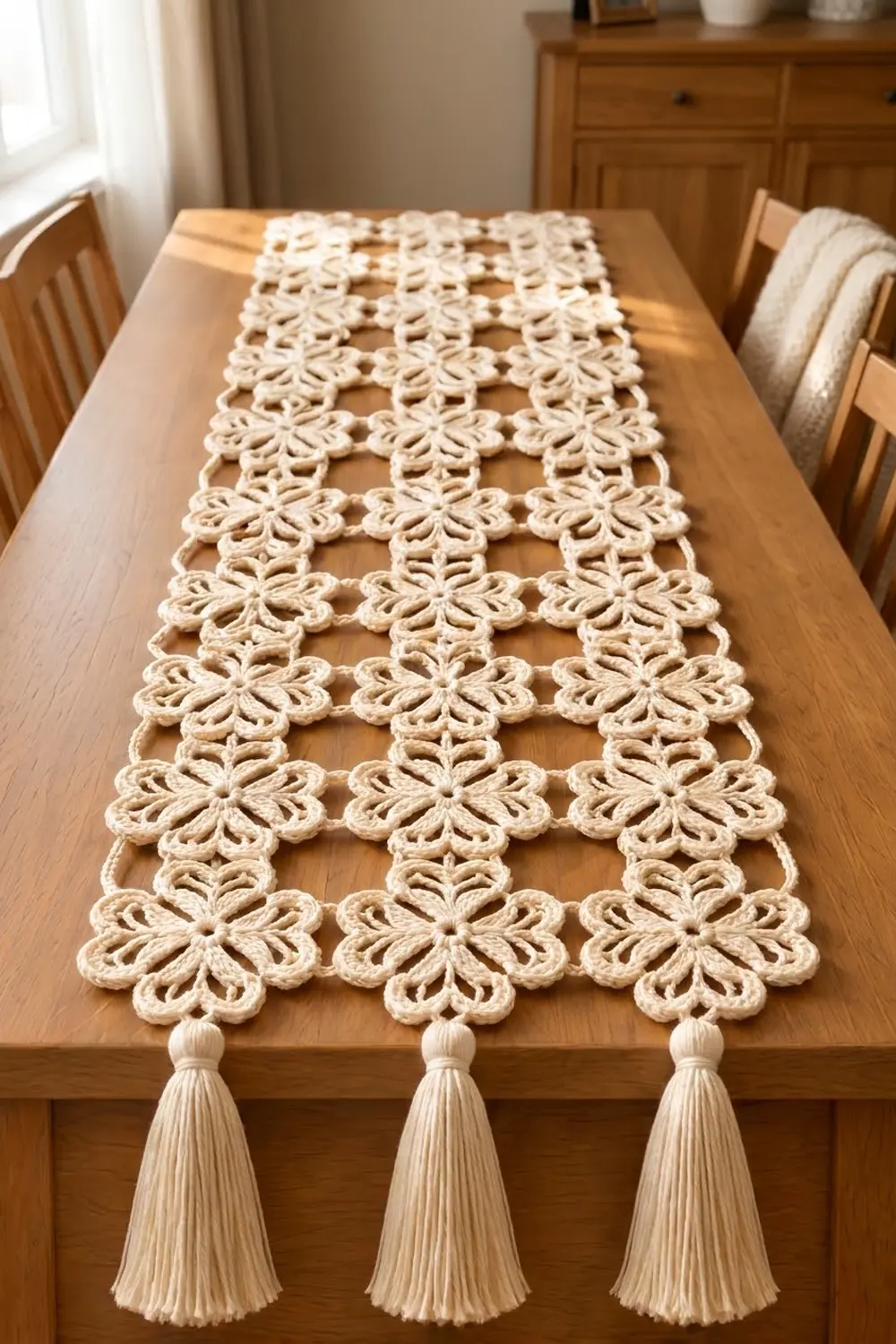
The runner is worked in a single cream or ivory cotton, so the texture of the stitches does the decorating. It suits a holiday table but is quiet enough to leave out all year. Three tassels finish each short end.
This pattern uses US crochet terms. The finished runner measures 15.25 in x 40.25 in (38.7 cm x 102.2 cm) including the border. The tassels add 5 in (12.7 cm) at each end.
Construction is straightforward. You crochet 24 motifs in the round. Starting with the second motif, you join each one to its neighbors during its last round, at the lobe tips. Then you work a two-round border around the whole panel and add six tassels.
Finished Size and Construction
- Finished size: 15.25 in x 40.25 in (38.7 cm x 102.2 cm), not counting the tassels
- Skill level: Intermediate
- Terminology: US crochet terms
- Yarn weight: DK / light (#3) cotton or cotton blend
- Hook: 3.5 mm (E-4)
- Number of pieces: 24 identical motifs
- Layout: 3 motifs wide x 8 motifs long
- Motif size: 4.5 in (11.4 cm) across, heart tip to heart tip
- Gap between motifs: 0.5 in (1.3 cm), bridged by chain bars
- Size before border: 14.5 in x 39.5 in (36.8 cm x 100.3 cm)
- Border depth: 0.375 in (1.0 cm) on each side
- Tassels: 6 in total, each 5 in (12.7 cm) long
Materials
Yarn: Choose a smooth, mercerized or combed DK cotton with good stitch definition. A tightly plied yarn gives the rope-like heart outlines you see in the photo. Fuzzy or loosely spun yarn will blur the lace.
- Cream / Ivory: 300 g, about 690 m (755 yd)
- Motifs: about 192 g (8 g each)
- Border: about 15 g
- Tassels: about 48 g (8 g each)
These quantities include a margin of about 15%. If you plan longer tassels or a longer runner, buy one extra ball from the same dye lot.
Tools:
– 3.5 mm (E-4) crochet hook
– Tapestry needle
– Scissors
– Stitch markers
– Stiff card, 5.5 in (14.0 cm) tall, for the tassels
– Rust-proof pins and a blocking mat or folded towels
– Spray bottle
– Tape measure
Abbreviations (US Terms)
- ch – chain
- sl st – slip stitch
- sc – single crochet
- hdc – half double crochet
- dc – double crochet
- sp – space
- st(s) – stitch(es)
- rep – repeat
Special stitches:
- Inner Heart (IH): Worked into one ch-14 loop: 3 sc, 2 hdc, 3 dc, hdc, sl st, hdc, 3 dc, 2 hdc, 3 sc. This makes 18 sts plus 1 sl st, which forms the notch.
- Leaf: Worked into one ch-6 loop: sc, hdc, dc, ch 2, dc, hdc, sc. This makes 6 sts plus a ch-2 tip.
- Lobe: Worked into one ch-9 sp: 2 sc, 2 hdc, 2 dc, ch 2, 2 dc, 2 hdc, 2 sc. This makes 12 sts plus a ch-2 lobe tip.
- Joining Lobe (JL): Work a Lobe, but replace its ch 2 with: ch 3, sl st in the facing lobe-tip ch-2 sp of the finished motif, ch 3. The stitch count stays at 12.
Turning chains and sl sts are never counted as stitches in this pattern.
Gauge and Checkpoints
Base gauge: 20 sc and 22 rows = 4 in (10.2 cm) in sc worked flat.
Make one full motif before you commit to the project. Block it lightly, then check these measurements:
- After Round 1: the ring is about 1 in (2.5 cm) across, with a center hole of about 0.5 in (1.3 cm)
- After Round 3: about 3 in (7.6 cm) across, inner heart tip to inner heart tip
- After Round 5: 4.5 in (11.4 cm) across, outer heart tip to outer heart tip
A difference of up to 0.25 in (0.6 cm) is fine.
If your motif is too big: go down to a 3.25 mm hook, or tighten the long chain loops. Loose chains are the most common cause.
If your motif is too small: go up to a 3.75 mm hook. If the hearts look cramped, chain a little more loosely.
Each 0.25 in (0.6 cm) of error per motif adds up to 0.75 in (1.9 cm) across the width and 2 in (5.1 cm) along the length. That is why it pays to test first.
Motif (Make 24)
Ch 8 and sl st to the first ch to form a ring.
Round 1: Ch 1, work 16 sc into the ring. Sl st to the first sc. (16 sc)
Round 2 (loops): Ch 1. (sc, ch 14, sc) in next sc, sc in next sc, (sc, ch 6, sc) in next sc, sc in next sc; rep from * 3 more times. Sl st to the first sc.
(24 sc, 4 ch-14 loops, 4 ch-6 loops)*
The four long loops become the inner hearts. They sit at the top, right, bottom and left. The short loops become the diagonal leaves.
Round 3 (inner hearts and leaves): Work IH in the next ch-14 loop, sl st in each of the next 3 sc, work Leaf in the next ch-6 loop, sl st in each of the next 3 sc; rep from * 3 more times. The last sl st lands in the joining st. Fasten off.
(96 sts: 4 hearts x 18 + 4 leaves x 6; plus 4 heart notches and 4 leaf ch-2 tips)*
Ease each heart into shape as you go. The sl st notch should face outward, and the 3 sc at each end should gather into a point near the center ring.
Round 4 (outer frame): Join yarn in any leaf ch-2 tip. Ch 1, sc in the same tip. Ch 9, sc in the notch sl st of the next inner heart, ch 9, sc in the next leaf ch-2 tip; rep from * 3 more times, leaving out the final sc. Sl st to the first sc.
(8 sc, 8 ch-9 sps)*
The sc at each notch makes the visible chain tie between the inner and outer heart.
Round 5 (outer hearts): Ch 1. (sc, ch 3, sc) in the next leaf-tip sc for a corner, Lobe in the next ch-9 sp, sl st in the notch sc, Lobe in the next ch-9 sp; rep from * 3 more times. Sl st to the first sc. Fasten off.
(104 sts, 4 corner ch-3 sps, 8 lobe-tip ch-2 sps)*
Side count: Each side of the motif runs corner to corner across one outer heart: 1 corner sc + 12 Lobe sts + 12 Lobe sts + 1 corner sc = 26 sts per side. This count already includes both corner sts. 4 sides x 26 = 104 ✓.
For the first motif only, work Round 5 exactly as written. For every other motif, follow the joining section below.
Make All Pieces
- Cream: 24 motifs
Layout (M = motif, = = chain-bar join, || = chain-bar join):
M = M = M      Row 1
||  ||  ||
M = M = M      Row 2
...
M = M = M      Row 8
That makes 3 columns and 8 rows. The outer hearts point up, down, left and right. The leaves point into the open squares between motifs.
Joining
Method: Join-as-you-go during Round 5.
Work Round 1 through Round 4 of each new motif as usual. In Round 5, any side that touches a finished motif uses Joining Lobes (JL) instead of plain Lobes. Each shared side has 2 joins, one at each lobe tip, so each side links to its neighbor with two short double-chain bars.
Order: Work row by row, from left to right.
– Motif 1 has no joins.
– Each motif after it in Row 1 joins on its left side (2 JL).
– The first motif of each new row joins on its top side (2 JL).
– All other motifs join on both the top and left sides (4 JL).
Stitch-to-stitch logic: A lobe tip always joins the lobe tip that faces it directly. For example, the right lobe of a top heart joins the left lobe of the heart above it. Corners are never joined. That is what leaves the open square where four motifs meet.
Total bars: There are 2 column seams x 8 motif pairs x 2 bars = 32. There are 7 row seams x 3 motif pairs x 2 bars = 42. That makes 74 bars in all.
Tension: Each bar is a ch 3 going out and a ch 3 coming back. Keep those chains the same size as your normal chains. If they are too tight, the motifs pucker toward each other. If they are too loose, the panel sags.
Size checkpoint: After Row 1, the panel should measure 14.5 in (36.8 cm) wide: 3 x 4.5 in + 2 x 0.5 in. After Row 2, it should measure 9.5 in (24.1 cm) long. The finished panel should be 14.5 in x 39.5 in (36.8 cm x 100.3 cm).
Border
Border gauge: 5 sc per inch (2.5 cm), the same as the base gauge.
Round 1: Join yarn in the corner ch-3 sp at any outer corner of the runner. Ch 1, 3 sc in the corner sp. Then work around the whole panel:
- Along each motif side: sc in each of the 26 sts. Sl sts are skipped. Over each lobe-tip ch-2 sp, ch 2 and skip that sp.
- At each seam on the outer edge: after the last corner sc of one motif, ch 5 and skip both facing corner ch-3 sps. Then sc in the first corner sc of the next motif.
- At each outer corner of the runner: 3 sc in the corner ch-3 sp.
Sl st to the first sc.
Counts per side:
– Short sides: 3 x 26 = 78 sc, 2 seam ch-5 sps, 6 lobe ch-2 sps
– Long sides: 8 x 26 = 208 sc, 7 seam ch-5 sps, 16 lobe ch-2 sps
– Corners: 4 x 3 = 12 sc
– Round total: 78 + 78 + 208 + 208 + 12 = 584 sc
Round 2: Ch 1.
– Sc in each sc along the sides.
– 2 sc in each lobe ch-2 sp.
– 5 sc in each seam ch-5 sp.
– At each corner, sc in the first corner sc, 3 sc in the center corner sc, then sc in the last corner sc.
Sl st to the first sc and fasten off.
Counts per side:
– Short sides: 78 + (2 x 5) + (6 x 2) = 100 sc
– Long sides: 208 + (7 x 5) + (16 x 2) = 275 sc
– Corners: 4 x 5 = 20 sc
– Round total, as a trim round: 584 worked one into each st, plus 90 into the seam sps (18 x 5), plus 88 into the lobe sps (44 x 2), plus 8 corner increases = 770 sc
Check: 100 + 100 + 275 + 275 + 20 = 770 ✓
Why the math works: Round 1 puts exactly one sc on each existing motif stitch, so the scalloped edge neither stretches nor ruffles. The border’s starting count is simply (motifs along that side) x 26, with nothing added at the seams. Each seam ch-5 is about 1 in (2.5 cm) long, which spans the two corners that dip inward plus the 0.5 in (1.3 cm) gap between them. In Round 2, the 5 sc in that space lie flat at 5 sc per inch. The 3-sc corner groups, plus 2 more increases per corner in Round 2, keep the runner corners square. The two rounds add 0.375 in (1.0 cm) per edge, which gives a final size of 15.25 in x 40.25 in (38.7 cm x 102.2 cm).
Tassels (Make 6)
- Wrap yarn 30 times around the 5.5 in (14.0 cm) card.
- Slide a 12 in (30.5 cm) tie strand under the loops at the top and knot it tightly. Cut the loops at the bottom.
- Wrap a separate strand 8 times around the tassel, 1 in (2.5 cm) below the top, and knot it. Bury the ends inside the tassel.
- Trim the tassel to 5 in (12.7 cm).
- Use the tie strand to attach a tassel at the notch of the outer heart on each end motif. That gives 3 tassels at each short end. Knot the tie strand securely and weave in the ends.
Final Blocking
- Weave in all ends along the stitches before blocking, but leave the last 0.5 in (1.3 cm) of each tail unclipped.
- Pin the runner flat to 15.25 in x 40.25 in (38.7 cm x 102.2 cm). Use a tape measure along both long edges.
- Pin each lobe tip so all four lobes of a motif match in shape. Check that every open square between motifs is square, with all four corners at matching angles.
- Pin each motif’s center ring open so its hole stays round.
- Spray until damp but not soaked. Gently shape each inner heart with your fingertips.
- Leave it to dry completely, usually 12 to 24 hours.
- Unpin and clip the tails close. Comb the tassels straight with your fingers, then trim them evenly.
Final Quality-Control Checklist
- 24 motifs, each 4.5 in (11.4 cm) across
- Every motif has 104 sts in Round 5 and 26 sts per side
- All 74 chain bars are present and the same length
- The open squares are all the same size
- Border Round 1 has 584 sc and Round 2 has 770 sc
- Finished size is 15.25 in x 40.25 in (38.7 cm x 102.2 cm)
- 3 tassels at each end, centered under the end motifs
- No visible knots or loose tails
Troubleshooting
Inner hearts look like plain loops: The notch sl st is not pulled down. Tighten the sl st and make sure the 3 dc on either side are worked fully into the loop.
Outer hearts cup or bowl: The ch-9 sps are too tight. Chain more loosely, or work them with a hook one size larger.
Motif ruffles: The ch-9 or ch-14 loops are too long. Check that you are not adding extra chains.
Panel narrows in the middle: The joining bars are too tight. Redo them with relaxed ch-3s.
Border waves at the seams: Use 4 sc in the ch-5 sps instead of 5, and note the change for the long-side count.
Border pulls in at the seams: Chain 6 at the seams in Round 1 and keep 5 sc in Round 2.
Care
Hand wash in cool water with mild soap, roll it in a towel to press out the water, and dry it flat. Pin it back to size if the hearts need reshaping. Iron with a cool iron on the wrong side only, and keep the iron away from the tassels.
Final Notes
The measurement chain is simple. One 4.5 in (11.4 cm) motif with 26 sts per side, set in a grid of 3 x 8 with 0.5 in (1.3 cm) bars, gives a panel of 14.5 in x 39.5 in (36.8 cm x 100.3 cm). Two border rounds bring it to 15.25 in x 40.25 in (38.7 cm x 102.2 cm). If you get the first motif right, the rest of the runner falls into place.
Happy crocheting!