

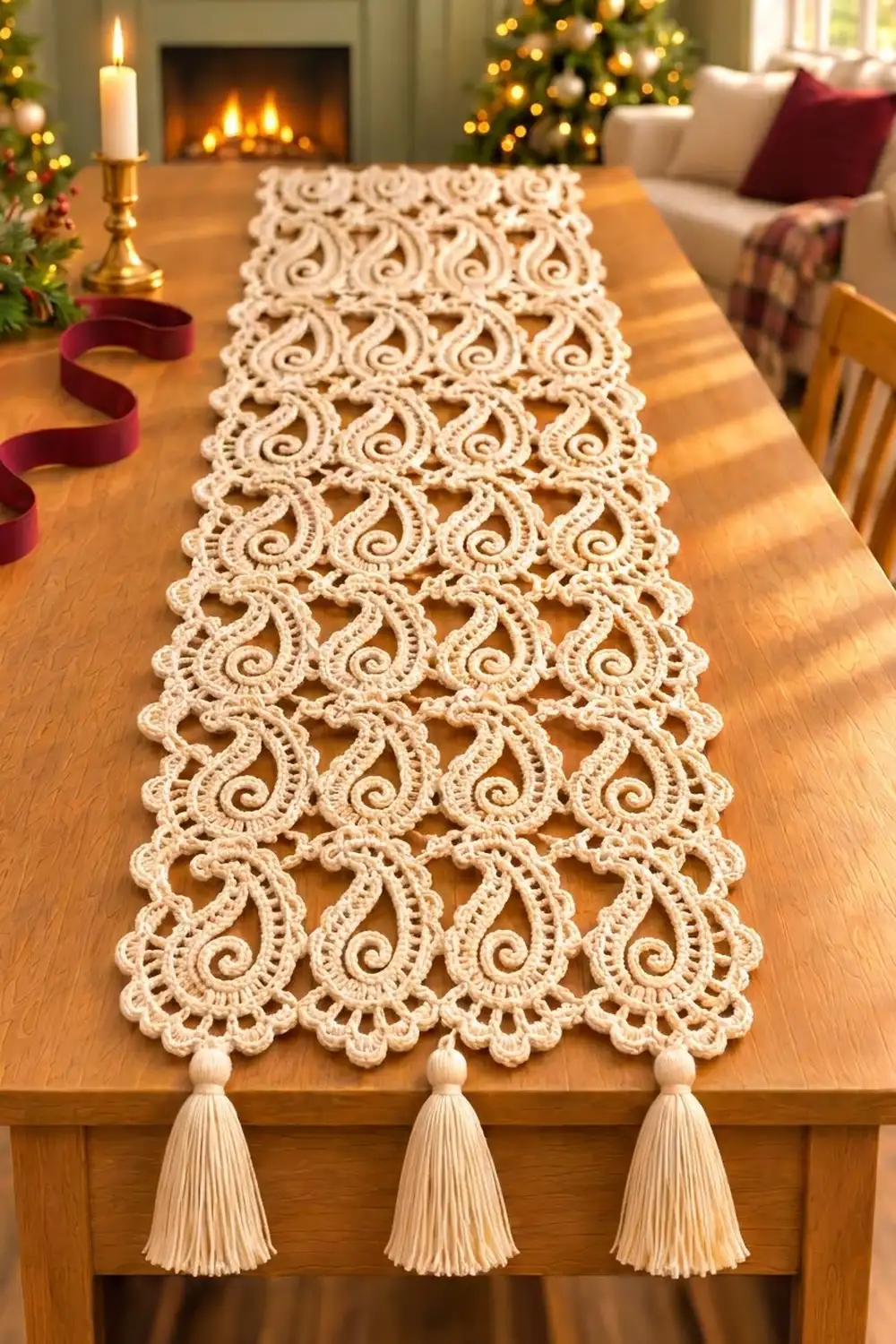
This runner is made from openwork paisley motifs in one soft cream cotton. Each paisley has a rolled spiral in the center, a ring of open double-crochet “ladder” posts, a firm single-crochet outline, and a scalloped shell edge around the rounded end. The narrow tip curls to one side and ends in a small hook.
Twenty-one motifs are joined into a lace panel three motifs wide and seven motifs long. Short chain links hold the motifs together and leave little windows between them, so the table shows through. Three tassels hang from each short end. The single color makes it look calm and classic, and it suits holiday tables as well as everyday ones.
The pattern uses US crochet terms. The finished runner measures about 14.5 in (36.8 cm) wide and 48.5 in (123.2 cm) long, not counting tassels. Each tassel adds 4 in (10.2 cm) at its end.
Construction is simple and repetitive. You work each paisley frame in four rounds around a chain ring, crochet a short strip, and coil it into the center. From the second motif on, you join each new motif to its neighbors as you work the last round. There is no separate border, because the shell round of each motif becomes the finished edge.
Finished Size and Construction
- Finished size: 14.5 in x 48.5 in (36.8 cm x 123.2 cm), plus 4 in (10.2 cm) tassels at each end
- Skill level: Intermediate
- Terminology: US crochet terms
- Yarn weight: Sport (#2) cotton
- Hook: 3.0 mm
- Number of pieces: 21 motifs (each one frame plus one spiral insert) and 6 tassels
- Layout: 3 motifs wide x 7 motifs long
- Motif size: 4.5 in (11.4 cm) wide x 6.5 in (16.5 cm) tall, including the tip hook
- Size before border: after Round 3, each motif is 3.5 in x 5.25 in (8.9 cm x 13.3 cm)
- Border depth: about 0.5 in (1.3 cm), the shell round of each motif; no added rounds
Materials
Yarn: Use a sport-weight cotton with about 155 m (170 yd) per 50 g. Cotton shows the shells and spiral clearly and blocks flat. Acrylic tends to make the scallops roll.
- Cream: 200 g, about 620 m (678 yd)
That covers about 105 g for the motifs and spirals plus about 48 g for six tassels, with a margin for swatching and blocking. All quantities include a margin.
Tools:
- 3.0 mm crochet hook
- Tapestry needle
- Stitch markers (at least 4)
- Sharp scissors
- A piece of stiff card 4.5 in (11.4 cm) tall for tassels
- Rustproof pins and a blocking mat or folded towels
- Spray bottle
Abbreviations (US Terms)
- ch – chain
- sl st – slip stitch
- sc – single crochet
- hdc – half double crochet
- dc – double crochet
- sk – skip
- sp – space
- st(s) – stitch(es)
- RS / WS – right side / wrong side
Special stitches
- Shell: 5 dc in the same st.
- Picot: ch 3, sl st in 3rd ch from hook.
- Curl hook: ch 5, sl st in 2nd ch from hook, sc in next 3 ch, sl st in the last sc made on the motif.
- Joining shell: 2 dc in the st, ch 2, sl st in the center (3rd) dc of the matching shell on the neighbor motif, ch 2, 3 dc in the same st as the first 2 dc. It still counts as one shell of 5 dc.
- Joining picot: ch 2, sl st in the center dc of the matching shell on the motif above, ch 2, sl st in the last sc made. It counts as one picot.
Gauge and Checkpoints
Gauge: 24 sc = 4 in (10.2 cm), which is 6 sts per inch.
Before making all 21, crochet and block one complete motif as your test piece. Then measure at each stage:
- After Round 1: pinch the ring into a teardrop and lay it flat. The ring is 54 sts around, about 9 in (22.9 cm), and the opening is about 1.75 in x 3.25 in (4.4 cm x 8.3 cm).
- After Round 3: 3.5 in x 5.25 in (8.9 cm x 13.3 cm).
- After Round 4 (blocked): 4.5 in x 6.5 in (11.4 cm x 16.5 cm).
Too big? Go down to a 2.75 mm hook, or keep your dc posts shorter. Too small? Go up to a 3.25 mm hook. Even 0.25 in (0.6 cm) of extra width per motif adds up to 0.75 in (1.9 cm) across the runner and 1.75 in (4.4 cm) along its length, so match gauge before going on.
Paisley Motif (Make 21)
The frame has a tip section (Round 1 sts 1–12) and a body section (sts 13–54). Put a marker in st 1 and another in st 13, and move them up each round.
Round 1 (ring): Ch 54 and join with a sl st to the first ch to form a ring, taking care not to twist. Ch 1 (does not count as a st here or on later rounds), sc in each ch around. Join with a sl st to the first sc. (54 sc)
Round 2 (ladder round): Ch 1. Tip section: sl st in sts 1–2, sc in sts 3–6, hdc in sts 7–12. Body section: (dc, ch 1) in each of sts 13–54. Join with a sl st to the first sl st.
(12 tip sts + 42 dc + 42 ch-1 sps = 96 sts)
The short sl sts and sc on one side of the tip, with taller hdc on the other, make the point lean and start the curl. The dc with ch-1 spaces form the open ladder ring and add the extra length the larger outer edge needs.
Round 3 (outline): Ch 1. Sc in each of the 12 tip sts, then sc in each dc and each ch-1 sp around the body (84 sc). Join with a sl st to the first sc.
(12 tip sc + 84 body sc = 96 sc)
Checkpoint: 3.5 in x 5.25 in (8.9 cm x 13.3 cm).
Round 4 (shell edge): This round is a trim round. Every Round 3 stitch is used exactly once, as either a base stitch or a skipped stitch.
Ch 1. Tip: sc in next 3 sts, picot (P1), sc in next 3 sts, curl hook, sc in next 3 sts, picot (P2), sc in next 3 sts. (12 sc + 2 picots + 1 curl hook; uses 12 sts)
Body: (sc in next st, sk 2 sts, shell in next st, sk 2 sts) 14 times. Join with a sl st to the first sc of the round. Fasten off and weave in the ends.
(14 sc + 14 shells of 5 dc; uses 14 x 6 = 84 sts)
Total stitches used: 12 + 84 = 96, the same as the Round 3 count.
Shell numbering: Shells 1–5 run down the first side after the tip (Side A). Shells 6–9 go across the rounded bottom, with 6–7 on the Side A half and 8–9 on the Side B half. Shells 10–14 go back up the other side (Side B). Shell 1 and shell 14 sit next to the tip. On every motif, Side A falls on the same side.
Spiral Insert (Make 21)
Row 1: Ch 39. Sc in 2nd ch from hook and in each ch across. (38 sc) Fasten off, leaving a 12 in (30.5 cm) tail.
Starting at the end without the tail, roll the first 20 sts into a flat coil of about 2 turns, 1.2 in (3.0 cm) across. Tack the coil with a few stitches on the WS. The other 18 sts, about 3 in (7.6 cm), are the stem.
Lay the spiral inside the motif opening, with the coil sitting in the rounded end and the stem curving up into the tip. Using the tail, sew the stem end to the inside of Round 1 at the tip. Then tack the outer turn of the coil to Round 1 at 3 points across the bottom. Keep the tacking loose enough that the opening lies flat.
Make All Pieces
- Cream: 21 motifs, 21 spiral inserts, 6 tassels
Lay out the motifs RS up, all tips pointing toward the same short end (the “top”). In each row, Side A of every motif faces the next motif along. The tassels hang from the bottom end of Row 7 and the tips of Row 1.
Top end (tips + top tassels)
Row 1:  M1   M2   M3
Row 2:  M4   M5   M6
Row 3:  M7   M8   M9
Row 4:  M10  M11  M12
Row 5:  M13  M14  M15
Row 6:  M16  M17  M18
Row 7:  M19  M20  M21
Bottom end (shells + bottom tassels)
M1 is a complete motif. Work Rounds 1–3 of every other motif as usual, then join it during Round 4.
Joining (Join-As-You-Go)
Every join replaces a normal stitch with its joining version, so the stitch counts don’t change: a joining shell is still 5 dc, and a joining picot still counts as one picot.
Joining to the motif above (Rows 2–7): Work P1 as a joining picot into shell 8 of the motif directly above. Work P2 as a joining picot into shell 7 of the same motif. This puts the narrow tip of the new motif under the wide bottom of the one above. That’s 2 links per vertical pair.
Joining to the side neighbor (columns 2 and 3): Work the new motif’s shell 11 as a joining shell into the neighbor’s shell 4. Then work shell 13 as a joining shell into the neighbor’s shell 2. Shells 2 and 13 sit at the same height near the tip, and shells 4 and 11 sit lower down, so the motifs line up without tilting. That’s 2 links per side seam.
Join totals: 6 vertical seams x 3 columns x 2 links = 36 links. 2 side seams x 7 rows x 2 links = 28 links.
Tension: Keep the ch-2 links the same height as your dc posts. If links are tight, the runner puckers. If they are loose, the windows sag. Before you sl st into a neighbor, lay the two motifs flat and make sure neither is pulling.
Each link opens a gap of about 0.5 in (1.3 cm).
Size checkpoint after Row 1: 3 x 4.5 in + 2 x 0.5 in = 14.5 in (36.8 cm) wide.
Size checkpoint after Row 2: 6.5 + 0.5 + 6.5 = 13.5 in (34.3 cm) long.
Size checkpoint after Row 7: 7 x 6.5 in + 6 x 0.5 in = 48.5 in (123.2 cm) long.
Border
This runner has no added border rounds. The shell round (Round 4) of each motif forms the finished edge, which keeps the open, scalloped outline.
Border gauge: Each shell repeat uses 6 sts of Round 3. At 6 sts per inch, that’s one scallop every 1 in (2.5 cm) along the Round 3 line, and about 0.5 in (1.3 cm) deep.
Edge counts per side:
- Long edge (Side B of column 1): 7 motifs x 5 free shells (shells 10–14) = 35 shells
- Long edge (Side A of column 3): 7 motifs x 5 free shells (shells 1–5) = 35 shells
- Bottom short end (Row 7): 3 motifs x 4 shells (shells 6–9) = 12 shells
- Top short end (Row 1): 3 motifs x (12 sc + 2 picots + 1 curl hook) = 36 sc, 6 picots, 3 curl hooks
Why the math works: On every motif, 84 body sts / 6 sts per repeat = exactly 14 shells, with no extra or missing stitch at the join. Joining shells and joining picots replace their normal versions one for one, so no stitches are added per seam. The edge count on each side is just the number of motifs times that motif’s free shells.
Tassels (make 6): Wrap yarn 30 times around the 4.5 in (11.4 cm) card. Slide a 10 in (25.4 cm) strand under the wraps at one edge and tie it tightly. Cut the opposite loops. Wrap another strand 6 times around the bundle 0.75 in (1.9 cm) below the top, tie it, and bury the ends inside. Trim the tassel to 4 in (10.2 cm).
Tie one tassel to the sc between shells 7 and 8 on each Row 7 motif, and one to the curl hook of each Row 1 motif.
Final Blocking
- Weave in all ends before blocking, and leave the tassels untrimmed if you can.
- Soak the runner in cool water for 15 minutes. Press out the water; don’t wring it.
- Roll the runner in a towel to take out the extra moisture.
- Lay it on a blocking surface RS up. Pin the four corners to 14.5 in x 48.5 in (36.8 cm x 123.2 cm).
- Pin the center dc of each edge shell so the scallops fan out.
- Gently push each curl hook into a curve and pin it.
- Press each spiral flat with your fingers and make sure the ladder posts stand straight.
- Let it dry completely, then unpin it, comb the tassels, and trim them evenly.
Final Quality-Control Checklist
- Every motif has 14 shells, 2 picots and 1 curl hook.
- Every motif measures 4.5 in x 6.5 in (11.4 cm x 16.5 cm) after blocking.
- All tips point toward the same end, and all curl hooks bend the same way.
- Every spiral is centered, tacked, and lies flat.
- 36 vertical links and 28 side links are present.
- The runner measures 14.5 in x 48.5 in (36.8 cm x 123.2 cm).
- The long edges each show 35 shells, and the bottom end shows 12.
- The six tassels are each 4 in (10.2 cm) and firmly tied.
- No ends are visible on the RS.
Troubleshooting
Ring twisted in Round 1: Undo it and rejoin, keeping the chain bumps facing down all the way around.
Tip won’t curl: Check that Round 2 starts with sl sts and ends the tip section with hdc. Re-block and pin the hook into a curve.
Shells crowd or ruffle: You probably skipped too few stitches. Count 6 Round 3 sts per repeat, or go down a hook size for Round 4.
Opening too small for the spiral: Roll the coil tighter, to about 1 in (2.5 cm) across, or work Round 1 more loosely.
Runner bows or narrows: One column is tighter than the others. Measure each motif and re-block the short ones to 4.5 in (11.4 cm).
Links stretch out: Work the ch 2 more firmly, or swap to ch 1 on both sides of the joining sl st, the same way on all motifs.
Care
Hand wash in cool water with mild soap, press out the water, and dry flat, reshaping the scallops and spirals. Don’t tumble dry. A light steam from above refreshes it between washes.
Final Notes
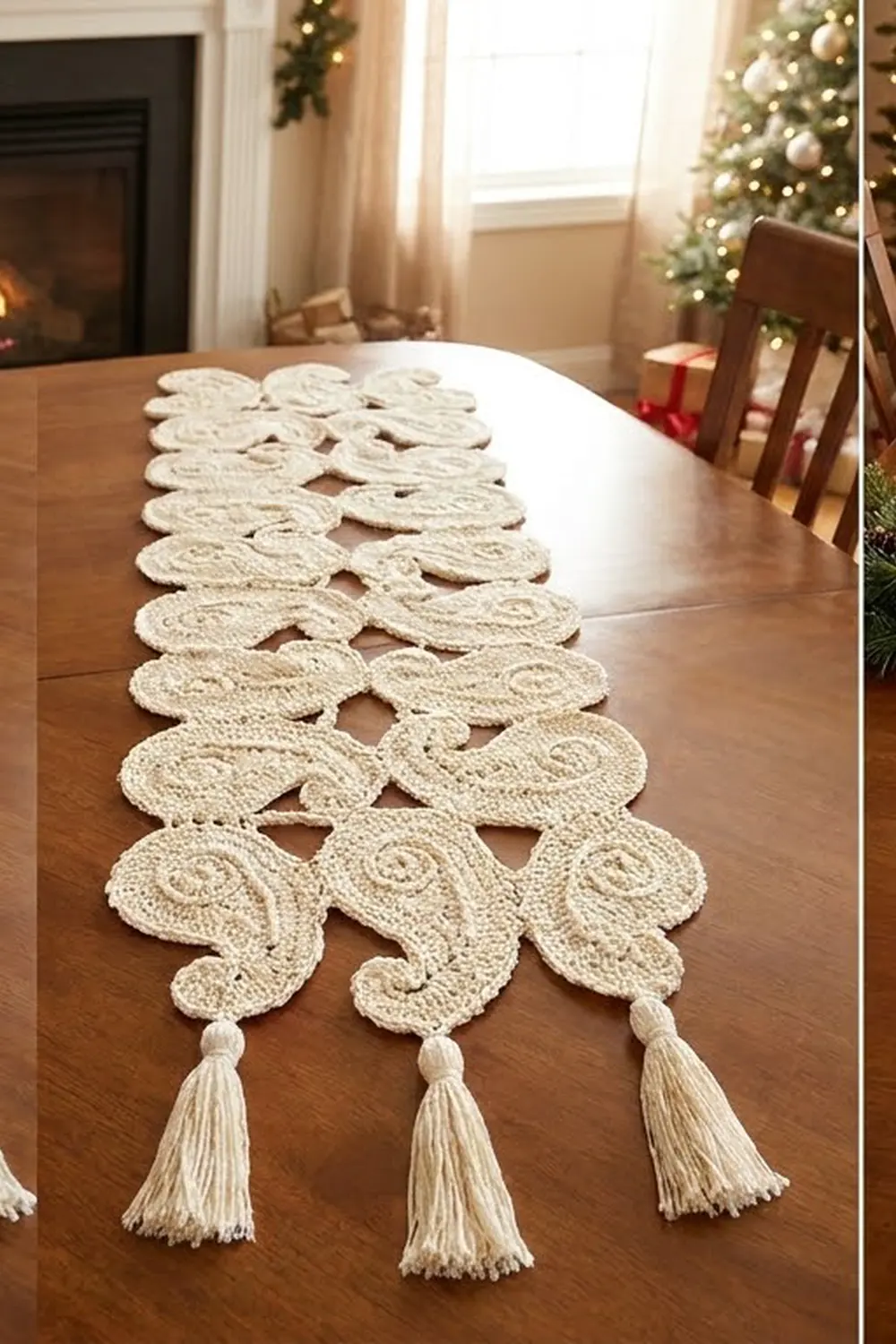
The measurement chain is short and easy to check. A 54-st ring opens to 96 sts in Rounds 2 and 3. Round 4 uses those 96 sts in a 12-st tip and 14 shells of 6 sts each, and each motif comes out at 4.5 in x 6.5 in (11.4 cm x 16.5 cm). Three motifs plus two 0.5 in (1.3 cm) gaps give 14.5 in (36.8 cm) of width. Seven motifs plus six gaps give 48.5 in (123.2 cm) of length. If your test motif matches, the runner will too.
Happy crocheting!