
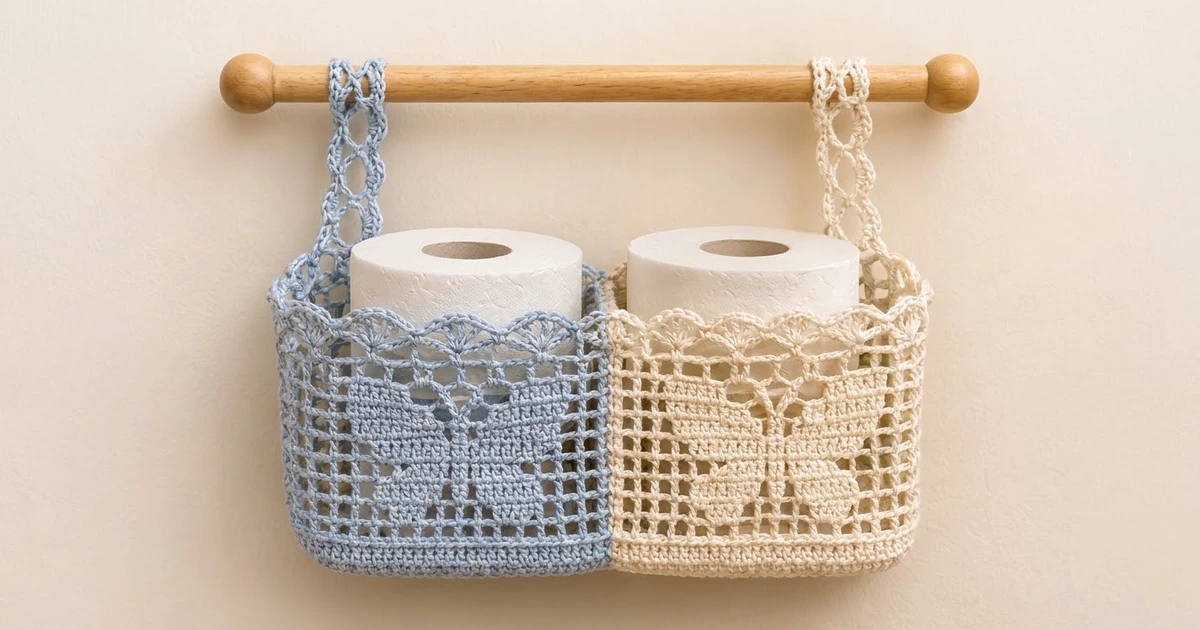
This hanging basket holds two spare toilet rolls in two filet pockets, each with a butterfly on the front. One pocket is powder blue and the other is cream. Each butterfly is worked in the same color as its pocket, so the motif comes from the contrast between solid blocks and open mesh rather than from a color change.
The look is soft and cottage-style. A scalloped fan edge finishes the top, and two lattice straps hang the basket from a towel bar or wooden dowel. The pattern uses US crochet terms throughout.
The joined basket measures 11 in (27.9 cm) wide, 4 in (10.2 cm) deep and 5.5 in (14.0 cm) tall, not counting the straps. Each pocket is 5.5 in (14.0 cm) wide.
Each pocket starts with a flat rectangular base worked in rows. You then work around the base edge and continue upward in rounds of filet mesh, with the butterfly chart on the front. Next you seam the two pockets together, work the fan border around each top opening, and attach the straps.
Finished Size and Construction
- Finished size: 11 in x 4 in x 5.5 in (27.9 cm x 10.2 cm x 14.0 cm)
- Skill level: Intermediate
- Terminology: US
- Yarn weight: Sport (2), cotton
- Hook: 3.0 mm (C/2 or D/3)
- Number of pieces: 2 pockets and 2 straps
- Layout: 2 pockets side by side (blue on the left, cream on the right)
- Pocket size: 5.5 in (14.0 cm) wide x 4 in (10.2 cm) deep
- Wall height before border: 4.75 in (12.1 cm)
- Border depth: 0.75 in (1.9 cm)
Materials
Use a smooth mercerized or combed cotton in sport weight. Cotton holds the box shape well and shows filet blocks clearly. Avoid fuzzy or very stretchy yarns, because they blur the butterfly.
- Color A, powder blue: 50 g / about 155 m (one pocket and one strap)
- Color B, cream: 50 g / about 155 m (one pocket and one strap)
Tools:
– 3.0 mm crochet hook
– Tapestry needle
– 4 stitch markers
– Scissors and a measuring tape
– Wooden dowel or towel bar, about 14 in (35.6 cm) long
– Rust-proof pins and a blocking mat
Each pocket and strap uses about 40 g. The quantities above include a margin for your swatch and any frogging.
Abbreviations (US Terms)
- ch: chain
- sl st: slip stitch
- sc: single crochet
- dc: double crochet
- BLO: back loop only
- sk: skip
- sp: space
- st(s): stitch(es)
- rnd: round
- beg: beginning
Special stitches:
– Mesh square: dc in next dc, ch 2, sk the next 2 sts (or the next ch-2 sp).
– Block square: dc in next dc, then 2 dc in the next ch-2 sp (or 1 dc in each of the next 2 dc).
Every square is 3 sts: the opening dc plus the 2 sts after it. A round of 38 squares is therefore 114 sts.
Gauge and Checkpoints
- Sc gauge: 24 sc x 28 rows = 4 in (10.2 cm)
- Filet gauge: 8 squares x 8 rnds = 4 in (10.2 cm), so 1 square = 0.5 in (1.3 cm)
Make the full blue pocket and check it before you start the cream one.
Checkpoints:
– Base after Row 28: 5.5 in x 4 in (14.0 cm x 10.2 cm)
– After Rnd 3: the band stands about 0.3 in (0.8 cm) tall, and the circumference is 19 in (48.3 cm)
– After Rnd 12: the wall is 4.75 in (12.1 cm) tall
– After the border: the pocket is 5.5 in (14.0 cm) tall
If your piece measures too big, go down 0.25 mm in hook size. If it measures too small, go up 0.25 mm. If only the filet is off while the sc base matches, change hooks for the wall rounds only.
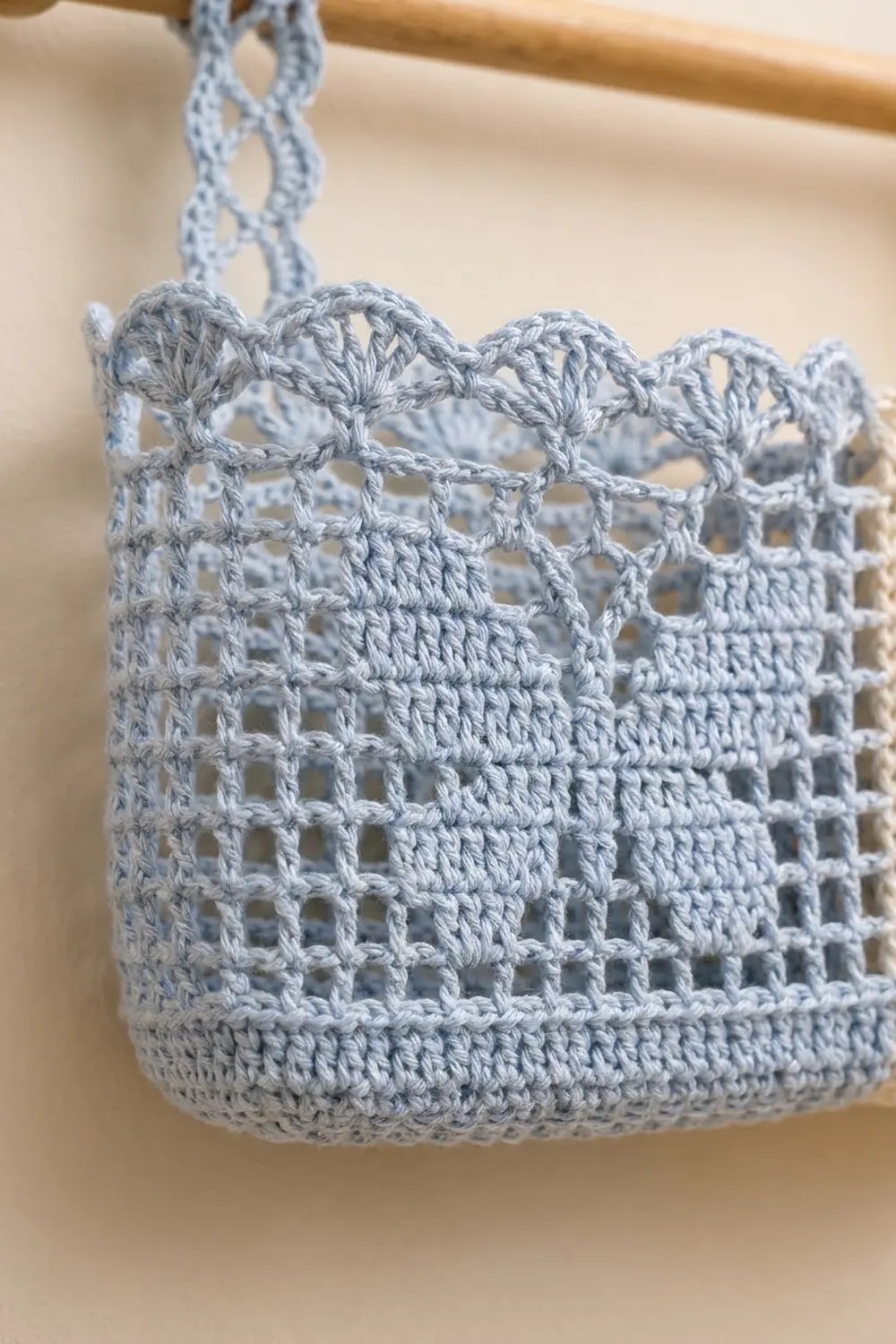
Pocket (Make 1 in Color A and 1 in Color B)
Base
Ch 34.
Row 1: Sc in 2nd ch from hook and in each ch across, turn. (33 sc)
Rows 2–28: Ch 1, sc in each st across, turn. (33 sc)
Checkpoint: 5.5 in x 4 in (14.0 cm x 10.2 cm). Do not fasten off.
Base Band and Walls
From here, work in rnds with the right side facing out. Do not turn.
Rnd 1 (edging): Ch 1, then work around the base as follows:
– 33 sc across Row 28 (Side A)
– 24 sc evenly down the row ends (Side B), skipping every 7th row end
– 33 sc across the foundation ch (Side C)
– 24 sc evenly up the row ends (Side D)
Sl st to the first sc. (114 sc: 33 + 24 + 33 + 24)
Each corner st counts toward its long side, so no extra corner sts are added. This keeps the corners softly rounded. Place a marker at each corner.
Rnd 2 (turning ridge): Ch 1, sc BLO in each st around, sl st to first sc. (114 sc) This rnd folds the wall upward.
Rnd 3: Ch 1, sc in each st around, sl st to first sc. (114 sc)
Rnd 4 (mesh foundation): Ch 5 (counts as dc + ch 2), sk next 2 sc, *dc in next sc, ch 2, sk 2 sc; repeat from * 36 more times, sl st to 3rd ch of beg ch-5. (38 mesh squares = 114 sts)
The squares fall as follows:
– Squares 1–11: Side A (back)
– Squares 12–19: Side B
– Squares 20–30: Side C (front)
– Squares 31–38: Side D
The round joins at a back corner, so the jog stays hidden.
Butterfly Chart Rounds
Every rnd opens with ch 5 (counts as dc + ch 2) for Square 1. Square 1 is always mesh. Close every rnd with a sl st to the 3rd ch of the beg ch-5. Squares 1–19 and 31–38 are always mesh.
Work Squares 20–30 from the chart below. Column 1 is Square 20. X = block square, . = mesh square. The chart reads bottom to top, and it is symmetrical, so the working direction does not matter.
Rnd 12:  . . . . . . . . . . .
Rnd 11:  . . . . X . X . . . .
Rnd 10:  . X X X . X . X X X .
Rnd 9:   . X X X X X X X X X .
Rnd 8:   . X X X X X X X X X .
Rnd 7:   . . X X X X X X X . .
Rnd 6:   . X X X X X X X X X .
Rnd 5:   . . X X . X . X X . .
         1 2 3 4 5 6 7 8 9 10 11
Rnd 5: Lower wing tips in columns 3, 4, 6, 8 and 9. (5 blocks, 33 mesh, 114 sts)
Rnd 6: Lower wings, columns 2–10. (9 blocks)
Rnd 7: Waist, columns 3–9. (7 blocks) This narrowing separates the lower wings from the upper wings.
Rnds 8–9: Upper wings, columns 2–10. (9 blocks each rnd)
Rnd 10: Wing tops in columns 2–4, 6 and 8–10. (7 blocks) The mesh squares in columns 5 and 7 split the wings from the head.
Rnd 11: Antennae in columns 5 and 7. (2 blocks)
Rnd 12: All mesh. (38 squares, 114 sts)
Checkpoint: the wall is 4.75 in (12.1 cm) tall from the base. The butterfly is 9 squares (4.5 in / 11.4 cm) wide, with one mesh square on each side of it. Fasten off and leave a 6 in (15.2 cm) tail.
Strap (Make 1 in Color A and 1 in Color B)
Ch 7.
Row 1: Sc in 2nd ch from hook and in each ch across, turn. (6 sc)
Row 2: Ch 1, sc in first sc, ch 4, sk 4 sc, sc in last sc, turn. (2 sc, 1 ch-4 sp)
Row 3: Ch 1, sc in first sc, ch 2, sc in ch-4 sp, ch 2, sc in last sc, turn. (3 sc, 2 ch-2 sps)
Row 4: Ch 1, sc in first sc, ch 4, sk (ch-2, sc, ch-2), sc in last sc, turn.
Repeat Rows 3–4 until the strap measures 10 in (25.4 cm), ending on a Row 3. On the last row, work 6 sc across: 1 in each sc and 1 in each ch-2 sp, plus 1 more in the center sc. Fasten off and leave a 12 in (30.5 cm) tail.
The strap is 1 in (2.5 cm) wide. The alternating chain bars cross to form the diamond lattice.
Make All Pieces
- Color A (blue): 1 pocket, 1 strap
- Color B (cream): 1 pocket, 1 strap
Layout, front view:
[ Strap A ]                 [ Strap B ]
[ Blue pocket D | B ][ D | B Cream pocket ]
          seam here ↑
Turn the blue pocket so its butterfly faces you. Its Side B (Squares 12–19) is then on the right, and that is the side that gets seamed. Turn the cream pocket so its butterfly faces you, with its Side D (Squares 31–38) on the left, against the blue pocket.
Joining
Hold the two pockets side by side with the butterflies facing forward. The blue pocket’s Side B touches the cream pocket’s Side D. Each of these sides is 24 sts at the base and 8 squares across the wall.
Base seam: Thread the blue tail and whipstitch through the BLO ridge loops from Rnd 2. Join 24 sts to 24 sts, one st to one st.
Front corner seam: Whipstitch the corner dc posts of the two pockets together, 1 stitch per rnd. Cover Rnds 3–12: 1 sc band rnd plus 9 filet rnds.
Back corner seam: Repeat the front corner seam at the back corners.
Leave the middle of the side walls unsewn. The two walls simply rest against each other, which keeps the mesh open and even.
Tension: Pull each stitch until the edges just meet. If you pull harder, the walls pucker and the fronts no longer sit flat.
Checkpoint: the joined basket is 11 in (27.9 cm) wide and 4 in (10.2 cm) deep.
Border
Work the border on each pocket separately, in its own color, around its own top opening. The two pockets are already joined, but each opening is still a closed ring of 114 sts.
Border gauge: 3 sc = 0.5 in (1.3 cm). This matches the filet square, so the edge neither flares nor pulls in.
Join yarn at the back corner where Square 1 begins.
Rnd 13: Ch 1, then work around the opening, sl st to first sc. (114 sc)
– Work 1 sc in each dc and 2 sc in each ch-2 sp.
– This gives 33 sc on Side A, 24 on Side B, 33 on Side C and 24 on Side D.
– The count is 38 squares x 3 sts = 114. No sts are added at the corners or at the seam.
Rnd 14: Ch 1, sc in first sc, *ch 4, sk 2 sc, sc in next sc; repeat from * around, ending ch 4, sk 2 sc, sl st to first sc. (38 sc, 38 ch-4 arches) That is 11 arches on Side A, 8 on Side B, 11 on Side C and 8 on Side D.
Rnd 15: Sl st into first arch, ch 1, sc in same arch, *7 dc in next arch, sc in next arch; repeat from * around, ending 7 dc in last arch, sl st to first sc. (19 fans: 133 dc and 19 sc)
Why the math works: each arch uses exactly 3 sts, so 114 / 3 = 38 arches. Each fan pair uses 2 arches, and 38 is even, so the round ends with a complete fan. The fans run around the corners in an even line.
Checkpoint: the border is 0.75 in (1.9 cm) deep, and the pocket stands 5.5 in (14.0 cm) tall.
Attach the straps:
1. Center the blue strap on the outside of the blue Side D.
2. Overlap 0.5 in (1.3 cm) of the strap onto the inside of the wall, below Rnd 13, and whipstitch it in place.
3. Attach the cream strap to the cream Side B the same way.
4. Loop the free end of each strap over the dowel. Fold 1.5 in (3.8 cm) back onto the strap and sew through both layers.
Final Blocking
- Weave in all ends along the sc rnds or the seams. Never weave through mesh spaces.
- Wet the basket in cool water and gently squeeze it out. Do not wring it.
- Roll it in a towel to remove the extra water.
- Fill each pocket with a toilet roll wrapped in a plastic bag, or a block cut to 5 in x 4 in (12.7 cm x 10.2 cm).
- Pin the butterflies square, and pin the fans open one at a time.
- Pin the straps flat to 10 in (25.4 cm), without the fold.
- Let everything dry completely, then remove the forms.
Final Quality-Control Checklist
- [ ] The base is 5.5 in x 4 in (14.0 cm x 10.2 cm) on each pocket
- [ ] Every filet rnd has 38 squares (114 sts)
- [ ] Both butterflies are centered, with 1 mesh square on each side
- [ ] Both round jogs sit at a back corner
- [ ] The base seam joins 24 sts to 24 sts
- [ ] Each pocket has 19 fans
- [ ] The straps are 1 in (2.5 cm) wide and match in length
- [ ] The joined basket is 11 in (27.9 cm) wide
Troubleshooting
The butterfly looks slanted. Work the dc of each block into the dc below, not into the space beside it.
The mesh squares are taller than they are wide. Your dc is too tall. Shorten your yarn-over pull or try a smaller hook.
The wall flares outward. Check that Rnd 3 still has 114 sts. Extra sts there carry into every round above.
There is a half fan at the end of Rnd 15. Recount Rnd 14. You need exactly 38 arches.
The basket sags at the strap. Sew through 2 rnds of the wall so the weight is spread out.
The two pockets are different heights. Block them both together on the same forms.
Care
Hand wash in cool water with mild soap and lay flat to dry, reshaping it over a roll. Do not tumble dry, because heat shrinks the cotton and closes up the mesh.
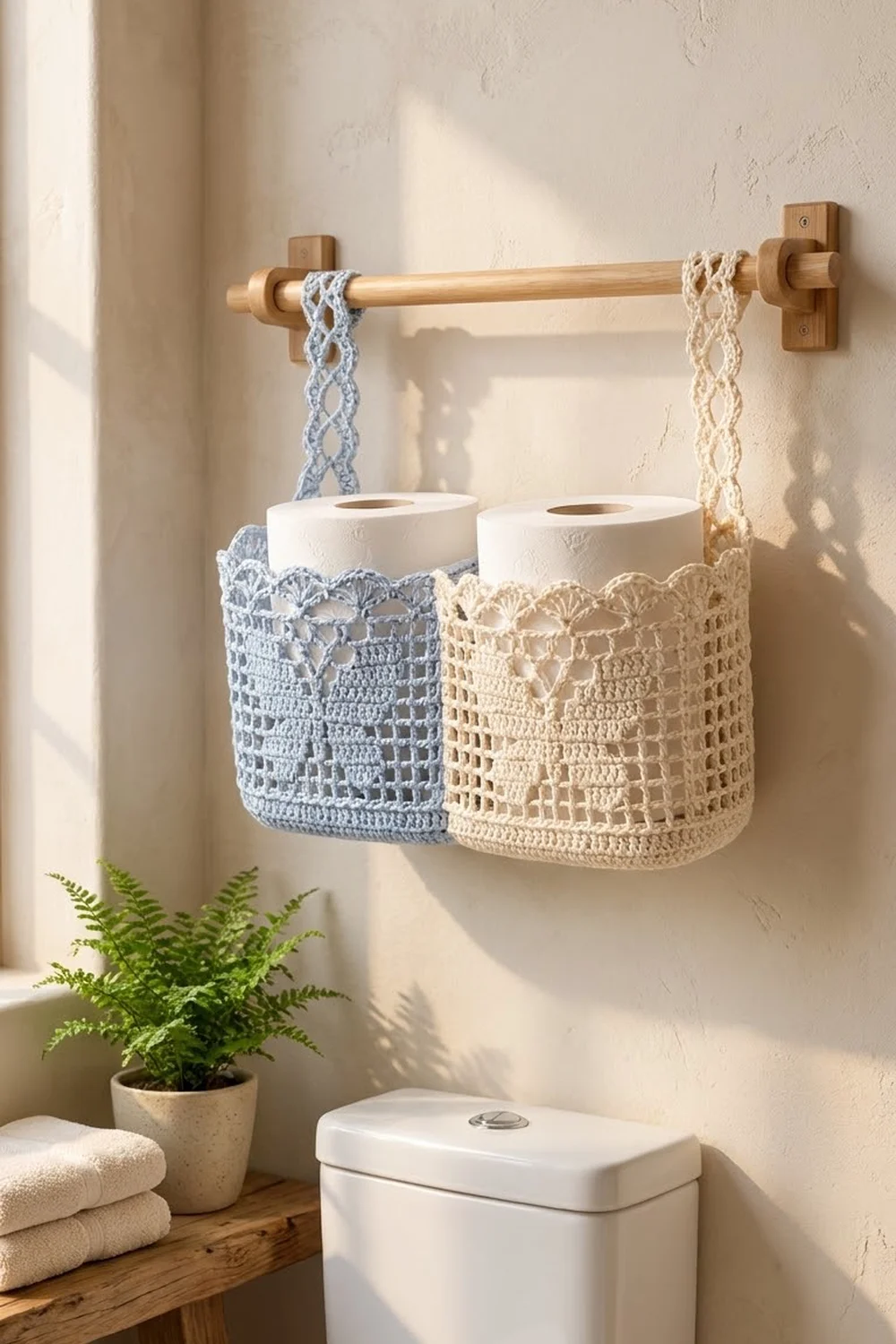
Final Notes
Everything in this pattern follows one measurement chain:
– 6 sc per inch gives a 33 x 28 base of 5.5 in x 4 in (14.0 cm x 10.2 cm).
– The base edge has 114 sts, which become 38 filet squares at 0.5 in (1.3 cm) each.
– Nine filet rnds and the base band give a 4.75 in (12.1 cm) wall.
– The 114 sts become 38 arches and then 19 fans, which add 0.75 in (1.9 cm) for a total height of 5.5 in (14.0 cm).
– Two pockets side by side make a basket 11 in (27.9 cm) wide.
Check each stage against these numbers and both pockets will match.
Happy crocheting!