

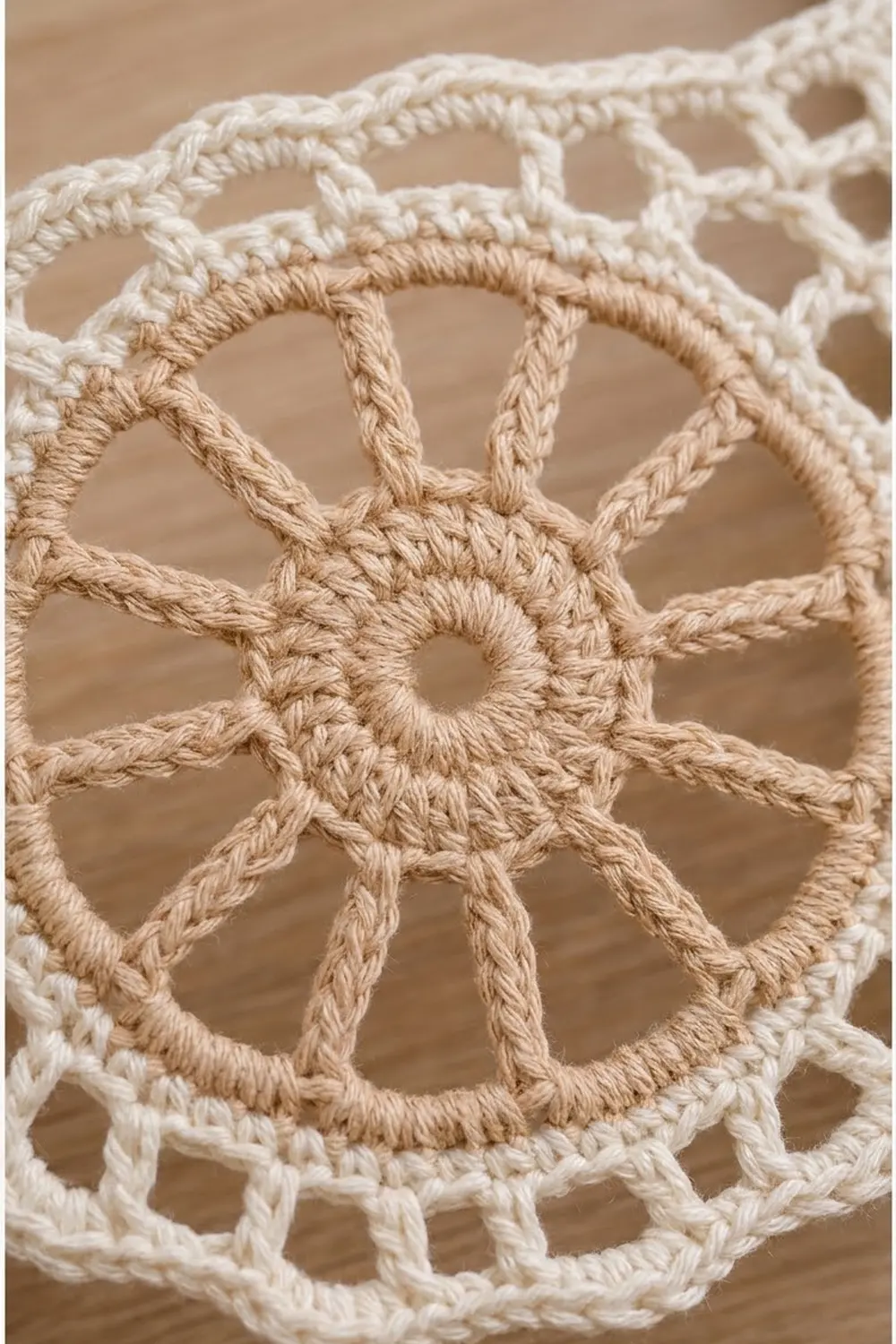
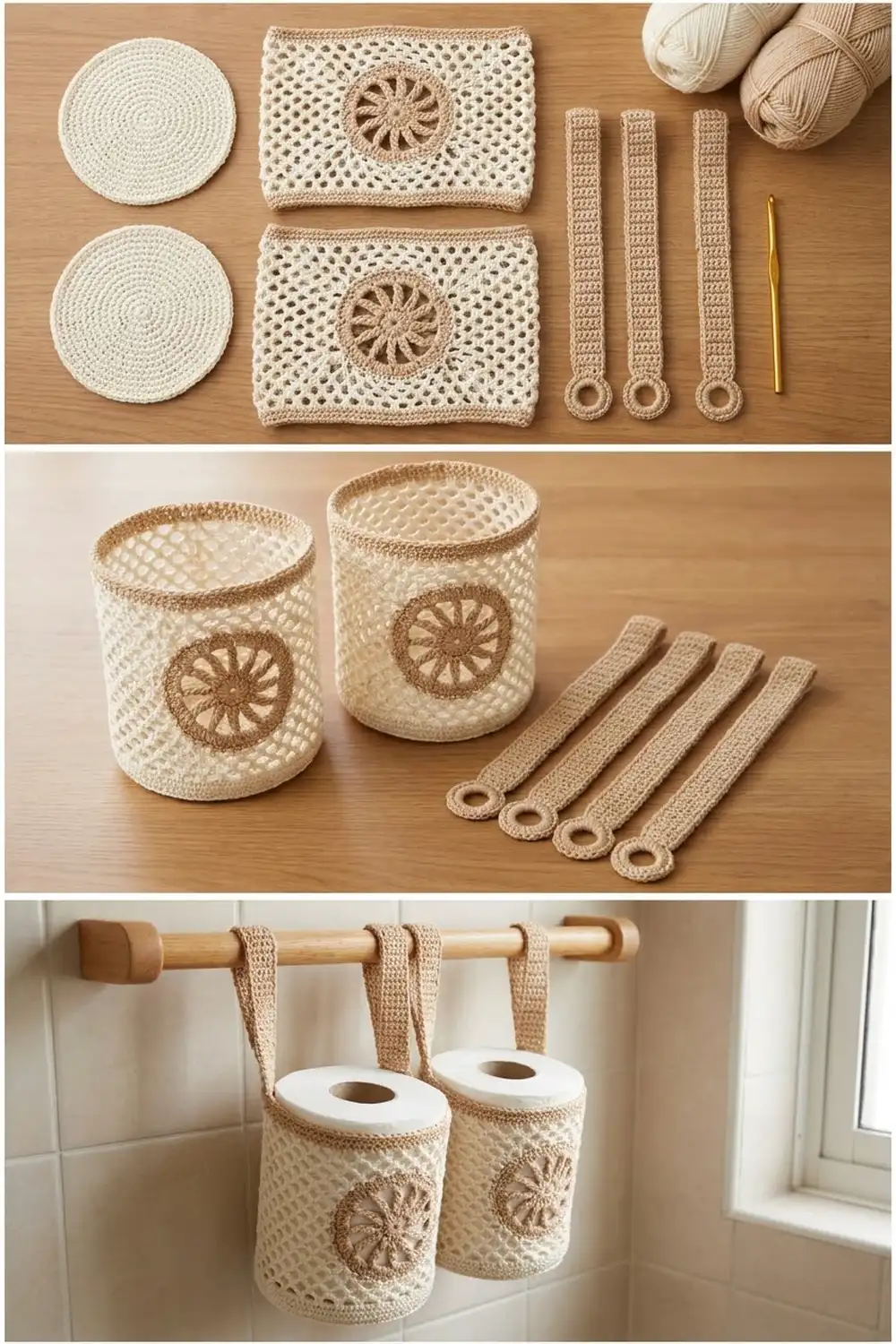
This hanging double toilet-paper holder has two lace cups joined side by side. It hangs from a towel bar on four tan straps. Each cup has a cream mesh body, a tan cartwheel motif on the front and back, and a scalloped top edge. It looks light and lacy but holds its shape well with a standard roll inside.
There are only two colors: cream for the bases, mesh and border, and a soft tan for the wheels and straps. Together they give a calm, natural look that suits a neutral bathroom.
The pattern uses US crochet terms. One cup measures about 5.3 in (13.5 cm) across and 5.6 in (14.2 cm) tall. The joined pair is about 10.6 in (26.9 cm) wide. That fits a standard roll about 4.5 in (11.4 cm) across and 4 in (10.2 cm) tall.
How it’s built: Each cup body is a ring of four square blocks: wheel, mesh, wheel, mesh. A flat round base is crocheted onto the bottom, and a four-round scalloped border is worked around the top. The two cups are sewn together where their mesh blocks touch. Four straps, each worked onto a crocheted ring, are then sewn to the rims.
Finished Size and Construction
- Finished size (one cup): 5.3 in (13.5 cm) diameter × 5.6 in (14.2 cm) tall
- Finished size (joined holder): 10.6 in (26.9 cm) wide
- Skill level: Intermediate
- Terminology: US
- Yarn weight: DK / light worsted cotton (weight 3)
- Hook: 3.5 mm (E-4)
- Number of pieces: 14 (2 bases, 4 wheel blocks, 4 mesh blocks, 4 ring straps)
- Layout: Each cup is a ring of 4 blocks (W–M–W–M); the 2 cups are joined side by side
- Block size: 4.2 in × 4.2 in (10.7 cm × 10.7 cm), 21 sc per side
- Cup height before border: 4.4 in (11.2 cm), counting the base joining round
- Border depth: about 1.2 in (3.0 cm)
Materials
Choose a smooth mercerized or combed cotton. Cotton holds its shape, handles humidity, and shows the lace stitches clearly. Avoid acrylic, which tends to sag in a hanging basket.
- Cream: 100 g / about 240 m (2 × 50 g balls)
- Tan: 50 g / about 120 m (1 × 50 g ball)
- 3.5 mm (E-4) crochet hook
- Tapestry needle
- Stitch markers
- Scissors
- Rust-proof pins and a blocking mat
- Optional: 4 small sew-on snaps
These quantities include roughly a 20% margin for gauge differences and the gauge swatch.
Abbreviations (US Terms)
- ch – chain
- sl st – slip stitch
- sc – single crochet
- hdc – half double crochet
- dc – double crochet
- tr – treble crochet
- sk – skip
- sp – space
- st(s) – stitch(es)
- rep – repeat
- MR – magic ring
- BLO – back loop only
Special stitch – Scallop: 5 dc in the same stitch.
Gauge and Checkpoints
Base gauge: 20 sc = 4 in (10.2 cm); 9 rows of dc = 3.8 in (9.7 cm).
Make one wheel block first and use it as your gauge swatch. It should measure 4.2 in (10.7 cm) square after Round 6. Every other measurement in the pattern depends on it.
Checkpoints:
- Wheel block, Round 3: 2.3 in (5.8 cm) across
- Wheel block, Round 4: 3.0 in (7.6 cm) per side
- Wheel block, Round 5: 3.8 in (9.7 cm) per side
- Wheel block, Round 6: 4.2 in (10.7 cm) per side
- Mesh block before edging: 3.8 in × 3.8 in (9.7 cm × 9.7 cm)
- Base, Round 7: 2.7 in (6.9 cm) across
- Base, Round 14: 5.3 in (13.5 cm) across
- Joined block ring: 16.8 in (42.7 cm) around, or 8.4 in (21.3 cm) wide when pressed flat
If your block is too big, go down a half or whole hook size. If it’s too small, go up one. Don’t change any stitch counts. The joins only line up if every block has exactly 21 sts per side.
Base (Make 2, Cream)
Work in continuous rounds, joining each round with a sl st. The ch-1 at the start of a round does not count as a stitch.
Rnd 1: In MR, ch 1, 6 sc. (6)
Rnd 2: 2 sc in each st around. (12)
Rnd 3: Sc in next st, 2 sc in next st; rep around. (18)
Rnd 4: Sc in next 2 sts, 2 sc in next st; rep around. (24)
Rnds 5–14: Keep increasing 6 sts evenly per round. Work 1 more sc between increases each round, and stagger the increases so the circle doesn’t turn hexagonal.
- Rnd 5: 30 sts
- Rnd 6: 36 sts
- Rnd 7: 42 sts (checkpoint: 2.7 in / 6.9 cm across)
- Rnd 8: 48 sts
- Rnd 9: 54 sts
- Rnd 10: 60 sts
- Rnd 11: 66 sts
- Rnd 12: 72 sts
- Rnd 13: 78 sts
- Rnd 14: 84 sts
Fasten off. The base should be 5.3 in (13.5 cm) across and lie flat.
Wheel Block (Make 4)
Wheel (Tan)
Rnd 1: In MR, ch 3 (counts as dc), 11 dc. Sl st to top of ch-3. (12 dc)
Rnd 2: Ch 5 (counts as dc + ch 2). Dc in next dc, ch 2; rep 10 more times. Sl st to 3rd ch of beg ch-5. (12 dc, 12 ch-2 sps; 36 sts counting chains)
The 12 dc posts form the spokes.
Rnd 3: Ch 1. Sc in same st, 2 sc in next ch-2 sp. Sc in next dc, 2 sc in next ch-2 sp; rep around. Sl st to first sc. (36 sc)
This solid round is the wheel’s rim. Checkpoint: 2.3 in (5.8 cm) across. Fasten off.
Squaring Rounds (Cream)
Rnd 4: Join cream in any sc that sits directly above a spoke.
- Ch 4 (counts as tr), ch 2, tr in same st. This is the first corner.
- Ch 1, dc in next st, ch 1, hdc in next st, sc in next 2 sts, ch 1, sc in next 2 sts, hdc in next st, ch 1, dc in next st, ch 1*, (tr, ch 2, tr) in next st.
- Rep from * 2 more times, then rep from * to ** once.
- Sl st to top of beg ch-4.
Each quarter of the wheel uses 9 rim sts. Count each side from corner space to corner space, including the chains: tr, ch, dc, ch, hdc, sc, sc, ch, sc, sc, hdc, ch, dc, ch, tr = 15. (60 sts + 4 corner ch-2 sps)
Rnd 5: Sl st into corner ch-2 sp. Ch 3 (counts as dc), (dc, ch 2, 2 dc) in same sp.
- Dc in each of next 15 sts (every tr, st and ch-1 sp)*, (2 dc, ch 2, 2 dc) in next ch-2 sp.
- Rep from * 2 more times, then rep from * to ** once.
- Sl st to top of ch-3.
Each side has 2 + 15 + 2 = 19 dc. (76 dc)
Rnd 6: Ch 1. Sc in same st and in next dc.
- (Sc, ch 2, sc) in corner sp, sc in each of next 19 dc; rep 2 more times.
- (Sc, ch 2, sc) in last corner sp, sc in next 17 dc.
- Sl st to first sc.
Each side has 1 corner sc + 19 + 1 corner sc = 21 sc. (84 sc + 4 ch-2 sps)
Fasten off. The block should be 4.2 in (10.7 cm) square.
Mesh Block (Make 4, Cream)
Foundation: Ch 21.
Row 1: Dc in 4th ch from hook and in each remaining ch. (19 sts; the skipped ch-3 counts as 1 dc)
Row 2: Ch 4 (counts as dc + ch 1), turn.
- Sk next st, dc in next st.
- Ch 1, sk next st, dc in next st; rep across, working the last dc into the top of the turning ch.
- (10 dc, 9 ch-1 sps = 19 sts)
Rows 3–8: Ch 4, turn.
- Sk ch-1 sp, dc in next dc.
- Ch 1, sk ch-1 sp, dc in next dc; rep across, working the last dc into the 3rd ch of the turning ch-4.
- (19 sts)
Row 9: Ch 3 (counts as dc), turn. Dc in each ch-1 sp and each dc across. (19 dc)
Checkpoint: 3.8 in × 3.8 in (9.7 cm × 9.7 cm).
Edging round: Ch 1, turn.
- Top and bottom edges: Work (2 sc, ch 2, 2 sc) in each corner st and 1 sc in each of the 17 sts between corners.
- Row-end edges: Work 17 sc along the 7 row-ends between corners. That’s 2 sc in each row-end, but 3 sc in the row-ends of Rows 2, 5 and 8 (4 × 2 + 3 × 3 = 17).
- Sl st to first sc.
Every side has 2 + 17 + 2 = 21 sc. (84 sc + 4 ch-2 sps)
Fasten off. The block should be 4.2 in (10.7 cm) square, the same as the wheel block.
Make All Pieces
| Piece | Qty | Colors |
|---|---|---|
| Base | 2 | Cream |
| Wheel block | 4 | Tan wheel, cream frame |
| Mesh block | 4 | Cream |
| Ring strap | 4 | Tan |
Layout (top view, blocks in ring order):
 Cup A              Cup B
 [W1] front         [W1] front
 [M2]    [M1] <-->  [M2]    [M1]
 [W2] back          [W2] back
The arrow marks where Cup A’s M1 is sewn to Cup B’s M2.
Ring Strap (Make 4, Tan)
Ring: Ch 12, sl st to the first ch to form a ring.
- Rnd 1: Ch 1, 24 sc into the ring. Sl st to first sc. (24)
- The ring is about 1.1 in (2.8 cm) across.
Strap:
- Row 1: Ch 1. Sc in each of next 5 sts of the ring. (5)
- Rows 2–40: Ch 1, turn. Sc in each st across. (5)
The strap is 1 in (2.5 cm) wide and about 7.3 in (18.5 cm) long. Fasten off and leave a 12 in (30.5 cm) tail.
Joining
Block Rings
Lay out each cup’s blocks in the order W1, M1, W2, M2. Hold two adjacent blocks with right sides together.
Whipstitch through the BLO of the side edges, pairing all 21 sc on one block with all 21 sc on the other. Start corner to corner and keep the count 1:1. Pull each stitch snug, but don’t let the seam pucker.
Close the ring by sewing M2 back to W1.
Checkpoint: The ring measures 16.8 in (42.7 cm) around. The bottom edge has 4 × 21 = 84 sc. The corner ch-2 spaces sit at each seam and are not counted.
Attaching the Base
Turn the ring wrong side out and place the base inside it, wrong sides together. Join cream at any seam.
Sc through each base st and the matching ring st together, skipping the corner ch-2 spaces. Base Round 14 has 84 sts and the ring edge has 84 sts, so they pair 1:1 with no easing. (84 sc)
Fasten off and turn the cup right side out. Checkpoint: Cup height is about 4.4 in (11.2 cm).
Border
The border is worked in cream around the top of each cup. It uses the same gauge, 20 sts = 4 in (10.2 cm).
Rnd 1: Join at a seam.
- Ch 1, sc in each sc around, skipping the corner ch-2 spaces.
- That’s 21 sc per block × 4 blocks. (84 sc)
Rnd 2: Ch 4 (counts as dc + ch 1).
- Sk next st. Dc in next st, ch 1, sk next st; rep around.
- Sl st to 3rd ch of beg ch-4.
- (42 dc + 42 ch-1 sps = 84 sts)
Rnd 3: Ch 1. Sc in each dc and each ch-1 sp around. (84 sc)
Rnd 4: Ch 1, sc in first st.
- Sk 2 sts, Scallop in next st, sk 2 sts, sc in next st; rep around, omitting the final sc.
- Sl st to first sc.
- (14 scallops: 70 dc + 14 sc = 84 sts)
Why the math works: Each block edge carries 21 sts, so the rim is 4 × 21 = 84. Rnd 2 has 42 dc plus 42 spaces, which is 84 again. The scallop repeat uses 6 sts, and 84 ÷ 6 = 14 with nothing left over. No increases are needed, so the rim stays straight up and doesn’t flare.
Checkpoint: The border is about 1.2 in (3.0 cm) deep, for a total cup height of 5.6 in (14.2 cm).
Joining the Cups
Stand the cups side by side with Cup A’s M1 touching Cup B’s M2. With cream yarn, whipstitch the two mesh blocks together down their center column:
- the 11th edging sc at the top,
- the 10th st of Row 9,
- the center ch-1 sp of Rows 8 down to 2,
- the 10th st of Row 1,
- the 11th edging sc at the bottom.
Tack through Border Rnds 1–3 at the same column. The seam is about 4.2 in (10.7 cm) long plus the border, and the joined holder is 10.6 in (26.9 cm) wide.
Attaching the Straps
Sew each ring to the inside of the rim over Border Rnds 1–3, using the strap tails. Place one ring at each of the two seams beside each cup’s front wheel block (W1), so there are 4 rings in total.
Fold the top 2 in (5.1 cm) of each strap to the back to form a loop for the rod, and sew the end down. The loop fits a rod up to about 1.25 in (3.2 cm) across. Each strap hangs about 5.3 in (13.5 cm) below the rod.
To hang the holder without taking the rod down, sew a snap inside each fold instead of stitching it closed.
Final Blocking
- Soak the holder in cool water for 10 minutes.
- Press out the water in a towel. Don’t wring it.
- Slip a 5.3 in (13.5 cm) can or jar into each cup.
- Ease each wheel into a circle and square up each block’s corners.
- Pin the scallops into even arcs over a rolled towel.
- Pin the straps flat and straight.
- Let everything dry completely, about 24 hours.
Final Quality-Control Checklist
- Every block measures 4.2 in (10.7 cm) and has 21 sc per side.
- The wheels sit centered, with 12 evenly spaced spokes.
- The bases lie flat at 5.3 in (13.5 cm).
- Each base join has 84 sc, with no gaps at the seams.
- Each cup has 14 even scallops and no flare.
- The cups are joined straight, with level rims.
- All 4 straps are the same length.
- All tails are woven in securely.
Troubleshooting
- Base ruffles: Your increases are too frequent or too loose. Go down a hook size for the base only.
- Base cups: Your tension is too tight. Go up a hook size, or check that you made 6 increases in every round.
- Wheel block isn’t square: Check that every Rnd 4 side has 15 sts and that each corner tr is fully worked.
- Seams pucker: Whipstitch more loosely and match the stitches exactly 1:1.
- Base doesn’t line up: Recount both edges. The ring needs 84 sc once the corner spaces are skipped.
- Scallops flare: Make the dc shorter or use a smaller hook for Rnd 4.
- Cups tilt forward: Move the rings slightly toward the back seams.
Care
Hand-wash in cool water with mild soap and lay flat to dry. Reshape over a can while damp.
Final Notes
The measurement chain is short and checkable at every stage:
- Every block is 4.2 in (10.7 cm) with 21 sc per side.
- Four blocks give an 84-stitch ring, 16.8 in (42.7 cm) around.
- That ring meets an 84-stitch base 5.3 in (13.5 cm) across.
- The 84-stitch border divides into 14 scallops.
- Each cup ends up 5.6 in (14.2 cm) tall, and the joined pair is 10.6 in (26.9 cm) wide.
Check your first block, and the rest follows. Happy crocheting!