
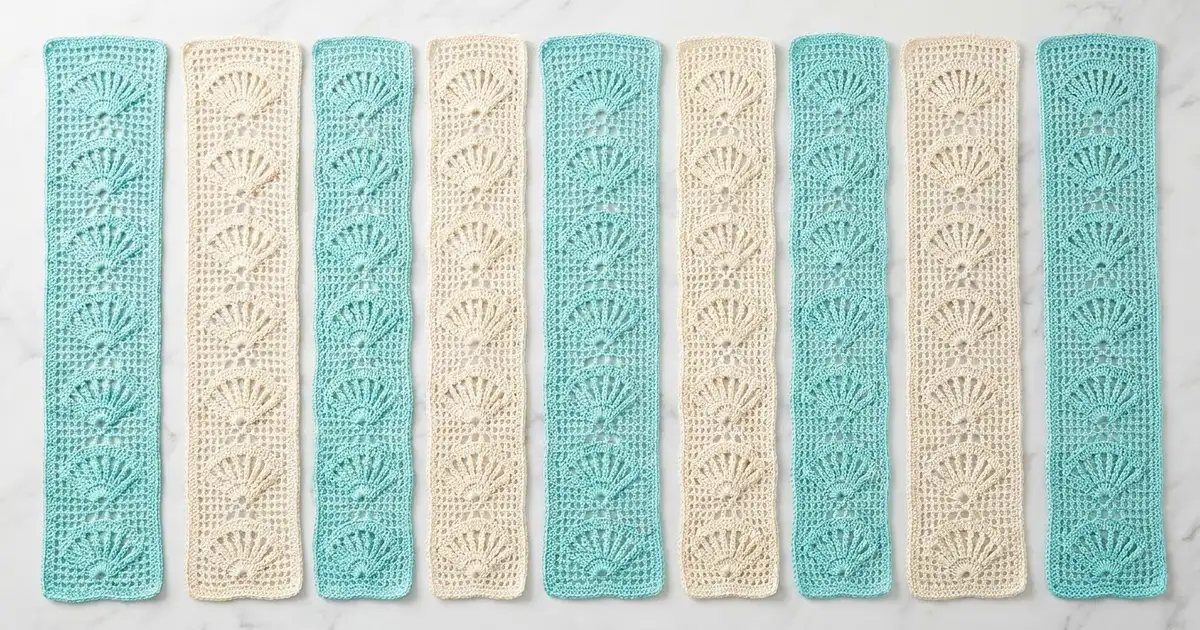
This breezy doorway curtain is made from nine slim filet-crochet strips. Each strip has a repeating scallop shell. Open square meshes let light and air through, and solid double-crochet blocks form the fan-shaped shells. A smooth single-crochet frame keeps every edge straight.
The palette alternates soft aqua and warm cream, with aqua at both outer edges. Together they give the curtain a calm, coastal look that works in a kitchen doorway, a beach cottage or a closet opening.
This pattern uses US crochet terms. Each finished strip measures 4.0 in (10.2 cm) wide by 74.0 in (188.0 cm) long before folding. After the top is folded into a rod casing, each strip hangs 71.0 in (180.3 cm). Nine strips with 0.5 in (1.3 cm) gaps between them fill a 40.0 in (101.6 cm) rod.
Each strip is worked in rows from the bottom up. You work one solid foundation row, then plain mesh rows, then 14 repeats of a 12-row shell section, then a plain top section and a solid last row. Two rounds of single crochet frame the strip. The top 3.0 in (7.6 cm) folds to the back and is sewn down to make the rod casing. The strips are never joined to each other.
Finished Size and Construction
- Finished strip size: 4.0 in x 74.0 in (10.2 cm x 188.0 cm)
- Hanging length after casing: 71.0 in (180.3 cm)
- Curtain width as hung: 40.0 in (101.6 cm) with 0.5 in (1.3 cm) gaps
- Skill level: Easy–Intermediate (repetitive, but you need to read the block layout carefully)
- Terminology: US
- Yarn weight: Sport (#2) mercerized cotton
- Hook: 3.25 mm (US D-3)
- Number of pieces: 9 separate strips (5 aqua, 4 cream)
- Layout: 9 strips side by side in one row, not joined
- Strip size before border: 3.6 in x 73.6 in (9.1 cm x 186.9 cm)
- Border depth: 0.2 in (0.5 cm) per side, 2 rounds
Materials
Yarn: Use a smooth, mercerized sport-weight cotton, about 155 m (170 yd) per 50 g. Cotton holds the crisp grid and does not stretch much as it hangs. Avoid acrylic and very fuzzy yarns: the meshes will blur, and long strips may grow over time.
- Aqua (Color A): 550 g, about 1,705 m (1,865 yd), for 5 strips
- Cream (Color B): 450 g, about 1,395 m (1,526 yd), for 4 strips
Each strip uses about 95–100 g. The quantities above include a margin of about 10% for gauge swatches and differences in tension.
Tools:
– 3.25 mm (US D-3) crochet hook
– Tapestry needle
– Stitch markers
– Measuring tape
– Rust-proof pins and blocking mats (or a clean carpet covered with a towel)
– Spray bottle
– Curtain rod, up to 1 in (2.5 cm) in diameter, at least 40.0 in (101.6 cm) wide
Abbreviations (US Terms)
- ch – chain
- sl st – slip stitch
- sc – single crochet
- dc – double crochet
- sp – space
- st(s) – stitch(es)
- rep – repeat
Special stitches:
- Mesh (open square): ch 2, skip the next 2 sts or the next ch-2 sp, dc in the next dc.
- Block (solid square): fill the square with 2 dc, then dc in the next dc.
- Over a mesh: 2 dc in the ch-2 sp, dc in the next dc.
- Over a block: dc in each of the next 3 dc.
Every row has 10 dc “posts” with 9 squares between them, which equals 28 sts. A row that starts with a mesh begins with ch 5, which counts as a dc plus ch 2. A row that starts with a block begins with ch 3, which counts as a dc. In this design, every row except the first and last starts with a mesh.
Gauge and Checkpoints
Gauge: 10 squares and 10 rows = 4 in (10.2 cm) in filet mesh. One square measures 0.4 in x 0.4 in (1.0 cm x 1.0 cm).
Test one piece first. Work Rows 1–19 of the first strip (the foundation, the plain mesh section and one full shell repeat), then lay it flat and measure.
- After Row 1: width is 3.6 in (9.1 cm).
- After Row 7: height is 2.8 in (7.1 cm).
- After Row 19: height is 7.6 in (19.3 cm). The shell is 2.8 in (7.1 cm) wide and 2.4 in (6.1 cm) tall.
- After Row 184: height is 73.6 in (186.9 cm).
- After the border: 4.0 in x 74.0 in (10.2 cm x 188.0 cm).
If your strip is too big, switch to a 3.0 mm hook. If it is too small, switch to a 3.5 mm hook. Squares that are taller than they are wide usually mean your dc are loose; shorten the yarn-over pull-through rather than changing hooks. Because the strip is 184 rows long, an error of just 0.05 in (0.1 cm) per row adds 9.2 in (23.4 cm) by the top, so check carefully.
Strip Pattern (make 9)
Foundation and Plain Section
Ch 30.
Row 1 (solid): Dc in 4th ch from hook (the skipped ch count as a dc) and in each ch across. Turn. (28 sts = 9 blocks)
Row 2 (mesh): Ch 5 (counts as dc + ch 2), skip next 2 dc, dc in next dc. Ch 2, skip next 2 dc, dc in next dc; rep from * 7 more times, working the last dc in the top of the turning ch. Turn. (10 posts, 9 meshes = 28 sts)*
Row 3 (mesh): Ch 5 (counts as dc + ch 2), dc in next dc. Ch 2, dc in next dc; rep from * 7 more times, working the last dc in the 3rd ch of the turning ch-5. Turn. (9 meshes = 28 sts)*
Rows 4–7: Rep Row 3. (9 meshes each)
Checkpoint: 2.8 in (7.1 cm) tall.
Shell Repeat (12 rows)
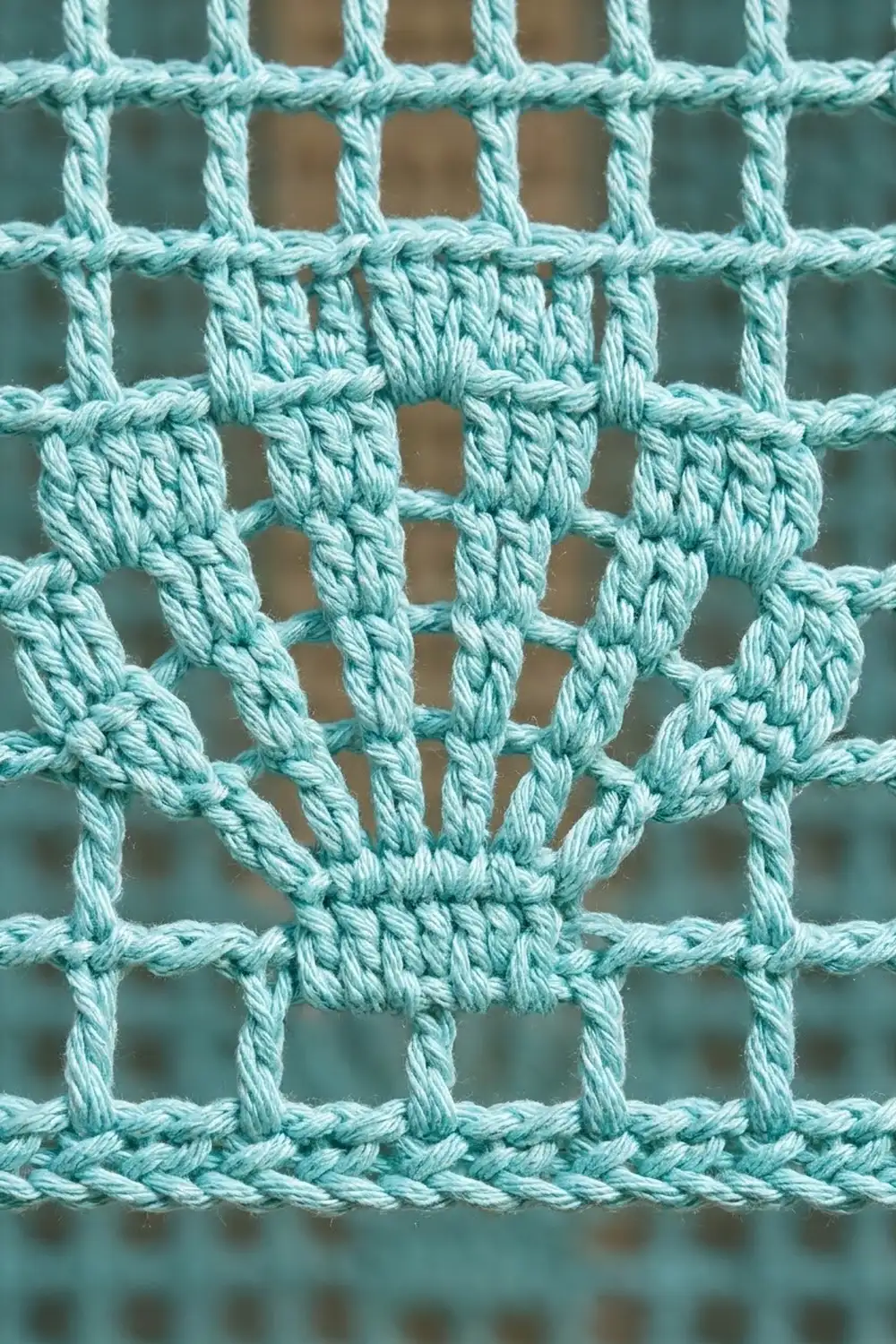
Squares are numbered 1–9 across the row. The shell sits in squares 2–8, so there is always at least one open square at each edge. The motif is symmetrical, so you read every row the same way in either direction. Every row is 28 sts. The open and solid squares are listed in working order.
Shell Row 1 (hinge): 3 meshes, 3 blocks, 3 meshes. (Blocks in squares 4–6)
Shell Row 2 (rays begin): 2 meshes, 1 block, 1 mesh, 1 block, 1 mesh, 1 block, 2 meshes. (Blocks in squares 3, 5, 7)
When you work square 4 over the hinge block, ch 2 and skip the 2 dc. When you work square 5 over the block, dc in each of the next 3 dc.
Shell Row 3: Same as Shell Row 2. (Blocks in squares 3, 5, 7)
Shell Row 4 (flares): 1 mesh, 2 blocks, 1 mesh, 1 block, 1 mesh, 2 blocks, 1 mesh. (Blocks in squares 2, 3, 5, 7, 8)
Shell Row 5: Same as Shell Row 4. (Blocks in squares 2, 3, 5, 7, 8)
Shell Row 6 (rounded top): Same as Shell Row 2. (Blocks in squares 3, 5, 7)
Shell Rows 7–12: 9 meshes each, worked as Row 3.
One repeat is 12 rows, 4.8 in (12.2 cm) tall. The solid hinge, the three separate rays with open squares between them, and the outer flares together form the fan shell, with plain mesh above and below it.
Rows 8–175: Work the Shell Repeat 14 times. (168 rows, 14 shells)
Top Section
Rows 176–183: Rep Row 3. (8 mesh rows, 9 meshes each)
Row 184 (solid): Ch 3 (counts as dc). 2 dc in next ch-2 sp, dc in next dc; rep from * across, working the last dc in the 3rd ch of the turning ch-5. Do not fasten off. (28 sts = 9 blocks)*
Checkpoint: 3.6 in x 73.6 in (9.1 cm x 186.9 cm). Row total: 1 + 6 + 168 + 8 + 1 = 184 rows. At 0.4 in (1.0 cm) per row, that is 73.6 in (186.9 cm).
Make All Pieces
- Color A (aqua): 5 strips
- Color B (cream): 4 strips
Border each strip in its own color.
Layout as hung, left to right:
[A] [B] [A] [B] [A] [B] [A] [B] [A]
 1   2   3   4   5   6   7   8   9
Each strip is 4.0 in (10.2 cm) wide and there are 8 gaps of 0.5 in (1.3 cm): 36.0 in + 4.0 in = 40.0 in (101.6 cm).
Joining: Rod Casing and Hanging
The strips are not joined to each other. Each strip’s top end is folded into a casing so it can slide onto the rod on its own. Work the border first (see below), then make the casing.
Method: Measure 3.0 in (7.6 cm) down from the top bordered edge. That brings you to the fold line, which falls between Rows 177 and 178. Fold Rows 178–184 and the top border to the back.
Stitch-to-stitch logic: The folded top edge lines up with the back of Row 171, which is a plain mesh row. Round 2 of the border has 30 sc along the top edge: 1 corner-group sc, 28 center sc and 1 corner-group sc. With matching yarn and a tapestry needle, whipstitch the 28 center sc one-for-one to the 28 sts of Row 171 (10 dc posts plus 2 ch in each of the 9 ch-2 sps). Then whipstitch each end corner sc to the side border.
Sew the two long sides of the casing closed along the border sc, but leave the top fold open so the rod can pass through.
Tension advice: Keep the whipstitches snug but not tight; the seam should lie as flat as the mesh around it. Pin every third mesh before you sew, so the casing doesn’t twist.
Size checkpoint: The casing loop measures about 6.0 in (15.2 cm) around and slides easily over a rod up to 1 in (2.5 cm) in diameter. The strip now hangs 74.0 − 3.0 = 71.0 in (180.3 cm). Slide the strips onto the rod in the layout order and space them 0.5 in (1.3 cm) apart.
Border
Border gauge: On the long sides, 5 sc = 1 in (2.5 cm), which is 2 sc per dc row-end. On the short ends, work 1 sc per st, so 28 sc across 3.6 in (9.1 cm).
Round 1: Continue from Row 184 without fastening off and work clockwise:
1. Ch 1. Top edge: sc in each of the 28 sts of Row 184. Ch 1 for the corner.
2. Long side: 2 sc in each of the 184 row-ends. (368 sc) Ch 1 for the corner.
3. Bottom edge: working into the free loops of the foundation ch, sc in each of the 28 chs. Ch 1 for the corner.
4. Second long side: 2 sc in each of the 184 row-ends. (368 sc) Ch 1 for the corner.
5. Sl st to the first sc.
(Short sides 28 sc each, long sides 368 sc each, total 792 sc + 4 ch-1 corner sps)
Round 2: Ch 1. Sc in each sc around, and work (sc, ch 1, sc) in each corner ch-1 sp. Sl st to the first sc. Fasten off and weave in the ends.
- Short sides: 28 sc (1 per existing st) + 2 sc (1 from each corner group) = 30 sc
- Long sides: 368 sc (1 per existing st) + 2 sc = 370 sc
- Total: 800 sc + 4 ch-1 corner sps
Why the math works:
- Long sides: Each dc row is 0.4 in (1.0 cm) tall, and 2 sc span 0.4 in at 5 sc per inch. So 368 sc cover exactly 73.6 in (186.9 cm), and the sides neither ruffle nor pull in.
- Short ends: Placing 1 sc per st follows the natural width of the solid rows at the top and bottom.
- Corners: The ch-1 corner spaces turn the corners without adding bulk. In Round 2, the corner groups add exactly 2 sts per side.
- Size: Two rounds add 0.2 in (0.5 cm) on every side, which takes the strip from 3.6 in x 73.6 in to 4.0 in x 74.0 in (10.2 cm x 188.0 cm).
Final Blocking
- Weave in all ends along the border, never across open meshes.
- Wet each strip in cool water for 10 minutes, then press out the water gently in a towel. Don’t wring.
- Lay the strip flat on the mats in sections, or on a long towel-covered carpet.
- Pin each long side straight so the strip measures 4.0 in (10.2 cm) wide along its whole length. Pin about every 4 in (10.2 cm).
- Square up the meshes in each shell with your fingers, so the rays stay separate and the open squares stay open.
- Check the length: 74.0 in (188.0 cm). Ease the strip to this length gently; don’t stretch it.
- Let it dry completely. Make the casing only after blocking.
Final Quality-Control Checklist
- Every row has 28 sts (10 posts, 9 squares).
- Each strip has 14 shells, and every shell has a 3-block hinge, 3 rays and flares in squares 2 and 8.
- Rows 2–7 and 170–183 are plain mesh, so there is no shell inside the casing.
- Border Round 2 counts: 30 / 370 / 30 / 370.
- All strips are 4.0 in x 74.0 in (10.2 cm x 188.0 cm) before the casing is made. Lengths across the nine strips match within 0.5 in (1.3 cm).
- The casing seam falls on Row 171 on every strip, so all strips hang at the same height.
- The layout alternates A and B, with aqua strips at both ends.
Troubleshooting
- Strip is leaning or twisting: You likely worked the last dc into the wrong ch of the turning ch-5. Always work it in the 3rd ch.
- Shell looks lopsided: Count the squares from the edge. Square 1 and square 9 must be open in every shell row.
- Squares are tall and narrow: Tighten your dc, or use ch 1 + 1 extra-tight ch instead of ch 2 if your chains run loose.
- Long sides ripple: You worked more than 2 sc per row-end. Rip back and recount to 368.
- Long sides pull in: You skipped some row-ends. Each dc row-end needs exactly 2 sc.
- Strips hang at different lengths: Block them all together. Fix strips that are too long by adjusting the casing fold by up to 1 row (0.4 in / 1.0 cm).
Care
Hand wash in cool water with mild soap, press out the water in a towel, and dry flat at full length. Do not tumble dry or hang the strips wet, or they will stretch.

Final Notes
Here is the measurement chain from start to finish:
- Squares: Each square is 0.4 in (1.0 cm), so 9 squares make a 3.6 in (9.1 cm) strip width.
- Rows: 184 rows give 73.6 in (186.9 cm).
- Border: Two border rounds add 0.2 in (0.5 cm) per side, for a 4.0 in x 74.0 in (10.2 cm x 188.0 cm) strip.
- Casing: A 3.0 in (7.6 cm) fold leaves 71.0 in (180.3 cm) of hanging length.
- Curtain: Nine strips with 0.5 in (1.3 cm) gaps fill 40.0 in (101.6 cm).
If your first strip passes every checkpoint, the other eight will match it.
Happy crocheting!