
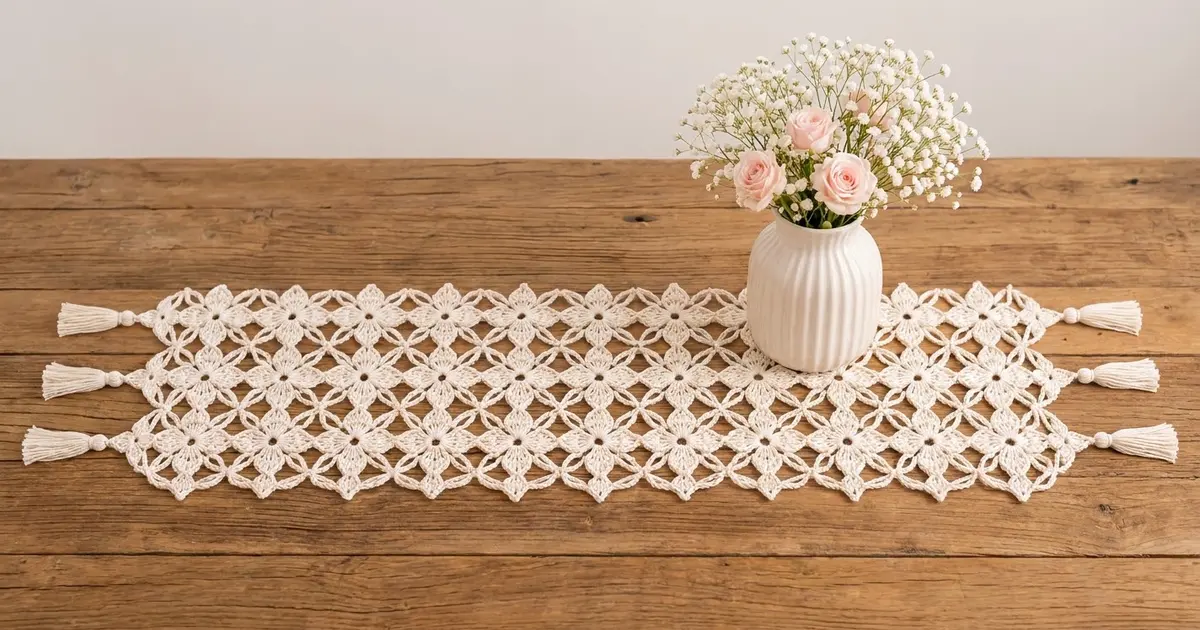
This runner is made from small four-petal lace flowers joined into a long, open grid. Each flower has four solid fan petals that end in points, plus four slim corded loops on the diagonals. Where the flowers meet, they leave diamond-shaped openings, so the runner looks light on the table and still holds its shape.
The whole piece uses one color, a soft ivory cotton. A single color shows off the stitch texture and suits both everyday and special-occasion tables. Three tassels hang from each short end and add weight so the ends drape neatly over the table edge.
The pattern uses US crochet terms. The finished runner measures 12.5 x 44.5 in (31.8 x 113.0 cm) after the border, not counting the tassels. With the tassels, it is 53.5 in (135.9 cm) long.
You’ll make 33 motifs and join them as you go on the last round, three across and eleven long. A two-round edging then links the outer points, and the six tassels go on last.
Finished Size and Construction
- Finished size: 12.5 x 44.5 in (31.8 x 113.0 cm), or 53.5 in (135.9 cm) long including tassels
- Skill level: Intermediate
- Terminology: US crochet terms
- Yarn weight: DK / light worsted (#3) cotton
- Hook: 3.5 mm (E-4)
- Number of pieces: 33 motifs and 6 tassels
- Layout: 3 motifs wide x 11 motifs long
- Motif size: 4 in (10.2 cm) from petal tip to petal tip
- Size before border: 12 x 44 in (30.5 x 111.8 cm)
- Border depth: about 0.25 in (0.6 cm) on each side
Materials
Yarn: Use a smooth mercerized or combed cotton in DK weight. Cotton gives the petals clear definition and blocks crisply. Avoid fluffy or brushed yarns, because they blur the openings.
- Ivory / cream: 300 g, about 690 m (based on 230 m per 100 g)
- Motifs: about 165 g (5 g each)
- Border: about 20 g
- Tassels: about 30 g (5 g each)
Quantities include a margin of roughly 25% for gauge differences and a test motif.
Tools:
- 3.5 mm (E-4) crochet hook
- Tapestry needle
- Scissors
- Stiff card, 5 in (12.7 cm) tall, for the tassels
- Rustproof pins and a blocking board or foam mats
- Spray bottle
- Tape measure
Abbreviations (US Terms)
- ch – chain
- sl st – slip stitch
- sc – single crochet
- hdc – half double crochet
- dc – double crochet
- sp – space
- st(s) – stitch(es)
- RS – right side
Special stitch – Joining tip: Work this in place of a ch-3 tip. Ch 1, insert your hook from front to back into the ch-3 tip of the neighboring motif, sl st, then ch 1. This links the two motifs and keeps the tip the same size as an unjoined ch-3 tip.
Gauge and Checkpoints
Make one complete test motif before starting the runner. Gauge matters here because the motif size controls everything else: the 4 in (10.2 cm) motif gives the 12 in (30.5 cm) width and the 44 in (111.8 cm) length.
Checkpoints for one motif (lightly pressed flat):
- After Round 1: 1.25 in (3.2 cm) across
- After Round 2: 1.75 in (4.4 cm) across
- After Round 3: 3 in (7.6 cm) from fan to opposite fan
- After Round 4: 4 in (10.2 cm) from petal tip to opposite petal tip
If your motif is too big, switch to a 3.25 mm hook. Your chains may also be loose, so tighten them a little, especially the ch-14 loops.
If your motif is too small, switch to a 3.75 mm hook. Make sure each dc in the fans is pulled up to its full height.
A difference of 0.25 in (0.6 cm) per motif adds up to 2.75 in (7.0 cm) over the runner’s length, so fix gauge before you go on.
Motif Pattern
All rounds are worked with the RS facing. Do not turn.
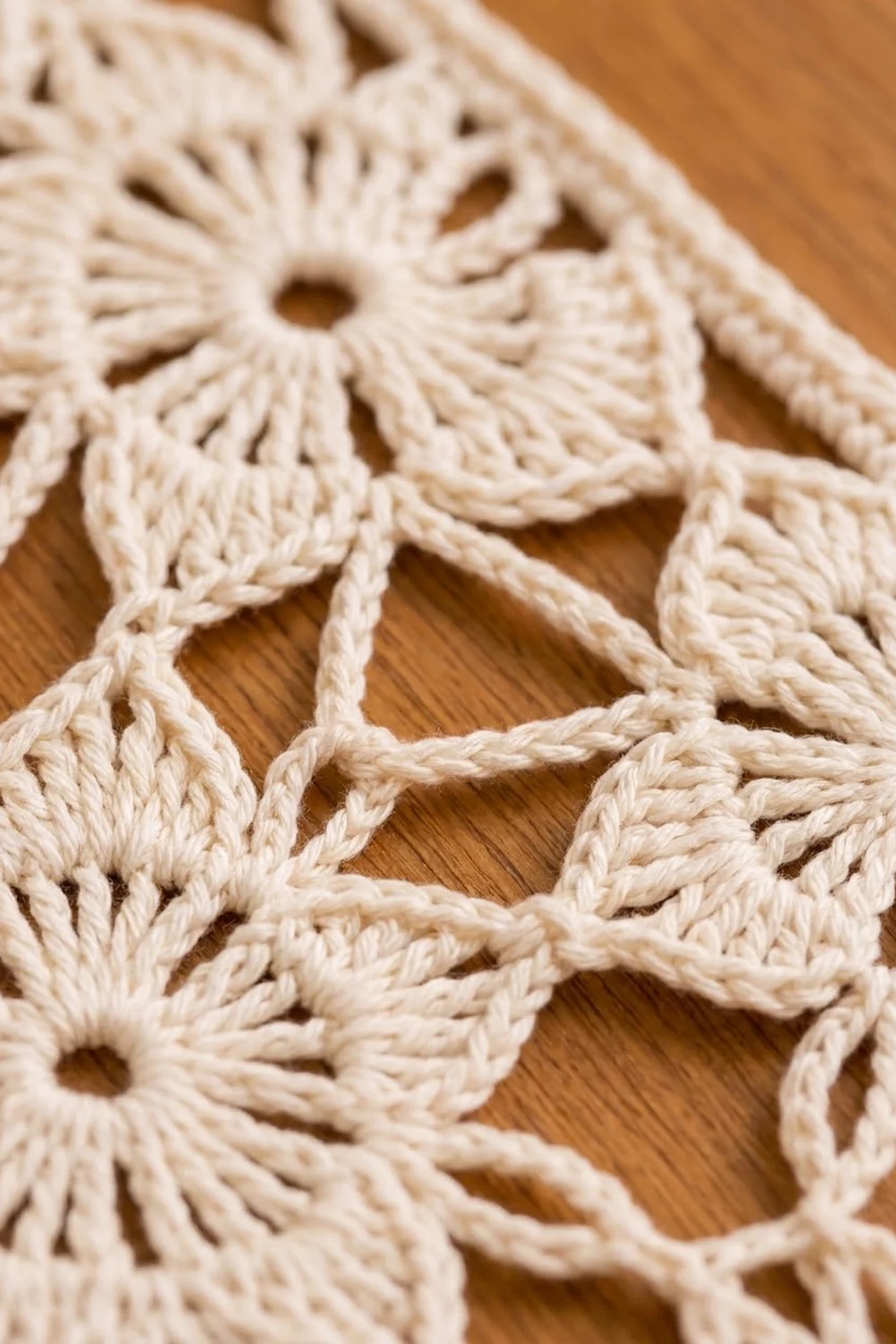
Round 1: Ch 6 and sl st to the first ch to form a ring. Ch 3 (counts as dc), then work 15 dc into the ring. Sl st to the top of the beginning ch-3. (16 dc)
Round 2: Ch 1, then sc in the same st. Ch 3, skip 1 st, sc in the next st. Repeat from * to * 6 more times. Ch 3, skip the last st, and sl st to the first sc. (8 sc and 8 ch-3 sps)
From here, the ch-3 spaces alternate between Space A, where the fan petals go, and Space B, where the diagonal loops go.
Round 3: Sl st into the first ch-3 sp (Space A). Ch 3 (counts as dc), then work 6 dc in the same sp to complete the first fan. In the next ch-3 sp (Space B), work (sc, ch 14, sc). In the next ch-3 sp (Space A), work 7 dc. Repeat from * to * 2 more times. In the last Space B, work (sc, ch 14, sc), then sl st to the top of the beginning ch-3.
(28 dc in 4 fans of 7 dc, 8 sc, and 4 ch-14 loops)
The sc from Round 2 stay underneath and are not worked into again. Each fan should spread into a half-circle, and each ch-14 loop should point diagonally outward.
Round 4 (motif 1, no joins):
Work the first petal over the 7 dc of the first fan as follows. Ch 1, then sc in the first dc, hdc in the next dc, and dc in the next dc. In the 4th (center) dc, work (dc, ch 3, dc) to make the tip. Then dc in the next dc, hdc in the next dc, and sc in the last dc.
To make the loop, sl st in the next sc. Work 8 sc into the ch-14 loop, ch 3 for the loop tip, then work 8 more sc into the same loop. Sl st in the next sc.
Repeat the petal and loop 3 more times, working each petal over the next fan. Sl st to the first sc and fasten off.
Round 4 counts:
- Per petal: 9 sts plus 1 ch-3 tip
- Per loop: 16 sc plus 1 ch-3 tip
- Whole motif: 36 petal sts, 64 loop sc, 8 sl sts, and 8 ch-3 tips (4 petal tips and 4 loop tips)
Working the dc into the center stitch with a ch-3 between them gives each fan its pointed tip. The 16 sc packed onto the ch-14 loop make the corded look with the open center.
Make All Pieces
Work Rounds 1–3 of all 33 motifs the same way. Round 4 changes for motifs 2–33 because they are joined as you go (see Joining).
- Ivory motifs: 33 total (3 per row x 11 rows)
- Tassels: 6 total (3 per short end)
Layout grid (each M is one motif; the numbers show the working order):
Row 1:   M1   M2   M3
Row 2:   M4   M5   M6
Row 3:   M7   M8   M9
Row 4:   M10  M11  M12
Row 5:   M13  M14  M15
Row 6:   M16  M17  M18
Row 7:   M19  M20  M21
Row 8:   M22  M23  M24
Row 9:   M25  M26  M27
Row 10:  M28  M29  M30
Row 11:  M31  M32  M33
Turn every motif so its fan petals point up, down, left and right. The loops then sit on the diagonals.
Joining (Join-As-You-Go)
Method: Work Round 4 as written. When you reach a tip that touches a motif that’s already finished, use the Joining tip instead of ch 3.
Petal joins:
- The left (W) petal tip of a new motif joins the right (E) petal tip of the motif to its left.
- The top (N) petal tip of a new motif joins the bottom (S) petal tip of the motif above it.
Loop joins:
- On an outer edge, two diagonal loops meet. Join the new loop tip to the existing loop tip.
- At an inside crossing, four loops meet, one from each surrounding motif. Join each new loop tip into the first loop tip that was joined at that point, so all four connect at a single spot.
Stitch-to-stitch logic: A join replaces ch 3 with (ch 1, sl st, ch 1). The tip keeps the same 3-stitch length, so the counts from Round 4 don’t change. Joining doesn’t add any stitches.
Tension: Work each joining sl st at the same tension as your chains. A tight sl st pulls the tips together and narrows the diamond openings. A loose one makes the tips sag.
Size checkpoint: After Row 3 (9 motifs), lay the piece flat. It should measure 12 x 12 in (30.5 x 30.5 cm). When all 33 motifs are joined, the piece should measure 12 x 44 in (30.5 x 111.8 cm).
Border
Border gauge: 18 sc = 4 in (10.2 cm) along the edge.
The four corners of the runner are the free outer loop tips of motifs M1, M3, M31 and M33.
Border Round 1 (chain arcs): With the RS facing, join yarn in the free loop tip of the top-left corner (M1). Work (sc, ch 3, sc) in this tip.
Work along the top short edge as follows:
- Ch 7, then sc in the next petal tip.
- Ch 7, then sc around the next joined loop point, working through both joined tips.
- Repeat steps 1–2 across, ending with ch 7 and sc in the last petal tip.
- Ch 7, then work (sc, ch 3, sc) in the corner loop tip.
Work the other three sides the same way and sl st to the first sc.
Round 1 counts per side, not counting the corner groups:
- Short side (3 motifs): 6 ch-7 arcs, 3 petal-tip sc, and 2 loop-point sc
- Long side (11 motifs): 22 ch-7 arcs, 11 petal-tip sc, and 10 loop-point sc
- Each corner: 1 (sc, ch 3, sc) group
- Round total: 56 ch-7 arcs and 60 sc
Each motif adds exactly 2 arcs and 1 petal tip to its side. That gives 3 x 2 = 6 arcs on a short side and 11 x 2 = 22 arcs on a long side. Loop points are only joins between motifs, so there is one fewer than the number of motifs on each side.
Border Round 2 (corded edge): Ch 1. Work 1 sc in each sc and 8 sc in each ch-7 arc. In each corner ch-3 sp, work 3 sc. The middle sc of those 3 is the corner stitch. Sl st to the first sc and fasten off.
Round 2 counts. These include both corner stitches. Each count runs from one corner stitch to the next and also includes the sc on either side of each corner stitch.
- Long side: 1 + 1 + 1 + (22 x 8 = 176) + 11 + 10 + 1 + 1 + 1 = 203 sc
- Short side: 1 + 1 + 1 + (6 x 8 = 48) + 3 + 2 + 1 + 1 + 1 = 59 sc
- Round total: (2 x 203) + (2 x 59) − 4 shared corner stitches = 520 sc
- Cross-check: (56 x 8 = 448) + 60 + (4 x 3 = 12) = 520 ✓
Why the math works: Each motif’s 4 in (10.2 cm) of edge gets 8 + 8 sc in its two arcs, 1 sc at its petal tip, and 1 sc at its loop point. That’s 18 sc, which matches the border gauge of 18 sc = 4 in (10.2 cm). A long side has 11 x 18 = 198 sc, minus the one loop point that is missing at the end, giving 197. Add the 6 corner-area stitches and you get 203. Because the edging lies flat and doesn’t pull, the finished runner measures 12.5 x 44.5 in (31.8 x 113.0 cm).
Tassels (make 6)
- Wrap yarn 40 times around the 5 in (12.7 cm) card.
- Slide a 10 in (25.4 cm) strand under the wraps at the top and tie it tightly.
- Cut the loops at the bottom.
- Wrap another strand 6 times around the tassel 0.75 in (1.9 cm) below the top, then knot it and hide the ends inside.
- Trim the tassel to 4.5 in (11.4 cm).
Use the tie strand to sew one tassel to the border sc at each petal tip on both short ends, for 3 tassels per end.
Final Blocking
- Weave in all the ends first, following the stitch lines so they stay hidden in the lace.
- Pin the runner out to 12.5 x 44.5 in (31.8 x 113.0 cm), RS up. Make sure it is rectangular by checking that both diagonals are the same length.
- Pin each petal tip and each corner loop tip outward so the points are sharp.
- Open the diamond spaces by pinning the 4-way loop joins in straight lines.
- Mist the runner until it is evenly damp but not soaked.
- Let it dry completely, which takes 12–24 hours.
- Unpin it. Comb the tassels gently and trim any uneven strands.
Final Quality-Control Checklist
- [ ] All 33 motifs measure 4 in (10.2 cm) from tip to tip
- [ ] Every fan petal has 9 sts and a ch-3 tip
- [ ] Every loop has 16 sc and a ch-3 tip
- [ ] All four loops meet at a single point at every inside crossing
- [ ] Border Round 1 has 22 arcs on each long side and 6 on each short side
- [ ] Border Round 2 totals 520 sc
- [ ] The runner measures 12.5 x 44.5 in (31.8 x 113.0 cm)
- [ ] All 6 tassels measure 4.5 in (11.4 cm) and are firmly attached
- [ ] No yarn ends are visible from the RS
Troubleshooting
The fans cup or ruffle. Seven dc packed into a ch-3 space can crowd it. Push the stitches together as you work, or make the Round 2 chains a little looser.
The loops twist. Before you start the sc in Round 4, check that the ch-14 isn’t twisted.
The diamonds look uneven. At 4-way crossings, every loop should join into the same first tip. Taking out one join and redoing it usually fixes this.
The border ruffles. Work 7 sc per arc instead of 8 on that stretch. It’s usually better to go down one hook size for the border.
The border pulls in. Make your ch-7 arcs looser, or use a 3.75 mm hook for Round 1.
The runner is too long. Check your motif gauge. Blocking can’t remove more than about 0.5 in (1.3 cm).
Care
Hand wash in cool water with a mild detergent and roll the runner in a towel to remove the water. Then lay it flat and pin it back to 12.5 x 44.5 in (31.8 x 113.0 cm) to dry.

Final Notes
Here’s how the sizes build on each other. The motif rounds grow from 1.25 in (3.2 cm) to 1.75 in (4.4 cm), then 3 in (7.6 cm), and finally 4 in (10.2 cm). Three motifs across make 12 in (30.5 cm), and eleven motifs long make 44 in (111.8 cm). The two-round border at 18 sc per motif edge brings the runner to 12.5 x 44.5 in (31.8 x 113.0 cm). The 4.5 in (11.4 cm) tassels on each end take the full length to 53.5 in (135.9 cm). If each motif is right, everything else comes out right.
Happy crocheting!