
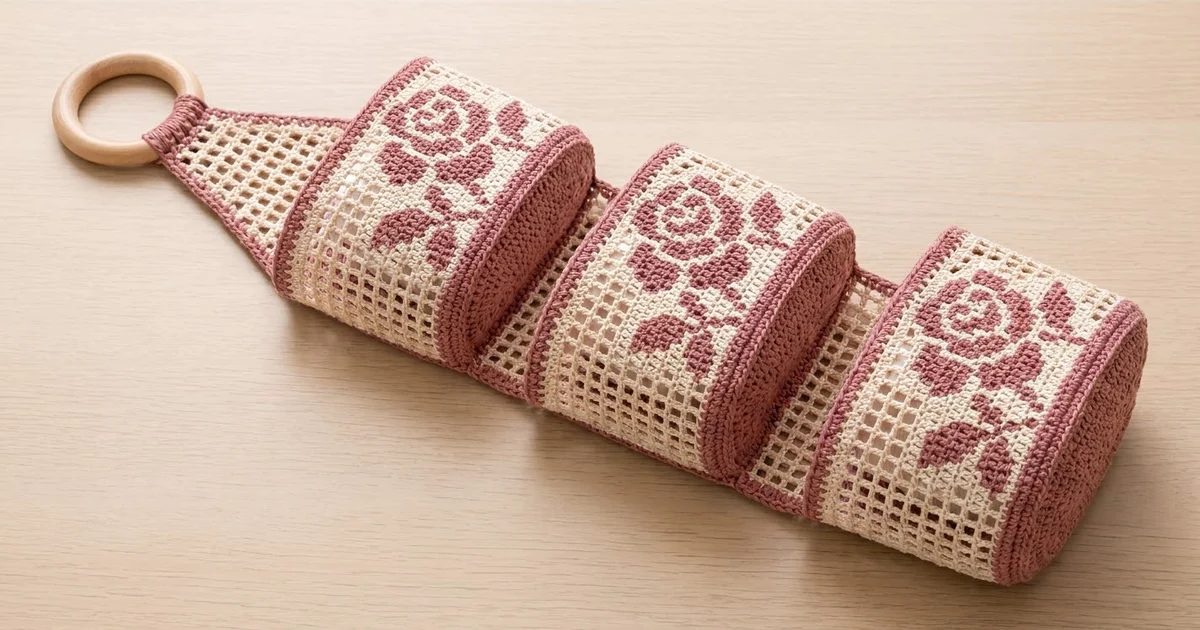
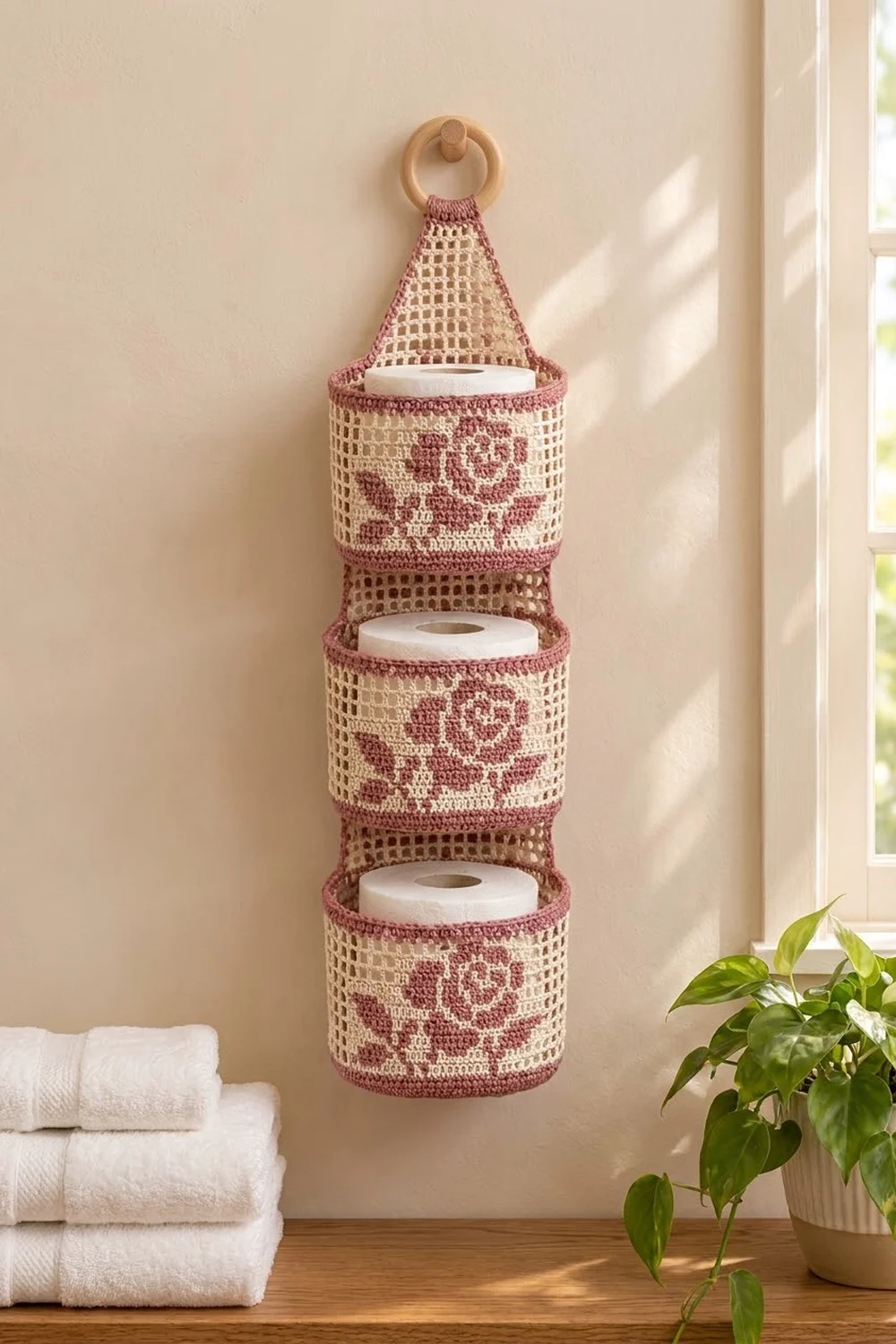
The Rose Trellis holder is a wall-hung organizer that stores three toilet rolls in open cups. A cream filet-mesh back panel tapers into a pointed top and hangs from a wooden ring. Three oval pockets are stitched onto the front, and each one has a dusty-rose filet rose with two leaves across its front.
The palette is just two colors: soft cream for the mesh and dusty rose for the bases, rims, motif and edging. Worked in cotton, the piece looks light and vintage, and it is firm enough to hold its shape when full.
This pattern uses US crochet terms. The finished holder measures 6.6 in (16.8 cm) wide across the bordered panel. The panel is 20.4 in (51.8 cm) tall, and the whole piece measures about 23 in (58.4 cm) from the bottom edge to the top of the ring.
You make the back panel flat in rows of filet mesh, decreasing to form the triangle. You then work a single rose border round and a short strap. Each pocket is worked separately: an oval base in rounds, turned rounds of filet mesh with the colorwork rose, and a solid rim. Finally you sew the pockets onto the panel stitch for stitch, and wrap the strap around the ring.
Finished Size and Construction
- Finished size: 6.6 in x 20.4 in (16.8 cm x 51.8 cm) panel; about 23 in (58.4 cm) overall with ring
- Skill level: Intermediate
- Terminology: US
- Yarn weight: DK (#3) cotton
- Hook: 3.5 mm (E-4)
- Number of pieces: 4 (1 back panel, 3 pockets)
- Layout: pockets stacked vertically in 1 column, with 0.8 in (2.0 cm) of open mesh between them
- Pocket size: base 6 in x 4.8 in (15.2 cm x 12.2 cm); circumference 16 in (40.6 cm); height 4.4 in (11.2 cm)
- Panel size before border: 6.2 in x 20 in (15.7 cm x 50.8 cm)
- Border depth: 0.2 in (0.5 cm), 1 round of sc
Materials
Use a smooth, mercerized or combed DK cotton. Cotton keeps the mesh square and the cups upright, while acrylic tends to sag under the weight of the rolls.
- Cream (Color A): 100 g, about 226 m
- Dusty rose (Color B): 100 g, about 226 m
These quantities include a comfortable margin for swatching and sewing.
Tools:
- 3.5 mm (E-4) crochet hook
- Wooden ring, 2.5 in (6.4 cm) outer diameter
- Tapestry needle
- 6 locking stitch markers
- Scissors
- Blocking mat, rust-proof pins and a spray bottle
Abbreviations (US Terms)
- ch – chain
- sl st – slip stitch
- sc – single crochet
- dc – double crochet
- sk – skip
- st(s) – stitch(es)
- sp – space
- BLO – back loop only
- inc – 2 sc in the same st
- RS / WS – right side / wrong side
- rep – repeat
Special stitches
- Open block: a post dc plus a ch-1 filler.
- Filled block: a post dc plus a dc filler worked into the ch-1 sp below.
- Color change: work the last yarn-over of the previous st with the new color.
Gauge and Checkpoints
- Filet mesh: 10 blocks (20 sts) and 10 rows = 4 in (10.2 cm). Each block is 0.4 in (1.0 cm) square.
- Single crochet: 20 sts and 20 rows = 4 in (10.2 cm). Each sc row is 0.2 in (0.5 cm).
Test one piece first. Make Pocket 1 before you start the panel, because it checks both gauges.
Checkpoints:
- Pocket base after Rnd 12: 6 in x 4.8 in (15.2 cm x 12.2 cm)
- Pocket after Rnd 22: circumference 16 in (40.6 cm); height from the base ridge 3.8 in (9.7 cm)
- Finished pocket: 4.4 in (11.2 cm) tall
- Panel after Row 12: 6.2 in (15.7 cm) wide, 4.8 in (12.2 cm) tall
- Panel after Row 38: 15.2 in (38.6 cm) tall
- Panel after Row 50: 20 in (50.8 cm) tall
If your piece is too big, go down 0.25 mm in hook size. If it is too small, go up 0.25 mm. If only the height is off, check that your dc is pulled to a full, even height. Don’t change any stitch counts, because the pockets are matched to the panel stitch for stitch.
Pocket (make 3)
Oval Base (Color B)
Ch 7.
Rnd 1: Work 3 sc in the 2nd ch from hook and sc in each of the next 4 ch. Work 3 sc in the last ch. Rotate and sc in each of the next 4 ch along the opposite side of the foundation. Join with sl st to the first sc. (14 sts)
Rnd 2: Ch 1. [2 sc in each of the next 3 sts, sc in the next 4] twice. Join. (20 sts)
Rnd 3: Ch 1. [(Sc in the next st, inc) 3 times, sc in the next 4] twice. Join. (26 sts)
Rnd 4: Ch 1. [(Sc in the next 2 sts, inc) 3 times, sc in the next 4] twice. Join. (32 sts)
Rnds 5–12: On each round, work 1 more sc before each inc than on the previous round. Keep the 4-st straight sections unchanged.
- Rnd 5: 38 sts
- Rnd 6: 44 sts
- Rnd 7: 50 sts
- Rnd 8: 56 sts
- Rnd 9: 62 sts
- Rnd 10: 68 sts
- Rnd 11: 74 sts
- Rnd 12: (sc 10, inc) 3 times, sc 4 – all twice (80 sts)
Check the base: it should measure 6 in x 4.8 in (15.2 cm x 12.2 cm).
Rnd 13 (turning ridge): Ch 1, then sc BLO in each st around. Join. (80 sts) Fasten off.
Place a marker in the gap between the 2nd and 3rd sts of the second 4-st straight section. This marks the center back.
Filet Sides (Color A, with Color B motif)
The 40 blocks are numbered by their position around the pocket. Seen from the RS, they run 1 to 40 counterclockwise from the join.
- RS rounds: work the blocks in order 1 → 40, post first and then filler.
- WS rounds: work them 40 → 1, filler first and then post.
- Every round: ch 3 (counts as dc), then work 39 dc posts and 40 fillers. (80 sts)
Rnd 14 (RS): Join A in the st just after the center-back marker. Ch 3, ch 1, sk the next st. [Dc in the next st, ch 1, sk the next st] 39 times. Join to the top of the ch-3. (40 blocks, 80 sts) Turn.
Rnds 15–21 (motif): Work open blocks everywhere except the filled blocks listed below. Work both stitches of each filled block in B.
Join B at block 26 on Rnd 15. Carry B only across blocks 14–26, inside the stitches. Across open blocks in that area, let B float on the inside of the pocket. Because the rounds are turned, B is always waiting at the edge of the motif where the next round enters.
| Round | Side | Filled blocks (B) | Count |
|---|---|---|---|
| Rnd 15 | WS | 15, 16, 20, 24, 25 | 5 |
| Rnd 16 | RS | 14–17, 20, 23–26 | 9 |
| Rnd 17 | WS | 15, 16, 19–22, 24, 25 | 8 |
| Rnd 18 | RS | 18, 19, 21, 22, 23 | 5 |
| Rnd 19 | WS | 18, 20, 21, 23 | 4 |
| Rnd 20 | RS | 18, 19, 22, 23 | 4 |
| Rnd 21 | WS | 19–22 | 4 |
Every motif round still totals 40 blocks (80 sts). Turn after each round, and cut B after Rnd 21.
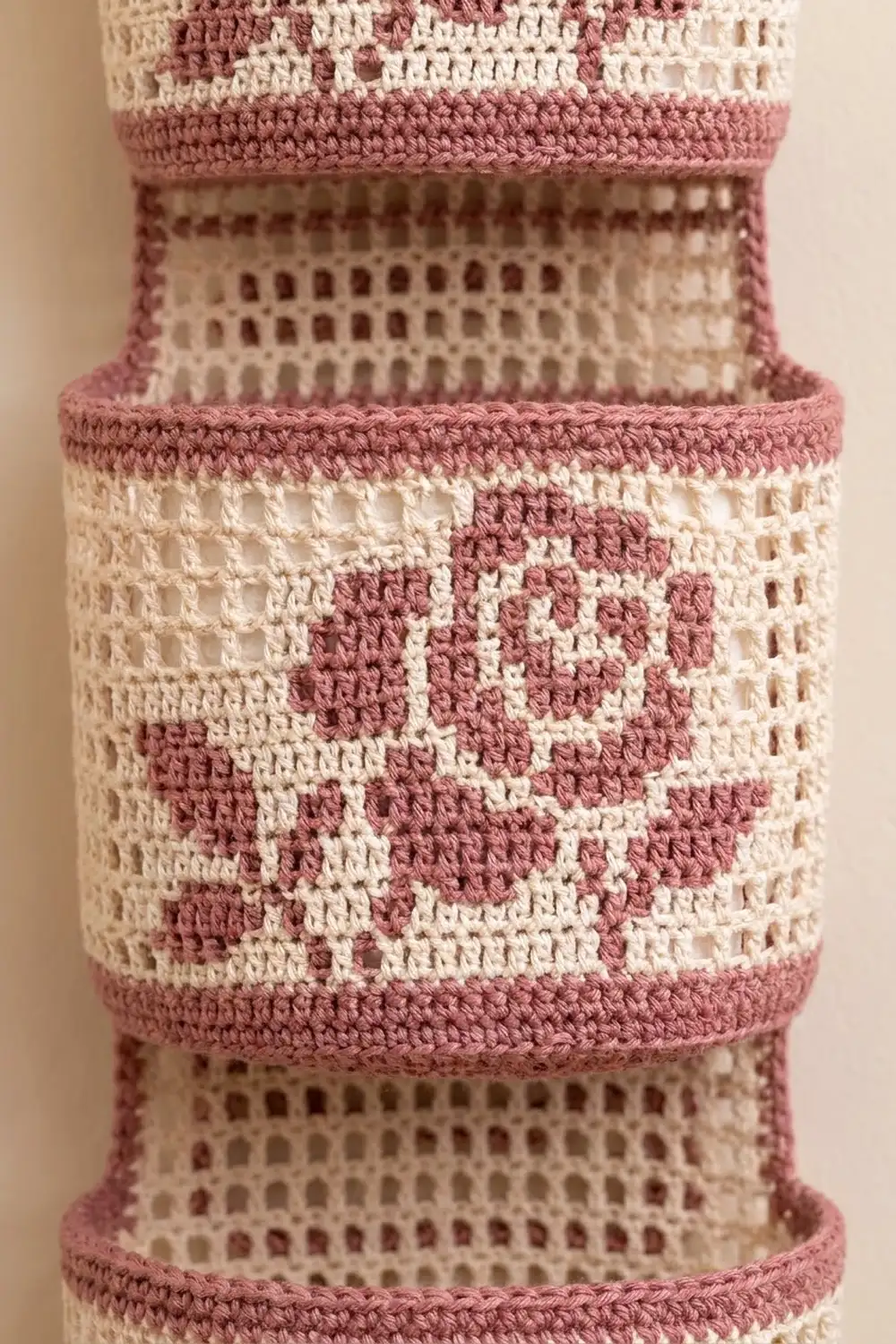
In this layout, Rnds 15–17 make the leaves and stem, and Rnds 18–21 make the rose bloom with its open swirl center. The motif sits on the front of the pocket, opposite the join.
Rnd 22 (RS): Work open blocks only. (40 blocks, 80 sts) Fasten off A.
Rim (Color B)
Rnd 23 (RS): Join B at the join. Ch 1, then sc in each dc and each ch-1 sp around. This is 1 sc per existing st plus 0 added. Join. (80 sts) Do not turn.
Rnds 24–25: Ch 1, sc in each st around. Join. (80 sts) Fasten off.
The finished pocket is 0.2 in ridge + 3.6 in (9.1 cm) of mesh + 0.6 in (1.5 cm) of rim = 4.4 in (11.2 cm) tall. The circumference is 80 sts = 16 in (40.6 cm), which leaves room for a roll about 4.5 in (11.4 cm) wide.
Back section: On Rnd 25 and on Rnd 13, mark the last 15 and first 16 sts of the round. These 31 sts measure 6.2 in (15.7 cm), exactly the panel width. The other 49 sts form the 9.8 in (24.9 cm) front curve.
Back Panel (Color A)
Ch 33.
Row 1 (RS): Dc in the 4th ch from hook (the skipped ch count as a dc) and in each ch across. (31 sts) Turn.
Row 2: Ch 3 (counts as dc). [Ch 1, sk the next st, dc in the next st] 15 times, working the last dc in the top of the turning ch. (15 blocks, 31 sts) Turn.
Rows 3–38: Ch 3, then [ch 1, sk the ch-1 sp, dc in the next dc] 15 times. (15 blocks, 31 sts) Turn after each row.
Check the panel: it should be 15.2 in (38.6 cm) tall and 6.2 in (15.7 cm) wide.
Triangle
The triangle uses two kinds of rows, alternating:
- Decrease row: Sl st in the first dc, the ch-1 sp and the next dc. Ch 3 (counts as dc). Work blocks across until 1 block remains, ending with a dc in the dc before the last ch-1 sp. Turn, leaving that block unworked. This removes 1 block at each end.
- Straight row: Ch 3, then work blocks across with no shaping.
| Row(s) | Type | Blocks | Sts |
|---|---|---|---|
| Row 39 | Decrease | 13 | 27 |
| Row 40 | Straight | 13 | 27 |
| Rows 41–42 | Decrease, then straight | 11 | 23 |
| Rows 43–44 | Decrease, then straight | 9 | 19 |
| Rows 45–46 | Decrease, then straight | 7 | 15 |
| Rows 47–48 | Decrease, then straight | 5 | 11 |
| Rows 49–50 | Decrease, then straight | 3 | 7 |
Fasten off. The panel measures 6.2 in x 20 in (15.7 cm x 50.8 cm), and the triangle is 12 rows = 4.8 in (12.2 cm) tall.
Make All Pieces
- Color A: 1 panel, plus the mesh sides of 3 pockets
- Color B: 3 pocket bases, 3 pocket rims, 3 rose motifs, the panel border and the strap
The finished layout, read from the bottom up, is:
          ( ring )
           [strap]
          /  tri  \         Rows 39–50
   |   POCKET 3   |         Rows 28–38
   |  open mesh   |         Rows 26–27
   |   POCKET 2   |         Rows 15–25
   |  open mesh   |         Rows 13–14
   |   POCKET 1   |         Rows 2–12
   |  base row    |         Row 1
Joining
Sew the pockets on before the border so the border round covers the panel edges cleanly. Use B and a whipstitch, working 1 panel st to 1 pocket st.
Placement:
| Base sewn to the top of | Rim sewn to the top of | Covers | |
|---|---|---|---|
| Pocket 1 | Row 1 (0.4 in / 1.0 cm) | Row 12 (4.8 in / 12.2 cm) | 11 rows = 4.4 in (11.2 cm) |
| Pocket 2 | Row 14 (5.6 in / 14.2 cm) | Row 25 (10.0 in / 25.4 cm) | 11 rows = 4.4 in (11.2 cm) |
| Pocket 3 | Row 27 (10.8 in / 27.4 cm) | Row 38 (15.2 in / 38.6 cm) | 11 rows = 4.4 in (11.2 cm) |
Each pocket covers the same 11 rows, which match its 4.4 in (11.2 cm) height, so the pockets sit flat without puckering.
Stitch logic:
- Rim: Sew the 31 marked back sts of Rnd 25 to the 31 sts along the top of the target row (16 dc and 15 ch-1 sps, or 31 dc on Row 1). Join 1 stitch to 1 stitch.
- Base: Sew the 31 marked sts of Rnd 13 to the 31 sts of the base row the same way.
Nothing is added or skipped, so the cup’s back lies flat while the 49 front sts bow forward.
Tension: Pull each whipstitch just snug enough to close the gap, without gathering the mesh. Pin both ends and the center of each seam first.
Check the size: After joining, the panel should still measure 6.2 in (15.7 cm) wide at every seam.
Border (Color B)
Border gauge: 2 sc per filet row-end. A row is 0.4 in (1.0 cm) and 2 sc at 5 sts per inch is also 0.4 in, so the edge stays flat.
Border Rnd (RS): Join B in the first foundation ch at the bottom-right corner, then work each section in order:
| Section | How to work it | Sts |
|---|---|---|
| Bottom | 3 sc in the first st, sc in the next 29, 3 sc in the last st (counts both corners) | 35 |
| Left rectangle side | 2 sc in each row-end, Rows 1–38 | 76 |
| Left triangle side | 2 sc per row-end on Rows 39–50 (24), plus 2 sc across each of the 6 stepped blocks (12) | 36 |
| Top | Sc in each st of Row 50 (no corner incs) | 7 |
| Right triangle side | Same as the left side | 36 |
| Right rectangle side | Same as the left side | 76 |
Join to the first sc. Total: 35 + 76 + 36 + 7 + 36 + 76 = 266 sts. Fasten off.
Why the math works:
- Sides: 2 sc for each 0.4 in row matches the sc gauge exactly.
- Bottom: 31 sts, plus 2 extra sc in each corner st, gives 35. Those 4 extras turn the corners without adding width.
- Triangle: Each step exposes 1 block (2 sts), so 2 sc covers it.
Strap
Row 1: With RS facing, join B in the first of the 7 top sc. Ch 1, sc in each st. (7 sts) Turn.
Rows 2–12: Ch 1, sc in each st. (7 sts) Turn after each row.
The strap measures 1.4 in x 2.4 in (3.6 cm x 6.1 cm). Wrap it through the ring to the WS and sew Row 12 across the back of the border, leaving a 12 in (30.5 cm) tail to sew with.
Final Blocking
- Weave in all ends along solid sc or dc, never across open mesh.
- Spray the whole piece until it is damp.
- Pin the panel flat to 6.6 in x 20.4 in (16.8 cm x 51.8 cm), keeping the side edges straight.
- Pin each mesh column straight, then square the blocks to 0.4 in (1.0 cm).
- Stuff each pocket with a toilet roll wrapped in plastic so the cups dry rounded.
- Leave it to dry completely, usually 12–24 hours.
Final Quality-Control Checklist
- The panel has 31 sts across and 50 rows.
- Every pocket has 80 sts per round and is 4.4 in (11.2 cm) tall.
- Each rose has its filled blocks in the listed positions, with no stray B floats on the outside.
- All three seams are 31 sts to 31 sts, and there is 0.8 in (2.0 cm) of open mesh between pockets.
- The border has 266 sts and the corners are flat.
- The strap is sewn securely and the ring hangs centered.
Troubleshooting
- Pocket base ruffles: Your sc gauge is loose. Go down a hook size for Rnds 1–13 only.
- Pocket is too short for the roll: Your dc is short. Pull up a taller loop before you yarn over.
- Mesh blocks are rectangles: Adjust the height of your dc, not the stitch counts.
- B shows through the open mesh: Keep the floats on the inside and loosen them slightly.
- The rose leans: The motif shifts by one block if your round starts in the wrong place. Restart Rnd 14 right after the center-back marker.
- Panel edges wave: Use exactly 2 sc per row-end in the border.
Care
Hand wash in cool water, press out the water in a towel and lay flat to dry, reshaping the cups over a roll. Do not tumble dry.
Final Notes
The measurements build on each other:
- Each 0.4 in (1.0 cm) block gives a 31-st panel that is 6.2 in (15.7 cm) wide.
- Each pocket’s 31 back stitches match the panel’s 31 stitches exactly.
- Eleven 0.4 in rows hold a 4.4 in (11.2 cm) pocket.
- Fifty rows make a 20 in (50.8 cm) panel.
- One border round brings it to 6.6 in x 20.4 in (16.8 cm x 51.8 cm).
Check each measurement as you go, and the pieces will fit together without adjustment.
Happy crocheting!