

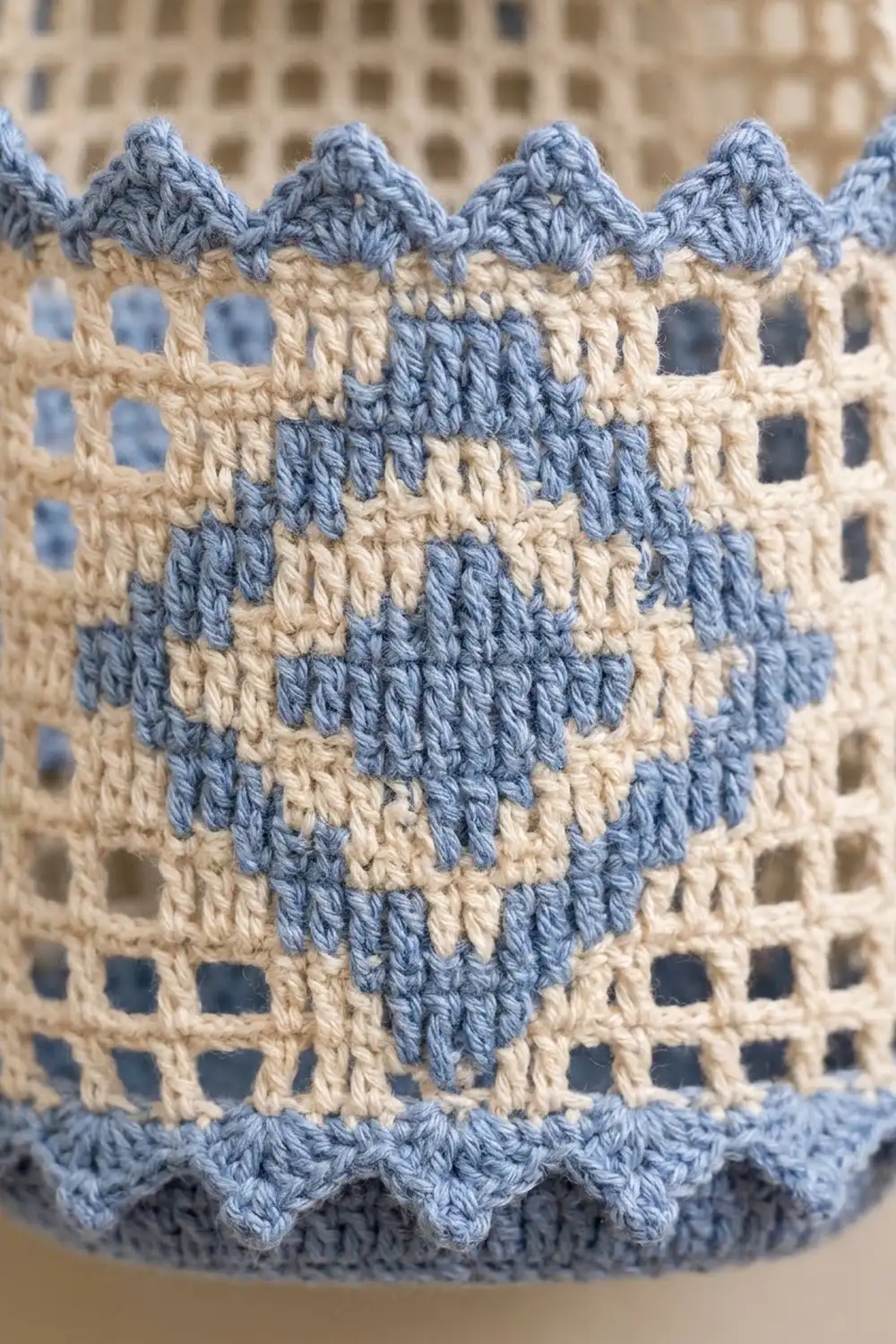
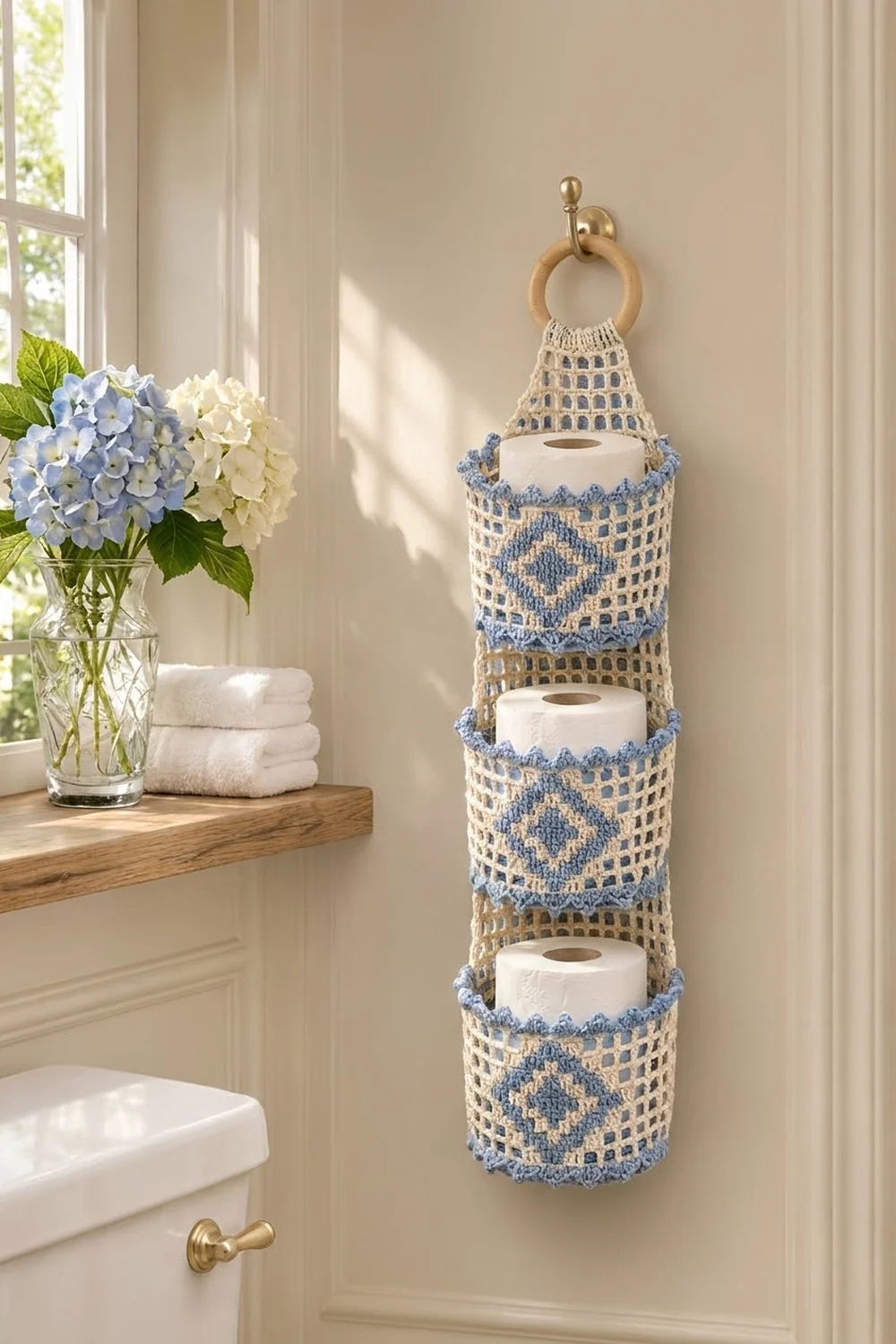
This hanging holder pairs crisp ecru filet mesh with soft cornflower blue. Three round pockets hang from one long mesh strip, and each pocket shows a blue diamond-within-a-diamond on the front. Small blue picot scallops trim the top and bottom of every pocket, and a natural wooden ring at the top holds everything up.
The look is cottage-style and airy. The open mesh lets the rolls show through, while the solid blue bases and picot edges give the piece a defined shape. It suits a guest bathroom, a powder room, or any small space with little shelf room.
This pattern uses US crochet terms. The finished holder is about 24 in (61.0 cm) long including the ring. Each pocket is about 5 in (12.7 cm) across and 4.75 in (12.1 cm) tall. The back strip is 3.8 in (9.7 cm) wide.
Construction is simple. Each pocket starts as a flat blue hdc circle. Its wall is then worked upward in filet mesh rounds, with the diamond worked in blue blocks, and the rims are finished with picot trim. The back strip is worked flat in rows, tapered at the top, and closed around the ring. Last, the pockets are sewn to the strip.
Finished Size and Construction
- Finished size: about 24 in (61.0 cm) long × 5 in (12.7 cm) wide at the pockets
- Skill level: Intermediate (filet mesh, color changes, sewing)
- Terminology: US crochet terms
- Yarn weight: Sport (2), mercerized or matte cotton
- Hook: 3.5 mm (E-4)
- Number of pieces: 4 (1 back strip and 3 pockets)
- Layout: 3 pockets stacked vertically on one strip, with a 1-row gap between pockets
- Pocket size: 5 in (12.7 cm) base diameter, 4.75 in (12.1 cm) tall
- Pocket size before border: 4.25 in (10.8 cm) tall
- Border depth: 0.5 in (1.3 cm) at the top rim (sc band plus picots)
Materials
Use a smooth cotton so the mesh squares stay sharp and the piece holds its shape. Cotton also stands up to bathroom humidity better than acrylic.
- Ecru (Color A): 100 g, about 300 m (328 yd)
- Cornflower blue (Color B): 80 g, about 240 m (262 yd)
These amounts include roughly a 15% margin for swatching and joining.
Tools:
– 3.5 mm (E-4) crochet hook
– Wooden ring, 2.75 in (7.0 cm) outer diameter
– Tapestry needle
– 4 locking stitch markers
– Scissors
– Rust-proof pins and a blocking mat
– A cardboard tube or rolled towel, about 5 in (12.7 cm) across, for blocking
Abbreviations (US Terms)
- ch – chain
- sl st – slip stitch
- sc – single crochet
- hdc – half double crochet
- dc – double crochet
- BLO – back loop only
- FLO – front loop only
- sp – space
- st(s) – stitch(es)
- beg – beginning
Special stitches:
- Mesh (open): ch 1, skip 1 st (or ch-1 sp), dc in next dc. One mesh is 2 sts wide: the dc and its ch-1 sp.
- Block (filled): dc in next ch-1 sp, dc in next dc. A block is 2 sts wide and fills the square.
- Picot scallop: in one st, work (dc, ch 3, sl st in 3rd ch from hook, dc).
Gauge and Checkpoints
Gauge: 5 mesh (10 sts) = 2 in (5.1 cm) wide, and 5 mesh rows = 2 in (5.1 cm) tall. That makes 1 mesh square 0.4 in (1.0 cm).
Before you start, make a swatch. Ch 27 and work 12 rows of open mesh (pattern below). Measure 5 mesh across and 5 rows up in the center of the swatch.
- If your swatch is too big, go down 0.25 mm in hook size.
- If it’s too small, go up 0.25 mm.
- If the squares aren’t square, keep your hook size and adjust how high you pull up the dc loop.
Test one pocket first. It’s the piece where fit matters most.
Checkpoints:
– Base, Rnd 6: 3 in (7.6 cm) across
– Base, Rnd 10: 5 in (12.7 cm) across, flat or very slightly cupped
– Pocket wall after Rnd 16: 2 in (5.1 cm) above the base fold
– Pocket before border (through Rnd 21): 4.25 in (10.8 cm) tall
– Strip after Row 10: 4 in (10.2 cm) long; after Row 50: 20 in (50.8 cm)
Pocket (Make 3)
Base
Use Color B.
Rnd 1: Make a magic ring. Ch 2 (doesn’t count as a st here or in later rounds), work 8 hdc in the ring, then sl st to the first hdc. (8 sts)
Rnd 2: Ch 2, work 2 hdc in each st around, then join. (16 sts)
Rnd 3: Ch 2, hdc in next st, 2 hdc in next st; rep around, join. (24 sts)
Rnd 4: Ch 2, hdc in next 2 sts, 2 hdc in next st; rep around, join. (32 sts)
Rnds 5–10: Keep increasing 8 sts per round. Work 1 more plain hdc between increases each round.
– Rnd 5: 40 sts
– Rnd 6: 48 sts (checkpoint: 3 in / 7.6 cm)
– Rnd 7: 56 sts
– Rnd 8: 64 sts
– Rnd 9: 72 sts
– Rnd 10: 80 sts (checkpoint: 5 in / 12.7 cm)
Rnd 11 (turning round): Ch 1, sc BLO in each st around, then join. (80 sc)
The free front loops of Rnd 10 stay available for the bottom picot trim. Place a marker in the joining st of Rnd 11. This point is center back. Fasten off Color B.
Wall
Rnd 12: Join Color A with a sl st in the marked st. Ch 4 (counts as dc + ch 1), skip next sc. Then work dc in next sc, ch 1, skip next sc 39 times. Sl st in the 3rd ch of the beg ch-4. (40 mesh, 80 sts)
Numbering the mesh: Mesh 1 is the beg ch-4. Every later mesh is “dc in next dc, ch 1”, numbered 2 through 40. Mesh 20 sits at the exact center front.
Basic round (all open): Ch 4 (counts as dc + ch 1). Then work dc in next dc, ch 1 39 times, and join to the 3rd ch of the beg ch-4. (40 mesh, 80 sts)
In Rnds 13–21, work each round as the basic round. Replace the listed mesh numbers with blocks worked in Color B.
Color changes: Finish the last dc before a block with a yarn over in the new color. Within the motif zone (mesh 16–24), carry the unused color along the top of the previous round and work over it so it’s hidden. Outside the zone, leave Color B hanging on the inside of the wall.
Diamond motif (blocks in Color B):
– Rnd 13: block at mesh 20
– Rnd 14: blocks at mesh 19 and 21
– Rnd 15: blocks at mesh 18 and 22
– Rnd 16: blocks at mesh 17, 20, and 23 (checkpoint: 2 in / 5.1 cm above the fold)
– Rnd 17: blocks at mesh 16, 19, 20, 21, and 24
– Rnd 18: same as Rnd 16
– Rnd 19: same as Rnd 15
– Rnd 20: same as Rnd 14
– Rnd 21: same as Rnd 13
Every round still totals 40 mesh, 80 sts. A block replaces a ch-1 with a dc, so the stitch count doesn’t change.
The outline diamond is 9 mesh wide (mesh 16–24) and 9 rounds tall. The 3-block row in Rnd 17 and the single blocks at mesh 20 in Rnds 16 and 18 form the small solid center diamond. Fasten off Color A.
Checkpoint: The pocket now measures 4.25 in (10.8 cm) from the base fold to the top of Rnd 21.
Back Strip (Make 1)
Use Color A.
Ch 21.
Row 1: Dc in 5th ch from hook (the skipped ch count as dc + ch 1). Then work ch 1, skip 1 ch, dc in next ch 8 times. Turn. (9 mesh, 19 sts: 10 dc + 9 ch-1 sps)
Row 2: Ch 4 (counts as dc + ch 1). Work dc in next dc, ch 1 7 times, then dc in 3rd ch of the turning ch. Turn. (9 mesh, 19 sts)
Rows 3–50: Repeat Row 2. (9 mesh, 19 sts each row)
Checkpoints: 4 in (10.2 cm) after Row 10, and 20 in (50.8 cm) after Row 50. The strip is 3.8 in (9.7 cm) wide.
Taper
Each taper row leaves one mesh unworked at each end.
Row 51: Sl st in the first ch-1 sp and the next dc. Ch 4 (counts as dc + ch 1). Work dc in next dc, ch 1 5 times, then dc in next dc. Leave the last mesh unworked and turn. (7 mesh, 15 sts)
Row 52: Sl st in the first ch-1 sp and the next dc. Ch 4. Work dc in next dc, ch 1 3 times, then dc in next dc. Turn. (5 mesh, 11 sts)
Row 53: Sl st in the first ch-1 sp and the next dc. Ch 4. Work dc in next dc, ch 1, then dc in next dc. Turn. (3 mesh, 7 sts)
The taper adds 1.2 in (3.0 cm).
Row 54 (ring row): Hold the wooden ring just above the work. Ch 1. Work 1 sc in each of the 7 sts, enclosing the ring in every sc. (7 sc)
Fasten off and leave a 10 in (25.4 cm) tail. Wrap the tail tightly around the base of the gathered sts 5 times, then secure it.
Make All Pieces
- Pockets: 3. Each uses about 25 g of Color B and 20 g of Color A.
- Back strip: 1, all in Color A.
Layout (strip rows, bottom to top):
Rows 51–54  | taper + ring
Rows 39–50  | open strip (4.8 in / 12.2 cm)
Rows 27–38  | TOP POCKET
Row 26      | gap
Rows 14–25  | MIDDLE POCKET
Row 13      | gap
Rows 1–12   | BOTTOM POCKET
Joining
Complete the pocket borders (next section) before joining, but leave the bottom picot trim off until after joining.
Back zone: On each pocket, the back zone is mesh 36–40 plus mesh 1–4, which makes 9 mesh. Its edges are the dc of mesh 36 and the dc of mesh 5. In Rnd 11, the zone covers 19 sc (9 mesh × 2 + 1 closing st). That matches the strip’s 19 sts per row.
Alignment: Center mesh 40 over the strip’s mesh 5. Each pocket round lines up with one strip row:
– Bottom pocket: Rnd 11 on Row 1, Rnds 12–21 on Rows 2–11, Rnd 22 on Row 12
– Middle pocket: Rnd 11 on Row 14, Rnds 12–21 on Rows 15–24, Rnd 22 on Row 25
– Top pocket: Rnd 11 on Row 27, Rnds 12–21 on Rows 28–37, Rnd 22 on Row 38
Method: Use Color A and a tapestry needle to whipstitch.
1. Join the 19 zone sc of Rnd 11 to the 19 sts of the matching strip row, one-to-one.
2. Join the 19 zone sc of Rnd 22 the same way.
3. Up each side, take 1 whipstitch per round, joining the pocket’s edge dc to the strip’s edge dc. That’s 10 stitches per side.
4. Tack the center dc of mesh 40 to the strip’s center every 2 rounds.
Tension: Snug, not tight. The mesh should stay square, with no puckering.
Size checkpoint: After joining, the edges of the bottom pocket line up with the strip’s bottom edge, and the pockets sit 0.4 in (1.0 cm) apart.
Border
The border is the picot trim on each pocket. Border gauge: 1 scallop = 4 sts = 0.8 in (2.0 cm).
Top rim
Rnd 22: Join Color B at center back. Ch 1, then sc in each dc and each ch-1 sp around and join. (80 sc: 40 dc + 40 ch-sps, 1 sc each)
Rnd 23: Ch 1. Work sc in next st, skip 1 st, picot scallop in next st, skip 1 st 20 times, then join. (20 scallops) Fasten off.
Bottom trim
Do this after joining. Hold the pocket upside down and join Color B in a free front loop of Rnd 10 at center back. Work the same repeat into the 80 free loops. Through the 9-mesh back zone (19 loops), work sl sts only, so the trim lies flat against the strip. Finish the remaining 61 loops in pattern for 15 scallops, then sl st back to the start.
Why the math works
80 sts ÷ 4 sts per scallop = exactly 20 scallops, with no leftover sts. Each scallop covers 2 mesh, so 20 × 0.8 in = 16 in (40.6 cm), which matches the 80-st rim at 5 sts per inch. Ten scallops sit on the front half and ten on the back half, and the center front scallop lands above mesh 19–20, so the diamond sits under the center of the trim.
Final Blocking
- Weave in all ends inside the pockets, following the blue blocks where you can.
- Soak the holder in cool water for 10 minutes, then press out the water in a towel.
- Slide a 5 in (12.7 cm) tube or rolled towel into each pocket.
- Lay the piece flat and pin the strip straight to 3.8 in (9.7 cm) wide and 20 in (50.8 cm) long, plus the taper.
- Use your fingers to square up the mesh, then pin the picot points open.
- Let it dry completely, then remove the forms.
Final Quality-Control Checklist
- [ ] Every pocket wall has 40 mesh per round.
- [ ] The diamonds are centered on the front of each pocket and line up vertically.
- [ ] Each rim has 20 scallops.
- [ ] The strip is 9 mesh wide through Row 50.
- [ ] The ring is wrapped firmly and doesn’t twist.
- [ ] Rnd 22 of each pocket is joined at all 19 sts.
- [ ] Each pocket holds a 4.5 in (11.4 cm) roll easily.
Troubleshooting
- The base ruffles: Your hdc are too loose. Go down one hook size for the base only.
- The base cups too much: Check that each round adds exactly 8 sts.
- The diamond looks off-center: Recount from the beg ch-4. Mesh 20 should sit opposite the marker.
- Blue shows through the open mesh: Carry Color B only within mesh 16–24.
- The mesh slants: Make the joining seam the same way every round.
- The pockets sag: Add more center tacks to the strip.
Care
Hand wash in cool water and lay flat to dry, reshaping the pockets over a tube. Don’t hang it while wet.
Final Notes
Each measurement leads to the next. The 0.4 in (1.0 cm) mesh square sets the 80-st, 16 in (40.6 cm) rim. That rim fits the 5 in (12.7 cm) base. The 10 mesh rounds make the 4.25 in (10.8 cm) wall, and the border brings each pocket to 4.75 in (12.1 cm). Three pockets fit within 38 strip rows, and the 50-row strip, taper, and ring finish at about 24 in (61.0 cm).
Happy crocheting!