

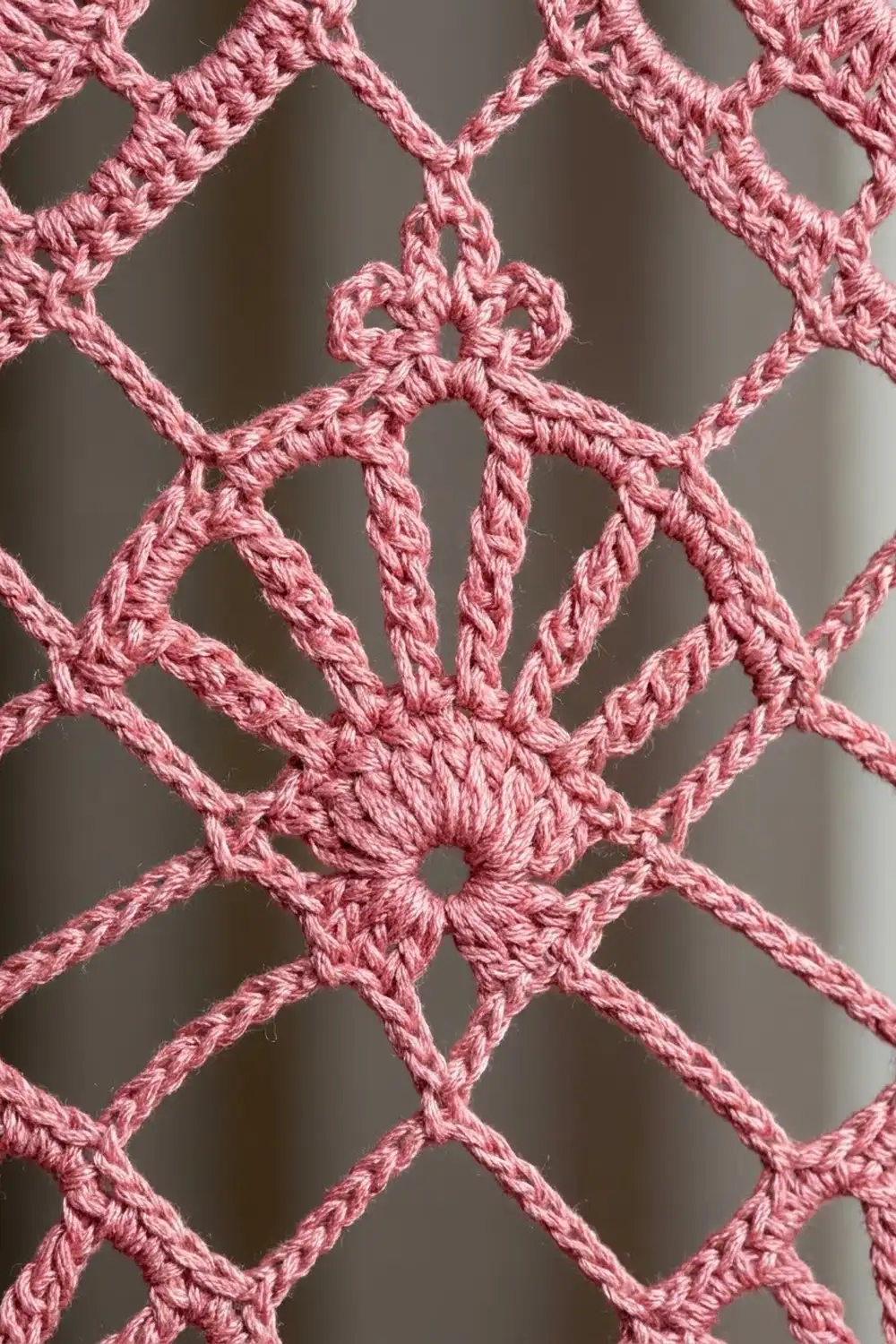
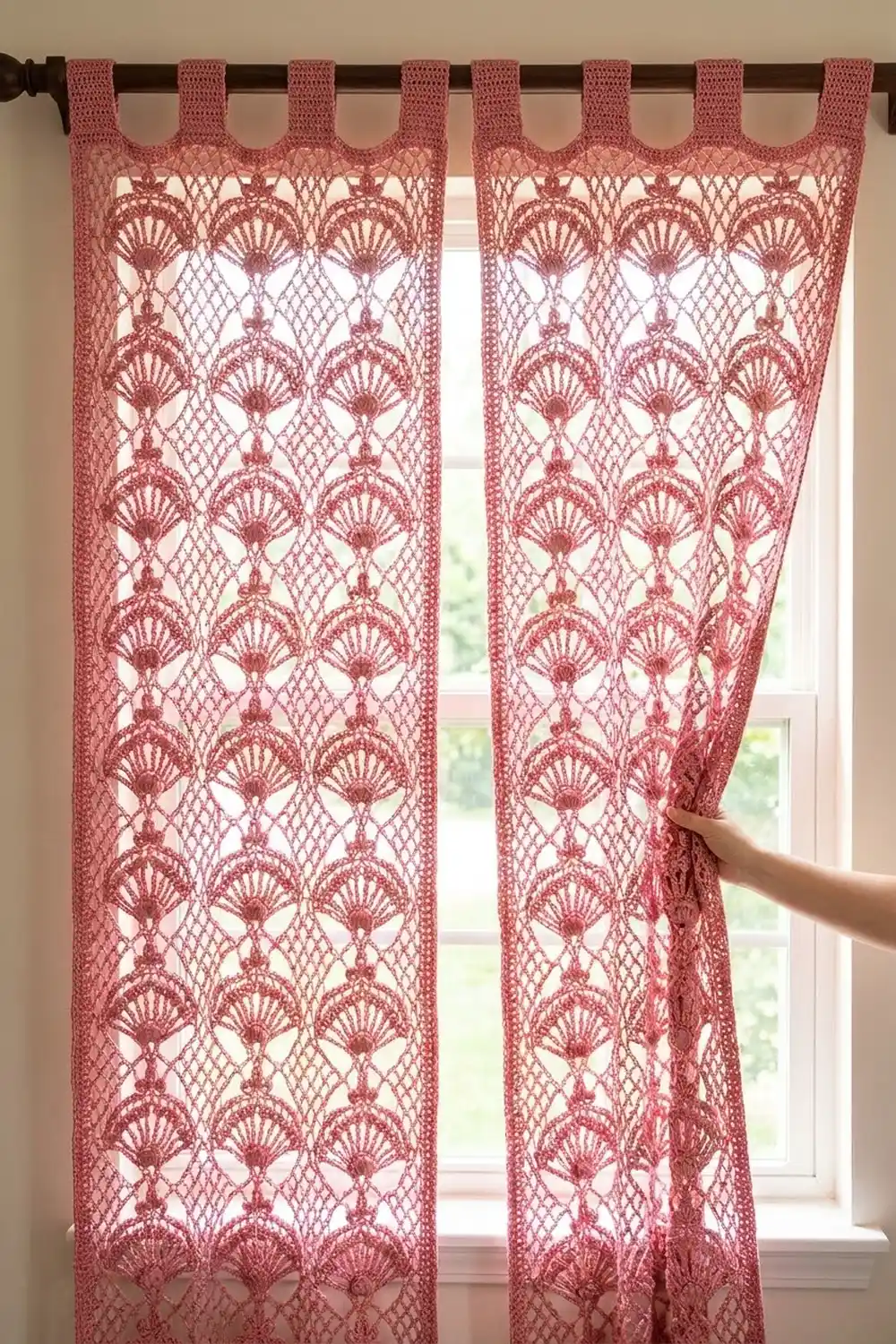
The Rosewater Fan Lace Curtain Panel is a soft pink lace panel built from columns of fans. Each fan has 8 treble spokes around a puffy center, sits inside a light chain frame, and has a small three-loop trefoil above it. Chain arches run between the columns and form an open diamond lattice that lets daylight through.
The whole panel uses one color, a warm rose pink, in a worsted-weight cotton. Hung from a wooden rod, it gives a romantic, vintage look that still feels light. Seven fold-over tabs along the top edge hold it on the rod.
This pattern uses US crochet terms. One finished panel measures 37¼ in (94.6 cm) wide by 81½ in (207.0 cm) long, not counting the tab loops. With the 3 in (7.6 cm) tab loops added, the panel hangs about 84½ in (214.6 cm) from the top of the rod.
Each panel is a single piece worked flat in rows. You work a foundation row of single crochet, repeat a 4-row lace pattern 32 times, and finish with a flat single crochet row. Then you add a 2-round border and crochet the tabs straight onto the top edge. The photo shows a pair of panels, so you make two identical panels. They are never joined to each other.
Finished Size and Construction
- Finished size (one panel): 37¼ x 81½ in (94.6 x 207.0 cm), excluding tabs
- Skill level: Intermediate
- Terminology: US
- Yarn weight: Worsted (#4), cotton or cotton blend
- Hook: 5.0 mm (H-8)
- Number of pieces: 2 separate panels (a pair), plus 7 tabs worked onto each panel
- Layout: Each panel is 12 fan columns wide and 32 fans tall
- Pattern repeat size: 3 in (7.6 cm) wide x 2½ in (6.4 cm) tall
- Size before border: 36¼ x 80½ in (92.1 x 204.5 cm)
- Border depth: ½ in (1.3 cm) on each edge
Materials
Choose a smooth, mercerized or matte cotton in worsted weight, about 170 m per 100 g. Cotton gives crisp stitch definition, hangs well, and stands up to sunlight and washing better than most acrylics. Stay away from fuzzy or very stretchy yarns, because they hide the fans and make the panel sag.
- Rose pink: 2,800 g / 4,760 m for the pair (about 1,400 g / 2,380 m per panel)
- 5.0 mm (H-8) crochet hook
- Tapestry needle
- Stitch markers (at least 10)
- Measuring tape
- Blocking space large enough for a full panel (clean floor, foam mats, or a bedsheet over carpet), plus rust-proof pins
- Spray bottle
- Curtain rod up to 1½ in (3.8 cm) across
The yarn amounts already include a margin of about 8% for your gauge swatch and for small differences in tension.
Abbreviations (US Terms)
- ch – chain
- sl st – slip stitch
- sc – single crochet
- dc – double crochet
- tr – treble crochet
- sk – skip
- sp – space
- st(s) – stitch(es)
- RS / WS – right side / wrong side
- rep – repeat
Puff stitch (puff): (Yarn over, insert hook in stitch, pull up a loop to about ¾ in / 1.9 cm tall) 3 times, then yarn over and pull through all 7 loops on hook.
Fan: Work (4 tr, puff, 4 tr) all in the same stitch. That makes 9 stitches: the puff is the 5th one and sits low at the center.
Trefoil: Work (sc, ch 3, sc, ch 4, sc, ch 3, sc) all in the same space. That makes 14 stitches (4 sc + 10 ch) and gives 3 loops. The middle loop is the ch-4 loop.
Gauge and Checkpoints
Gauge: 4 sc = 1 in (2.5 cm) in the foundation and final rows. One 12-stitch pattern repeat = 3 in (7.6 cm) wide. One 4-row repeat (Rows 2–5) = 2½ in (6.4 cm) tall after blocking. Sc tab rows: 4 rows = 1 in (2.5 cm).
Test swatch: Ch 38. Work Row 1 (37 sc), then Rows 2–5 three times, then the Final Row. Block the swatch. It should measure 9¼ in (23.5 cm) wide by 8 in (20.3 cm) tall: ¼ in (0.6 cm) for Row 1, 7½ in (19.1 cm) for three repeats, and ¼ in (0.6 cm) for the Final Row.
Checkpoints while you work the panel (blocked or lightly stretched):
- After Row 1: 36¼ in (92.1 cm) wide.
- After 8 repeats: 20¼ in (51.4 cm) tall.
- After 16 repeats: 40¼ in (102.2 cm) tall.
- After 24 repeats: 60¼ in (153.0 cm) tall.
- After the Final Row: 80½ in (204.5 cm) tall.
If your swatch is too big, use a hook 0.5 mm smaller. If it is too small, use a hook 0.5 mm larger. Lace stretches when you block it, so check the height after blocking, not before. If the width matches but the height is short, make your trebles a little taller and loosen the chain arches.
Panel Pattern
Each pattern repeat is 12 stitches, plus 1 stitch to balance the edge. The panel is 12 repeats wide.
Foundation: Ch 146.
Row 1 (WS): Sc in 2nd ch from hook and in each ch across. Turn. (145 sc)
Row 2 (RS, Fan Row): Ch 1, sc in first sc, sk next 5 sc, Fan in next sc, sk next 5 sc, sc in next sc; rep from * across. Turn. (12 Fans + 13 sc = 121 sts)*
Every Fan rises from a single point, so its spokes spread out from the puff center like the photo shows.
Row 3 (WS, Frame Row): Ch 6 (counts as tr + ch 2), sc in 3rd st of next Fan, ch 3, sc in 7th st of same Fan, ch 2, tr in next sc, ch 2; rep from * across, ending the last rep at ** with the tr in the last sc. Turn. (13 tr + 24 sc + 12 ch-3 sps + 24 ch-2 sps = 121 sts)*
The ch-3 passes over the puff and leaves the center open as a framed bobble. The tr posts make the vertical bars between the columns.
Row 4 (RS, Trefoil Row): Ch 3 (counts as dc), ch 4, sk ch-2 sp and sc, Trefoil in next ch-3 sp, ch 4, sk sc and ch-2 sp, dc in next tr; rep from * across, working the last dc in the 4th ch of the turning ch-6. Turn. (13 dc + 12 Trefoils of 14 sts + 24 ch-4 = 277 sts)*
Row 5 (WS, Net Row): Ch 1, sc in first dc, ch 5, sc in ch-4 center loop of next Trefoil, ch 5, sc in next dc; rep from * across, working the last sc in the top of the turning ch-3. Turn. (25 sc + 24 ch-5 sps = 145 sts)*
Row 5 brings the count back to 12 stitches per repeat, which is how the fan rows stay aligned. Its ch-5 arches meet at the dc posts and make the X-shaped diamonds between the columns.
Rows 6–129: Work Rows 2–5 another 31 times, for 32 repeats in total. From now on, in every Fan Row, skip each ch-5 sp where Row 2 tells you to skip 5 sc. The Fan goes into the sc sitting on top of each Trefoil, and the single sc goes into the sc above each dc. Stitch counts stay the same as above: 121, 121, 277, 145.
Row 130 (RS, Final Row): Ch 1, sc in first sc, 5 sc in next ch-5 sp, sc in next sc; rep from * across. Do not turn or fasten off. (145 sc)*
Check: 12 repeats x (5 + 1 + 5 + 1) + 1 = 145 sc, which matches Row 1. The top and bottom edges are now the same width, 36¼ in (92.1 cm).
Make the Second Panel
The photo shows a pair. Work a second panel exactly like the first, using the same hook and checking the same measurements, so both panels hang at the same length. The panels are hung side by side and never joined, so this pattern has no joining step.
Border
Border gauge: 4 sc = 1 in (2.5 cm) on every edge. Along the side edges, work 10 sc into each 4-row repeat: 1 sc in the end of the Fan Row, 4 sc around the tr of the Frame Row, 3 sc around the dc of the Trefoil Row, and 2 sc in the end of the Net Row. That puts 10 sc into each 2½ in (6.4 cm), which matches the 4 sc per inch gauge.
Round 1 (RS): Continue from the Final Row. Ch 1, 3 sc in the last st of Row 130 (corner). Work down the side: 320 sc along the row ends (32 repeats x 10). Then 3 sc in the first foundation ch (corner), sc in each of the next 143 foundation chs, and 3 sc in the last foundation ch (corner). Work up the other side: 320 sc. Then 3 sc in the first st of Row 130 (corner), sc in the next 143 sts. Join with sl st to the first sc. (Between corners: 143 top, 320 per side, 143 bottom; 4 corners of 3 sc; 938 sc total)
The 1 sc at each end of Row 1 and Row 130 goes into the corner groups, not into the 320 side stitches. That way no stitch is counted twice.
Round 2: Ch 1, sc in each sc around, with 3 sc in the center sc of each corner. Join with sl st. (Between corners: 145 top, 322 per side, 145 bottom; 4 corners of 3 sc; 946 sc total)
Each side gains exactly 2 stitches, one from each corner, so 938 + 8 = 946. The two rounds add ½ in (1.3 cm) all around. Width: 36¼ + 1 = 37¼ in (94.6 cm). Length: 80½ + 1 = 81½ in (207.0 cm). Fasten off.
Tabs
The top edge of Round 2 has 145 sc between the corner groups. Lay out 7 tabs of 7 sts each with 6 gaps of 16 sts: 7 x 7 + 6 x 16 = 49 + 96 = 145. Put markers in place before you start. Each tab is 1¾ in (4.4 cm) wide and each gap is 4 in (10.2 cm).
Each tab, Row 1 (RS): Join yarn in the first st of the tab section, ch 1, sc in the same st and in the next 6 sts. Turn. (7 sc)
Rows 2–24: Ch 1, sc in each sc across. Turn. (7 sc) The tab should be 6 in (15.2 cm) long.
Fasten off and leave a 10 in (25.4 cm) tail. Fold the tab to the WS and sew the last row along the base of Round 1. This makes a 3 in (7.6 cm) loop. Work tabs at both ends, so the first and last tabs line up with the panel edges.
Final Blocking
- Weave in all ends along the stitch posts on the WS. Do not trim them yet.
- Soak the panel in cool water with a little wool wash for 15 minutes. Press the water out gently without wringing.
- Roll the panel in towels to take out more water.
- Lay it flat with the WS up. Measure it to 37¼ x 81½ in (94.6 x 207.0 cm).
- Pin the corners first, then the sides about every 4 in (10.2 cm).
- Open each Fan by pinning lightly at the tr tips. Gently pull each Trefoil upward so all three loops show.
- Let it dry completely, then trim the ends.
- Repeat for the second panel, pinning it to the same measurements.
Final Quality-Control Checklist
- Both panels measure 37¼ x 81½ in (94.6 x 207.0 cm).
- All 12 fan columns line up straight from bottom to top.
- Every Fan has 4 tr on each side of a puff center.
- Every Trefoil shows 3 separate loops.
- The side edges lie flat and do not ruffle or pull in.
- Rounds 1 and 2 have exactly 938 and 946 sc.
- All 7 tabs are evenly spaced and the same length on each panel.
- Both panels hang at the same height.
Troubleshooting
Fans curl or cup: Your tr are too tight. Make the yarn overs looser, or go up half a hook size for the Fan Rows only.
Columns drift sideways: You probably placed a Fan in the wrong sc. The Fan always goes into the sc that sits on a Trefoil center loop.
Side edges ruffle: You worked too many border sc. Go back to exactly 10 sc per repeat.
Side edges pull in: You worked too few border sc, or your sc are tight. Check the count, then use a looser tension.
The panel is too short: Block it more firmly lengthwise, or add 1 to 2 more repeats before the Final Row. Each repeat adds 2½ in (6.4 cm) and adds 10 sc to each side count in both border rounds.
Tabs twist: Sew the tabs flat and centered, and catch each stitch of the last row.
Care
Hand wash in cool water, or machine wash on a gentle cycle in a mesh bag. Lay flat to dry and reshape to size. Do not tumble dry, because lace panels this long can stretch out of shape.
Final Notes
The measurement chain is simple. 4 sc per inch gives a 3 in (7.6 cm) repeat, and 12 repeats plus 1 stitch gives 36¼ in (92.1 cm). Each 4-row repeat is 2½ in (6.4 cm), and 32 repeats plus the two sc rows gives 80½ in (204.5 cm). The ½ in (1.3 cm) border brings each panel to 37¼ x 81½ in (94.6 x 207.0 cm), and seven 3 in (7.6 cm) tab loops finish it. If you check your gauge at each checkpoint, both panels will hang straight and match.
Happy crocheting!