

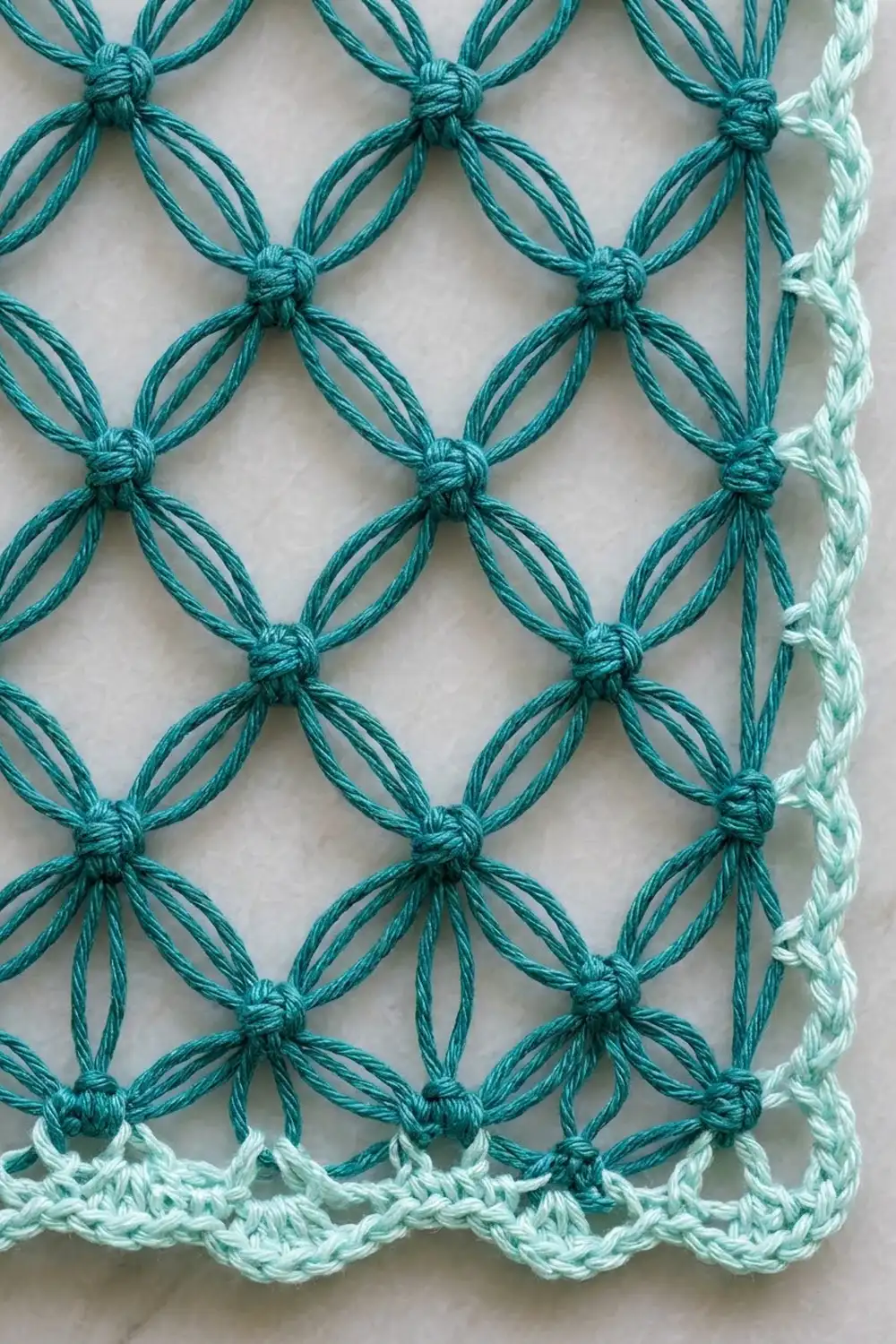
This airy curtain panel is made from Solomon’s knots, also called love knots. Each knot pulls up a long loop, so every mesh cell looks like a pointed, lens-shaped petal. Small locked knots form neat beads where four petals meet. The result is an open diamond lattice that filters light beautifully.
The body is worked in deep teal cotton, and a soft mint scalloped border frames all four edges. The style is breezy and coastal, with a little vintage macramé charm. This pattern uses US crochet terms throughout.
One finished panel measures 40 in wide x 83 in long (101.6 cm x 210.8 cm) after blocking. The photo shows a pair hanging from clip rings, but each curtain is a separate panel that is never joined to the other. For a pair, just work the pattern twice.
The construction is simple. You make a teal foundation chain and a first row of knot arcs, then repeat two alternating mesh rows until the panel is long enough. A three-round mint border straightens the top edge, firms up the sides and adds the scallops.
Finished Size and Construction
- Finished size (one panel): 40 in x 83 in (101.6 cm x 210.8 cm)
- Skill level: Intermediate (you should be comfortable with long-loop stitches)
- Terminology: US
- Yarn weight: Worsted (#4) cotton
- Hook: 5 mm (H-8)
- Number of pieces: 1 per panel (make 2 for a pair; they are not joined)
- Layout: one rectangle, 19 mesh repeats wide x 81 rows long
- Mesh unit: 1 repeat = 2 in (5.1 cm) wide; 2 rows = 2 in (5.1 cm) tall
- Size before border: 38 in x 81 in (96.5 cm x 205.7 cm)
- Border depth: 1 in (2.5 cm) on every side
Materials
Choose a smooth, firm worsted cotton or cotton blend with a good twist. A crisp yarn keeps the long loops open and shows the knots clearly. Avoid fuzzy or very stretchy yarns: they blur the lattice and let the panel get longer over time.
Per panel:
- Teal (body): about 300 g / 600 yd (549 m)
- Mint (border): about 100 g / 200 yd (183 m)
For a pair: double the amounts, so 600 g / 1200 yd (1097 m) of teal and 200 g / 400 yd (366 m) of mint.
All amounts include a margin of about 20 percent for swatching and differences in tension.
Tools:
- 5 mm (H-8) crochet hook
- Tapestry needle
- At least 4 stitch markers
- Flexible tape measure
- Rust-proof pins and a large blocking surface (a bed or a carpet covered with a towel works)
- Spray bottle
- 8 to 10 curtain clip rings per panel for hanging
Abbreviations (US Terms)
- ch: chain
- sc: single crochet
- hdc: half double crochet
- tr: treble crochet (yo twice)
- trtr: triple treble crochet (yo 4 times, then work off the loops 2 at a time)
- sk: skip
- sp: space
- st(s): stitch(es)
- yo: yarn over
- SK: Solomon’s knot
Solomon’s knot (SK): Pull the loop on the hook up to 1 in (2.5 cm). Yo and draw through, keeping the long loop long. Find the single back strand behind the long loop and insert the hook under it. Yo and draw up a loop, then yo and draw through both loops on the hook. That sc locks the knot.
Arc: 2 SK made one after the other. The center knot is the locking knot between the two long loops. It stays unworked until the next row.
Gauge and Checkpoints
Gauge matters because the length of each knot sets both the width and the length of the panel. Make a test swatch first.
- Foundation gauge: 4 ch = 1 in (2.5 cm)
- Knot length: draw each long loop to 1 in (2.5 cm)
- Mesh gauge (lightly pinned): 1 repeat = 2 in (5.1 cm) wide; 2 rows = 2 in (5.1 cm) tall
Test swatch: Ch 34. Work Row 1 (4 arcs), then work Rows 2 and 3 three times, for 7 rows in all. In Row 2, work the bracketed repeat 2 more times; in Row 3, work it 1 more time. Pin the swatch out gently without stretching it. It should measure 8 in wide x 7 in tall (20.3 cm x 17.8 cm).
- Too big: draw the knots shorter, to about 3/4 in (1.9 cm), or go down a hook size.
- Too small: draw the knots a little longer, or go up a hook size.
For the first rows, use a ruler or a strip of card 1 in (2.5 cm) wide as a loop gauge until the length feels automatic.
Panel checkpoints:
- Foundation chain before Row 1: about 38 in (96.5 cm)
- After Row 1: 38 in (96.5 cm) wide
- After 20 rows: 20 in (50.8 cm) tall
- After 41 rows: 41 in (104.1 cm) tall
- After 81 rows: 81 in (205.7 cm) tall
- After the border: 40 in x 83 in (101.6 cm x 210.8 cm)
Panel Body
With teal, ch 154.
Row 1: Sc in 2nd ch from hook, *make 2 SK, sk 7 ch, sc in next ch; rep from * 18 more times. Turn. (20 sc, 19 arcs, 19 center knots)
Each repeat uses 8 chains, so you work into 1 + (19 x 8) = 153 chains, plus the 1 turning chain.
Row 2: Ch 6 (counts as trtr), make 1 SK, sc in center knot of first arc, *make 2 SK, sc in center knot of next arc; rep from * 17 more times, make 1 SK, trtr in last sc. Turn. (19 sc, 2 trtr, 18 full arcs, 2 half arcs)
The single SK at each end makes a half-diamond. The trtr climbs 2 in (5.1 cm) at the edge, matching the height of two rows of knots in the middle.
Row 3: Ch 1, sc in top of trtr, make 2 SK, sc in center knot of first full arc, *make 2 SK, sc in center knot of next arc; rep from * 16 more times, make 2 SK, sc in top of turning ch-6. Turn. (20 sc, 19 arcs, 19 center knots)
Row 3 brings back the Row 1 layout: 1 + 1 + 17 + 1 = 20 sc. Both row types use 38 knots.
Rows 4–81: Repeat Rows 2 and 3 thirty-nine more times.
You now have 81 rows: Row 1 plus 40 pairs of Rows 2 and 3. The last row is a Row 3 type, so the top has 20 sc and 19 unworked center knots. Fasten off the teal.
Each side edge now shows 40 trtr posts, one per even row. Each post is about 2 in (5.1 cm) tall, for 80 in (203.2 cm) in all. The top center knots sit 1 in (2.5 cm) higher, which brings the body to 81 in (205.7 cm).
Border
Work the border in mint, in rounds, without turning.
Border gauge: 4 sts = 1 in (2.5 cm). Each side has 4 sts per inch plus 1. That gives 4 x 38 + 1 = 153 sts on the top and on the bottom, and 4 x 81 + 1 = 325 sts on each side. The corners are ch-2 spaces and are not counted in the side totals.
Round 1 (straightening): With the last teal row facing, join mint in the first sc of the top edge.
- Top: Ch 4 (counts as tr), *ch 3, sc in next center knot, ch 3, tr in next sc; rep from * 18 more times. (153 sts: 20 tr, 19 sc, 114 ch)
- Ch 2 for the corner.
- First side: Work 4 sc around the post of the last tr, 8 sc around each of the next 40 trtr posts, then 1 sc in the side of the Row 1 edge sc. (325 sc)
- Ch 2 for the corner.
- Bottom: Sc in the free loop of each of the 153 foundation chains. (153 sc)
- Ch 2 for the corner.
- Second side: Work 1 sc in the side of the Row 1 edge sc, 8 sc around each of the 40 trtr posts, then 4 sc around the beginning ch-4. (325 sc)
- Ch 2, sl st to top of beginning ch-4.
Round 1 total: 153 + 325 + 153 + 325 = 956 sts, plus 4 corner ch-2 sps.
The tr on the top edge fill the low points so the edge reaches the level of the center knots. This gives you a straight edge to hang from.
Round 2 (chain loops): Ch 1. Work each side like this: sc in first st, *ch 3, sk 1 st, sc in next st; rep from * across the side. At each corner, ch 3, sc in the corner ch-2 sp, ch 3, then sc in the first st of the next side. After the last side, ch 3, sc in the last corner sp, ch 3, sl st to first sc.
- Top and bottom: 77 sc and 76 ch-3 loops each (1 + 76 x 2 = 153 sts used)
- Each side: 163 sc and 162 ch-3 loops (1 + 162 x 2 = 325 sts used)
- Each corner: 2 ch-3 loops
Round 2 total: 76 + 162 + 76 + 162 + 8 = 484 ch-3 loops.
Round 3 (scallops): Sl st into the first ch-3 loop. Work (sc, hdc, sc) in each ch-3 loop around, including the corner loops. Sl st to first sc. Fasten off.
- Top and bottom: 228 sts each
- Each side: 486 sts
- Each corner: 6 sts
Round 3 total: 484 x 3 = 1452 sts.
Why the math works: Round 1 sets an even 4 sts per inch on every edge. Every side count is odd, so Round 2’s repeat of 2 sts per loop plus 1 anchor stitch divides it evenly with no partial repeats. Round 3 puts the same number of sts into every loop, so the scallops stay evenly spaced and the corners turn cleanly. The 3 rounds add about 1/4 in, 3/8 in and 3/8 in (0.6 cm, 1.0 cm and 1.0 cm), for a 1 in (2.5 cm) border.
Final Blocking
- Weave in all ends along the stitch paths, never through the long loops.
- Soak the panel in cool water for 15 minutes, then press the water out gently. Do not wring it.
- Roll the panel in towels to remove extra water.
- Lay it flat on a large surface. Ease the width to 40 in (101.6 cm) first.
- Ease the length to 83 in (210.8 cm), working from the center outward.
- Pin the top edge in a straight line, then pin the scallops along the sides and bottom.
- Open every petal so the lattice looks even, with the knots in straight diagonal lines.
- Let the panel dry completely, then unpin it and hang it with clip rings spaced evenly along the top border.
Final Quality-Control Checklist
- Every row has 38 knots.
- Odd rows have 20 sc; even rows have 19 sc plus 2 trtr.
- The body measures 38 in x 81 in (96.5 cm x 205.7 cm) before the border.
- Border Round 1 has 153 sts on the top and bottom and 325 sts on each side.
- Round 2 has 484 loops; Round 3 has 1452 sts.
- The top edge is straight and the corners lie flat.
- The finished panel measures 40 in x 83 in (101.6 cm x 210.8 cm).
- For a pair, both panels match to within 1/2 in (1.3 cm).
Troubleshooting
- Uneven knots: Use a 1 in (2.5 cm) card as a loop gauge, and lock each knot snugly before you start the next one.
- Side edges shorter than the center: Your trtr is too short. Add a yo to make a taller stitch, or loosen your yarn overs.
- Wavy side edges: Either your trtr is too tall or your knots are too short. Match both to the 2 in (5.1 cm) gauge.
- Can’t find the center knot: It is the knot between the two loops of an arc, not the one sitting on a sc. Mark the first few with stitch markers.
- Border ruffles: Work 7 sc per trtr post instead of 8 in Round 1. Each side count stays odd, so Round 2 still divides evenly.
- Border pulls in: Go up a hook size for the border only.
- Panel gets longer when hung: Block it again and let it dry flat. Use a firmer cotton for the second panel.
Care
Hand wash in cool water with a mild detergent and dry flat, reshaping the panel to its blocked size. Don’t tumble dry, because the heat and tumbling can stretch the long loops.

Final Notes
The measurements build on each other. A 1 in (2.5 cm) knot gives 2 in (5.1 cm) per mesh repeat and 1 in (2.5 cm) per row. Nineteen repeats and 81 rows give a 38 in x 81 in (96.5 cm x 205.7 cm) body. A 1 in (2.5 cm) border brings the panel to 40 in x 83 in (101.6 cm x 210.8 cm). Check your swatch and keep the knot length steady, and the panel will hang straight and even.
Happy crocheting!