
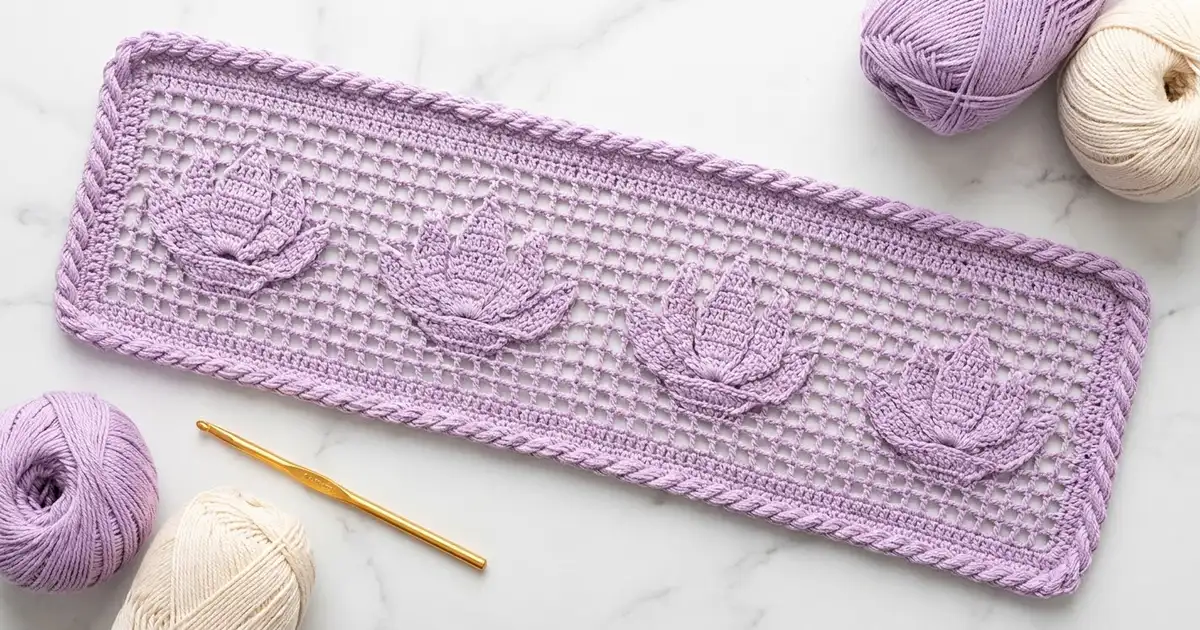
This filet strip has a column of four lotus flowers on an open grid of square meshes. Each lotus is built from solid blocks, so it looks dense and slightly raised against the airy background. A twisted crab-stitch edge frames the whole strip and gives it a corded finish.
The sample is soft lavender cotton. The strip also looks lovely in cream, and you can alternate the two colors if you make several to hang side by side. The style is calm and botanical. It suits a window, a doorway, a shelf edge, or a narrow wall.
The pattern uses US crochet terms. The finished strip measures 5 in wide x 24 in long (12.7 cm x 61.0 cm), including the border.
Construction is simple. You work one flat rectangle in rows of filet mesh, with one solid row at the bottom and one at the top. The lotus motifs are worked into the rows as solid blocks. Then you add a two-round border of single crochet and reverse single crochet all the way around. It’s one piece, so there’s no joining.
Finished Size and Construction
- Finished size: 5 in x 24 in (12.7 cm x 61.0 cm)
- Skill level: Easy-intermediate (you need to follow block and mesh placement)
- Terminology: US crochet terms
- Yarn weight: DK / light worsted cotton (weight 3)
- Hook: 3.5 mm (E-4)
- Number of pieces: 1
- Layout: One vertical strip, 9 squares wide x 47 rows tall, with 4 lotus motifs stacked down the center
- Piece size before border: 4.5 in x 23.5 in (11.4 cm x 59.7 cm)
- Border depth: 0.25 in (0.6 cm) on each side, 2 rounds
Materials
Yarn: Use a smooth combed or mercerized cotton in DK weight, about 245 m per 100 g. Cotton gives crisp mesh and sharp block edges, and it holds its shape when the strip hangs. Avoid fuzzy or very stretchy yarns, because they blur the lotus outline and let the mesh sag.
- Lavender: 40 g / 98 m (one strip, as shown)
- Cream (optional): 40 g / 98 m for each cream strip
These quantities include a margin of about 15% for the gauge swatch and for differences in tension.
Tools:
- 3.5 mm (E-4) crochet hook
- Tapestry needle
- Scissors
- Measuring tape or ruler
- Rust-proof pins and a blocking mat
- Spray bottle with clean water
- 2 stitch markers
Abbreviations (US Terms)
- ch – chain
- sc – single crochet
- dc – double crochet
- sk – skip
- sp – space
- st(s) – stitch(es)
- rsc – reverse single crochet (crab stitch)
- RS – right side
Filet terms used in this pattern:
- Beginning mesh: ch 5 (counts as dc + ch 2), sk 2 sts, dc in next dc.
- Mesh (open square): ch 2, sk 2 sts or the ch-2 sp, dc in next dc.
- Block (solid square): Over a mesh: 2 dc in ch-2 sp, dc in next dc. Over a block: dc in each of next 3 dc.
Each row has 10 vertical dc posts and 9 squares, called columns 1 to 9. Every row contains 28 sts: the first post plus 3 sts for each column (1 + 9 x 3 = 28). That count stays the same whether a column is a mesh or a block, which makes it easy to check your work.
Special stitch, rsc (crab stitch): Work from left to right (right-handers). Insert the hook into the next st to the right, yarn over, pull up a loop, yarn over, and draw through both loops on the hook. This makes the twisted, corded edge.
Gauge and Checkpoints
Filet gauge: 6 squares x 6 rows = 3 in x 3 in (7.6 cm x 7.6 cm). One square is 0.5 in (1.3 cm) wide and tall.
Border gauge: 6 sc = 1 in (2.5 cm).
Test swatch first. Ch 21. Dc in 4th ch from hook and in each ch across: 19 sts (1 + 6 x 3). Work 5 rows of mesh (6 squares each). Block the swatch lightly, then measure. The 6 squares should measure 3 in (7.6 cm) wide, and the 6 rows should measure 3 in (7.6 cm) tall.
- Swatch too big: Change to a 3.0 mm hook, or shorten your ch-2 spaces by snugging each chain.
- Swatch too small: Change to a 4.0 mm hook.
- Squares taller than wide: Pull up the first loop of each dc a little less. Square meshes are what make the lotus look right.
Checkpoints during the strip (width should always be 4.5 in / 11.4 cm):
- After Row 4: 2 in (5.1 cm) tall
- After Row 10 (first lotus): 5 in (12.7 cm) tall
- After Row 21 (second lotus): 10.5 in (26.7 cm) tall
- After Row 32 (third lotus): 16 in (40.6 cm) tall
- After Row 43 (fourth lotus): 21.5 in (54.6 cm) tall
- After Row 47: 23.5 in (59.7 cm) tall
A difference of up to 0.25 in (0.6 cm) is fine and blocks out easily.
Strip Pattern
Row structure:
- Row 1: solid foundation row
- Rows 2–4: mesh
- Rows 5–10: Lotus 1
- Rows 11–15: mesh
- Rows 16–21: Lotus 2
- Rows 22–26: mesh
- Rows 27–32: Lotus 3
- Rows 33–37: mesh
- Rows 38–43: Lotus 4
- Rows 44–46: mesh
- Row 47: solid top row
That gives 4 rows below the first lotus and 4 rows above the last one, so the strip is balanced top to bottom. The 11-row repeat (6 lotus rows + 5 mesh rows) sets the lotus spacing at 5.5 in (14.0 cm), center to center.
The lotus is symmetrical around column 5, so each row reads the same whichever direction you work it. Turn at the end of every row.
Foundation
With lavender, ch 30.
Row 1 (solid): Dc in 4th ch from hook (the skipped 3 ch count as 1 dc) and in each ch across. Turn. (28 sts)
Place a marker in the RS of this row so you can find the bottom edge later.
Mesh Rows
Row 2 (mesh over solid): Beginning mesh, (ch 2, sk 2 sts, dc in next st) 8 times. Work the last dc in the top of the turning ch. Turn. (9 meshes; 28 sts)
Rows 3–4 (mesh over mesh): Beginning mesh, (ch 2, dc in next dc) 8 times, with the last dc in the 3rd ch of the turning ch-5. Turn. (9 meshes; 28 sts)
Lotus Motif (6 rows)
The lotus is 7 columns wide (columns 2–8) and 6 rows tall, so 3.5 in x 3 in (8.9 cm x 7.6 cm). Columns 1 and 9 always stay open mesh, which keeps a clean open border around the flower.
Lotus Row 1 – base (blocks in columns 4–6): Beginning mesh, mesh 2 times (columns 2–3), block over mesh 3 times (columns 4–6), mesh 3 times (columns 7–9). Turn. (3 blocks, 6 meshes; 28 sts)
Lotus Row 2 – bowl widens (columns 3–7): Beginning mesh, mesh (column 2), block over mesh (column 3), block over block 3 times (columns 4–6), block over mesh (column 7), mesh 2 times (columns 8–9). Turn. (5 blocks, 4 meshes; 28 sts)
Lotus Row 3 – widest row (columns 2–8): Beginning mesh, block over mesh (column 2), block over block 5 times (columns 3–7), block over mesh (column 8), mesh (column 9). Turn. (7 blocks, 2 meshes; 28 sts)
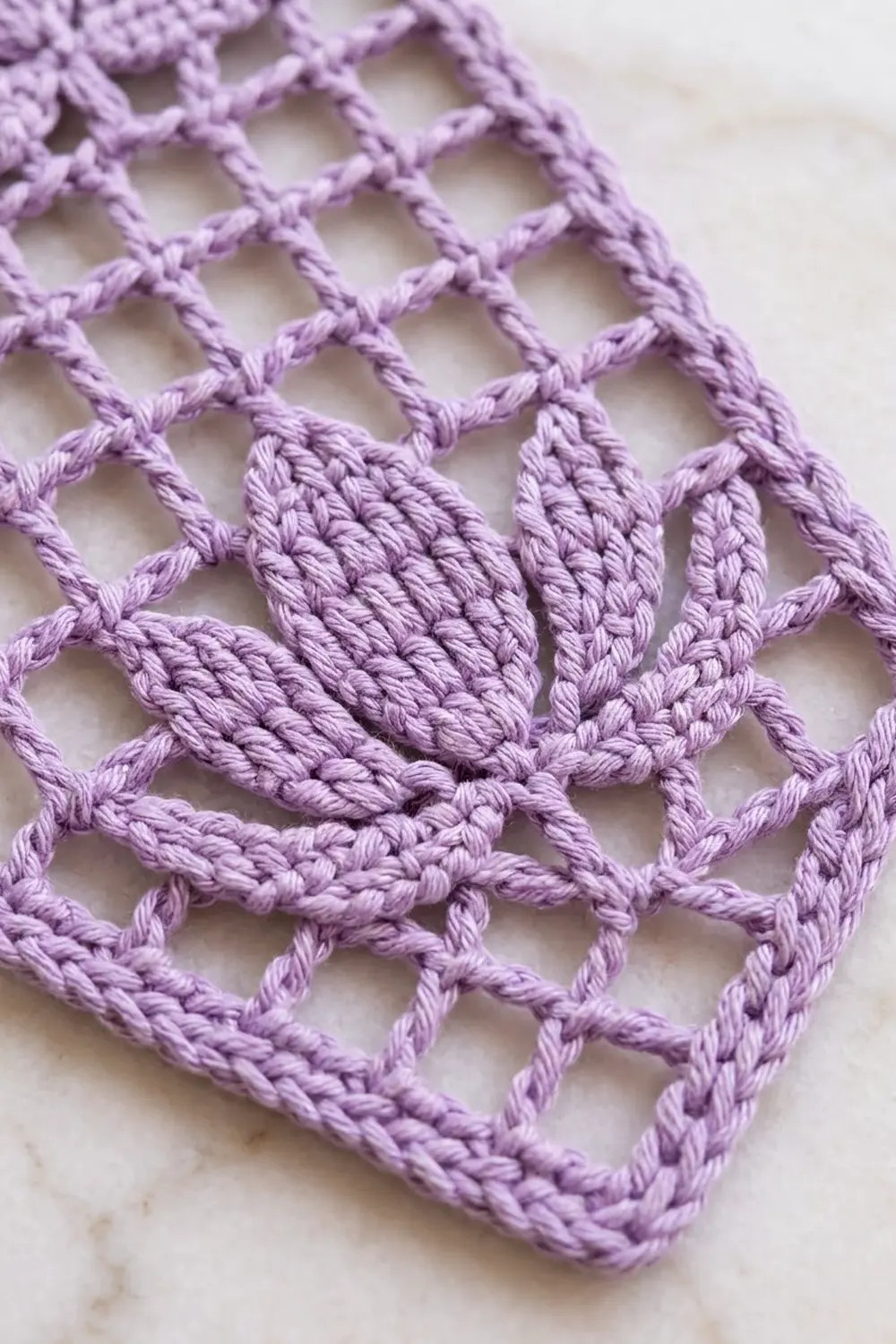
Lotus Row 4 – petals separate (columns 2, 4–6, 8): Beginning mesh, block over block (column 2), mesh over block (column 3: ch 2, sk 2 dc, dc in next dc), block over block 3 times (columns 4–6), mesh over block (column 7), block over block (column 8), mesh (column 9). Turn. (5 blocks, 4 meshes; 28 sts)
The open squares in columns 3 and 7 cut the outer petal tips away from the center petal.
Lotus Row 5 – center petal (columns 4–6): Beginning mesh, mesh over block (column 2), mesh (column 3), block over block 3 times (columns 4–6), mesh (column 7), mesh over block (column 8), mesh (column 9). Turn. (3 blocks, 6 meshes; 28 sts)
Lotus Row 6 – petal tip (column 5): Beginning mesh, mesh 2 times (columns 2–3), mesh over block (column 4), block over block (column 5), mesh over block (column 6), mesh 3 times (columns 7–9). Turn. (1 block, 8 meshes; 28 sts)
Working the Full Strip
Rows 5–10: Work Lotus Rows 1–6.
Row 11 (mesh over the tip): Beginning mesh, mesh 3 times, mesh over block (column 5), mesh 4 times. Turn. (9 meshes; 28 sts)
Rows 12–15: Mesh over mesh. (9 meshes; 28 sts each)
Rows 16–21: Lotus Rows 1–6.
Row 22: Work as Row 11. Rows 23–26: Mesh.
Rows 27–32: Lotus Rows 1–6.
Row 33: Work as Row 11. Rows 34–37: Mesh.
Rows 38–43: Lotus Rows 1–6.
Row 44: Work as Row 11. Rows 45–46: Mesh.
Row 47 (solid top row): Ch 3 (counts as dc), (2 dc in ch-2 sp, dc in next dc) 9 times. Work the last dc in the 3rd ch of the turning ch-5. Do not turn and do not fasten off. (28 sts)
Check: the strip should measure 4.5 in x 23.5 in (11.4 cm x 59.7 cm), and you should have 47 rows.
Border
The border is 2 rounds, worked with the RS facing.
Border gauge: 6 sc = 1 in (2.5 cm).
Round 1 (sc conversion round): Ch 1, rotate so you are working along the top edge.
- Top edge: 3 sc in first st (corner), sc in each of next 26 sts, 3 sc in last st (corner). That’s 28 sts worked 1 per stitch, plus 4 extra stitches from the two corners = 32 sc.
- First long side: 3 sc around each row end down the side, 47 row ends x 3 = 141 sc.
- Bottom edge: Work into the free loops of the foundation chain. 3 sc in first ch (corner), sc in each of next 26 ch, 3 sc in last ch (corner). That’s 28 sts worked 1 per stitch, plus 4 extra = 32 sc.
- Second long side: 3 sc around each row end, 47 x 3 = 141 sc.
Sl st to first sc. Round total: 32 + 141 + 32 + 141 = 346 sc.
Each corner group of 3 sc is counted once, with the top or bottom edge, and is not counted again in the long sides.
Round 2 (crab stitch): Ch 1. Working left to right, rsc in each sc around. Sl st to first rsc. Fasten off. (346 rsc)
Why the math works: Each row is 0.5 in (1.3 cm) tall. At 6 sc per inch, a row end needs exactly 3 sc, so 141 sc covers 23.5 in (59.7 cm) without ruffling or pulling. On the short edges, 28 sc over 4.5 in (11.4 cm) is just over gauge. That small amount of ease keeps the ends from cupping. The 2 extra sc at each corner turn the corner flat. The crab stitch round keeps the stitch count and adds a firm, corded frame about 0.25 in (0.6 cm) deep. Final size: 4.5 + 0.5 = 5 in (12.7 cm) wide, and 23.5 + 0.5 = 24 in (61.0 cm) long.
Weave in all ends through solid blocks or along the border, where they won’t show through the mesh.
Final Blocking
- Lay the strip RS up on the blocking mat.
- Spray it with water until it’s damp all the way through but not dripping.
- Pin the four corners first, at 5 in x 24 in (12.7 cm x 61.0 cm).
- Pin the long sides straight every 2 in (5.1 cm), checking that the width stays 5 in (12.7 cm) along the whole length.
- Gently square up the meshes with your fingers so each one is about 0.5 in (1.3 cm).
- Shape each lotus with your fingertips. Press the petal tips flat and line up the center tip on column 5.
- Let it dry completely before you unpin it. This usually takes 12–24 hours.
For a crisper hang, you can mist the strip with light spray starch before it dries.
Final Quality-Control Checklist
- Every row has 28 sts and 10 posts.
- There are 47 rows: 1 solid, 4 lotus sections of 6 rows, mesh rows between them, and 1 solid top row.
- Each lotus is centered on column 5, with columns 1 and 9 open.
- Petal tips in columns 2 and 8 are separated from the center by open squares in Lotus Row 4.
- Lotuses are evenly spaced, 5.5 in (14.0 cm) center to center.
- Border Round 1 has 346 sc (32 / 141 / 32 / 141).
- Border Round 2 has 346 rsc, and the corners lie flat.
- Blocked size is 5 in x 24 in (12.7 cm x 61.0 cm).
- All ends are hidden in solid areas.
Troubleshooting
Strip slants or gets wider as you go: You’ve probably added a stitch. Count 28 sts at the end of a row, and make sure the last dc goes into the turning chain.
Lotus is off center: Count columns from the edge, not by eye. Column 5 must be the middle of the 9 columns.
Meshes are taller than they are wide: Use shorter dc. Pull the first loop up less, or snug your ch-2 a little.
Long edges ruffle after the border: Your sc is shorter than gauge. Work 5 sc in every 2 row ends instead of 3 in each, and recount.
Long edges pull in: Go up a hook size for Round 1 only.
Crab stitch looks loose or loopy: Keep the loop on the hook short and work at an even tension. A 3.0 mm hook for Round 2 can help.
Blocks look flat or holey: Make sure the 2 dc go into the ch-2 sp, not into the chain stitches themselves, so the block fills evenly.
Care
Hand wash in cool water with a mild detergent and press out the water in a towel. Lay flat and reshape to 5 in x 24 in (12.7 cm x 61.0 cm) to dry. Don’t tumble dry.

Final Notes
The whole design comes from one measurement chain. One square is 0.5 in (1.3 cm), so 9 squares give a 4.5 in (11.4 cm) width, and 47 rows give a 23.5 in (59.7 cm) length. A 0.25 in (0.6 cm) border on every side brings the strip to 5 in x 24 in (12.7 cm x 61.0 cm). Check your swatch and your row checkpoints, and the lotuses will line up and sit neatly centered.
If you’d like to make more, work extra strips in lavender and cream and hang them side by side from a rod, the way they’re shown in the doorway.
Happy crocheting!