
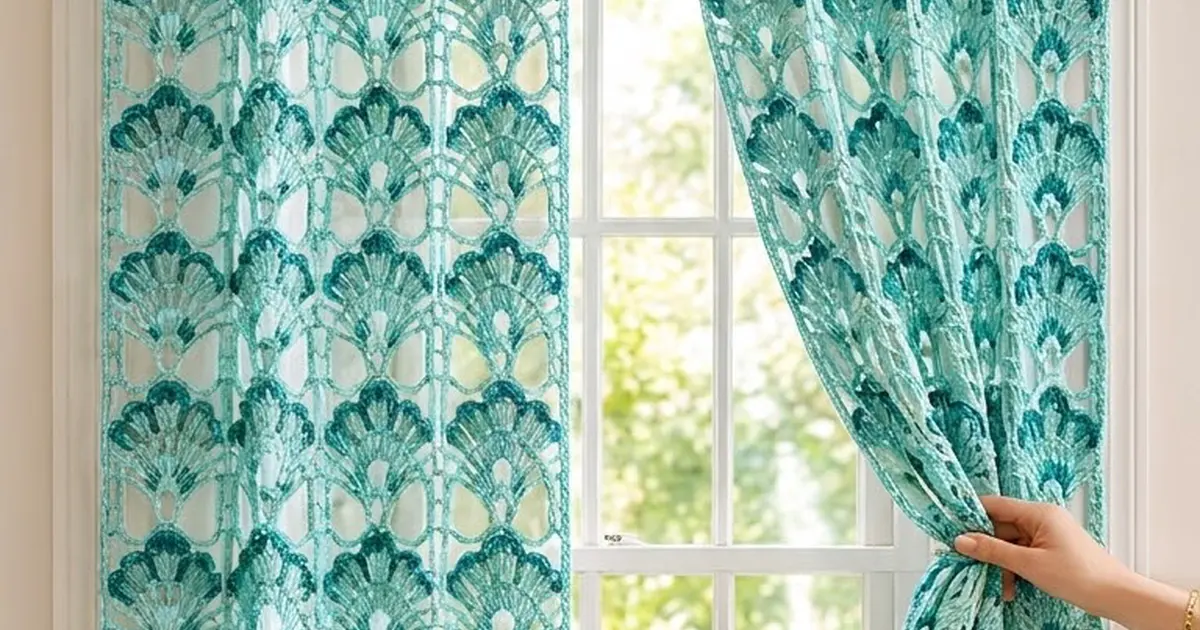
These lace curtains repeat a single motif: an aqua seashell fan with a deep teal center and teal-tipped petals. Set in neat columns, the fans make an airy panel that softens sunlight instead of blocking it.
The design uses only two colors. Light aqua (Color A) is used for the ladders, chain arches and petals. Deep teal (Color B) is worked in two short partial rows per motif: the solid center fan and the scalloped petal tips.
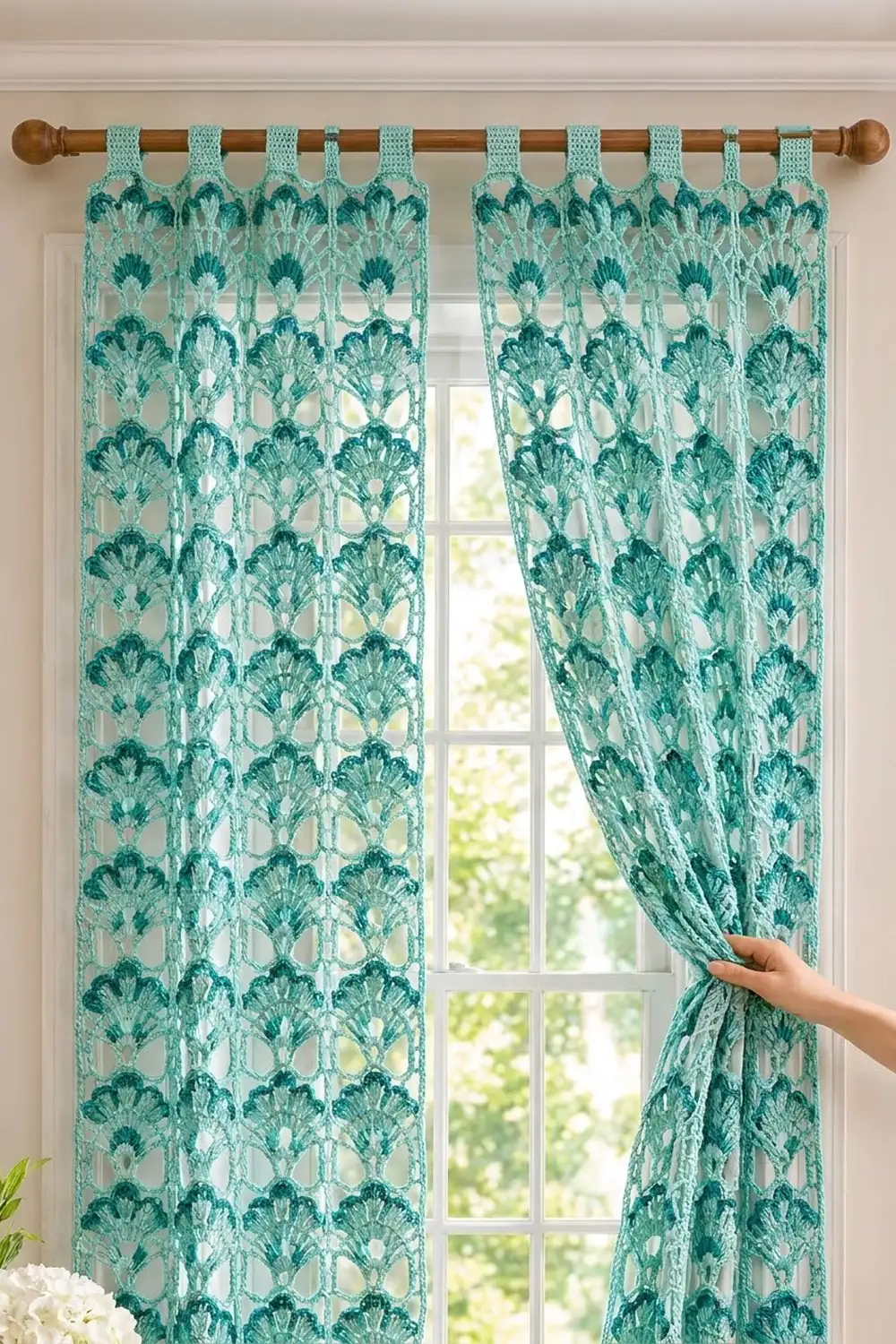
This pattern uses US crochet terms. Each finished panel measures 32 in (81.3 cm) wide and 77 in (195.6 cm) long. The tab loops add 3 in (7.6 cm), so the panel hangs about 80 in (203.2 cm) from the top of the rod.
You will make 60 rectangular motifs and join them 4 across and 15 down. Then you will add a three-round border and work nine tabs along the top edge. Make two panels for the pair.
Finished Size and Construction
- Finished panel size: 32 x 77 in (81.3 x 195.6 cm), plus 3 in (7.6 cm) tabs
- Skill level: Intermediate
- Terminology: US
- Yarn weight: DK (light, #3) cotton
- Hook: 4.0 mm (G-6)
- Number of pieces: 60 motifs per panel, 120 for the pair
- Layout: 4 motifs across x 15 motifs down
- Motif size: 7.5 x 5 in (19.1 x 12.7 cm)
- Panel size before border: 30 x 75 in (76.2 x 190.5 cm)
- Border depth: 1 in (2.5 cm) on each side
Materials
Choose a mercerized or combed DK cotton. It holds the fan shape, blocks crisply and stands up to sunlight. Avoid fuzzy yarn, which blurs the chain arches. The amounts below are for the pair and assume 115 m per 50 g ball.
- Color A, light aqua: 1,300 g (about 2,990 m), 26 balls
- Color B, deep teal: 300 g (about 690 m), 6 balls
These amounts include a margin of about 15 percent for swatching and joining. One panel uses about half of each amount.
Tools: 4.0 mm (G-6) hook, locking stitch markers, tapestry needle, blocking mats, rust-proof pins, spray bottle, measuring tape.
Abbreviations (US Terms)
- ch – chain
- sl st – slip stitch
- sc – single crochet
- dc – double crochet
- tr – treble crochet
- dtr – double treble crochet (yo 3 times, insert hook, pull up a loop, [yo, pull through 2] 4 times)
- sp – space
- sk – skip
- tch – turning chain
- RS / WS – right side / wrong side
Ring stitch: Sc in next ch, ch 8, then sl st into the top of that sc. This makes a small closed loop that stands above the row. It counts as 1 stitch.
Ladder: Each end of every Color A row is a ladder made of 2 posts with a ch-2 rung between them. Each ladder counts as 4 stitches.
Gauge and Checkpoints
Gauge: 22 sc = 5 in (12.7 cm) in Color A, measured in the edging and border.
Before you start making motifs in quantity, make one full motif and block it. That motif is your real gauge swatch.
- Checkpoint 1: Row 1 measures 7.5 in (19.1 cm) wide.
- Checkpoint 2: After Row 4, the ladder edge is about 2 in (5.1 cm) tall.
- Checkpoint 3: After Row 8, the motif is about 4.5 in (11.4 cm) tall.
- Checkpoint 4: The edged, blocked motif measures 7.5 x 5 in (19.1 x 12.7 cm).
If the motif is more than 0.5 in (1.3 cm) too large, change to a 3.75 mm hook. If it is too small, change to a 4.25 mm or 4.5 mm hook. Across 15 motifs, a small difference adds up to several inches.
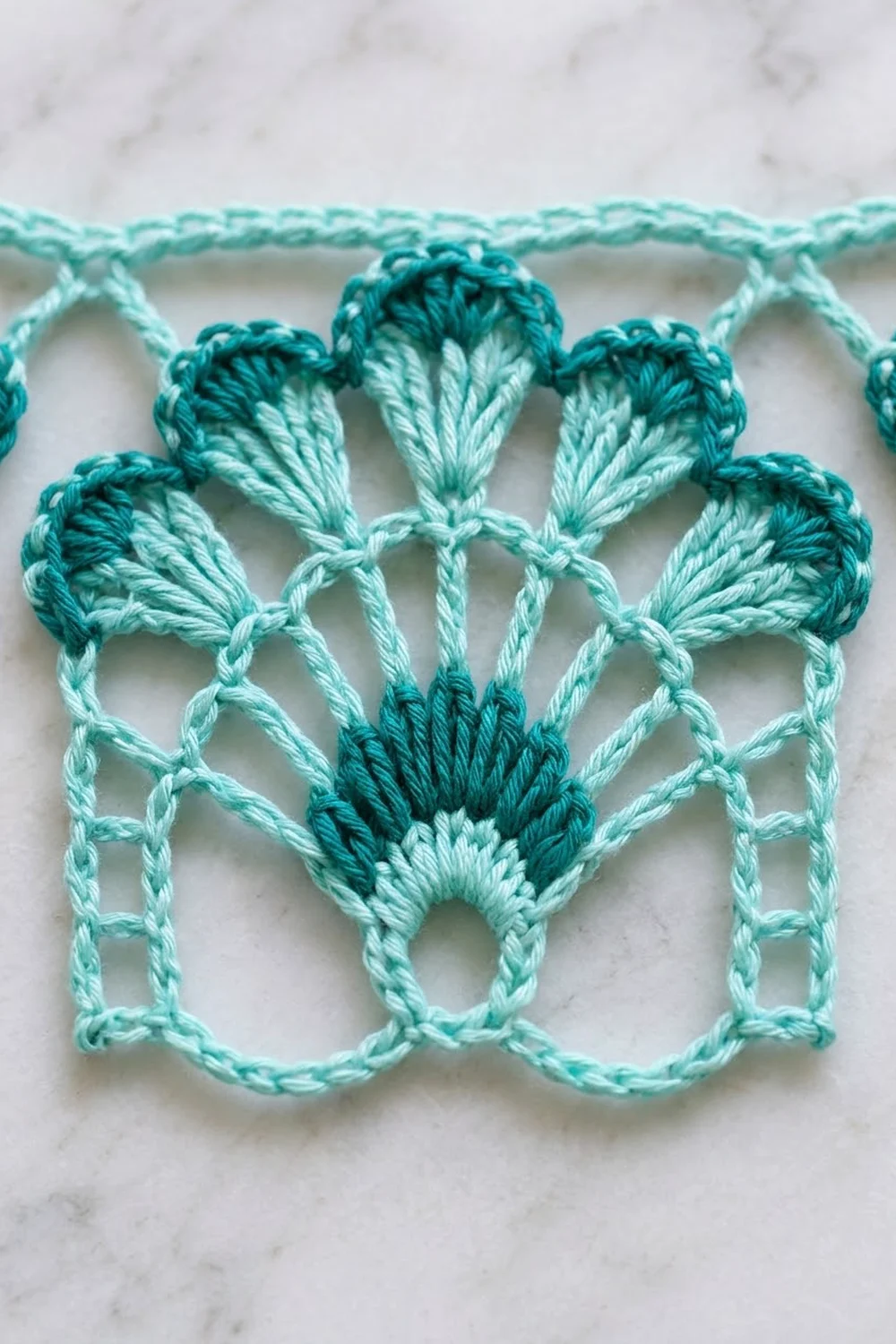
Motif (Make 60 per Panel)
Work the motif from bottom to top in rows. Color A works full-width rows. Color B works two short rows over the center only. Before each Color B row, put the Color A loop on a stitch marker; do not cut Color A.
Foundation: With A, ch 35.
Row 1 (RS): Dc in 6th ch from hook (the 5 skipped ch count as dc and ch 2), ch 5, sk 5 ch, sc in next ch, ch 5, sk 5 ch, sc in next ch, ring stitch in next ch, sc in next ch, ch 5, sk 5 ch, sc in next ch, ch 5, sk 5 ch, dc in next ch, ch 2, sk 2 ch, dc in last ch. Turn. (33 sts: 4 ladder sts at each end, four ch-5 sps, 4 sc, 1 ring stitch)
Row 2 (WS): Ch 3 (counts as dc), ch 2, dc in next dc, ch 4, sc in next sc, ch 3, sk next sc, 8 dc in ring, ch 3, sk next sc, sc in next sc, ch 4, dc in next dc, ch 2, dc in top of tch. Drop A. (8-dc aqua fan, 2 ladders)
Row 3 (RS, Color B): With RS facing, join B with sl st in first dc of fan. Ch 3 (counts as dc), dc in same st, 2 dc in each of next 7 dc. Fasten off B. (16 dc)
Row 4 (RS): Pick up A and turn so RS faces. Ch 5 (counts as dtr), ch 2, dtr in next dc, ch 4, sc in next sc, ch 4, sc in first B dc, [ch 4, sk 2 dc, sc in next dc] 5 times, ch 4, sc in next sc, ch 4, dtr in next dc, ch 2, dtr in top of tch. Turn. (5 spoke ch-4 sps; 2 side ch-4 sps at each side)
Row 5 (WS): Ch 5 (counts as dtr), ch 2, dtr in next dtr, ch 4, sc in next ch-4 sp, ch 2, sk next ch-4 sp, [(2 dc, ch 2, 2 dc) in next spoke sp, ch 1] 4 times, (2 dc, ch 2, 2 dc) in last spoke sp, ch 2, sk next ch-4 sp, sc in next ch-4 sp, ch 4, dtr in next dtr, ch 2, dtr in top of tch. Turn. (5 shells)
Row 6 (RS): Ch 5 (counts as dtr), ch 2, dtr in next dtr, ch 4, sc in next sc, ch 3, [(2 tr, ch 3, 2 tr) in ch-2 sp of next shell, ch 1, sc in next ch-1 sp, ch 1] 4 times, (2 tr, ch 3, 2 tr) in ch-2 sp of last shell, ch 3, sc in next sc, ch 4, dtr in next dtr, ch 2, dtr in top of tch. Drop A. (5 petals)
Row 7 (RS, Color B): With RS facing, join B with sl st in first tr of first petal. Ch 1, sc in same st, sk next tr, 5 dc in ch-3 sp, sk next tr, sc in last tr of petal. [Sc in first tr of next petal, sk next tr, 5 dc in ch-3 sp, sk next tr, sc in last tr of petal] 4 times. Fasten off B. (5 scallops of 5 dc)
Row 8 (WS): Pick up A and turn so WS faces. Ch 5 (counts as dtr), ch 2, dtr in next dtr, ch 2, sc in center (3rd) dc of first scallop, [ch 4, sc in center dc of next scallop] 4 times, ch 2, dtr in next dtr, ch 2, dtr in top of tch. (33 sts: 4 + 2 + 1 + 20 + 2 + 4)
The ch-4 sps are a little shorter than the scallops beneath them. This draws the scallops into a curved shell edge.
Edging Round (A): Ch 1, turn so RS faces. (Sc, ch 1, sc) in last st made (corner). Sc in each of next 31 sts across the top. (Sc, ch 1, sc) in last st (corner). Down the side, work 4 sc in the end of each dtr row (Rows 8, 6, 5, 4) and 2 sc in the end of each dc row (Rows 2, 1), for 20 sc. (Sc, ch 1, sc) in first foundation ch (corner). Sc in each of next 31 foundation chs. (Sc, ch 1, sc) in last foundation ch (corner). Work 20 sc up the second side. Sl st to first sc. Fasten off.
Edging counts: 33 sts across the top and 33 across the bottom. 22 sts along each side. Each side count includes its 2 corner sc; the ch-1 corner sps are not counted. (110 sc + 4 ch-1 corner sps)
Weave in the ends and block each motif to 7.5 x 5 in (19.1 x 12.7 cm).
Make All Pieces
Make 60 motifs for each panel, or 120 for the pair. On every motif, work Rows 1–2, 4–6, 8 and the edging in Color A, and Rows 3 and 7 in Color B.
Layout for one panel (M = motif, fan opening upward, ring at the bottom):
Top
M  M  M  M     row 1
M  M  M  M     row 2
...            (rows 3-14 the same)
M  M  M  M     row 15
Bottom
Joining
Join with Color A using slip stitch through the back loops only, working from the WS. The unused front loops form a raised double line on the RS. Together with the ladders, this line creates the ladder columns between the fans.
Step 1: Columns. Place two motifs with WS facing you, with the top edge of one motif against the bottom edge of the next. Start in the matching corner sc. Sl st through both back loops of each matching pair, 33 to 33, and end in the opposite corner sc. Continue until 15 motifs form one column. Make 4 columns.
Step 2: Join the columns. Join the long side edges the same way, matching 22 stitches to 22 on each motif, for 330 pairs per seam. Where the seams cross, work 1 sl st through all four corner loops.
Tension: Keep each slip stitch as loose as the sc beneath it. Tight joins pucker the lace and shorten the panel.
Checkpoint: Each column measures 75 in (190.5 cm). The joined panel measures 30 x 75 in (76.2 x 190.5 cm).
Border
Border gauge: 22 sc = 5 in (12.7 cm), the same as the edging.
Starting counts: The top and bottom edges each have 4 x 33 = 132 sts. Each side has 15 x 22 = 330 sts. These counts already include every motif’s corner sc, so no stitches are added at the seams. Skip the ch-1 corner sps at the seams and work only into the 4 outer corner sps.
Round 1 (A): With RS facing, join A in any outer corner ch-1 sp. Ch 1, sc in same sp. Sc in each st to the next outer corner, then sc in the corner sp. Repeat around and join. (132 sts across the top and bottom, 330 along each side, plus 4 corner sc: 928 sc)
Round 2 (A): Ch 3 (counts as dc), 2 dc in same st. Dc in each st to the next corner sc, then work 3 dc in the corner sc. Repeat around and join. (134 sts across the top and bottom and 332 along each side between the 4 center corner dc, plus those 4 dc: 936 dc)
Round 3 (A): Sl st into the center corner dc. Ch 1, 3 sc in same st. Sc in each st to the next center corner dc, then work 3 sc in it. Repeat around, join and fasten off. (136 sts across the top and bottom, 334 along each side, plus 4 center corner sc: 944 sc)
Why the math works: At 22 sts = 5 in, 132 sts = 30 in (76.2 cm) and 330 sts = 75 in (190.5 cm). These match 4 motifs x 7.5 in (19.1 cm) and 15 motifs x 5 in (12.7 cm). Rounds 2 and 3 add stitches only at the corners, 2 per side per round, so the edges stay flat. The three rounds add 1 in (2.5 cm) to each side, for 32 x 77 in (81.3 x 195.6 cm).
Tabs
The top edge has 136 sts between the center corner sc. Divide them into 9 tabs of 8 sts and 8 gaps of 8 sts: 72 + 64 = 136.
Each tab: With RS facing, join A in the first st of a tab position. Ch 1, sc in same st and in next 7 sts (8 sc). Work rows of 8 sc until the tab measures 6 in (15.2 cm). Fasten off, leaving a 12 in (30.5 cm) tail. Fold the tab to the WS and whipstitch it to the base of Round 1.
Each tab is about 1.8 in (4.6 cm) wide and makes a 3 in (7.6 cm) loop. The loops fit a rod up to 1.25 in (3.2 cm) in diameter.
Final Blocking
- Weave in the remaining ends along seams or ladder posts, not across open chain arches.
- Soak the panel in cool water for 15 minutes. Roll it in a towel to press out the water; do not wring it.
- Pin the panel flat to 32 x 77 in (81.3 x 195.6 cm). Pin the seam lines straight first.
- Open each fan by pinning the center of each scallop and each bottom ring.
- Let the panel dry completely, then block the second panel to the same size.
Final Quality-Control Checklist
- Each motif has 33 / 33 / 22 / 22 sts and 4 corner ch-1 sps.
- All fans open upward, with every ring at the bottom.
- Each motif has 5 teal scallops and a 16-dc teal fan.
- Seams match stitch to stitch, with no puckers at the corners.
- Border Round 3 has 944 sts, and the 9 tabs are evenly spaced.
- Both panels block to 32 x 77 in (81.3 x 195.6 cm).
Troubleshooting
The fan cups or ruffles: The Row 4 spokes are too loose. Work them more snugly, or use ch 3 for the spokes.
The top edge bows: The Row 8 chains are too tight. Relax your tension and recount: the row must have 33 sts.
The side edges are uneven: Check that you worked 4 sc per dtr row end and 2 sc per dc row end.
A seam is the wrong length: Unpick it and rejoin stitch to stitch. Do not ease in extra stitches.
Care
Hand wash, or machine wash cool on a gentle cycle in a mesh bag. Dry flat, pinned to size, then hang while still slightly damp so the panels straighten.
Final Notes
All the measurements build on one another. One motif has 33 x 22 sts and measures 7.5 x 5 in (19.1 x 12.7 cm). Joining 4 x 15 motifs gives 132 x 330 sts and 30 x 75 in (76.2 x 190.5 cm). The three border rounds bring the panel to 32 x 77 in (81.3 x 195.6 cm), and the 3 in (7.6 cm) tabs give a drop of about 80 in (203.2 cm). If your first motif is the right size, the panels will match.
Happy crocheting!