

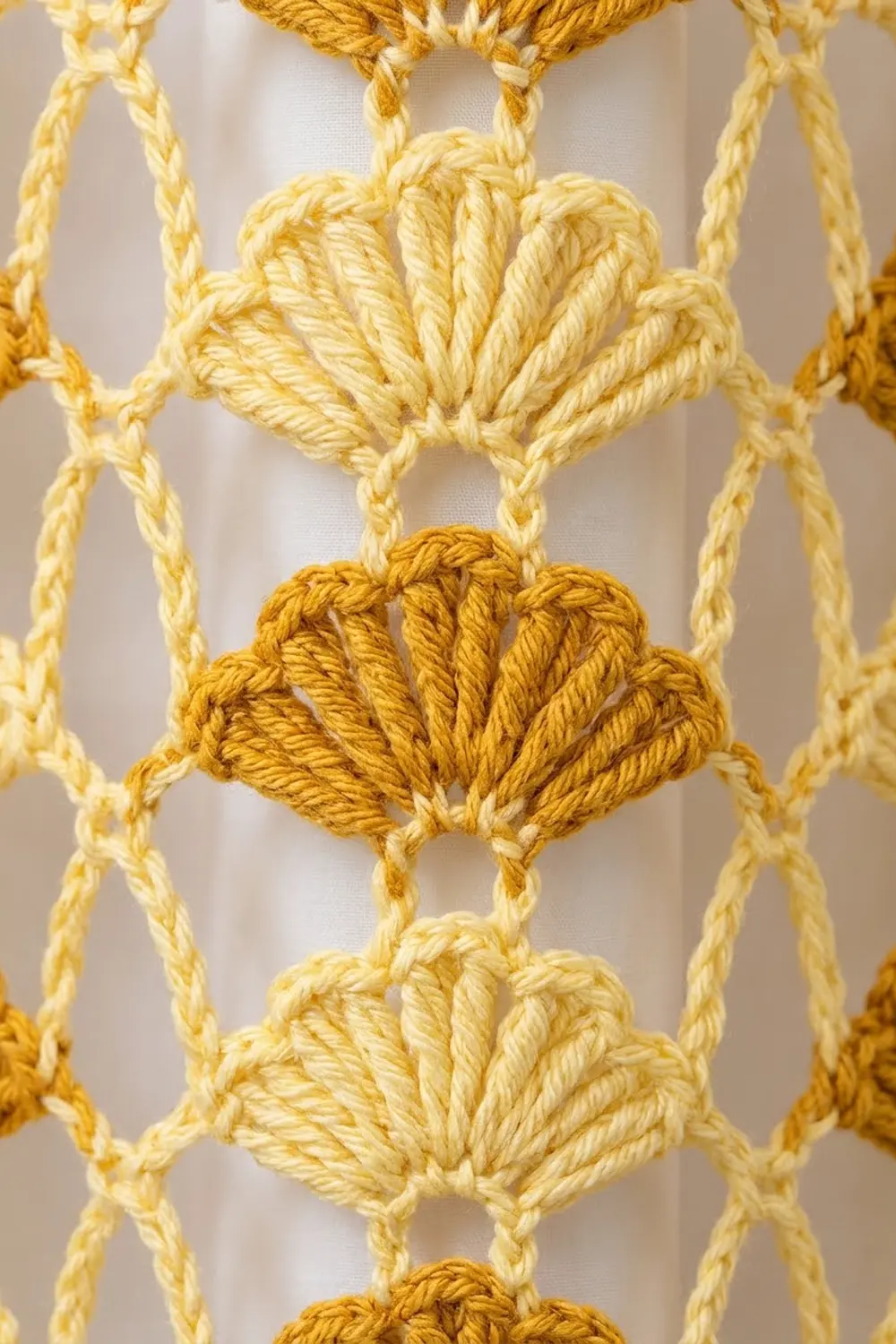
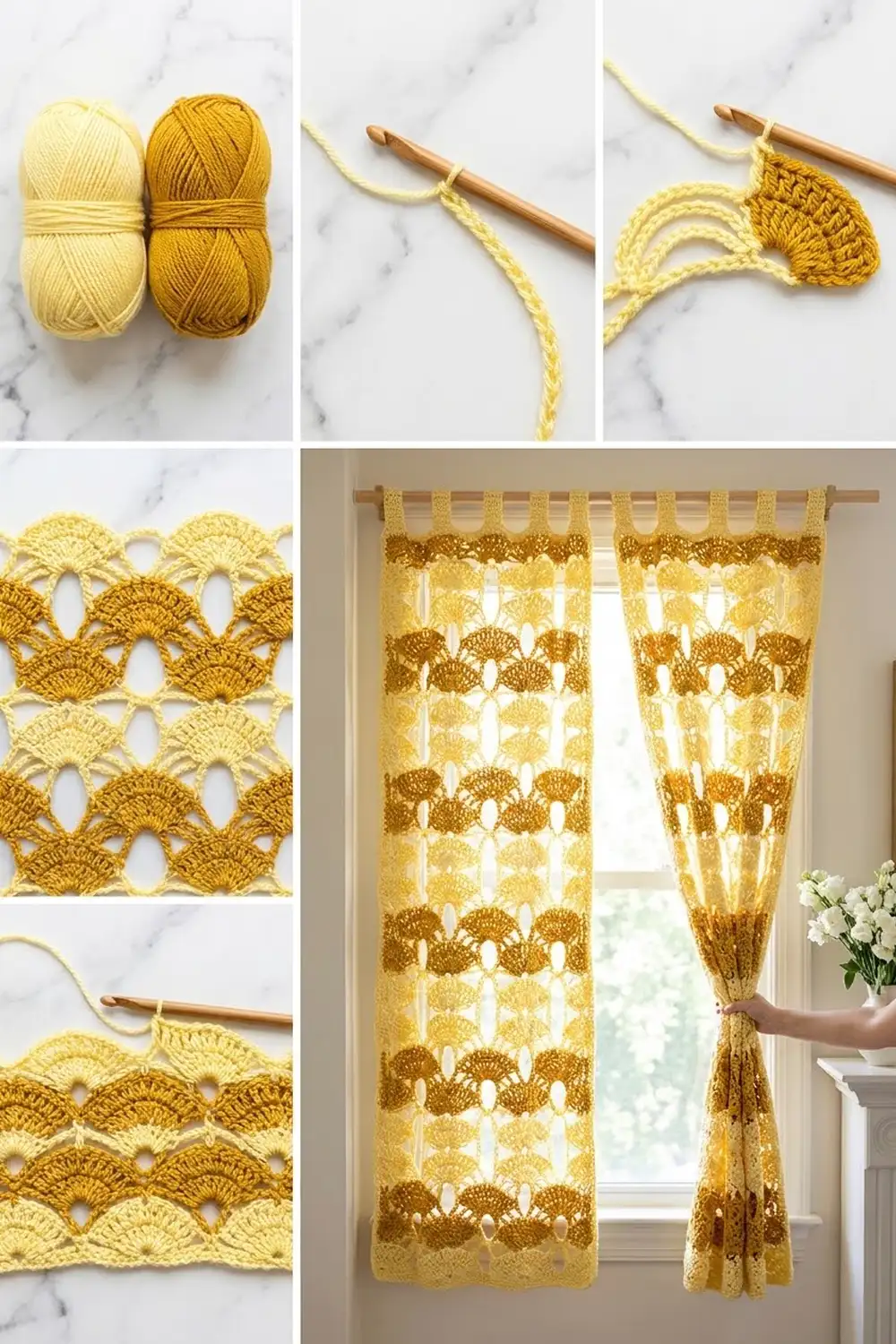
The Golden Ginkgo curtain is a light, airy tab-top panel covered in neat columns of fan stitches. The fans open upward like ginkgo leaves. The rows of fans alternate between pale butter yellow and warm mustard gold, so the panel reads as soft horizontal stripes of color held together by open chain ovals.
It looks like classic vintage lace, but the stitches are simple: single crochet, chains, and treble crochet fans. Light passes through the long chain arches, so the panel filters light without blocking it. This pattern uses US crochet terms throughout.
Each panel measures 31¼ in (79.4 cm) wide by 81 in (205.7 cm) long after the border. The tab loops add another 3 in (7.6 cm) above the top edge. The photo shows two matching panels hung as a pair. They are not joined to each other, so you simply make the same panel twice.
Construction is straightforward. You work one panel flat in rows from the bottom up, using a 4-row repeat of arch rows and fan rows. Then you finish the top with two single crochet rows, add a two-round single crochet border, and work six tabs off the top edge and fold them to the back.
Finished Size and Construction
- Finished size (one panel): 31¼ in × 81 in (79.4 cm × 205.7 cm), tabs not included
- Skill level: Easy-intermediate
- Terminology: US
- Yarn weight: Worsted (#4), cotton or cotton blend
- Hook: 5.0 mm (H-8)
- Number of pieces: 2 separate, identical panels (each one single piece)
- Layout: 10 fan columns across, 53 fan rows tall per panel
- Piece size before border: 30¼ in × 80 in (76.8 cm × 203.2 cm)
- Border depth: ½ in (1.3 cm) on every side
- Tabs: 6 per panel, each 1¾ in (4.4 cm) wide, folded into a 3 in (7.6 cm) loop
Materials
Choose a smooth worsted-weight cotton, either mercerized or matte. Cotton gives crisp fans, blocks well, and hangs straight without stretching the way acrylic can. Avoid fuzzy yarns, because they blur the ovals.
Per panel:
– MC (pale butter yellow): 420 g / 800 m
– CC (mustard gold): 170 g / 325 m
For the pair shown:
– MC: 840 g / 1,600 m
– CC: 340 g / 650 m
All quantities include a margin of about 15 percent for your gauge swatch, yarn tails, and small differences in tension.
Tools:
– 5.0 mm (H-8) crochet hook
– 2 locking stitch markers
– Tapestry needle
– Scissors
– Tape measure
– Blocking mats or a large clean surface, rust-proof pins, and a spray bottle
Abbreviations (US Terms)
- ch – chain
- sc – single crochet
- tr – treble crochet
- sl st – slip stitch
- sk – skip
- sp – space
- st(s) – stitch(es)
- MC – main color (pale yellow)
- CC – contrast color (mustard)
Special stitch – Fan: Work 7 tr in the same stitch. The 4th tr is the center of the fan.
Gauge and Checkpoints
Gauge: 12 sc = 3 in (7.6 cm) in Row 1. One fan repeat = 3 in (7.6 cm) wide. Rows 1–2 = 1½ in (3.8 cm) tall. One 4-row repeat (Rows 3–6) = 3 in (7.6 cm) tall. Each sc row = ¼ in (0.6 cm). Each fan row = 1¼ in (3.2 cm).
Test one piece first. Ch 38. Work Rows 1–6 below, then work Rows 3–6 once more. You will have 3 fans across.
- After Row 1: 37 sc measure 9¼ in (23.5 cm).
- After Row 2: the swatch is 1½ in (3.8 cm) tall.
- After the first Rows 3–6: 4½ in (11.4 cm) tall.
- After the second Rows 3–6: 7½ in (19.1 cm) tall.
- Pin the swatch out lightly damp. The 3 fan columns should span 9 in (22.9 cm).
If your swatch is too big, go down one hook size (4.5 mm). If it is too small, go up one hook size (5.5 mm). Get the width right first. If the width is right but the swatch is too short, pull up your tr loops a little taller instead of changing hooks.
Panel Pattern
With MC, ch 122.
Row 1 (RS): Sc in 2nd ch from hook and in each ch across, turn. (121 sc)
Checkpoint: 30¼ in (76.8 cm) wide.
Row 2 (setup fan row, MC): Ch 4 (counts as tr), sk 5 sc, Fan in next sc, sk 5 sc, tr in next sc; rep from * across, turn. (10 Fans + 11 single tr = 81 sts)*
Each repeat uses exactly 12 sc of Row 1 (5 skipped + 1 Fan + 5 skipped + 1 tr), and 10 × 12 + 1 = 121.
Row 3 (arch row, MC): Ch 1, sc in first tr, ch 7, sk 3 tr, sc in center (4th) tr of Fan, ch 7, sk 3 tr, sc in next single tr; rep from * across, working the last sc in the top of the turning ch-4. (21 sc, 20 ch-7 arches)*
Don’t turn yet. Take the hook out and put a stitch marker in the MC loop. This is the “dropped MC loop.”
Row 4 (fan row, CC): Turn the work. Join CC with a sl st in the last sc of Row 3. Ch 4 (counts as tr), ch 2, sk arch, Fan in next sc, ch 2, sk arch, tr in next sc; rep from * across. (10 Fans + 11 single tr = 81 tr, plus 20 ch-2 sps)* Fasten off CC, leaving a 6 in (15.2 cm) tail.
Row 5 (arch row, MC): Don’t turn. Go back to the edge where Row 4 began. Put the hook into the dropped MC loop and ch 3 (this climbing chain doesn’t count as a st). Sc in the top of the beginning ch-4 of Row 4, ch 7, sk ch-2 sp and 3 tr, sc in center tr of Fan, ch 7, sk 3 tr and ch-2 sp, sc in next single tr; rep from * across, turn. (21 sc, 20 ch-7 arches)*
Row 6 (fan row, MC): Ch 4 (counts as tr), ch 2, sk arch, Fan in next sc, ch 2, sk arch, tr in next sc; rep from * across, turn. (10 Fans + 11 single tr = 81 tr, plus 20 ch-2 sps)*
Every Fan is worked into the sc on top of the Fan below it, and every single tr is worked into the sc on top of the single tr below it. That is why the fans stack in straight columns. The ch-7 arches are longer than the 1½ in (3.8 cm) they span, so they relax into the open ovals between the columns.
Rows 7–106: Repeat Rows 3–6 another 25 times, for 26 repeats in total. The last row is a Row 6, which is an MC fan row.
You now have 53 fan rows, alternating colors: 27 in MC (including Row 2) and 26 in CC.
Checkpoints (measure flat, without stretching):
– After 10 repeats: 31½ in (80.0 cm) tall
– After 20 repeats: 61½ in (156.2 cm) tall
– After 26 repeats: 79½ in (201.9 cm) tall
Top Row 1 (conversion row, MC): Ch 1, sc in first tr, 2 sc in ch-2 sp, sc in each of next 7 tr, 2 sc in next ch-2 sp, sc in next single tr; rep from * across, working the last sc in the top of the turning ch-4, turn. (81 sts worked 1-per-stitch + 40 extra sc from the 20 ch-2 sps = 121 sc)*
Top Row 2 (MC): Ch 1, sc in each sc across, turn. (121 sc) Don’t fasten off.
Checkpoint: 30¼ in × 80 in (76.8 cm × 203.2 cm). The top edge now has the same 121 sts as the foundation, so the panel is a true rectangle.
Make All Pieces
Make 2 identical panels. Each panel uses 420 g MC and 170 g CC, so the pair uses 840 g MC and 340 g CC.
Layout as hung:
[ Panel 1 ]  [ Panel 2 ]
 10 columns   10 columns
 53 fan rows  53 fan rows
The two panels aren’t joined. Each one hangs on its own on the rod.
Border
Border gauge: 4 sc = 1 in (2.5 cm) along every edge. This matches the body gauge of 12 sc = 3 in (7.6 cm).
Round 1 (MC): Keep going from Top Row 2 without turning. Ch 2 for the corner, then work down the first side:
- Side: Work 1 sc around each arch-row end and each sc-row end. Work 5 sc around each fan-row end (around the tr or the ch-4, plus the climbing ch-3 where there is one). That gives 2 sc for the top rows, 12 sc for each of the 26 repeats (5 + 1 + 5 + 1), and 6 sc for Rows 1–2 (5 + 1). (320 sc)
- Ch 2 at the corner.
- Bottom: 1 sc in each foundation ch loop. (121 sc)
- Ch 2 at the corner.
- Side: Work as for the first side. (320 sc)
- Ch 2 at the corner.
- Top: 1 sc in each sc of Top Row 2. (121 sc)
- Join with a sl st to the first sc. (882 sc + 4 corner ch-2 sps)
Round 2: Ch 1, sc in each sc around, working (sc, ch 2, sc) in each corner ch-2 sp. Join. (Per side, including the corner sc at each end: top and bottom 123 sc, sides 322 sc; 890 sc total, plus 4 corner ch-2 sps) Fasten off.
Why the math works: 320 sc ÷ 4 = 80 in (203.2 cm), which is exactly the body height. 121 sc ÷ 4 = 30¼ in (76.8 cm), which is exactly the body width. Each border sc covers ¼ in (0.6 cm) of edge, so the border lies flat without ruffling or cupping. The two rounds add ½ in (1.3 cm) on every side: 30¼ + 1 = 31¼ in (79.4 cm) wide, and 80 + 1 = 81 in (205.7 cm) long.
Tabs
Work the tabs along the 123 sts of the top edge on Round 2, counting the corner sc at each end.
Placement: skip 3 sts, make a tab over 7 sts, then (skip 15 sts, make a tab over 7 sts) 5 times. The last 3 sts are left unused. Check: 3 + 7 + (15 + 7) × 5 + 3 = 123.
Each tab: With RS facing, join MC in the first st of the tab.
- Row 1: Ch 1, sc in same st and in next 6 sts, turn. (7 sc)
- Rows 2–24: Ch 1, sc in each sc across, turn. (7 sc)
The tab is 1¾ in (4.4 cm) wide and 6 in (15.2 cm) long. Fasten off, leaving a 12 in (30.5 cm) tail. Fold the tab to the WS and whipstitch the last row to the WS of Top Rows 1–2, directly behind the tab’s base. This makes a 3 in (7.6 cm) loop.
Final Blocking
- Weave in all ends. Run each CC tail through the tr of its own Fan so it disappears.
- Soak the panel in cool water for 15 minutes. Press the water out; don’t wring.
- Roll the panel in towels to remove extra moisture.
- Lay it flat on mats or a clean floor, RS up.
- Pin the corners to 31¼ in × 81 in (79.4 cm × 205.7 cm).
- Pin along each side every 6 in (15.2 cm), keeping the edges straight.
- Gently spread each Fan and open each oval with your fingers so all the columns line up.
- Let it dry completely. Block the second panel to the same measurements.
Final Quality-Control Checklist
- 10 fan columns, all straight and vertical
- 53 fan rows, alternating MC and CC, starting and ending with MC
- Every Fan has 7 tr
- Each arch row has 21 sc and 20 arches
- Body measures 30¼ in × 80 in (76.8 cm × 203.2 cm) before the border
- Round 2 of the border has 322 sc on each side and 123 sc on the top and bottom
- Finished panel measures 31¼ in × 81 in (79.4 cm × 205.7 cm)
- 6 evenly spaced tabs, each folded into a 3 in (7.6 cm) loop
- Both panels match in length to within ½ in (1.3 cm)
Troubleshooting
Fan columns drift sideways: A Fan went into the sc above a single tr. Fans always go into the sc that sits on a Fan’s center.
Panel narrows toward the top: Your ch-7 arches are too tight. Chain more loosely, or go up one hook size for the arches only.
Edges wave after the border: Recount the side stitches. There should be exactly 5 sc per fan row and 1 sc per arch row.
Ovals look flat or squashed: Block again and pin vertically through the center of each column of ovals.
MC loop is on the wrong side: Turn before Row 4, but don’t turn before Row 5.
Panels are different lengths: While it’s wet, block the shorter panel a little longer. Cotton will hold an extra ½ in (1.3 cm).
Care
Hand wash in cool water, or machine wash on a gentle cycle in a mesh bag. Reshape, dry flat, and hang only when fully dry so the length stays stable.
Final Notes
The whole panel depends on one chain of measurements. A gauge of 12 sc = 3 in (7.6 cm) sets the fan repeat, and ten repeats give 30¼ in (76.8 cm) of width. For the height, Rows 1–2 add 1½ in (3.8 cm), 26 repeats add 78 in (198.1 cm), and the top rows add ½ in (1.3 cm), for an 80 in (203.2 cm) body. The border adds ½ in (1.3 cm) on each side, for a finished panel of 31¼ in × 81 in (79.4 cm × 205.7 cm). Check your gauge, count at each checkpoint, and make two matching panels.
Happy crocheting!