

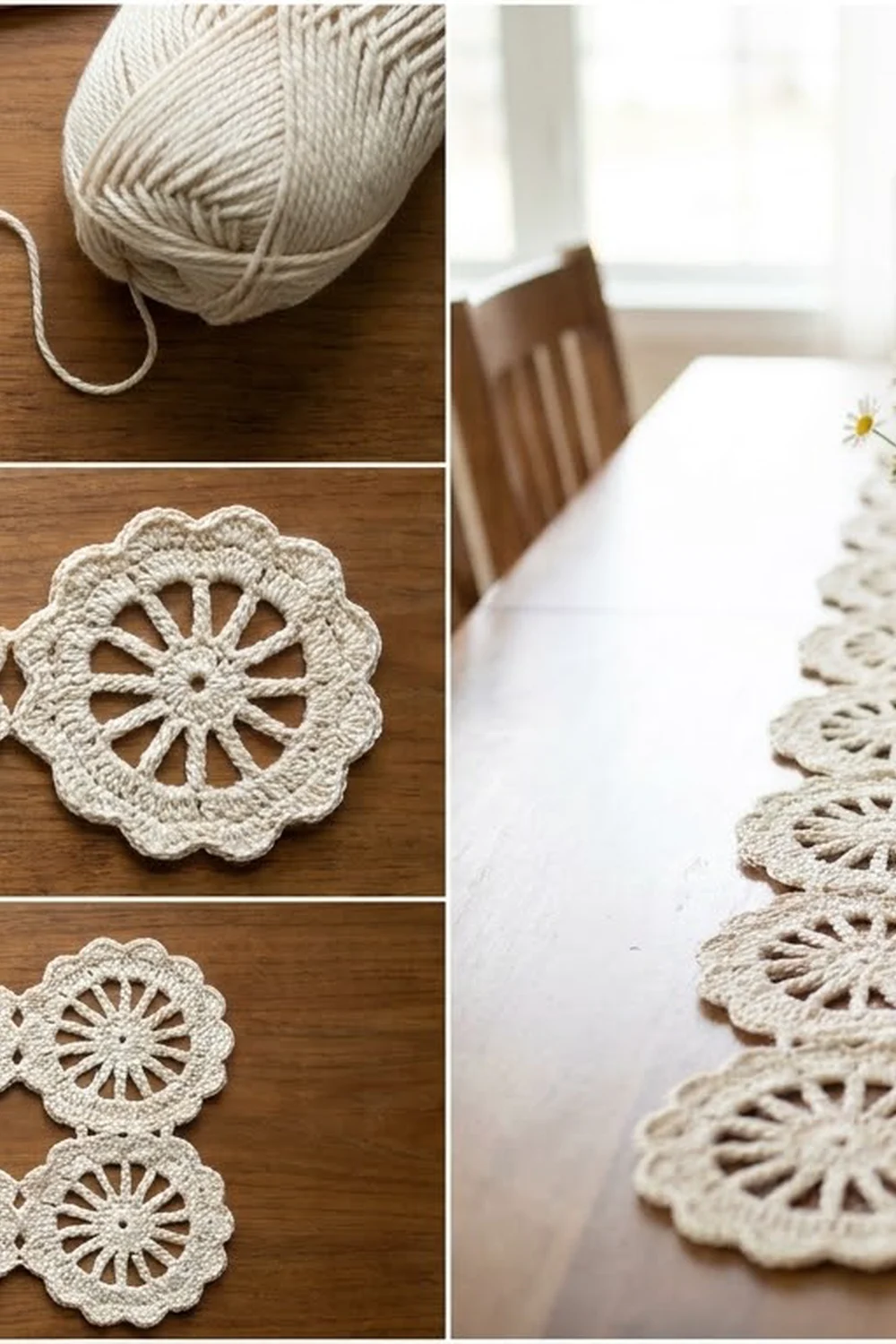
The Cartwheel Lace Table Runner is a light, airy runner made from 36 round motifs that look like little wagon wheels. Each motif has a tiny open center, 16 long spokes, a smooth solid rim, and a soft scalloped edge. When the circles are joined in a neat grid, small diamond-shaped windows of tabletop show through between them.
The runner uses one cream or ivory cotton, which keeps the look calm and classic. It suits a farmhouse table, a vintage dining room, or a simple everyday setting with a jar of fresh flowers in the middle.
This pattern uses US crochet terms. The finished runner measures 13.5 x 54 in (34.3 x 137.2 cm) after blocking. Each motif measures 4.5 in (11.4 cm) across, from scallop tip to scallop tip.
Construction is simple. You make the first motif completely. Then you join each new motif to its neighbors while you work its last round (join-as-you-go). There is no separate sewing and no added border. The scallops of the outer motifs form the finished edge.
Finished Size and Construction
- Finished size: 13.5 x 54 in (34.3 x 137.2 cm)
- Skill level: Easy-intermediate
- Terminology: US crochet terms
- Yarn weight: DK / light worsted (#3) cotton
- Hook: 3.5 mm (E-4)
- Number of pieces: 36 round motifs
- Layout: 3 motifs wide x 12 motifs long
- Piece size: 4.5 in (11.4 cm) diameter, scallop tip to scallop tip
- Size before border: 13.5 x 54 in (34.3 x 137.2 cm)
- Border depth: 0 in (0 cm); the scalloped motif edge is the finished edge
Materials
Yarn: Choose a smooth mercerized or combed DK cotton (about 110 m per 50 g). Cotton holds the spokes straight, blocks crisply and washes well. Avoid fuzzy or very stretchy yarns, because the lace will lose definition.
- Cream / ivory (one color only): 200 g (440 m), for example 4 balls of 50 g / 110 m
Each motif uses about 4 g (9 m), so 36 motifs need roughly 150 g (330 m). The amount above includes a margin of about 30% to cover differences in gauge, the joins, swatching and weaving in.
Tools:
- 3.5 mm (E-4) crochet hook
- Tapestry needle
- Scissors
- Stitch marker
- Measuring tape
- Blocking mats and rustproof pins
- Spray bottle with water
Abbreviations (US Terms)
- ch – chain
- sl st – slip stitch
- sc – single crochet
- dc – double crochet
- tr – treble crochet (yarn over twice, insert hook, pull up a loop, [yarn over, pull through 2 loops] 3 times)
- sp – space
- sk – skip
- st(s) – stitch(es)
- [ ] – repeat the instructions inside as directed
Special stitch – Scallop: 5 dc in the same stitch.
Special stitch – Joining Scallop: Work 3 dc in the stitch and take your hook out of the loop. Insert the hook from front to back through the center (3rd) dc of the matching scallop on the finished motif. Pick up the dropped loop and pull it through. Then work 2 more dc in the same stitch as the first 3 dc. This still counts as 5 dc in the stitch.
Gauge and Checkpoints
Gauge matters here because every small difference is repeated 36 times. Make one complete motif first. Wet it lightly, pin it flat and let it dry before you measure.
Motif gauge: 1 motif = 4.5 in (11.4 cm) across after blocking.
Checkpoints while working (unblocked, measured flat):
- After Round 2 (spokes): about 2.75 in (7.0 cm) across
- After Round 4 (solid rim): about 3.5 in (8.9 cm) across
- After Round 5 (scallops): about 4.25 in (10.8 cm) unblocked, 4.5 in (11.4 cm) blocked
If your motif is too big (over 4.75 in / 12.1 cm blocked), go down to a 3.25 mm hook. Otherwise the runner will grow by more than 9 in (22.9 cm) in length.
If your motif is too small (under 4.25 in / 10.8 cm blocked), go up to a 3.75 mm hook.
If the motif cups (the edges curl up), your spokes are too tight, so loosen your tension on Round 2. If it ruffles, your rim rounds are too loose, so work Rounds 3 and 4 more tightly.

The Cartwheel Motif
First Motif (Motif 1)
Round 1 (center ring): Ch 6, sl st in the first ch to form a ring. Ch 1, work 16 sc in the ring, sl st in the first sc to join. (16 sc)
The ring leaves a small open hole in the middle, which forms the hub of the wheel.
Round 2 (spokes): Ch 6 (counts as tr + ch 2), [tr in the next sc, ch 2] 15 times, sl st in the 4th ch of the beginning ch-6 to join. (16 tr, 16 ch-2 sps)
These 16 tall treble stitches are the spokes. The ch-2 spaces between them make the open gaps that give the wheel its look.
Round 3 (first rim round): Ch 1, sc in the same st as the join, 2 sc in the next ch-2 sp, [sc in the next tr, 2 sc in the next ch-2 sp] 15 times, sl st in the first sc to join. (48 sc)
Check: 16 sc on top of the 16 tr, plus 32 sc in the 16 ch-2 sps, makes 48 sc.
Round 4 (second rim round): Ch 1, [sc in each of the next 3 sts, 2 sc in the next st] 12 times, sl st in the first sc to join. (60 sc)
This is a growth round. The 48 stitches become 60 stitches (12 increases), which keeps the rim flat as the circle gets wider. Rounds 3 and 4 together form the solid rim around the spokes.
Round 5 (scallops): Ch 1, sc in the first st, sc in the next st, [sk 1 st, Scallop in the next st, sk 1 st, sc in each of the next 2 sts] 11 times, sk 1 st, Scallop in the next st, sk 1 st, sl st in the first sc to join. Fasten off. (12 Scallops; 60 dc + 24 sc = 84 sts)
Check the base: 2 sts at the start + (11 repeats x 5 sts) + 3 sts at the end = 60 sts. Every stitch of Round 4 is used exactly once.
Numbering the Scallops
For joining, number the scallops 1 to 12 in the order you work them. Scallop 1 is the first 5-dc group of Round 5. Hold the motif with Scallop 1 at the top (12 o’clock). Then:
- Scallop 1 points up (top)
- Scallop 4 points right
- Scallop 7 points down (bottom)
- Scallop 10 points left
The 12 scallops divide evenly into 4 groups of 3, so these four join points sit exactly 90 degrees apart. Mark Scallop 1 with a stitch marker until you are used to the orientation.
Joined Motifs (Motifs 2–36)
Work Rounds 1–4 exactly as for Motif 1. On Round 5, work a Joining Scallop in place of a normal Scallop wherever the new motif touches a finished one:
- Joining to the motif above: Scallop 1 of the new motif joins to Scallop 7 of the motif above.
- Joining to the motif on the left: Scallop 10 of the new motif joins to Scallop 4 of the motif on the left.
Work all other scallops normally. Round 5 still has 84 sts per motif, because the joining slip-through does not replace or add any stitches.
Make All Pieces
You need 36 motifs, all in cream. Work them in this order, joining as you go:
         Col A   Col B   Col C
Row 1:     1       2       3
Row 2:     4       5       6
Row 3:     7       8       9
Row 4:    10      11      12
Row 5:    13      14      15
Row 6:    16      17      18
Row 7:    19      20      21
Row 8:    22      23      24
Row 9:    25      26      27
Row 10:   28      29      30
Row 11:   31      32      33
Row 12:   34      35      36
- Motif 1: no joins
- Motifs 2 and 3: join on Scallop 10 only (to the motif on the left)
- Column A, Rows 2–12 (Motifs 4, 7, 10 … 34): join on Scallop 1 only (to the motif above)
- Columns B and C, Rows 2–12: join on Scallop 1 (above) and Scallop 10 (left)
Number of joins: 2 per row x 12 rows = 24 side joins, plus 3 per row x 11 rows = 33 top joins, for 57 joins in total.
Joining
Method: Join-as-you-go during Round 5, using the Joining Scallop.
Stitch-to-stitch logic: Each join connects the center dc of one scallop to the center dc of another. Scallop 1 always meets Scallop 7, and Scallop 10 always meets Scallop 4, so every motif sits on the same grid. The joins are only at the scallop tips, so each group of four motifs leaves a small diamond-shaped opening between them. The 2 scallops on each side of every join (for example Scallops 2–3 and 5–6) stay free and face these openings.
Order within a round: On an inside motif, you reach Scallop 1 first and join it to the motif above. Then work Scallops 2 through 9 normally and join Scallop 10 to the motif on the left. Finish Scallops 11 and 12 normally.
Tension advice: Pull the dropped loop through firmly, but don’t tug the neighbor’s scallop out of shape. The tips should just touch, with no gap and no overlap. Keep both motifs flat on the table while you join. If you join with one motif folded behind the other, the joins tend to twist.
Size checkpoint: After Row 1 (3 motifs), the strip should measure about 13.5 in (34.3 cm) wide when gently stretched flat. After Row 4, the panel should measure about 13.5 x 18 in (34.3 x 45.7 cm). After Row 6, the length should be 27 in (68.6 cm). If you are already more than 0.5 in (1.3 cm) off at Row 4, check your hook size before you continue.
Border: Scalloped Edge Finish
This runner has no added border rounds. The free scallops of the outer motifs form the finished edge, which keeps the airy, circular look shown in the finished piece. The border depth is 0 in (0 cm), so the size before and after the “border” is the same: 13.5 x 54 in (34.3 x 137.2 cm).
Border gauge: Along any outer edge, 1 motif = 4.5 in (11.4 cm) and shows 3 outward-facing scallops.
Outward scallops per side:
- Each long side: 12 motifs x 3 scallops = 36 scallops (the left side uses Scallops 9, 10, 11; the right side uses Scallops 3, 4, 5)
- Each short side: 3 motifs x 3 scallops = 9 scallops (the top uses Scallops 12, 1, 2; the bottom uses Scallops 6, 7, 8)
- Total perimeter: 36 + 9 + 36 + 9 = 90 outward scallops
Why the math works: Every motif has 12 scallops in 4 groups of 3, and each group is centered on one compass point. On an outer side, the group centered on the unjoined compass point faces out. A corner motif shows two of its groups, for example Scallops 9–11 and 12–2 on the top-left motif. These groups never share a scallop, so no corner is counted twice. The edge needs no extra stitches because each scallop already has a finished, rounded shape.
Finishing the edge: Weave every tail into the solid rim (Rounds 3–4), not through the scallops, so the edge stays clean. Leave 6 in (15.2 cm) tails when you fasten off, which is enough to weave in securely in cotton.
Final Blocking
- Weave in all ends before blocking. Trim them close only after the piece is dry.
- Soak the runner in cool water for 10 minutes, then gently press out the water. Don’t wring it.
- Roll it in a towel and press to remove extra moisture.
- Lay it on blocking mats and shape the outer rectangle first to 13.5 x 54 in (34.3 x 137.2 cm). Pin the 4 corners, then the midpoint of each side.
- Pin each outer scallop tip outward so the 90 edge scallops form an even, rounded line.
- Straighten the spokes of each motif so they spread evenly from the center. Gently open the center holes with a fingertip.
- Check that all the diamond-shaped gaps are the same size and that each motif measures 4.5 in (11.4 cm).
- Let the runner dry completely, then unpin it. For extra crispness, mist it lightly with spray starch while it is still pinned.
Final Quality-Control Checklist
- 36 motifs in a 3 x 12 grid
- Every motif has 16 spokes, a 60-st rim and 12 scallops
- Every join links center dc to center dc, at Scallops 1/7 and 4/10
- No joins are twisted or doubled
- The open diamond gaps are even across the whole runner
- The long sides show 36 scallops each and the short sides 9 each
- Finished size is 13.5 x 54 in (34.3 x 137.2 cm)
- All ends are woven into the solid rim and trimmed
Troubleshooting
Motif cups or bowls: The spokes are too short or tight. Loosen Round 2, or go up a hook size.
Rim ruffles: Round 4 is too loose. Work Rounds 3 and 4 a little tighter, or use a smaller hook for those rounds only.
Motifs don’t line up in rows: Scallop 1 was miscounted. Put a stitch marker on Scallop 1 of every motif while joining.
Join looks twisted: You inserted the hook from back to front. Always go into the neighbor’s center dc from front to back.
Gaps between joined scallops: The joining loop was pulled through too loosely. Tighten it slightly so the tips touch.
Runner is longer than planned: Measure after Row 4. If it is over 18.5 in (47.0 cm), switch to a smaller hook for the remaining motifs, or make the runner 11 rows long instead.
Center hole closes up: The ch-6 ring was pulled too tight. Keep the 16 sc relaxed on Round 1.
Care
Hand wash in cool water with mild soap, roll in a towel and dry flat, pinning the scallops if needed. Between washes, a cool iron through a pressing cloth will freshen the lace.
Final Notes
The measurements for this runner are easy to check as you go. Round 2 should reach 2.75 in (7.0 cm), Round 4 should reach 3.5 in (8.9 cm), and the blocked motif should measure 4.5 in (11.4 cm). Three joined motifs give 13.5 in (34.3 cm) of width, and twelve rows give 54 in (137.2 cm) of length. With no added border, the 90 outer scallops form the finished edge, and blocking sets the runner at 13.5 x 54 in (34.3 x 137.2 cm).
Make one motif, check it, then let the wheels roll down your table.
Happy crocheting!