

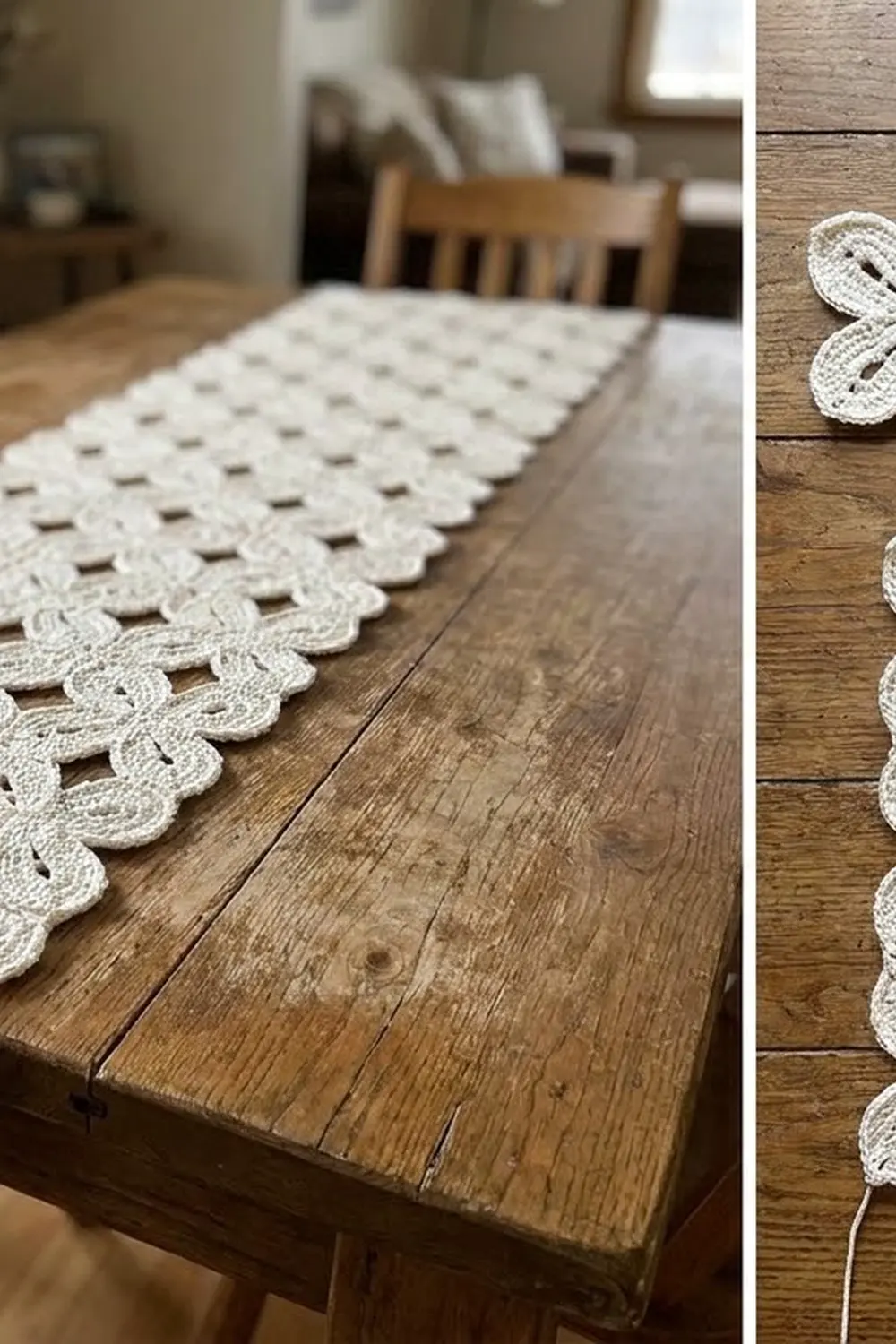
The Petal Lattice Table Runner is a light, airy lace runner made from small four-petal flower motifs. Each petal is a chain loop packed with single crochet. That gives it a smooth, rounded cord look and a large open window in the middle. Once the motifs are joined, the petals interlock into a lattice of ovals and small diamonds that lets the wood of your table show through.
The runner uses one color, a soft ivory or cream cotton, which suits farmhouse, Scandinavian, and classic cottage tables. There is no solid border. The outer edge stays gently scalloped by the petal tips, which keeps the design clean and modern.
This pattern uses US crochet terms. The finished runner measures 9 in x 36 in (22.9 cm x 91.4 cm) after blocking. It is 3 motifs wide and 12 motifs long, and each motif is 3 in (7.6 cm) square.
Construction is simple. You make a small center ring, then work four chain-loop petals and cover each one with single crochet as you go. From the second motif on, you join each new motif to its finished neighbors while working the petals (join-as-you-go). You never sew a seam.
Finished Size and Construction
- Finished size: 9 in x 36 in (22.9 cm x 91.4 cm)
- Skill level: Intermediate (join-as-you-go)
- Terminology: US crochet terms
- Yarn weight: DK / light (#3) cotton
- Hook: 3.5 mm (E-4)
- Number of pieces: 36 motifs, joined into one runner
- Layout: 3 motifs wide x 12 motifs long
- Motif size: 3 in (7.6 cm) square, measured side to side; about 4.2 in (10.7 cm) from petal tip to opposite petal tip
- Size before border: 9 in x 36 in (22.9 cm x 91.4 cm)
- Border depth: 0 in (0 cm). The design has no added border rounds; the petal tips form the edge.
Materials
Yarn: Use a smooth, mercerized or combed DK cotton. Cotton gives the crisp stitch definition that makes the covered petal loops stand out, and it blocks flat for table use. Avoid fuzzy or very stretchy yarns, because the petal loops will lose their shape.
- Ivory / cream: 150 g, about 345 m (377 yd). That is three 50 g balls of a typical DK cotton with about 115 m per ball.
The quantity includes a margin of about 35% over the estimated use (about 3 g per motif, 108 g total). The extra covers gauge differences and a test motif.
Tools:
– 3.5 mm (E-4) crochet hook
– Tapestry needle
– Scissors
– Stitch marker (optional, to mark sc 1 of a petal)
– Blocking mat, rustproof pins, and a spray bottle
– Measuring tape
Abbreviations (US Terms)
- ch – chain
- sc – single crochet
- sl st – slip stitch
- st(s) – stitch(es)
- MR – magic ring
- Rnd – round
Special stitch: JN (join). Take the hook out of your working loop. Insert the hook from front to back through the stated sc on the neighboring motif. Pick up the dropped loop and pull it through. A JN does not count as a stitch.
Gauge and Checkpoints
Make one complete test motif before starting the runner, then block it lightly.
- After Rnd 1: the center ring measures about 0.75 in (1.9 cm) across.
- One petal: from the center of the motif to the petal tip measures about 2.1 in (5.3 cm).
- Finished motif: 3 in (7.6 cm) side to side, and about 4.2 in (10.7 cm) tip to tip diagonally.
If your motif is too big: go down to a 3.25 mm (D-3) hook, or tighten your 14 chains. Loose chains make long, floppy petals.
If your motif is too small: go up to a 3.75 mm (F-5) hook. Also check that the 22 sc sit side by side in the loop and are not crushed together.
Even a 1/8 in (0.3 cm) difference per motif adds up to 1.5 in (3.8 cm) over 12 motifs, so match the gauge before you continue.
Motif Pattern
Hold the motif with the right side facing you. The four petals are worked counterclockwise around the center:
- Petal 1 points up-right (NE).
- Petal 2 points up-left (NW).
- Petal 3 points down-left (SW).
- Petal 4 points down-right (SE).
Each petal has 22 sc. Sc 1–11 form the petal’s first side, the side facing the previous petal. Sc 12–22 form its second side. Sc 11 and sc 12 sit at the tip.
On any petal that needs joining, the join points are:
– First side: after sc 7, worked into the neighbor’s sc 15.
– Second side: after sc 15, worked into the neighbor’s sc 8.
These positions are mirror images, so joined petals line up exactly.
Rnd 1 (center ring)
MR, ch 1, 8 sc in the ring, then sl st to the first sc to join. Pull the ring closed tightly. (8 sc)
Rnd 2 (petals)
Petal 1: Ch 14, then sl st in the same sc as the joining sl st, forming a loop. Work 22 sc into the ch-14 loop, then sl st in the same base sc.
Move: Sl st in each of the next 2 sc.
Petal 2: Ch 14, sl st in the same sc. Work 22 sc into the loop, then sl st in the base sc.
Move: Sl st in each of the next 2 sc.
Petal 3: Work as Petal 2.
Move: Sl st in each of the next 2 sc.
Petal 4: Work as Petal 2.
Sl st in the next sc, then sl st in the first sc of Rnd 1. Fasten off.
Stitch count after Rnd 2: 4 petals x 22 sc = 88 sc, plus the 8 center sc = 96 sc in total. The petals sit on Rnd 1 sc 1, 3, 5, and 7; the slip stitches pass through sc 2, 4, 6, and 8.
Check: As you work the first sc into a new petal loop, the sc should start on the side nearest the previous petal. If your stitches travel the other way (common for left-handed crocheters), simply swap “first side” and “second side” throughout the joining table. The motif is symmetric, so the result is identical.
Make All Motifs
You need 36 motifs, all ivory/cream. Work them in rows from left to right, starting at the top-left corner. Join each new motif as you go, to the motif on its left (West) and the motif above it (North).
Layout grid (3 wide x 12 long):
Row 1:   M1  - M2  - M3
Row 2:   M4  - M5  - M6
Row 3:   M7  - M8  - M9
Row 4:   M10 - M11 - M12
Row 5:   M13 - M14 - M15
Row 6:   M16 - M17 - M18
Row 7:   M19 - M20 - M21
Row 8:   M22 - M23 - M24
Row 9:   M25 - M26 - M27
Row 10:  M28 - M29 - M30
Row 11:  M31 - M32 - M33
Row 12:  M34 - M35 - M36
Joining (Join-As-You-Go)
Work Rnd 1 as usual, then work Rnd 2 with the joins below. Keep Petal 1 pointing NE relative to the runner. Every petal still has exactly 22 sc; the JN goes between stitches.
West join (to the motif on the left):
– Petal 2: sc 1–15, JN into the West motif’s Petal 1 sc 8, sc 16–22.
– Petal 3: sc 1–7, JN into the West motif’s Petal 4 sc 15, sc 8–22.
North join (to the motif above):
– Petal 1: sc 1–15, JN into the North motif’s Petal 4 sc 8, sc 16–22.
– Petal 2: sc 1–7, JN into the North motif’s Petal 3 sc 15, sc 8–22.
When a motif needs both joins, Petal 2 gets two joins: sc 1–7, JN (North), sc 8–15, JN (West), sc 16–22.
Which motifs get which joins:
– M1: no joins.
– Row 1, M2 and M3: West join only (2 JN each).
– First motif of Rows 2–12: North join only (2 JN each).
– All other motifs: West and North joins (4 JN each).
JN total: Row 1 has 0 + 2 + 2 = 4. Rows 2–12 have 2 + 4 + 4 = 10 each, so 11 x 10 = 110. That gives 114 JN in total. Check: there are 24 side-by-side contacts and 33 above-below contacts, each with 2 joins, and (24 + 33) x 2 = 114.
Stitch-to-stitch logic: Each motif side has exactly one petal half from each of its two petals facing a neighbor. A joint always connects a first-side point (after sc 7) to a second-side point (sc 15 of the neighbor), or the reverse. Joints therefore sit the same distance from the center on both motifs. That keeps the lattice square, with no gaps or overlaps.
Tension: Pull the dropped loop through firmly, but don’t tug the neighbor’s petal out of shape. The next sc should sit snugly against the joint.
Size checkpoints:
– After Row 1: 9 in x 3 in (22.9 cm x 7.6 cm)
– After Row 4: 9 in x 12 in (22.9 cm x 30.5 cm)
– After Row 12: 9 in x 36 in (22.9 cm x 91.4 cm)
Border (Edge Finish)
This runner has no added border rounds. The scalloped petal edge is part of the design. The edge still needs its own check, because the petal tips are what you pin during blocking.
Border gauge: 0 in (0 cm) added on every side. The finished size equals the motif size times the motif count.
Edge count, per motif side: Each motif side on the outer edge shows 2 outward petal halves of 11 sc, so 2 x 11 = 22 sc. Each half includes its own tip stitch, so no corner stitches are added.
- Long sides: 12 motifs x 22 sc = 264 sc each
- Short ends: 3 motifs x 22 sc = 66 sc each
- Total outward edge: 264 + 264 + 66 + 66 = 660 sc
Edge petal tips:
– Long sides: 12 x 2 = 24 tips each.
– Short ends: 3 x 2 = 6 tips each.
– The four corner petals each appear on two sides, so there are 24 + 24 + 6 + 6 − 4 = 56 distinct edge petals to pin.
Why the math works: No stitches are added at the edges or the seams, so the width is 3 x 3 in = 9 in (22.9 cm) and the length is 12 x 3 in = 36 in (91.4 cm). The edge count also comes only from motif stitches that already exist, so it can’t drift.
Final Blocking
- Weave in all ends inside the covered petal loops. Hide them along the sc, not across the open windows.
- Lay the runner on the blocking mat and smooth it to 9 in x 36 in (22.9 cm x 91.4 cm).
- Pin the four corner petal tips first, checking that both diagonals match.
- Pin the remaining 52 edge petal tips. Use one pin per tip, set straight outward.
- Gently open the petal windows into even ovals with your fingers.
- Spray until damp, not soaked.
- Leave it to dry completely, at least 12 hours, before unpinning.
Final Quality-Control Checklist
- 36 motifs, laid out 3 x 12
- Each motif has 8 center sc and 4 petals of 22 sc
- 114 joins in total, with no missed contacts
- Petal 1 points NE on every motif
- Width 9 in (22.9 cm) and length 36 in (91.4 cm)
- The scalloped edge is even, with 56 edge petals pinned
- All ends woven in invisibly
Troubleshooting
- Petals twist: the ch-14 was twisted before you closed the loop. Keep the chain flat as you sl st.
- Petals ruffle: your sc are too loose for the loop. Tighten them or use the smaller hook.
- Center hole is open: pull the magic ring tail tighter before weaving it in.
- Gaps at the joints: the JN went into the wrong sc. Count from the petal base and correct it.
- Runner is skewed: a motif was rotated. Check that Petal 1 points NE.
- Runner is too long: your motifs are oversized. Re-check the gauge before you make more.
Care
Hand wash in cool water with mild soap, press out the water in a towel, and dry flat, pinning the tips if needed. Press with a warm iron through a cloth to refresh it.
Final Notes
The measurement chain is short and reliable. A 0.75 in (1.9 cm) center ring with petals of 2.1 in (5.3 cm) makes a 3 in (7.6 cm) motif. Three motifs give the 9 in (22.9 cm) width. Twelve rows give the 36 in (91.4 cm) length, with 0 in (0 cm) of border added. If the motif is right, the runner will be right.
Happy crocheting!