

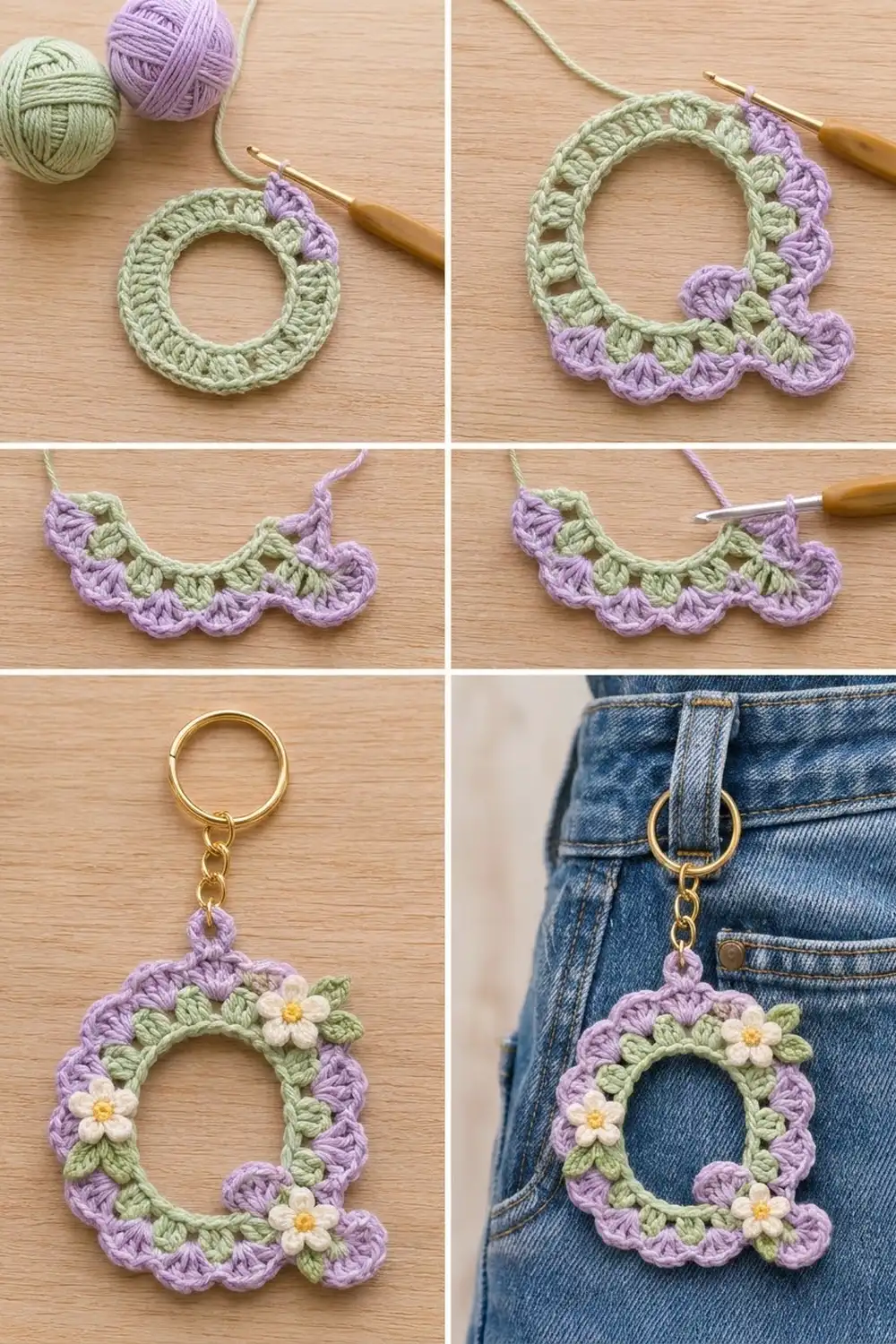
You can finish this little letter Q keychain in an evening and use it the next morning. It is one crocheted ring shaped like a capital Q. A sage green cluster round goes around the opening, a lavender scalloped edge goes around the outside, and a short curled tail at the lower right makes the letter easy to read.
Three tiny cream flowers with yellow centers and small sage leaves sit on the front: one at the upper right, one at the left and one on the tail. A small lavender tab at the top holds a gold jump ring, chain and split ring, so the Q can hang from your keys, a bag zipper or a jeans belt loop.
The pattern uses US crochet terms. The finished body measures about 3 in (7.6 cm) wide and 3.25 in (8.3 cm) tall. With the hanging tab it is 3.75 in (9.5 cm) tall, not counting the hardware.
The construction is simple. Crochet a foundation ring in green, add a round of green clusters, then work a lavender shell round. The shell round forms the scalloped edge and the outer bulge of the tail. Next, add a short lavender curl inside the opening and work the tab at the top. The flowers and leaves are made separately and sewn on.
Finished Size and Construction
- Finished size: 3 in (7.6 cm) wide x 3.25 in (8.3 cm) tall; 3.75 in (9.5 cm) tall with the tab
- Skill level: Easy / advanced beginner
- Terminology: US crochet terms
- Yarn weight: Fingering / 4-ply cotton (super fine, #1)
- Hook: 2.75 mm (US C/2)
- Number of pieces: 1 main Q body (single piece), plus 3 flower and 5 leaf appliqués
- Layout: One round ring, with the tail at about 4:30 and the tab at 12 o’clock
- Piece size: 3 in (7.6 cm) x 3.25 in (8.3 cm); inner opening about 1.5 in (3.8 cm) across
- Size before border: 2.25 in (5.7 cm) across after Round 2
- Border depth: about 3/8 in (1.0 cm) on each side, lavender scallops
Materials
Use a smooth mercerized cotton in fingering / 4-ply weight, about 170 m per 50 g. Cotton gives crisp stitch definition, holds the scallops well, and doesn’t pill on a keychain that gets handled every day. Avoid fuzzy or very stretchy yarns, because the Q will lose its shape.
- Color A, sage green: 3 g / 10 m (foundation, clusters, leaves)
- Color B, lavender: 4 g / 14 m (scallop edge, tail curl, tab)
- Color C, cream: 1 g / 3 m (flower petals)
- Color D, golden yellow: 1 g / 3 m (flower centers)
Tools:
- 2.75 mm (US C/2) crochet hook
- Tapestry needle with a small eye
- 2 stitch markers
- Gold split key ring, 0.75 in (1.9 cm) across
- Short gold chain, about 1 in (2.5 cm) long, plus a 6 mm jump ring
- 2 pairs of flat-nose pliers
- Scissors, pins and a small blocking mat
All quantities include a margin for yarn tails, a test round and one restart.
Abbreviations (US Terms)
- ch: chain
- sl st: slip stitch
- sc: single crochet
- hdc: half double crochet
- dc: double crochet
- sp: space
- st(s): stitch(es)
- sk: skip
- RS: right side
- [ ]: repeat the steps in brackets as directed
Special stitch: 3-dc cluster (cl). [Yarn over, insert hook in the given st, yarn over and pull up a loop, yarn over and pull through 2 loops] 3 times in the same st. Yarn over and pull through all 4 loops on the hook.
Beginning cluster (beg cl). Ch 2. Then [yarn over, insert hook, pull up a loop, yarn over and pull through 2 loops] 2 times in the same st. Yarn over and pull through all 3 loops on the hook.
Gauge and Checkpoints
Gauge is 6 sc and 7 sc rows = 1 in (2.5 cm) with a 2.75 mm hook. Gauge matters more here than on a blanket, because a few millimeters change how clearly the Q reads.
This is a single piece, so Round 1 is your test. Work it, lay it flat and measure before you go on.
- After Round 1: ring of 30 sc, inner opening about 1.5 in (3.8 cm), outer edge about 1.75 in (4.4 cm) across
- After Round 2: about 2.25 in (5.7 cm) across
- After Round 3: about 3 in (7.6 cm) wide and 3.25 in (8.3 cm) tall, including the tail bulge
- After the tab: about 3.75 in (9.5 cm) tall
If your ring is too big, go down to a 2.5 mm hook. If it is too small, or Round 2 cups into a bowl, go up to a 3 mm hook. Don’t change the stitch counts, because the shell round needs exactly 15 chain spaces.
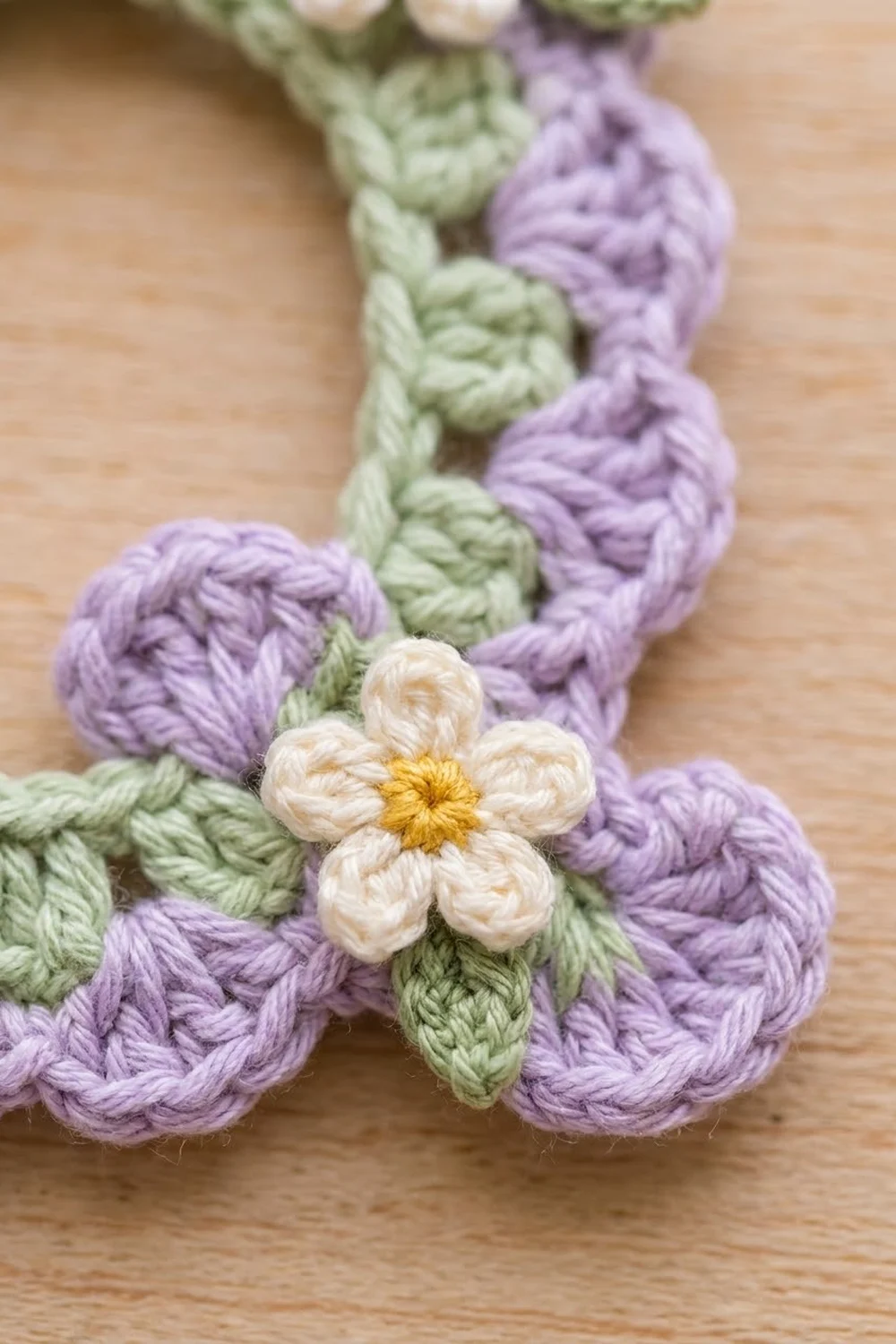
Round 1: Foundation Ring
With Color A, ch 30. Join with a sl st to the first ch, taking care not to twist the chain.
Round 1 (RS): Ch 1, sc in each ch around. Work into the top loops only, so the bottom loops of the chain stay free. Join with a sl st to the first sc. (30 sc)
Lay the ring flat with the RS up and the join at 12 o’clock. Place a marker in the free loop of the foundation chain at about 4:30. You will work the tail curl here later.
Tip: keep this round relaxed. A tight foundation ring makes the opening shrink and pulls Round 2 into a cup.
Round 2: Sage Clusters
Round 2: Beg cl in the same st as the join, ch 2, sk next sc, [cl in next sc, ch 2, sk next sc] 14 times. Join with a sl st to the top of the beg cl. (15 clusters and 15 ch-2 sps; 45 sts total)
Each cluster now sits over every other sc of Round 1. The ch-2 spaces open into the small gaps between the green bobbles. Fasten off Color A and weave in the tail on the wrong side.
Check that the piece lies flat and measures about 2.25 in (5.7 cm) across. Place the second marker in the ch-2 sp closest to your 4:30 marker. This is the tail space.
Flowers (Make 3)
Center: With Color D, make a magic ring. Ch 1, work 5 sc in the ring, pull the ring closed and join with a sl st to the first sc. (5 sc) Fasten off.
Petals: Join Color C in any sc. [Ch 2, 2 dc in the same sc, ch 2, sl st in the same sc, sl st in next sc] 5 times. The last sl st goes in the first sc. (5 petals) Fasten off and leave an 8 in (20.3 cm) tail for sewing.
Each flower measures about 0.8 in (2.0 cm) across.
Leaves (Make 5)
With Color A, ch 5. Sl st in the 2nd ch from the hook, sc in next ch, hdc in next ch, sc in last ch, ch 1. Turn the leaf and work along the other side of the foundation chain: sc in next ch, hdc in next ch, sc in next ch, sl st in last ch. (8 sts plus 1 tip ch) Fasten off and leave a 6 in (15.2 cm) tail.
Each leaf measures about 0.6 in (1.5 cm) long.
Border: Lavender Scallops
On this single piece, the scallop round works as the border. It also builds the outer bulge of the Q’s tail.
Border gauge: each 5-dc shell covers one ch-2 sp plus half of each cluster beside it. That is about 0.6 in (1.5 cm) along the outer edge, and the shell stands about 3/8 in (1.0 cm) tall.
Round 3: Join Color B with a sc in the top of the beg cl. [5 dc in next ch-2 sp, sc in top of next cl] around, but work 9 dc instead of 5 in the marked tail space. End with 5 dc in the last ch-2 sp and join with a sl st to the first sc.
Count: 14 regular shells x 5 dc = 70 dc, plus 1 tail shell of 9 dc, plus 15 sc. (94 sts total; 15 scallops)
The ring has no straight sides, so it has no corners. Count it in four quarters instead. Going clockwise from the top, the quarters hold 4, 4, 4 and 3 scallops (15 in total), and the tail shell sits in the lower right quarter.
Why the math works: the 30 sc of Round 1 divide evenly into 15 clusters and 15 ch-2 spaces. Each ch-2 space gets exactly one shell and each cluster top gets exactly one sc, so the round closes cleanly with no stitches left over. Five dc in a ch-2 space flare just enough to keep the outer edge flat at a 3 in (7.6 cm) diameter. The 9-dc tail shell crowds one space on purpose, so it pushes outward into the rounded bulge at the lower right.
If you want to work the tab right away, don’t fasten off yet. Otherwise, fasten off and weave in the end.
Tail Curl
With the RS facing, join Color B with a sl st in the marked free loop of the foundation chain at 4:30. Ch 4, work 7 dc in the 4th ch from the hook, sk next free loop, sl st in the following free loop. (7-dc fan) Fasten off.
The 3 skipped chains make a short stem, and the 7-dc fan curls into the opening to form the inner hook of the Q. Use the yarn tail to tack the fan to the Round 1 sc behind it, so it stays angled toward the center.
Hanging Tab
Find the shell closest to 12 o’clock. Counting around the top, it is 5 or 6 shells away from the tail shell. With the RS facing, join Color B in the 2nd dc of that shell.
- Row 1: Ch 1, sc in the same dc and in the next 2 dc. Turn. (3 sc)
- Row 2: Ch 1, sc in each sc. Turn. (3 sc)
- Row 3: Ch 1, sc in first sc, ch 5, sk next sc, sl st in last sc. (1 sc, 1 ch-5 loop, 1 sl st)
- Row 4: 7 sc in the ch-5 loop, sl st in the first sc of Row 3. (7 sc)
Fasten off and weave in all ends. The tab adds about 0.5 in (1.3 cm) to the height.
Final Blocking
- Mist the Q lightly with cool water until it is damp but not soaked.
- Lay it RS up on a blocking mat. Shape the opening into a round, centered hole about 1.5 in (3.8 cm) across.
- Pin each of the 15 scallops outward so they sit evenly. Ease the tail shell into a rounded bulge at the lower right.
- Check that the piece is 3 in (7.6 cm) wide and 3.25 in (8.3 cm) tall without the tab. Let it dry completely.
- Sew on the flowers: one at the upper right over Rounds 2–3, one on the left at about 9 o’clock, and one on the tail at about 5 o’clock. Tuck 2 leaves beside the upper right flower, 2 below the left flower and 1 below the tail flower. Stitch through the green and lavender stitches, not across the opening.
- Open the 6 mm jump ring with two pairs of pliers. Thread it through the tab loop and the end link of the chain, then close it fully. Attach the split ring to the top of the chain.
Final Quality-Control Checklist
- Round 1 has exactly 30 sc, and the ring isn’t twisted.
- Round 2 has 15 clusters and 15 ch-2 spaces.
- Round 3 has 14 five-dc shells, 1 nine-dc tail shell and 15 sc.
- The tail curl points into the opening at about 4:30.
- The tab is centered at 12 o’clock.
- The body measures 3 in (7.6 cm) x 3.25 in (8.3 cm).
- The flowers and leaves are stitched flat with no loose loops on the back.
- The jump ring is fully closed with no gap.
- All ends are woven in and trimmed.
Troubleshooting
The ring twisted after joining. Undo the join, lay the chain flat with all the bottom bumps facing the same way, and join again.
Round 2 cups into a bowl. Your clusters are too tight. Loosen the ch-2 spaces a little or go up 0.25 mm in hook size.
Round 2 ruffles. Your ch-2 spaces are too loose. Keep them snug or go down one hook size.
The scallops look flat or crowded. Make sure each shell goes into a ch-2 space, not into a cluster top. Count again to check for 15 scallops.
The tail doesn’t read as a Q. Make sure the 9-dc shell and the inner curl both sit at the 4:30 position. Tack the curl more firmly toward the center.
The flowers look cupped. Steam them lightly and pin them flat before sewing.
The tab stretches out of shape. Work Rows 1–2 more tightly, or add one extra row of 3 sc for strength.
Care
Hand wash in cool water with mild soap, press the water out in a towel, and lay flat to dry. Remove or cover the metal hardware if it might tarnish.
Final Notes
The whole Q depends on one simple chain of numbers. 30 sc make a ring with a 1.5 in (3.8 cm) opening, and 15 clusters bring it to 2.25 in (5.7 cm). Then 15 lavender scallops, one of them enlarged for the tail, finish it at 3 in (7.6 cm) wide and 3.25 in (8.3 cm) tall. The tab brings the total height to 3.75 in (9.5 cm), and three flowers with five leaves add the cottage-garden finish. Check each measurement as you go and the letter will come out crisp and easy to read every time.
Happy crocheting!